I’m 28. 8 years ago I was 20. 20 =/= 28. The only thing that disproves is that I’m 28 and 20 at the same time.
I do not understand why you choose to post this question here and not on the physics forum. Is it because your amateur, pseodo-scientific reasoning has a chance of surviving scrutiny here, and not be shot down by people who actually know the subject?
Friedmanite, triknighted is trying to understand the logical argument for the big bang theory - not the empirical evidence that suggests it happened.
0 = 1 is not a correct starting point. Zero is not a number. This is correct, however; 0+1=1. 0 1 1 2 3 5 8 13 21…
1+1/1+1/1+1/1+1 and so on… This gives dimension in geometry; “extreme and mean ratio”
Existence itself may be beyond our (human) comprehension and that is why perspective matters. The big bang is not disproved by “0 = 1 is not true” example. You are correct, but as my formula above shows, perspective, both micro and macro, extends ad infinitum. For all we know the “Big bang” is just the other side of a super massive black hole. Also, in denying the big bang, we are left in the same spot; either existence has always been (which explains nothing) or… (I won’t even mention it.) It is my opinion that the Universe, like everything else, is a cycle. The ‘big bang’ is not a start to anything.
http://www.toequest.com/forum/toe-theories/788-phi-universe.html
The Universe is shaped like a dodecahedron?
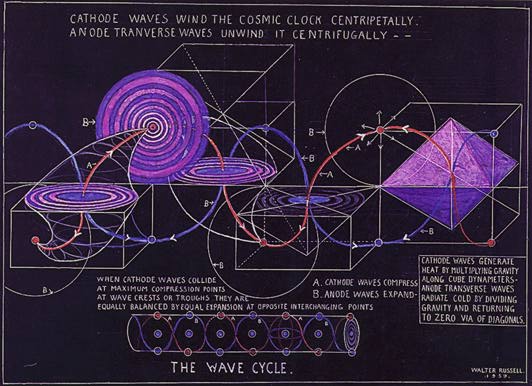
You can see in this picture, and on this site, “where” the “big bang” would be from our infinitesimally small “perspective.”
Sound, or more specifically (quantum) harmony, are the keys to understanding matter and the formation of virtually everything…
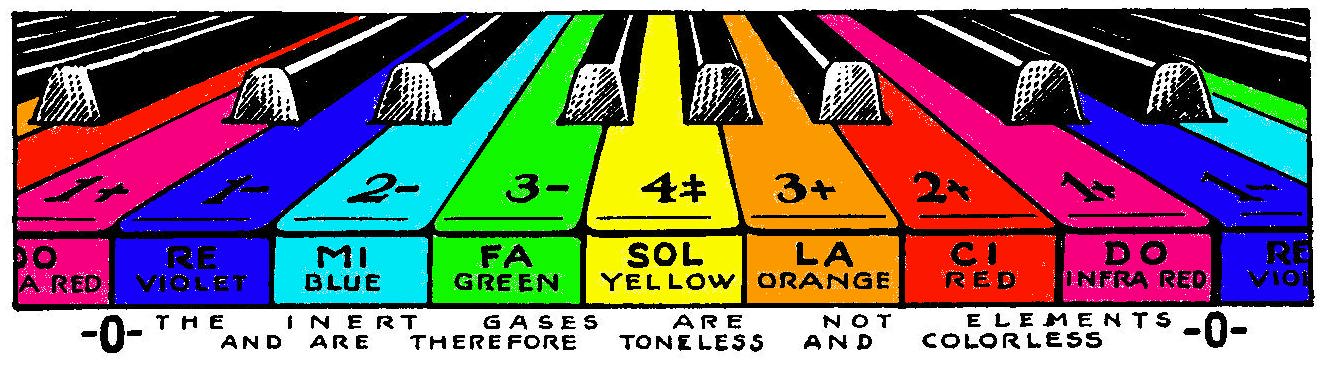
And the best for last:
Here’s a TED talk on cymatics. (If you do not trust me, which I wouldn’t, watch this.)
All in all, the big bang is a theory that is grasping at straws to avoid the conclusion that something created the universe through a universal mathematical principle and/or that the Universe has no definable start or end.
So leave the experimental physics to the physicists and the theoretical physics to the Austrian economists? Okay.
I don’t know enough to elaborate on String Theory- I just think it’s an interesting thing to think about. There have been critiques of modern physics on this forum here and probably elsewhere on the forums if you search for them (if interested). I wouldn’t say that it follows that because something cannot be observed that that thing isn’t scientific (space and time are assumed to exist for every object one even sees–yet they play critical roles in scientific analysis, especially physics and chemistry).
Are there physicists who deny that something preceded the Big Bang? Perhaps you could cite some?
I haven’t read the Objectivist links, so I’ll have to respond later.
Well, I didn’t know there was a physics forum as I’m relatively new here. As for your comment, I think you meant to write pseudoscientific, dickhead.

Friedmanite, I must ask: what is your specialty? What is your Ph.D. in? And if not in physics, why are you even commenting on this “worthless” thread? Regardless of what your specialty might be, if you even have one, I’d love for you to explain to me either how the universe originated or prove that it did not have an origin; that’s sort of the entire point, so I’d love a sound proof. I am merely pondering the question as are others; I didn’t know that was “amateurish.” Please enlighten us with your “superior” intellect if you can. . . .
Also, I see that some on here have this bias against a lack of ethos, as though you need an advanced degree in mathematics to list simple math equations. I don’t need Einstein to come back from the dead to tell me that 0 cannot equal 1. Sorry that “pseudoscientific” reasoning is too amateurish to please you, I’m sure the rest of the members on this thread are as worried about it as I am.
Exactly, you clarified it perfectly.
So leave the experimental physics to the physicists and the theoretical physics to the Austrian economists? Okay.
That’s fine, but I doubt any of us are either of those two categories. Come to think of it I doubt you have any type of authority to tell people on a social forum what ought and ought not be discussed. If people wanted a more professional method of seeking out an answer they would take it. But by you entering this conversation and giving your two bits you are no better off than whomever you are trying to moralize on.
Right or wrong, your thoughts on the matter are just as amaturish as thedude who brought up the topic - and no matter what your position is your authority on the matter is the exact same as the person you criticize by the very nature of the forum. Your appeals to authority have no validity.
If you have something to say you are goind to have to condescend to the people you are trying to communicate with.
I’m really done commenting on these threads. I never claimed be an expert on physics, (although I am math major/physics minor), but it’s really quite astounding that of all internet forums, you chose this one to ask about the Big-fucking-bang. I know the type of posters here; they’re masters at giving the most muddled to the most straightforward questions imaginable (seriously, I could probably start a thread about does 1+1 = 2, and it would probably become just as long and useless as Achilles vs T).
The thing is you know you can have all your questions about the big bang answered through other means. To me, this suggests that you don’t even care about your question. You just want to have a pseudo-intellectual discussion with other posters equally ignorant as you about science. Whatever.
Btw, I posted the OP’s post here :http://physics.stackexchange.com/questions/28984/big-bang-anybody. Most of the answerers are actual physicists.
Really? That’s interesting. What other means exactly? Even this gentleman can’t answer the same question I have about the Big Bang. At least he’s honest.
Btw, I posted the OP’s post here :http://physics.stackexchange.com/questions/28984/big-bang-anybody. Most of the answerers are actual physicists.
That’s useful. Your expertise is useful. But you jumped on the guys throat right away.
You are right it is off topic - but on this forum I would expect there to be a decent amount of math / physic majors and hobbyists. I don’t see much harm in such questions unless someone is throwing out crank theories as authoratative answers.
But this guy is just a layman asking a question. I wouldn’t see much reason to flip my lid if a dude asked a question about the History Channels rather poor use of history - it’s at least a good starting point to get a person interested in something of actual substance.
The answer you got in that link is exatcly what I started my second post in this thread off saying. “0 = 1” is incorrect for a starting point. “0+1=1” is correct.
The link to this guy, that triknighted provided, also corroborates what my post said. ‘The creation of the universe may well be beyond our comprehension.’
The lecturer at the TED talk that I linked to also said the same thing as me, that ‘cymatics may play an integral role in the creation of the universe.’
Does anyone care to respond to anything in my post? Or are you just going to squabble amongst yourselves about credentials that no one has?
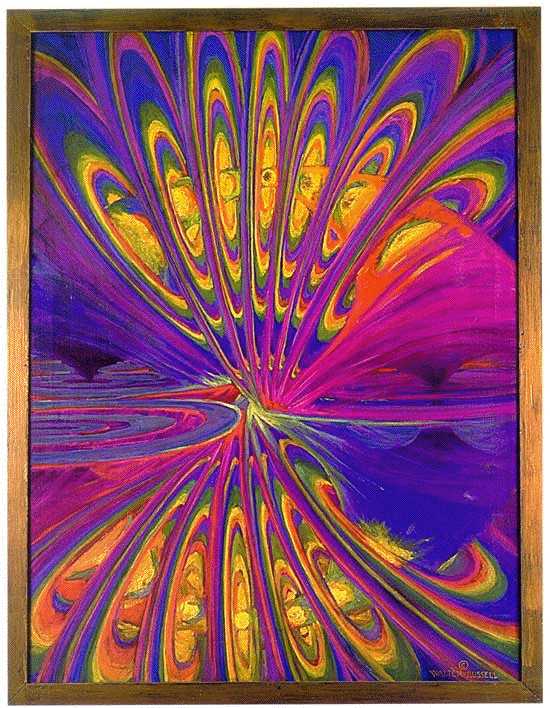
Vacuum - quantum fluctuations - false vacuum - quantum fluctuations - false vacuum bubble nucleation - two bubbles collide - point of collision is big bang - blah, blah - decay to vacuum - repeat
Space is eternal and evolves cyclically. Nothing comes from nothing.
You haven’t thought through the implications of time beginning with the universe. Understand that the concept of causation relies on the existence of time. For something to cause another thing, the cause must precede the effect.
If God pre-existed time itself, then it’s irrational to call god the uncaused cause. God needs no cause when thinking about a period when causation was literally impossible because there was no time.
If you think of time as a unidirectional dimension, meaning it only moves one way, forward into the future, then God may come from a period where time had two or three or more dimensions, rather than one. In such a period–and I know this becomes very difficult to imagine–in a place where time has two or more dimensions, causality itself breaks down completely. Effects can precede causes.
If there is a god, and if he created the universe, then probably the nature of the universe itself is the best evidence we will ever get as to the nature of god. Lots of assumptions built into that of course.
Yes, naturally. Naturalism itself is an article of faith. But scientists are terrible philosophers generally.
There are many honest scientists whom do take the agnostic position. It’s the only position that can be established for sure based on the evidence.
If the universe is a computer and God a programmer, then powering on the simulation known as our universe is something coming from nothing, because we can only experience things within the simulation and cannot access the true cause of the simulation which is the computer and etc. outside the simulation. The reason then that god can come from nothing and nothing else can is because god, as programmer, as someone controlling the environment variables of our simulation, is the only one that can break the rules of the simulation. Just as in a videogame, someone will cheat codes can do things the simulation otherwise disallows completely.
I think you’re spot on here, Aristophanes.
In my opinion, philosophers should be perplexed and distracted by cosmology, specifically the original cause (and implicitly if there even was one, so on and so forth). I guess we will have to be content with having no answer–and apparently no means for an answer–for now. It just gnaws at me, though, when scientists and philosophers alike willingly throw their hands up and give up. I realize others accused me of doing that too soon with the Achilles thread, but I have a genuine stance on it that makes me believe the solution is impossible within mathematics. It’s not so with anybody concerning what came before the Big Bang, or more specifically, how the Big Bang came from nothing.
I don’t believe in paradoxes, yet apparently, according to our own logic, we are living here and now as an ultimate result of one.
That’d be a relevant example, Anenome, but in that example, God as a programmer can turn in his swivel chair and eat a sandwich (not meaning to sound disrespectful by any means; simply listing a possibility in the example). In the Big Bang, God as a “programmer” is outside of creation, but the question is begged concerning how he got there.
Whether the universe is infinite or it was created by God who is infinite, the question of infinity and how anything can be an uncaused cause is perplexing.
This was the most detailed response I found on that forum:
Obviously we can’t see the Big Bang, and we can’t make another Big Bang in our lab (ignore anyone who tells you that the LHC recreates the conditions of the Big Bang, because it doesn’t). So what we do is to devise theories to explain why the universe looks the way it does, and then we do experiments to compare our theory with the real world. If the experiments match our predictions then we feel confident that our theory is correct.
In this case the theory we use to describe the universe is General Relativity. When we make a few simplifying assumptions about the universe and feed these into General Relativity it tells us that our universe is described by an equation called the FLRW metric. We’ve used this to make predictions about the universe, and so far they’ve all been proved true, so we think the FLRW metric really works.
The key prediction of our theory of the universe is the cosmic microwave background. The WMAP satellite has measured this to extreme accuracy and it perfectly matches what we’d expect.
The thing about the FLRW metric is that we can use it to wind time back and calculate how the universe must have been in the past. If we do this we find the universe gets denser and denser and hotter and hotter, until around 13.7 billion years ago the density and temperature become infinite. This is the point we’ve called the Big Bang.
The problem is that we can’t do calculations when physical properties like density and temperature become infinite. That’s because infinity isn’t a number and you can’t feed it into an equation. This means no-one knows what actually happened at the Big Bang. But we can get very close to it. In fact we can get to within 1 picosecond, that’s seconds after the Big Bang. That’s how back the LHC takes us - to get any further back we’d need an even bigger accelerator, which i guess we’ll build some day.
So when you say:
“a point arrives where the scientists give up”
well that’s quite correct, and there’s an excellent chance we’ll never know exactly what happened at the moment of the Big Bang itself. However if we can calculate back to 1 picosecond after the Big Bang and get the right answers then you’d have to concede that if our theories tell us that the Big Bang happened then it probably did.