This is a good explanation of the explanatory scientific method and how it justifies the Austrian approach and invalidates many of the mainstays of mainstream economics and physics.
Nice. I would have liked to have seen more fleshing out of the reasons for his particular assertions and categorizations… such as the necessity of positing causal agents, the grounding of cause-and-effect (why is cause-and-effect a necessary component of any explanation?) as well as how do we know that the method is complete, that there aren’t things that we may have overlooked to include.
Prediction is raised in the comments section but there is an easy answer to this - his method actually already includes prediction, it’s just not obvious. Prediction and explanation are both two sides of the same coin. If you can explain something, that means you can give a reason for it. What does it mean to “give a reason”? Well, it means that you can represent the phenomena under study with less information than would be required to give every particular. To put it into 21st century language, valid generalizations compress the data of particulars.
We can think of the hypothesis as a compression algorithm which allows us to represent the particulars in the much smaller form of generalities. Compression connects explanation and prediction. Explanation is a compression algorithm run forward, prediction is a compression algorithm run in reverse.
He is missing discussion of the feedback of the scientific method into itself. This feedback process is heavily distorted in mainstream science. Today, we treat the scientific method as a high-stakes game of monopoly tournament where the best scientific hypothesis completely wipes out all others and sucks up all the oxygen in the room and receives 99.999% of all available funding. Look at modern cosmology which is in a dramatically bad state of affairs. We have a pantheon of metaphysical absurdities parading around the cosmos in full naked glory while everyone who is wise enough to see them is supposed to pretend that The Cosmology is not, in fact, naked. Black holes with infinite density at a single geometric point? Elementary particles with infinite forces at their centers? Dark matter and dark energy that supposedly comprise 95% of all matter in the Universe??? Seriously?? 95% of all matter in the Universe is something which is non-observable except as it influences other matter through the force of gravity. This is religion, not science.
But there is a viable alternative which has been around for more than half a decade and sits neglected on the shelf of plausible scientific cosmological theories that didn’t win the Grand Tournament of Peer Review and Government Grant Funding. It is called Plasma Cosmology, first put forward by physicist Hannes Alfven. Rather than investigating this and other alternatives, modern science plunges headlong into the abyss of metaphysical gibberish, throwing around infinities by saying “they’re only in the limit and we choose to neglect the limit” and black holes supposedly popping into existence unobservably all around us like so many demons and goblins. This is religion, not science.
If you want to read an examplary of the scientific method, I recommend you take a look at Ernst Mach’s The Science of Mechanics. He weaves together the process of hypothesization, theorization, observation and feedback into a seamless process that will make you cry when you compare it to the pathetic excuse for a science that is called “physics” today. Read the section where he carefully and perspicuously he goes through the reasons why the lever principle is true! Today, you are lucky if a single line of a physics textbook is given to explaining the equation: FD = fd. I guess they just assume you’ve read Mach even though they don’t cite him. Read the section where he gives the limit argument for conservation of momentum… in physics class, I was taught that Newton just imagined something moving through empty Cartesian space and said “Aha! It would have no reason to come to rest so, therefore, it must continue on forever” and this is supposed to be the reason we today accept the conservation of momentum. Not so. Mach explains how the conservation of momentum is the inescapable conclusion of real experiment combined with thought-experimental continuation of the real experiment to its limit! It’s truly mind-blowing!
Just from the Introduction… how often do you read something like this in a modern scientific textbook??:
An instinctive, irreflective knowledge of the processes instinctive knowledge of nature will doubtless always precede the scientific, conscious apprehension, or investigation, of phenomena. The former is the outcome of the relation in which the processes of nature stand to the satisfaction of our wants. The acquisition of the most elementary truth does not devolve upon the individual alone : it is pre-effected in the development of the race.
Clayton -
“why is cause-and-effect a necessary component of any explanation”
Are you posing this as something that he should’ve explained more, although it should be obvious, or are you really asking this?
Nice video and, Clayton, excellent post.
Exactly! What especially econometricians fail to understand is that the complexity of their models (explanations) is roughly of the same order of magnitude as the complexity of the events they are trying to explain. The robustness of both explanations and predictions is directly proportional to the amount of compression (sublimation) performed by the model that produces them. From this perspective, Austrian Economics wins hands down.
I think he’s saying that after you specify what the objects in your theory are, you have to show how they interact. Like if you have particles, you’d have to specify whether they bounce off each other, go through each other, fuse together, etc.
I agree. Only, I’d say explanation (in physics) is actually a movie of how something happens (mechanically). Prediction is basically trivial if you have a movie of the entire process. In economics you can only make a “movie” out of your own ability to model other human beings inside your head, based on yourself. Still has to be a sensory movie of some sort.
As to plasma cosmology, the thing I don’t get about it is what “energy” and “plasma” are supposed to be. But I haven’t looked deeply into it.
I completely agree that black holes are nonsense, even semantically the concept is incoherent on its face. There are a lot of religion-like aspects in modern physics, that I really wanted to believe for a long time because they seemed so magical and fascinating. More on the religion angle, curved space, black holes (infinity):

Porco: Yeah, I’m asking it - what is so important about cause and effect? Answering this question is doubly important because phenomenalism and empiricism either ignore or deny (respectively) causality.
Why is it not possible to have a scientific theory of the natural world that is based entirely on correlation. “If you wiggle X, Y flashes… this correlation is observed 100% of the time and while we don’t (or can’t) know that X causes Y to flash, it doesn’t matter since we know we can always make Y flash by wiggling X.” What’s wrong with this?
Clayton -
What’s “wrong” with such a purely statistical correlation is that it is not an explanation, just a description. Descriptions are useful, but they are not science* – more like cataloging relations.
Think of it in the case of gravity:
Any kid can tell you that if you let go of your pen it will fall to the ground under normal conditions. Anyone with the necessary measuring devices can track the speed, and with a little math they could come up with an equation that fits its rate of descent. Go further and you get Newton’s equation. All that is very useful for certain things, but it will never bring you much closer to, say, building an anti-gravity device.
Assuming gravity manipulation is possible, there are basically three ways to figure out how to build an anti-gravity device:
-
Try a bunch of stuff haphazardly and get lucky (“tinkering”)
-
Look around and find some situation where gravity is anomolous (“cataloging appearances”) and try to reproduce it under controlled conditions
-
Figure out the underlying mechanism of gravity so that you can actually see how to manipulate it (what I would call “science”*)
What disturbs me most is that the mainstream has effectively given up on 3 in many areas, some even going so far as to say that 3 is irrelevant.
*I realize this is not how science is normally defined, but I hope to convince the reader that the term should be reserved for this use exclusively.
On the same subject, but from a different perspective: https://forum.freecapitalists.org/t/whats-the-action-axiom/18369 There I wrote:
I can predict that a female will come home with me with high accuracy if I hear certain noises from her. I need not - and don’t - predict specific concrete visuals of her walking with me to a certain station and doing a certain thing, nor specific movements, other than the general change in location to my room. Yet I can predict this entirely through statistics: it has worked every time so far, so I am pretty confident it will work again. I don’t need to know or ever consider the process teleologically. I can entirely comprehend the means without any teleological consideration at all. All I need is, “It worked before many times, so it will probably work this time.”
Statistical methods are indeed useful, but without insight into the underlying mechanisms I cannot really hope to improve my success rate with the ladies other than by tinkering and cataloging. If, on the other hand, I have a theory of mind that suggests that a female’s mind works in such and such a way (either like mine in some way (teleology), or through a mechanical metaphor), I can potentially boost my success rate to a whole new level.
Thats quite insightful.
With respect to astrophysics/cosmology, are you familiar with the theories of paul laviolette? This isnt really my field, but I thought his explanation of redshift among observed bodies was interesting, as he postulated a “tired light” theory where gravity leeches energy from this radiation causing it to move towards the red end of the spectrum. If gravity is drawing energy in, it might explain the observation that generally speaking, the more massive a body is, the hotter it is.
AJ,
I agree with everything you wrote, and I was wondering how you (and others) would distinguish between a sufficiently detailed description and an explanation. Does an explanation require reference to a theory?
I think we can tie anti-causality to absurdity. Here’s how.
Imagine a box which cannot be opened. On the front is a Red light and a Green light. One or the other light is always lit (never both). On the front is a button. As we push the button, we notice different patterns in the alternation of the Red and Green light.
For example, let’s say that every time we push the button the light switches from its current state to the opposite state (Red->Green or Green->Red).
Now, one possible explanation of the operation of the box is that, inside the box, there is a coin-flipping device attached to the button and that the Green light lights whenever the coin comes up heads and the Red light lights whenever the coin comes up tails.
After pushing the button twenty times and observing the light switching every time from Red->Green->Red->…, the probability that the coin came up heads, tails, heads, tails etc. is 2^-20 (which is approximately one in a million). As we continue pushing the button and observing the light switching from Red->Green, the probability of the heads-tail sequence goes to zero exponentially quickly.
On the other hand, another explanation of the operation of the box is that inside the box is a small computational device that alternates between two states every time the button is pushed and that each of these states is wired to the Red and Green lights respectively so that when the computational device is in State A the Red light is lit and when it is in State B the Green light is lit.
With some very technical (though rigorous) hand-waving, we can actually quantify the probability of such a device (so long as we take an abstract reference device called a Universal Turing Machine as a given for the purposes of the though-experiment). However improbable the posited device is, its probability is some fixed constant. The probability of the coin-flipping device, on the other hand, becomes vanishingly small by comparison.
Hence, we can say that it is exponentially more likely that the two-state computational device is alternating the lights on the panel of the box than that there is a fair coin-flipping device which keeps repeatedly flipping heads, tails, heads, tails, etc.
To assert that only correlation can be established (not causation) in scientific theory is equivalent to asserting that the mechanistic explanation is no better than the coin-flipping explanation of the Red-Green box. Such a view is only possible in an absurd universe where there are no explanations for anything, where all events without exception have happened by sheer, random chance. This is the definition of absurdity. Because I am rational and believe that the Universe admits to rational explanation, I reject the idea that every event in the Universe is just one, gigantic random outcome out of all possible outcomes and that the appearance of causal, mechanistic relations between events is sheer coincidence.
The less complex a posited mechanism is for a given pattern of Red-Green lights, the more likely it is compared to other, more complex mechanisms and the more likely it is versus a Red-Green box that is lit by a coin-tossing device.
This idea is not original to me though this particular way of arguing it is. See Solomonoff Induction.
Clayton -
In the explanatory scientific method as detailed in that guy’s video in the OP, explanation = theory = movie of how you think something mechanistically happened.
I had the same question initially, since usually description and explanation are pretty similar words. But I think I have it sorted out now.
In this context, “description” means describing the observed phenomenon (e.g., an apple falls to the ground; it accelerates at such-and-such rate). “Explanation” means making a movie, 3D model, or actual mock-up of the unobserved hypothetical phenomena that are proposed to mechanically produce the observed phenomenon (e.g., the earth is connected to the apple by an invisible lasso that pulls on it). Explanation could also be done with words if the words are clear enough that everyone ends up visualizing the same thing.
Some explanations (movies) are given in modern physics, like Einstein’s gravity well:
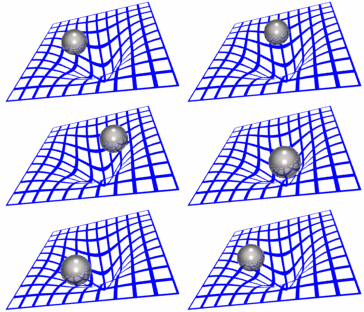
However, here it is absolutely not clear how this warped grid, which is supposed to be space (=nothingness), mechanically pushes on the ball to explain how the ball is kept from flying away. If pressed on this point, I’ve found that physicists will back away from the movie (the explanation) and say it’s just a visualization for laymen, and that the real deal is in the equations. All right, but the equations will just be a description of what happens, not an explanation of how it happens mechanistically.
Without such an explanation, there is no way to advance science more deeply. No hypothetical objects are proposed that mediate gravity, let alone a movie of how they would do so. We are still stuck at Newton’s hypotheses non fingo (“I feign no hypothesis [for gravity]”).
Nice example. That’s exactly it: when we move away from explanation and into pure cataloging of relations (equations), we are in effect claiming that “all beyond this point is fundamentally unknowable, inconceivable to the human mind even in principle, 100% absurd.”
I suppose it could be possible for this to be the case, but it would be quite an amazing statement. After all, there is no way to know that a new explanation could never be proposed that would make it all conceivable again.
In other words, it is just a veiled way of giving up on science. Alternatively, viewed in terms of incentives, it could be a way of deliberately stalling when progress on the explanation front gets too difficult, so as to continue getting grant money in perpetuity.
What’s “wrong” with such a purely statistical correlation is that it is not an explanation, just a description. Descriptions are useful, but they are not science* – more like cataloging relations.
Think of it in the case of gravity:
Any kid can tell you that if you let go of your pen it will fall to the ground under normal conditions. Anyone with the necessary measuring devices can track the speed, and with a little math they could come up with an equation that fits its rate of descent. Go further and you get Newton’s equation. All that is very useful for certain things, but it will never bring you much closer to, say, building an anti-gravity device.
Assuming gravity manipulation is possible, there are basically three ways to figure out how to build an anti-gravity device:
1) Try a bunch of stuff haphazardly and get lucky (“tinkering”)
2) Look around and find some situation where gravity is anomolous (“cataloging appearances”) and try to reproduce it under controlled conditions
3) Figure out the underlying mechanism of gravity so that you can actually see how to manipulate it (what I would call “science”*)
What disturbs me most is that the mainstream has effectively given up on 3 in many areas, some even going so far as to say that 3 is irrelevant.
I like this. It comes down to “what are we talking about and why” - we can never talk about “physics for the sake of physics”, or physics as a “thing in itself” it becomes nonsensical. I think it may be our task to show that option 3 is unavoidable by the nature of our very being, it is what we are always doing anyway, and it can not be ignored. I think that Aristotle video that talked about perspectives kind of touches on that.
I have to say, I came to this thread with a skeptical eye, but now feel I should withold judgment until I’m better acquainted with some of this fascinatiing material. I’ve always felt that the way in which the “scientific method” in a Popperian falsificationist form, actually betrays a lot fo the subtleties of reasoning, which is both deductive and inductive, underlying the formulation of scientific theories.
Thanks very much for the link Clayton. I must ask, have you read any of Landau’s Course of Theoretical Physics, and if so, what do you make of it? I ask, as I recently perused one of the earlier editions of the volume on Statistical Mechanics and at the end of the 1st chapter, he contains one of the most thoughtful discussions concerning the problems with probabilistic rationales underlying the increasing entropy principle of the 2nd law of thermodnamics and how it must relate to time’s progression. (Cf. Landau and Lifshitz, Statistical Physics: Volume 5, 3rd edition, pp. 29-34)
[My thoughts…]
I’ll I’d add that, as a rule of thumb, a hypothesis means the WHAT (definitions, assumptions, invoked objects/exhibits); the theory hopes to answer WHY questions (filling in the movie blanks, possible causes, motivations); which also requires answering HOW (i.e. mechanisms) especially in fields like physics.
HOW would relate more to physics than, say, history. History might answer WHY questions in a theory about personal motivations. E.g. “Why did the British Government go to war?” / “Well, Churchill thought that … The state conspired with …” etc. This is mostly true of economics, too. But there is obviously overlap (“Napolean probably thought that … which explains …” [motivation/why] / “If the shooter’s bullets ricocheted off the wall, then hit the soldier … This suggests that …” [exhibits/how]).
In physics we’re dealing almost exclusively with existence (objects w/ location). So there are absolutely no motivations; only causes! Explanation/theory is ideally objective, yet ultimately an author’s interpretation, which thus requires filling in blank movie frames with mechanical interactions and so on.
It’s worth noting that there is a LOT of confusion (especially in positivist/empiricist schools) about the difference between subjective, objective, and rational/irrational. These three at least I think I’ve nailed and understand well. But there’s more; trickier stuff.
An hypothesis is purely objective and geenrally descriptive. It paints the scene. There is no interpretation. All base assumptions, definitions, and facts are taken strictly on face value just as they are. We invoke a ball and a cube (exhibits), and an equation (fact). Maybe there was a ball, maybe there wasn’t. But we have to proceed to use it in our theory, so we ASSUME (hypothesize) the ball/cube/equation/definition etc for the purpose of hearing the theory that follows (explanation).
A theory is filling in empty scenes from the past using bits and pieces from the hypothesis. Converting static images to dynamic movies. “Suppose that the ball fell on the cube, and bounced, this explains the equation because X represents …” bla bla. This doesn’t mean an interpretation of possible events is not rational. Two entirely different things as I understand it: one’s ideas can be subjective but rational; or objective and rational. [Or plain irrational.]
Everything from a scientific hypothesis, to theory, to conclusion, MUST be rational (thought-through OR illustrated, step by step). Visualization through illustration is the most objective possible method of communication. This might not work for motivations (i.e. philosophy: history, economics, ethics) because these things cannot be well illustrated. However, this is where we need narrative (why) explanation, based on precise objective definitions. The way a scene is cut snd spliced, illustrated, and objects moved about, is entirely up to the theorist. Whether you agree or not about the likelihood of a movie having actually played out in the past, is post-scientific i.e. entirely up to you.
To summarize how I currently understand it:
- Subjective: requires human observers/interpretation.
- Objective: rules out observers/interpretation.
- Rational: amenable to illustration; can be visualized i.e. followed step-by-step in the mind.
- True fact: tautology; description (i.e. list of proprties); exhibits (true “evidence”). Objective.
- Assumed facts: assumptions (aka “statement of the facts”). Scene-setting.
- Hypothesis: first stage of the SM; exhibits/objects; facts; assumptions; definitions. Objective, descriptive.
- Theory: second stage of the SM; speculation; interpretation, inc. causes/motivations. Ideally objective. Explanatory.
- Conclusions: opinions about the theory.
Proofs and truth are subjective. Tautologies (A=A; 2+3=5) are just facts (‘defined as such’; resolve to artificial base axioms) and may add weight to a conclusion (to sway the audience). Science is first and foremost RATIONAL and OBJECTIVE.
See some of BIll Gaede’s ramblings, here… youstupidrelativist.com/02Sci/04Hypot/01WhatHypo.html / youstupidrelativist.com/02Sci/05Theory/01Theory.html / youstupidrelativist.com/02Sci/06Conclusion.html.
Curiously, Bill elucidates the following in his earlier work (possibly incomplete or edited since):
“A theory is believed or not, and in between there are gradients; degrees of belief. A hypothesis is accepted or not. It is a black or white issue. A conclusion includes a testable experiment or doesn’t. Another black or white issue.”
SO what do you guys think?
These are just my initial thoughts and ramblings after reading this interesting thread, and others. I hope it’s of some value. Any disagreements please let me know.
One thought I’ve had recently is this: is a HOW/WHAT problem just a subset of a WHY type question?
For instance:
“WHY is the sky blue?” [<< implies there are blank frames requiring general explanation?]
Could be rephrased as:
“HOW does the sky [object] create our experience [subjective] of colour [concept]?” [<< implies we need a movie of physical events?]
Or more generally:
“WHAT is (or do we mean by) sky/colour?” [<< implies we must hypothesize exhibits/definitions first!]
Is this even important? Am I just mixing words needlessly? Are WHAT/WHY/HOW terms slightly interchangeable or of themselves in need of better definition/association? Is it just more helpful to think primarily in terms of consistency and illustration?
I’d love to hear your thoughts.
I think that’s key: navigating and manipulating the physical world is what we do from birth, and even what the animals we evolved from do.
What, how, and why can have a lot of different meanings, and then so can blue. So there’s that.
But perhaps there is something that still needs to be clarified regarding description vs. explanation:
Description vs. Explanation in the Explanatory Scientific Method (click the arrow key to move forward in the presentation)
Hello everyone, I’m the creator of the video above.
Reading the comments I pretty much agree with the bulk of what AJ and gokuju are saying. Gokuju you mention Bill Gaede’s writings, that is where a lot of the ideas came from.
There is a succinct version of Gaede’s scientific method which can be found here.
For people interested in this stuff I’d suggest reading through Gaede’s writings first. My goal was to more or less question whether or not Austrian economics could be formulated under a similar version of the scientific method. I’ll try to answer some of your question the best I can tho.
Clayton -
“such as the necessity of positing causal agents”
“Causal agents” may not be the best way to put it. What I am trying to argue is that if an explanation is a version of how/why something happened, which we assume points to something whose existence is not contingent on our ideas (ie, can’t be proven or disproven via observations), then the onus is on the theorist to communicate their assumptions with respect to this existence external to the mind. If their explanation involves supposing something like “X exists,” then the theorist must be able to communicate the meaning of such a proposal. I can’t begin to try to evaluate the truth or falsity of any such proposition like “X exists and does such and such” if I can’t first understand the meaning of the proposition itself.
While I think it may be possible to formulate Austrian economics under an explanatory scientific method, I don’t think the level of “objectivity” will ever compete with the set of definitions for physics. I cannot imagine any mode of communication more straightforward than using 3D shape as the inherent quality of an existing object. That being said, I still think Austrian economics can be communicated “objectively,” ie, to the point where everyone perceives pretty much the same thing. I’m thinking that it is impossible to objectively communicate assumptions about the facts of someone else’s experience, ie, like stepping into someone else’s mind and experiencing something precisely as they experienced it. But I can at least suppose that there is an external mind, and that this mind is aware of certain things, like certain choices. Whether or not this will pan out I’m not sure, but I don’t see why it shouldn’t be possible.
“the grounding of cause-and-effect (why is cause-and-effect a necessary component of any explanation?”
I also wondered whether causality was necessary. I can show you a movie of my statement of the facts for how something happened, and I don’t think you have to assume anything about cause/effect to watch and understand. For example, say I find that my TV remote has been chewed up. I suspect the dog and imagine him chewing the remote. If that qualifies as “explanation,” then I’d argue that you’d have to break explanation down into two categories: how and why. A movie without causality is an explanation of how something happened, a movie presented with the cause/effect assumptions is an explanation of why something happened. I can communicate “the dog chewed the remote” all by itself, but if I want to go deeper I can try to answer why questions (why did the dog chew the remote? why do canine teeth cause remote plastic to deform?).
“Why is it not possible to have a scientific theory of the natural world that is based entirely on correlation. ‘If you wiggle X, Y flashes… this correlation is observed 100% of the time and while we don’t (or can’t) know that X causes Y to flash, it doesn’t matter since we know we can always make Y flash by wiggling X.’ What’s wrong with this?”
I think you’ve targeted the difference between prediction and explanation. This is an example of how the prevailing “scientific method” uses terms inconsistently. Sometimes “hypothesis” means “given X conditions, Y will result,” sometimes it means, “X exists.” I don’t think there is anything necessarily wrong with prediction as long as it is separated from explanation.
So as to the root of the difference between the two…In the physical sciences, it’s almost taken for granted that we are talking about objects “out there,” ie, outside of our minds. That is what makes them “real.” We assume that the existence of these objects is not contingent upon our ideas of them. Likewise, our ideas of them are just mental constructions invented by the mind, ie, representations of the facts, not the facts themselves. So if the theorist plans to invoke “X exists” for the purpose of communicating an explanation, they need to decide upon a definition of “existence” prior to presenting us with the theory and remain consistent with it. The definition of “existence” must be taken at face value as it is a construction of the mind. So explanatory theories then can never be proven, they can only be judged based upon whether or not they are rational (ie, conceivable), consistent, and how well they explain the evidence.
Prediction however is a convenient way of introducing terms like “prove” or “confirm.” You can make predictions without having to define the term “existence” consistently. I predict that when I take my next step I won’t perceive that I have fallen to the center of what I perceive to be the Earth. Done, verified. If I base everything on the facts of my sensory experience, I can use pattern recognition to make predictions without having to make any claims about what does or does not physically exist. This is fine, but it does not allow us to gain a deeper understanding of how or why things happen. It deals purely with predicting what will be observed given what was observed in the past.
“To assert that only correlation can be established (not causation) in scientific theory is equivalent to asserting that the mechanistic explanation is no better than the coin-flipping explanation of the Red-Green box. Such a view is only possible in an absurd universe where there are no explanations for anything, where all events without exception have happened by sheer, random chance. This is the definition of absurdity. Because I am rational and believe that the Universe admits to rational explanation, I reject the idea that every event in the Universe is just one, gigantic random outcome out of all possible outcomes and that the appearance of causal, mechanistic relations between events is sheer coincidence.”
Exactly. If the universe is so bizarre and outside of our ability to understand rationally, then we just have to give up and admit that we can’t understand it. It is beyond our ability to comprehend and we are relegated to just making predictions about what we will observe. No amount of irrational physical interpretations can save us fom our ignorance of the how and the why. But given the amount of regularity that we are surrounded with, there is good reason to believe that there are rational, mechanistic possible explanations for what we observe.
malachie -
“I was wondering how you (and others) would distinguish between a sufficiently detailed description and an explanation. Does an explanation require reference to a theory?”
I’m with AJ on this one. I think a description is a narration of sensory experience (“an apple falls to the Earth,” “this is what an apple looks like,” “i made such and such measurement”) whereas an explanation actually deals with attempting to represent facts which are not contingent upon sesnory experience (“this is how the fusion of helium occurs,” “this is why gravity holds us to the Earth”).
As to the precise difference between theory and explanation, I pretty much use them interchangeably, but I suppose you could say a theory is the stage of the method where explanation is presented, whereas an explanation is an account of how/why something happened. What is really required for a specific explanation is a series of assumptions in the hypothesis that set the stage for the theorist’s account of events.
gokuju -
"One thought I’ve had recently is this: is a HOW/WHAT problem just a subset of a WHY type question?
For instance:
“WHY is the sky blue?” [<< implies there are blank frames requiring general explanation?]
Could be rephrased as:
“HOW does the sky [object] create our experience [subjective] of colour [concept]?” [<< implies we need a movie of physical events?]
Or more generally:
“WHAT is (or do we mean by) sky/colour?” [<< implies we must hypothesize exhibits/definitions first!]
Is this even important? Am I just mixing words needlessly? Are WHAT/WHY/HOW terms slightly interchangeable or of themselves in need of better definition/association? Is it just more helpful to think primarily in terms of consistency and illustration?
I’d love to hear your thoughts."
Color is a tricky one. Is the question about the mechanism behind how a sensation is produced in the mind, or about the mechanism behind a certain wavelength of light being produced? If the why question is about the wavelength, then the objects of the theory, ie, the WHAT, would be the atoms in the atmosphere, etc. Otherwise, color seems to be a qualitative experience which is not reducible to physical phenomena. It seems by asking, “why is something a particular color” you are attempting to bridge the explanatory gap, ie, to explain why certain qualitites of our experience are the way they are. Why does poking a tac into my thumb produce the uncomfortable sensation that it does? How do you go from neuron activity to actual sensation? I’m not sure the mind is capable or reconciling these apparently different realms of existence. As such, I think color is something taken for granted, it’s something you point to. There is no way to explain its specific qualitites. But I am not sure that is exactly what you are inquiring about.
As for what/why/how, I am somewhat confused on the distinctions. Here is what I am thinking:
what: the objects
how: the statement of the facts of an event absent causality, a movie of just the relative motion of the objects
why: a statement about the causes of the events shown in the how statement, justification of the how with causal reasoning
So if the sky question was about the mechanism behind wavelength, the what would be the objects, like atoms in the atmosphere. The how would be the statement of the facts of what the objects actually did, like the atoms pumped like this and signals went down the ropes like this. The why would be the statement of the causes of the events shown in the how, like why atoms pumping causes signals to be sent down EM ropes. Perhaps because the threads push on one another in a certain way, the cause being collision, and the effect being repulsion, etc. I think those distinctions can be used consistently.