OK, well how about social democrats vs. Chicago school “conservatives”.
Chavez vs. Pinochet?
OK, well how about social democrats vs. Chicago school “conservatives”.
Chavez vs. Pinochet?
Great quote, almost exactly why I’m no longer a lefty.
I’m not sure they have “more” goals in common with libertarians or not, since it’s hard to measure such quantities if you examine beyond a bullet-formatted list. But they (in my opinion) have been leaving a “progressive” path of destruction far greater, with more stealth, and with a more successful propaganda campaign than the “conservative” movement has. (I think evidence of this can be seen in how the “conservative” movement now agrees, out of political necessity, with the “progressives” in so many fundamental areas. Not to mention that the term “free market” is a dirty word.)
For the OP- it’s hard to pick but I’d lean towards economic restrictions aiming to “equalize wealth”, “promote fairness”, redistribute wealth and violate property rights over laws which aim to outlaw ‘negative’ behaviors. My reasoning is basically that without your property and full ownership of the fruits of your labor, what liberty is there left to be had? (I feel like I read this before in an essay, I know I’ve seen it somewhere.)
Another thing to consider is that restricting behavior can only be done in small parts due to the vast number of possible “unhealthy” habits and liberties, but you only have so much wealth that can be stolen. i.e. It’s much easier to create a law to steal 90% of your income than to limit 90% of your “bad habits”.
Wow, Sage is the only one who prefers social freedom to economic?
Well, I guess that makes sense on this forum, where the greedy come to meet!
To me the question was about which group I thought was a bigger threat not what I preferd, two seperate things
Well, I would deny that such a dichotomy is coherent. Like Mises, I believe freedom is indivisible.
Exactly, you can’t have one freedom and not the other in those terms.
I don’t think anyone is really saying that these freedoms aren’t linked. The end result of both groups’ actions is basically the same. When I read the question, I think the OP was asking about the methods these two groups use for limiting freedoms. One uses primarily economic regulation, wealth redistribution and so on, to enforce their agenda. The other (mostly?) uses politics seeking to prevent certain types of behavior or actions (including foreign coercion in this pot), allegedly preferring fewer economic limitations on what’s left of the free market.
I think the economic methods are much more dangerous because they seem much more efficient at destroying freedom, not to mention the “political correctness” aspect which makes economic interventions popular (thus more dangerous).
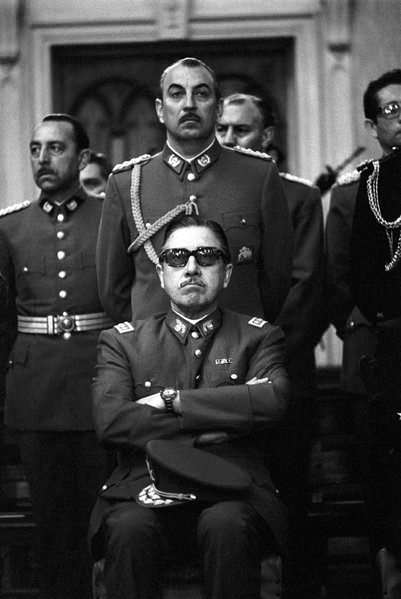
Looks like the lovechild of the Star Wars Imperials, House Corrino of Dune and Miami gangsters.
Acted like all three, too.
The mercantilist regime at least recognizes the limits of its power to confiscate resources. Social democracy is never sated.
I would say that the biggest threat to personal liberty for most of us are our own thoughts, and the limitations imposed by those thoughts/assumptions and subsequent actions.
The second biggest personal liberty threat [for most of us, I imagine] is probably the government.[:)]
regards, onebornfree.
I would argue that neither recognize limits of power, they just distribute privilege to different sets of cronies.
A threat to liberty in what sense? Pinochet = a CIA asset. Chavez = an anti-empire firebrand. No contest here.
And yet Chavez is running his country into the ground, while Pinochet’s Chile has today one of the strongest economies in South America. How could there be a contest between socialist ruin and a nominally free market regime is beyond me.
I take it you are in the Allende > Pinochet crowd.
That is only money. Freedom has no price.
So empty anti-empire rhetoric equals more freedom? It’s alright; when Chavez finishes turning Venezuela into a marxist basket case, people will start voting with their feet.
Some good points from both sides of the field
The “Miracle of Chile”, but at what cost?