I never thought that there would be a whig interpretation of human productivity. Everyday we supposedly become more and more productive.
Sweet, it looks like we are already in the “something else” phase. Where are all the robots?
What if we get to the point where robots are nearly indistinguishable from humans in terms of function, but far cheaper in terms of price? All human labor could effectively be replaced by humans, so humans would no longer be needed to work. This will be great for a large part of the population, those that can afford robots. (And I imagine robots would be continually getting cheaper, so many people could afford them.) However, what of those lower income individuals who cannot afford robots, will they rely on charity in a free society in order to survive?
The only solution that I could come up with to this puzzle is to argue that a market for human labor would develop. That is, the human aspect of labor would become a value in itself. Much like people pay a premium now for hand crafted or hand made items, over machine made items. However, this doesn’t seem completely satisfying. What are your thoughts?
Sweet, it looks like we are already in the “something else” phase. Where are all the robots?
http://www.google.com/search?hl=en&tbo=p&tbs=vid:1&q=robots+assembly&aq=f&aqi=g2&aql=&oq=&gs_rfai=
(some pretty cool videos)
What does afford mean? You seem to be assuming this external variable for income, where humans don’t need to work, yet still have income. Why do they have incomes? If there’s no need to work, the only scarcity is in time and location.
Next, suppose you’re right. What is the problem, and why would they rely on charity? They could, you know, farm and build things. That is, they could do actual labor, and with robots being continually cheaper, soon buy a robot, and use it to build more robots.
Is anyone else noticing that Benjamin is ignoring all of the arguments which utterly destroy his? e.g. “before the robots which replace human labor are built, the firms which build the robots need to employ human labor” and “demand for human labor will increase in the service industries as a result of a fully automated manufacturing industry”
Didn’t we already cover this by supposing the effects of a robot economy? The OP is new so perhaps they did not see that thread.
This tends to happen a lot in his threads.
I called out his less than intelligent arguments in another thread briefly, but others weren’t too happy about that. Any bets that he’s a migrant from RevLeft?
Nitro: I wouldn’t be surprised. Anyone noticed a certain similarity to historical materialism in what he’s claiming?
I bet. He couldn’t make it any more blatant. Like he’ll quote the half of the post that doesn’t refute his point, but completely ignore the half that destroys his argument.
“before the robots which replace human labor are built, the firms which build the robots need to employ human labor”
So a firm wants to build a building construction robot. This firm must first hire human labor to build the factory building where the robots are assembled. But the second factory for producing building construction robots can be assembled by robots, as can the third and the fourth etc.
If robots can build a car, surely they can build other types of robots as well…
Demand for human labor will increase in the service industries…
Well, under capitalism as we’ve known it, there has been an obligatory symbiotic relationship between capital and labor. Capital needed labor; it couldn’t do anything without it. This guarantees/d that labor gets/got a share of the pie produced by capital. I would say that this relationship is the essence of capitalism. Growth in production creates growth in employment, which creates growth in demand, which creates growth in production, in a spontaneous virtuous cycle that benefits everyone.
Maybe it’s just semantics, but if capital needed labor only for its ability to consume, but not (or at least to a decreasing degree) for its ability to produce (to “labor”), I would think that this break would be seismic enough to merit a new term for what the economic system is. That is, capitalists might want the services or goods of non-capitalists in the future, but they won’t need the services or goods of non-capitalists (unless you count consumption as a service), and this would be (is) a break from the entire history of capitalism, or even from all of human history. It would be a whole new ball game, economically speaking
With rhetoric like ‘machines DO steal people jobs’, ‘I don’t click on banner ads’, ‘dominant social class’ and a handful of adverbs implying an answer to his/her question - I’d say the odds are 3 to 1 4 to 1 yes?
Or perhaps a refugee from the Venus Project?
Yes, the point is that somewhere down the line, human labor has to be utilized first, in order to construct the robot that constructs the robot, etc. So before any unemployment even arises, demand for labor would increase.
Furthermore, even if demand for labor would fall, that would only mean necessitate a fall in nominal wages. Ultimately, however, increased productivity would increase real wages.
You don’t need anything besides food, water, and shelter. No human cooperation or interaction is needed at all in order to attain these goods. The majority of work done in the first world nations of the world is nonessential: e.g. servers, clerks, pizza delivery guys, taxi cab drivers, auto workers, coal miners, etc. So by your own definition, all of human history is a break from all of human history, economically speaking. In other words, your statement is utterly absurd.
A move from manufacturing involving labor to manufacturing involving only capital would not change capitalism at all. Capitalism still is and will remain the economic system under which all (or most) property has an identifiable private owner.
Moreover, a move towards fully robotic manufacturing would be a great development for workers, since real wages would rise precipitously as a result of the higher productivity that capital-only manufacturing would bring.
Automated supply chains still require capital to run them, unless you invented machines that did not require maintenance, ever.
The story is bogus.
That would make the robot salesman and the robot factory workers very happy, indeed.
This is a silly question, Benjamin. When the garmet industry switched to production overseas, scores of people were without a job as garmet makers. Are these people still without a job, wandering aimlessly on the streets? Or did they simply find something else to do? People did not stop buying shirts and pants.
Besides this, I don’t think you understand: Even with fully robtized factories and supply chains, you need people making purposeful decisions as to where to invest in new chains, fix problems, talk to angry customers, design new lines, new products, advertise, etc.
Something else: Robots are used in industry because they can do repetitive, tiresome and downright dangerous jobs better than humans, so humans can be released to do something more productive. Just because it seems “cool” that robots can do many things does not mean it is ECONOMICAL for them to do all things. Humans are still cheaper for many tasks, and they have common sense, something that is very difficult to teach a robot well.
Let’s look at what’s really happening in the real world in the U.S economy for starters:
U.S. wages have been stagnant for decades:
http://www.stateofworkingamerica.org/tabfig/03/SWA06_Fig3C.jpg

The U.S. manufacturing sector has been shrinking for decades:
http://www.epi.org/page/-/old/images/snap20030611.gif

Debt is increasing to artificially replace demand formerly created by income:
http://www.swimmingfreestyle.net/.a/6a00e54f0885ce8834011571161910970c-350wi
Wealth inequality has been increasing for decades:
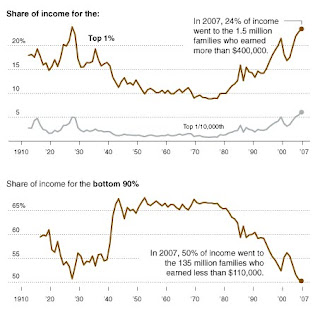
Wealth levels are falling in absolute terms for the lowest economic quintile (those most cut off from access to capital)
http://oregonstate.edu/instruct/anth484/sippabnw.gif

Despite rising levels of productivity:
http://radicalnotes.com/journal/wp-content/uploads/2008/11/prod.png

While unemployment is exploding:
http://www.youtube.com/watch?v=RrP9qJmjIsA
Every single one of these are not only explained but also predicted by this productivity/demand model.
It even explains the exponential increase in the U.S. national debt, as the artificial demand is required to replace the demand lost from wages. Under our current economic model, artificial demand can only come from credit, which is why every single debt graph is currently vertical. Even world debt!
http://www.stubbornmule.net/blog/wp-content/world-debt.png

http://bloodbankers.typepad.com/submerging_markets/chart_intro.1.%20Growth%20of%20the%20Debt.jpg

Well, if the productivity/demand model were true, one would expect to be seeing
-
long stagnant wage levels (as workers are cut off from the benefits of capital)
-
skyrocketing debt levels in all sectors (as people and governments turn to credit to replace lost demand formerly created by wages)
-
increasing wealth inequality (as workers are cut off from the benefits of capital)
-
lower wealth in absolute terms for poorest sector of society (the people who are most cut off from the benefits of capital)
-
a shrinking manufacturing sector (as human labor is becomes unable to compete with automation in all but the poorest nations)
-
a growing, low wage service sector (made of discarded manufacturing workers)
-
steadily growing unemployment (as automation out-competes human labor on a macro, not only micro scale)
-
“quantitative easing” (as governments become desperate to artificially replace demand formerly created by wages)
Does anyone dispute that we have 1-8? The only question seems to be whether 1-8 are temporary or secular trends.
I say they’re secular, at least with our current economic institutions.
I don’t understand what the assertion in the parenthesis even means. How are workers cut off from the benefits of capital? And why would one expect to see long stagnant wage levels from the productivity/demand model?
You’re conflating two totally different issues. First, “people” do not turn to credit to replace lost demand, they instead close shop and do something else. At one point, people stopped buying buggy whips.
Governments that follow a Keynesian model turn to SPENDING in the erroneous assumption that what drives an economy is consumption ALONE. That’s a separate issue.
This is a red herring. Who determines what is “inequality”? You?
Again, another red herring. You seem to be quite fascinated by red herrings . . .
You’re equivocating here - if a manufacturing sector utilizes robots instead of humans, that does not mean it is a “shrinking manufacturing sector”.
Maybe - who cares? All other things being equal, if automation really is more economical, then the lower wages will not mean anything. It is Purchasing Power that’s important. If PP improves, who gives a rat’s ass about a “wage level”?
What happened to the growing service sector you mentioned on 6?
I don’t understand why would you bring this up on a discussion about a Production/Demand model. If you want to discuss a Keynesian model, or Facism, change the nature of your post. Don’t conflate two distinct, opposed issues - government action is anathema to economic development.
Wrong question, Benjamin. The correct question is: Do 1-8 have ANYTHING to do with a Production/Demand model? I contend that they do not.
You may have heard of the Flying Spaghetti Monster explanation of all the events in the Universe.
Forgive my saying so, and with all due repsect, but your analysis of 1-8 reminds me of a Flying Spaghetti Robot Monster Theory of the Universe.
Alternate reasons for 1-8:
- Not sure if the fatcs are right, so of course their “explanation” is off.
and
Doesn’t look so bad, does it?
- For people, because they felt they could repay all their debts easily because their house would always rise in price forever.
For gov’t because it’s easier than taxing and inflating.
-
Here is wikipedia’s explanation for it. It doesn’t mention “workers being cut off from the benfit of capital.” Not that I know what you mean by that. Is it some kind of thinking that says “If A owns the factory, and B works there, then B deserves a piece of the factory”?
-
I think this is just false. As this source tell us.
-
I heard this is caused by govt regulations, taxes, and unions choking the possibilities of making a buck in manufacturing.
LInks here and here.
-
Hey we agree here!. 6. is caused by 5.
-
When I read recent newspaper articles about unemployed people, NOT ONE says “A robot got my job.” They DO say things like “I was a real estate agent/construction worker/financial analyst, but no one is buying real estate/stocks now.”
8.According to Wikipedia, “quantitative easing” just means “printing money.” Here is the full quote:
“Quantitative easing is sometimes described as ‘printing money’, although the central bank actually creates it electronically ‘out of nothing’ by increasing the credit in its own bank account.”
If you want to know why govts print money, there is a simple explanation. Occam’s Razor will tell us it is the right one.
“Say you, dear reader, had a legal right to have a printing press in your basement and to print all the dollars you wanted, and then spend them any way you want to. Would you use it?”
“Of course.”
“But why? Is it because you are desperate to artificially replace demand formerly created by wages?”
“Nope.”
“Then why?”
“BECAUSE I CAN!”
-
Wage levels stagnate because there’s a labor surplus. There’s a labor surplus because human labor is becoming increasingly irrelevant to production.
-
People drain assets, use credit cards, take out second mortgages to maintain their standard of living. Duh.
-
wealth = assets − liabilities. I’m not even sure by what you mean as “who determines what is inequality.” I suggest you look up the GINI coefficient and then read the newly out title “The Spirit Level.” Or just click here: http://media.mcclatchydc.com/smedia/2008/10/30/16/201-20081024-Wealth-gap.large.prod_affiliate.91.jpg
-
“The expression red herring is an idiom referring to a device which intends to divert the audience from the truth or an item of significance” If you’re suggesting that increasing absolute poverty for the people who are already the poorest is not relevant or an item or significance, I don’t know what to say to you.
-
Shrinking in terms of the percent of the population it employs
-
I would suggest you read a book by Ludwig von Mises, where he’ll prove to you that there is a government policy of inflation, which means declining purchasing power for those furthest from the sources of inflation.

http://investorsconundrum.com/english_edition/wp-content/uploads/2009/06/us-dolar-ppp-historical.jpg

-
The expansion of crappy service sector jobs kept unemployment down in the U.S. over the last three decades, but now even the service sector is shrinking. Underemployment, which is endemic in the service sector, isn’t measured in the common statistics.
-
Governments need tax revenue to sustain their wasteful and destructive budgets. When wages started faltering, credit expansion created a growing bubble that they could tax. When the credit bubble began to pop, governments had to turn to printing money directly, which is what quantitative easing means. I’m not defending it, I’m explaining why governments encouraged the credit bubble and why they’ll turn to printing money as it fails. It’s because if they limited themselves to taxing wages, they would hardly have grown since the 1970’s.
If A owns the factory, and B works there, then B deserves a piece of the factory"?
No, if A owns the factory, and B works there, then B gets a piece of the factory. It’s called a wage. It’s why people work places under a capitalist system.