I suppose A is forcing B to buy his products in order to survive…
its becoming clear what your all about… just stop sucking at it.
I suppose A is forcing B to buy his products in order to survive…
its becoming clear what your all about… just stop sucking at it.
I suppose A is forcing B to buy his products in order to survive…
In order for who to survive?
A needs B’s labor and consumption while B needs A’s wages and salaries in order to survive.
Wages paid to Bs create the demand for A’s products.
Not sure this is accurate. He gets his wage, but not part ownership of the factory. I mean, say the factory owner hires someone to babysit, and pays the babysitter with money he got as profits from running the factory. Would you say the babysitter has gotten a piece of the factory?
If you do, then we disagree. Anyway, I see the guy working in the factory in exactly the same light as the babysitter. Both work for the owner, both get paid in money, both don’t get a piece of the factory.
Of course maybe you are using the word “get” in an unconventional manner. Still, would you say the babysitter gets a piece of the factory?
Would you say the babysitter has gotten a piece of the factory?
Basically yes. They’ve gotten a ‘piece of the action.’ Some of their income is almost directly coming from the income of the factory.
Maybe it would be better to say they directly benefit from the factory’s income?
If there is a labor surplus, wages do not stagnate, they would DECREASE. What does any of this have to do with the purported explanation you originally gave, that “labor gets cut off from the benefits of capital”?
No, SOME people do this. You’re asserting that ALL people do this. This is false. Also, this has NOTHING to do with a Production/Demand model, even if there were more robots.
Benjamin, I am not looking at some made-up level. “Inequality” is a subjective term. Who determines what it “inequality”? A self-appointed committee of the terminally envious?
Simple - don’t use RED HERRINGS. Saying “all those poor people that will become poorer as we use more robots!” is a red herring. People didn’t become poorer during the industrial revolution, they actually became RICHER, as goods were more available thanks to increased production.
That does not make it a "shrinking sector’. By your definition, intensive farming should be a “shrinking sector” just because it employs fewer workers.
And, I said - ALL THINGS BEING EQUAL. However, you want your cake and eat it, too: You are trying to make a critical argument regarding the Production/Demand model and also include government interventionism as if both were contingent to one another. This is FALSE.
Ok, maybe the service sector is shrinking, what does that have to do with the objection I posited to your assertion that unemployment will STEADILY increase? How does your theory mesh with the current reality you are mentioning, which surely does NOT involve ROBOTS?
AND? What does this have to do with ROBOTS and the Production/Demand model? By the way, THAT is a Red Herring.
AND? What does this have to do with ROBOTS and the Production/Demand model?
Say’s Law, or the Law of Markets, is an economic proposition attributed to French businessman and economist Jean-Baptiste Say (1767–1832), though it actually originated earlier and elsewhere. Say’s Law is founded on the notion that commodities are produced as a means to acquire other commodities. It states that in a market economy, goods and services are produced for exchange with other goods and services, and in the process a sufficient level of real income is created in order to purchase the economy’s entire output.
Robots do not receive income, but they do produce goods and services. When it becomes possible on a macro level to increase production without increasing salaries (income), new products are created but a new market for those products is not created.
The creation of credit can hide this process for a time, the credit creates ‘artificial demand’ and ‘artificial markets,’ which are artificial in the sense that they are not created by income. Not everyone will turn to credit to maintain the standard of living formerly afforded by their income, but enough will so that the aggregate levels of debt rise, also creating a rise or stability in aggregate demand.
Or prices can fall since more goods and less consumers means the currency is more valuable.
Would you worry about massive unemployment if God appeared on the scene tomorrow and said “You guys are screwing things up down there - from now on, I’m just going to give everyone everything they want”?
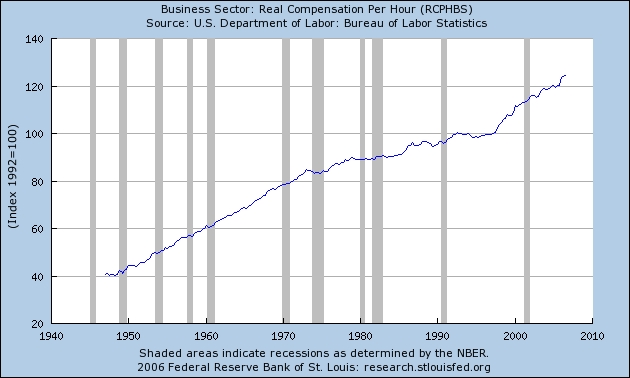
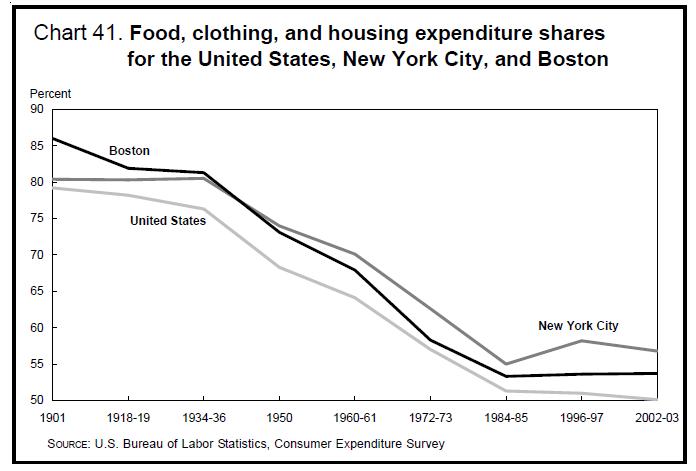
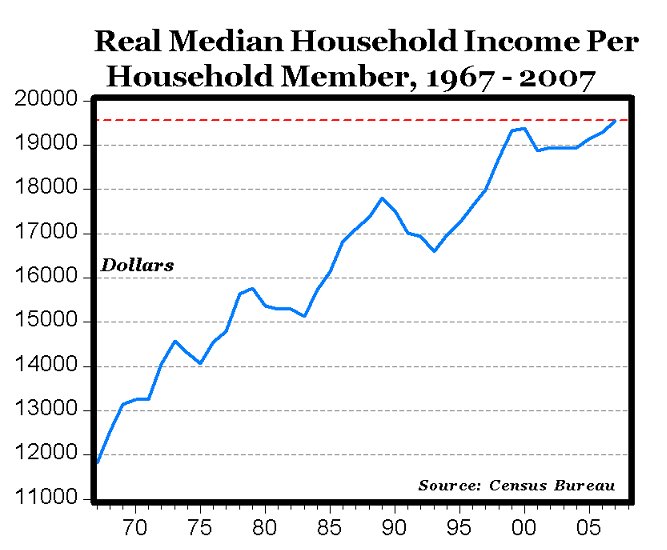
Official inflation and real wage numbers don’t actually capture living standards accurately, partly because inflation numbers capture nonessential goods and partly because real wage numbers often don’t include total real hourly compensation for labor (wages + benefits). Look at this data:
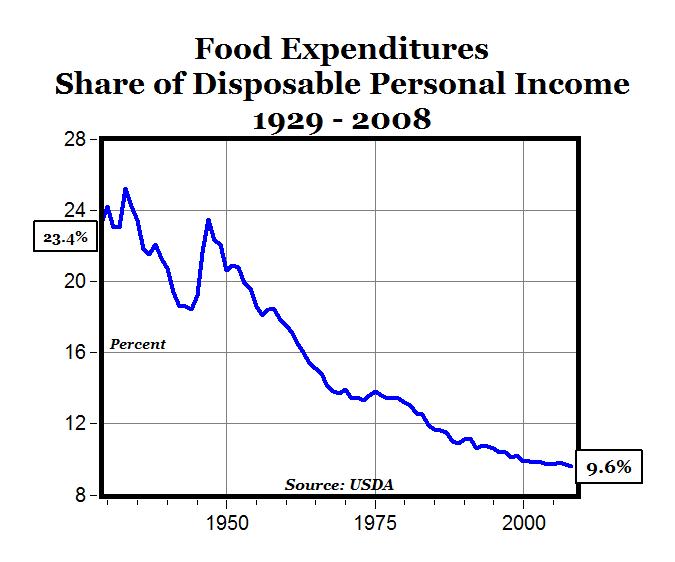
So for all intents and purposes, rising productivity as a result of capital accumulation, has increased the standards of living of the workers that the capital replaced.
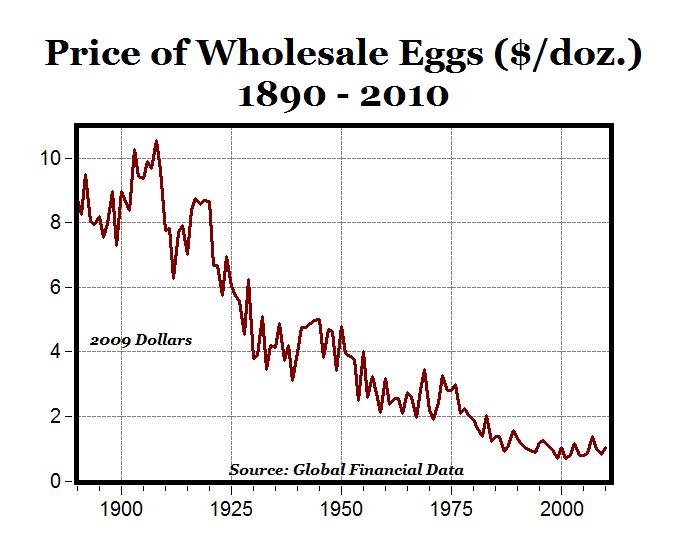
It’s called lower prices. Increased productivity means lower costs of production and higher supply, which means lower prices, which attracts customers. That’s what creates markets.
Bullcrap! You are talking in aggregates, and espousing the “overproduction” hypothesis of yore. I should have known. What robots do is reduce the cost of PRODUCTION,but that does not translate directly into lower DEMAND.
So its robots all the way down.
Robot owners do recieve income on the robot’s behalf, and they do spend that income as well. (Not that it matters, spending does not drive production)
By afford I mean be able to purchase. Robot owning humans wouldn’t need to work because the robots would be doing their work for them. I think the idea is that the non-robot owners wouldn’t be able to farm and build things because they wouldn’t be able to compete with the more efficient robots. Sure, non-robot owning individuals could possibly farm their own food, etc, but no one would want to trade with them because their items would be too expensive. (Due to labor costs) Therefore, they would live off whatever they could produce, without trading. (Unless, as I mentioned earlier, people are willing to pay more for human labor despite the indistinguishability of the product.)
I am just playing devil’s advocate here, as I said, it is a puzzle that I haven’t found a satisfying solution to. I first heard the argument from Marshall Brain, a man trained in engineering, and the founder of howstuffworks.com. He has written quite a bit about his vision of robots and how they will affect the economy in the future. Some of his writings can be found here: http://marshallbrain.com/
I just want to know what the ‘Something else’ after capitalism is…
Wait…something after the full maturity of capitalism!?
!(http://i29.photobucket.com/albums/c272/smi-o/New pix/its-a-trap-cat.gif)
SOCIALISM!
People lived this way for most of human history. What you have is a small minority who live, without being aggressed against, in a way that is the most popular throughout history, while the majority lives in unimaginable leisure - and has a lot more than before to give to charity. Now, either the robot owners live in a post-scarcity world, or they don’t. If they do, then they can give away as much as they want without losing, and the others have nothing to worry about. If they don’t, then at the right price, they do benefit from trade even with non-robot owners.
Cal, it would be a great development for everyone if robots could play an identical role to all forms of human labor. If this did happen, it would be basically as if the population of humans exploded upward (due to the near-human robots), but the demand for the necessities of life didn’t. As a result of this, prices for all goods and services would fall incredibly. At the same time, the price for labor would have to fall dramatically, since nobody would hire unless you provided a service at a cheaper price than a robot. So, basically, what would happen is that nominal wages would fall drastically (assuming little or no inflation), but increased productivity would be so great that real wages would actually rise. In other words, human laborers would have to compete with the robots for jobs. Another thing to consider is that stocks are very affordable, so I’d think that most everyone would be a “capitalist” of some sort by the time we have a fully robotic economy.
Besides that, I think there still would be some demand for specifically human labor. This probably isn’t the best example, but I doubt that robotic prostitutes would replace human ones, unless they were completely indistinguishable. The same would apply to waiters, cashiers, and greeters. Humans still desire other human contact and I doubt robots would be able to sufficiently provide for that.
I think it’s a very good example.
Give me a robot that replaces a human and is at least as good as, or better than in every way, and we’ll have bigger issues to worry about than unemployment.
Until we get robots that good, (if it’s even possible) there’s going to be a demand for human employment.
I think this thread has gotten to the point that Benjamin’s argument can be countered by quoting previous parts of this thread.
Wrong, but +1 on the locatephor (lolcat metaphor, copyright Nitroadict, etc.)
Free-market activity (assuming that people keep mislabeling mercantilism & corporatism as capitalism) would emerge from the crumbling statist economies, which runs the gamut of free-market anti-capitalism & free-market capitalism.
Time will only tell if people learn how involuntary capitalism doesn’t work as well as involuntary anything, let alone socialism.