It’s been like that since Page 2.
P.S. That cat is incredibly cute.
It’s been like that since Page 2.
P.S. That cat is incredibly cute.
I was tempted to include that in every post I made in this thread.
But seriously, lets assume that someday industry will suddenly require a fraction of the previous work force. I don’t know how likely it is, but its not unthinkable. It happened in agriculture, and caused a flood of labor to industry. Certain service sector jobs are being automated as well, ATMs, vending machines, gas pumps, self check out lines, etc. Labor would leave industry for whatever is next in line on the hierarchy of needs, science or art I suppose.
People would be scientists, doctors, lawyers, musicians, painters, chefs, athletes, actors, psychiatrists, masseurs, barbers, journalists, dancers, scuba instructors, and prostitutes, just to name a few.
Pretty much. In a free market, labor tends to go where it’s needed most. People will make themselves useful to get something back for themselves.
!(http://www.canalred.info/public/Fondos_Pantalla/3d/Sexy Robot 3d.jpg)
Dude, how could you pass that up?
Sex Robot Roxxxy Looking for Some Action
I imagine they’d make great pimps too?
Is that guy checkin’ out her mouth?
just wondering…lol[:P]
Is there an Austrian explanation of the simultaneous, exponential world-wide explosion in debt?
Profligate monetary policy might work as an explanation on a case by case basis, but it seems insufficient to explain it happening everywhere at the same time.
A need for permanent artificial demand creation for even continuing the current level of economic activity is my explanation, I’d be curious if someone else has one.
(If you’re curious as to what I see the ‘something else’ after mature capitalism as, it’s either penury or sustained artificial demand creation to replace permanently lost wage demand)
National debt as % of GDP:
!(http://bloodbankers.typepad.com/submerging_markets/chart_intro.1. Growth of the Debt.jpg)
And here we go:
Wages as percent of GDP:
SOURCE: John Bellamy Foster and Fred Magdoff, “Financial Implosion and Stagnation: Back to The Real Economy,” Monthly Review 60.7, December 2008


Benjamin, falling wages as a percentage of GDP doesn’t mean that real compensation has fallen. You’re basically using an absolutely useless statistic when it comes to measuring living standards.
Also, if you’re a fan of sex dolls, then I guess those robots would be good enough for you. But what people value in most service jobs includes the genuine human contact - something that only real robots with artificial intelligence (not machines, which is really what we’ve been talking about) could be able to provide.
And so what if we invented artificial intelligence? That would have the effect of pushing up the labor supply drastically (since these robots would be equivalent to human labor), increasing labor productivity and total factor productivity greatly, while not putting a strain on the resources that humans use to sustain themselves (e.g. food, traditional shelter like homes and apartments, etc.). In other words, this would be a great advancement for human civilization, as the real wages for humans would have to shoot up drastically.
Most central banks around the world have had and continue to set abnormally low interest rates.
The US Dollar is the world currency, so the interest rates the Fed sets are very important.
Four most important currencies: USD, EUR, JPY, GBP. All four central banks controlling these interest rates set extremely low interest rates. The BOJ, for example, set interest rates so low that the JPY became a carry-trade currency.
Financial innovations has allowed people to save more efficiently than ever before.
Young and old populations tend to dissave (much of the population of the United States and Europe is becoming elderly, which is why the US and European countries will all have national pension problems).
Not all countries have seen “an explosion of debt” (at least not when compared to savings). For example, the PRC has been a huge saver, on net.
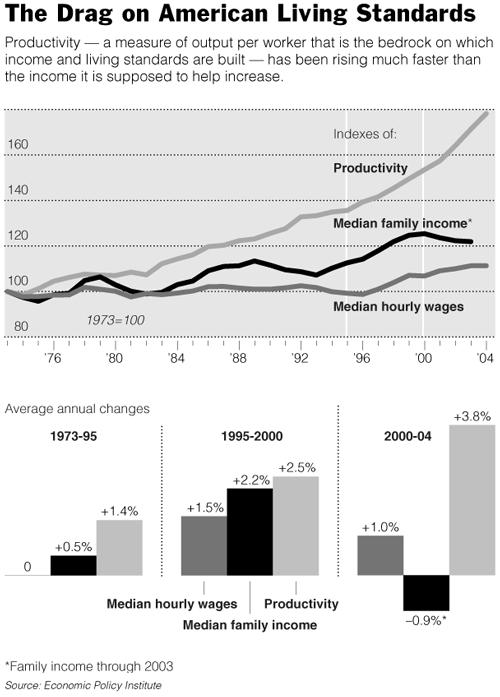
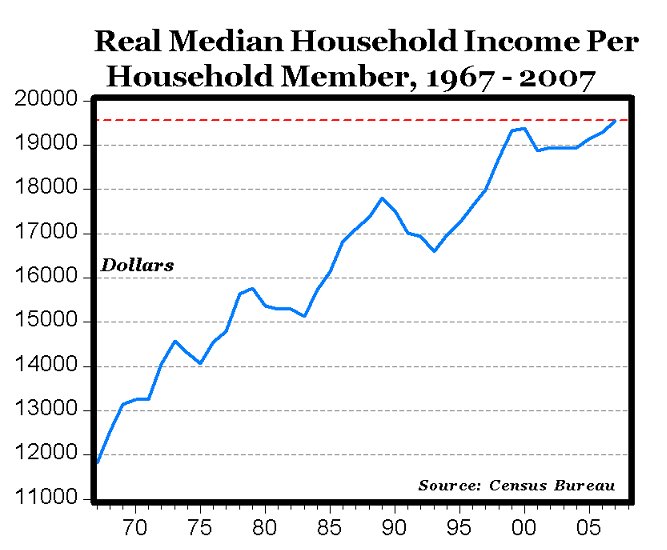
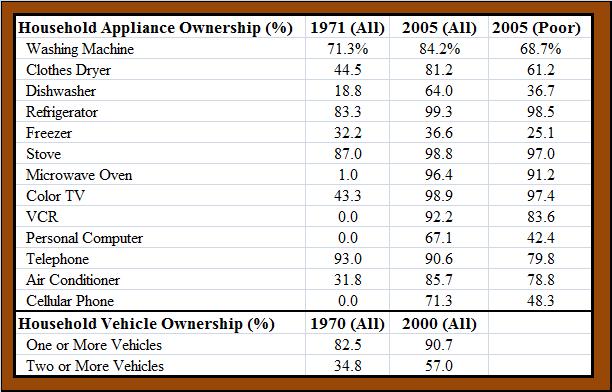
How can you make this statement in light of the fact that real compensation has risen drastically over the decades?
Moreover, this is a silly claim theoretically. The reason why firms invest is so they can lower the cost of production and expand supply of the good/service they produce. This means that, in nominal terms, demand could fall and firms would still remain profitable.
Good argument.
Most central banks around the world have had and continue to set abnormally low interest rates.
sure, but why?
Four most important currencies: USD, EUR, JPY, GBP. All four central banks controlling these interest rates set extremely low interest rates. The BOJ, for example, set interest rates so low that the JPY became a carry-trade currency.
sure, but why?
There’s not much savings going on…
True, life expectancy could account for a lot of it. Still, our entire society seems to have leveraged everything of value simply to afford consumables.
China is where the U.S. was in the 1940’s -1970’s. Expanding manufacturing jobs are causing shortages of human labor which is leading to increased general demand and rising standards of living.
I’ve read that the U.S.Army uses robots to sew much of its uniforms, because they’re required to produce in the U.S. and the robots are cheaper than the wages they’d have to pay in the U.S. At some point, the technology will be progress to become cheaper than workers in China, or anywhere. China, on aggregate, will likely then pay down their savings reserves to maintain their accustomed demand levels. Eventually, the whole world will need an alternative to wages as a means of producing economic demand.
Also, I don’t think those robots are being designed for sex… the video shows them reading and solving math equations…
It certainly has nothing to do with robots and the Production/Demand model, let’s get that out of the way…
The explanation does not need to be Austrian… The explosion in debt has to do with ever cheaper fiat money.
That’s absurd, like saying “the microbe theory of disease may work on a case by case basis but how then can you explain all the cases of sniffles happening at the same time?” Don’t you think central banks around the world talk to each other?
That’s a reason for the profligacy, not the reason for the phenomenon.
But . . . with robots . . . Right???
The gap between wage and productivity increases is what needs to be compensated for in artificial demand for an economy to grow at optimal levels. If the economy only grew at the rate of wage growth; that is, if central banks were not profligate, then economies would only have grown in proportion to wage growth, despite the fact that it’s very possible for them to grow at the rate of productivity growth if artificial demand makes up the difference between wage stagnation and productivity growth.
Central bank profligacy is a disastrous way to create artificial demand however; the debt can never be paid down and creates increasing debt-service load which eventually become un-serviceable.
This is creating a “double bust;” as credit is defaulted upon, causing demand to leave the system and economic activity falls back to only what can be supported by wages, despite the fact that productivity might allow even double such a level of economic activity, if only there were economic demand.
This is why this recession ‘is different.’ It’s not a part of the normal business cycle; the system can’t recover, because no level of optimism will lead to significant hiring, and no significant hiring means no significant expansion of demand and the path to a self-sustaining recovery.
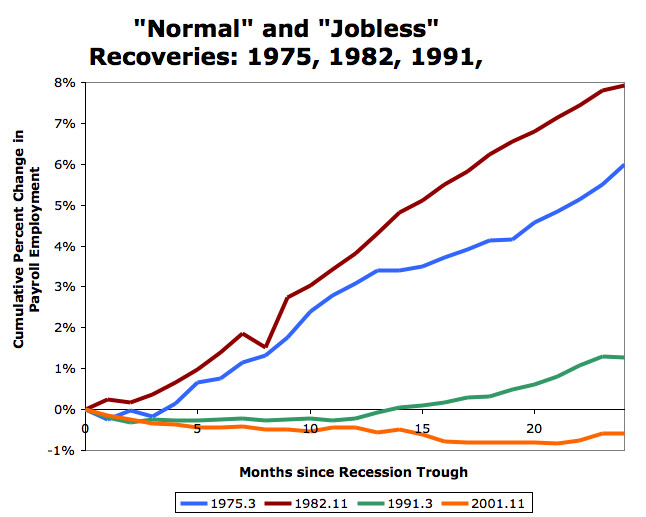
This is why we’ve been having ‘jobless recoveries’ in the recent past:
http://en.wikipedia.org/wiki/Jobless_recovery
A jobless recovery is usually seen as a bad thing in a capitalist industrialized society. This is primarily because in such a society most people need jobs to earn the money they need to purchase goods and services from the marketplace.
…
http://www.economist.com/blogs/freeexchange/2010/01/jobless_recovery_illustrated
The jobless recovery, illustrated
A NEW Goldman Sachs report on the state of the real-estate market in America includes the nice graphic below, on America’s lacklustre labour market:
Employment used to recover a lot more quickly than it has in recent recessions, but even by the pitiful standard of those recent downturns the current recovery is a jobless one.
http://www.economist.com/blogs/freeexchange/2010/01/here_comes_jobless_recovery
Here comes the jobless recovery
THIS week, your blogger is in the print edition discussing the likelihood that the current recovery will be jobless. The answer, I conclude, is yes; the strongest job sectors can’t add workers fast enough, and consumer-side employment will be very slow to recover until households clean up their balance sheets. [note: which they can’t without wage growth or severe drops in living standards]
Because central bankers are generally Keynesians or monetarists and they believe that low interest rates are part of the solution to combat a recession.
I know. And that’s because of artificially low interest rates that the Fed set.
The elderly dissave in order to consume. There really is no point in spending money on higher education or on starting a new business when you’re pushing 90.
But the main driver of low savings has been the Fed’s low interest rates. I’m only listing factors which contributed ever so slightly - e.g. an aging population and financial innovation.
I know. That’s my point - they’re a net saver. That’s a counterexample to your claim that every third world country is a debtor country.
Again, you’re missing the point that I’ve stressed multiple times now in this thread. If and when robots become similar to human labor, it shall be a great development. Why? Because these robots will produce without consuming as much as humans. That means that humans will have to take a pay cut in order to remain competitive with the robots, but the real wages of humans will rise as a result of a huge boost in overall productivity. Imagine if (say) food could be produced at half the cost due to robots but everyone took a 25% pay cut. Everyone would still come out better than before.
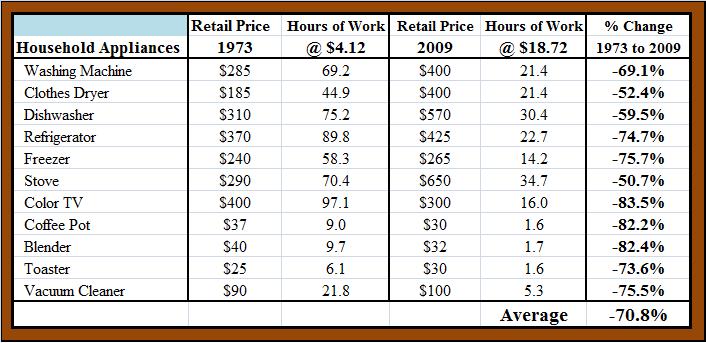
A potent reminder of what Keynesian economics has done to America and why we need to abolish the Fed and return to free markets:
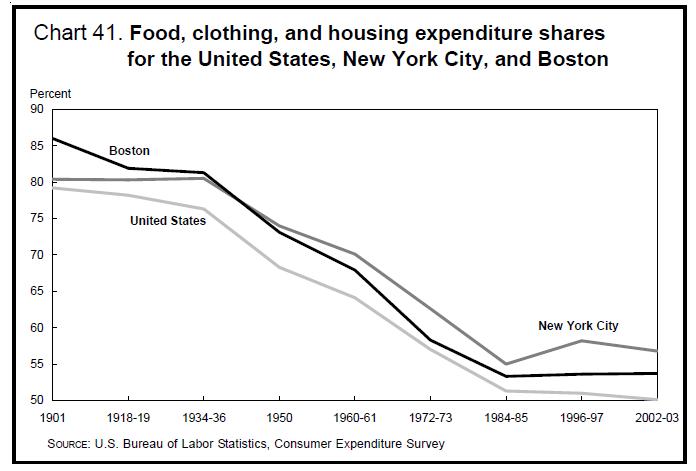
I’ll buy that food and clothing costs have gone down, but I’m a bit skeptical about housing:
Additionally, there seems to be serious inflation in medical care costs (I in no way blame the ‘free market’ for this)
!(http://www.americanthinker.com/Figure 1_Understanding the Cause of Health Care Inflation.jpg)
As well as in education costs:
Perhaps because increasing amounts of education are required to be employable in the automated economy? In some sense, every additional year of (usually debt funded) education a person has to endure to expect a reasonable income is a step backwards.
Benjamin,
Housing and Tuition are two bubbles driven upwards by cheap credit. Health Care is a heavily regulated industry, distorted by the subsidies that come from the government in the form of its welfare schemes.
The costs for housing probably included renting apartments. But yes, there was a bubble in housing due to actions expansionary monetary policies and low interest rates set by the Fed. That wouldn’t be a problem in a free market.
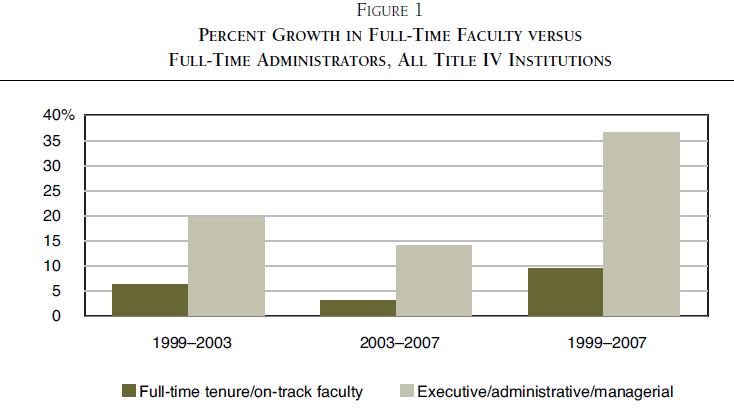
As for education costs, an econ professor at UM Flint has the answer:
Looks like administrative costs are heading up increasing higher education costs. Now why is this happening? Because public universities receive subsidies from the government, so they become complacent and spend profligate amounts of money on things they do not need. A return to free market education would make it much more affordable.