Where’s the rub? Why would you need to worry about reducing inequality after you’ve presumably eliminated its cause?
Ah, there’s the rub. How can we get people to hate the government for the inequality it creates and then at the same time get them to believe that the existing inequality doesn’t need to be reduced?
So everything must have only one dimension? The subject is multi-faceted. There can be simultaneous forces acting to create an apparent effect. My argument is
-
Statistics about wealth inequality do not mean that the poor are being trampled per se
-
On the other hand, government does help to increase the earnings of the big businesses
z1235: Where’s the rub? Why would you need to worry about reducing inequality after you’ve presumably eliminated its cause?
You mean if a thief steals money from me and gives it to his boss, I don’t need to worry about getting it back as long as the thief has been caught?
Wheylous:
So everything must have only one dimension? The subject is multi-faceted. There can be simultaneous forces acting to create an apparent effect. My argument is
Statistics about wealth inequality do not mean that the poor are being trampled per se
On the other hand, government does help to increase the earnings of the big businesses
What do you mean by “per se”? Is the inequality that the government creates trampling the poor or not? I mean, statistics about the number of homes that have been destroyed in Iraq over the past 10 years does not mean that the US has bombed them per se. We could talk about the hypothetical scenarios where such statistics might indicate voluntary economic development (for example, such a statistic might indicate how many old dilapidated houses were replaced by new ones), but the truth is that in this case they indicate an aggressive bombing campaign. Similarly, the wealth inequality statistics indicate massive government intervention in the economy on behalf of the corporate elite.
By all means, if you can prove someone has stolen something from you, then you should definitely worry about getting it back. Now, who exactly has stolen from you, and what exactly?
How exactly is this entity (inequality) trampling the poor?
How exactly does the wealth inequality between person A and person B, on its own, indicate that one necessarily must owe something to the other? Are you suggesting that wealth inequality would be nonexistent in a world devoid of aggression and government intervention?
Some Inequality in wealth is due to genetics (but I don’t think all of it is). Anyways, I saw what I believed to be a good refutation of an inequality graph by Mother Jones. It pretty much confirmed that equality has a negative correlation with interest rates. What Thomas Sowell has written is also good.
http://www.rightcondition.com/2011/10/wealth-inequality-in-america.html
There could be things wrong with it as I just took it at face value, but I think that in a free society inequalities in wealth could be reduced to about 75% of what they are now. For example, I couldn’t imagine an economically egalitarian Occupy Wall Street before Lincoln came to power. It illustrate my point, the Jeffersonians were the vast majority and they were the laissez-faire ones vs. the minority Hamiltonians who favored heavy government intervention in the economy which was proven to be for the elites and by the elites. The popularity of the Jefferson and Jackson, the Whiskey Rebellion, and Shay’s rebellion (which we know was mostly a tax revolt) also illustrate that point as well as the fact that Lincoln lost more than 3/5 of the popular vote.
Your article links to this study by the St. Louis Fed, which appears to discuss similar things as Sowell:
http://www.stlouisfed.org/publications/itv/articles/?id=1920
By all means, if you can prove someone has stolen something from you, then you should definitely worry about getting it back. Now, who exactly has stolen from you, and what exactly?
The government has stolen my money through taxation and has given it to bondholders.
How exactly is this entity (inequality) trampling the poor?
Huh? I was asking whether Wheylous thought it was or not. I take it your answer would be no.
How exactly does the wealth inequality between person A and person B, on its own, indicate that one necessarily must owe something to the other? Are you suggesting that wealth inequality would be nonexistent in a world devoid of aggression and government intervention?
Wheylous said that “government creates this inequality in the first place.” So it seems to me that Wheylous indeed is suggesting that wealth inequality would be nonexistent (or at least drastically reduced) in a world devoid of aggression and government intervention.
http://www.stlouisfed.org/publications/itv/articles/?id=1920
Income inequality will still exist even if the income inequality statistics are adjusted to account for the aforementioned factors. Given the negative attention income inequality receives in the media, it is important to ask whether reducing income inequality is a worthy goal of public policy. It is important to understand that income inequality is a byproduct of a well-functioning capitalist economy. Individuals’ earnings are directly related to their productivity. Wealthy people are not wealthy because they have more money; it is because they have greater productivity. Different incomes reflect different productivity levels.
Haha. What else could you expect from the FED though?
It has stolen everyone’s money. Get in line. Btw, where’s the government going to get the money to pay you (and everyone else) back?
Um, it’s the other way around. Bondholders are the ones lending (giving) money to the government.
I meant, how could inequality (a non entity) be trampling anybody?
I think he meant that the government contributes towards making the wealth inequality larger. This doesn’t mean that all wealth inequality is necessarily created through aggression and government intervention.
Yeah, you’re right. I shouldn’t have said that disparity would “disappear” if you divvied things up by state.
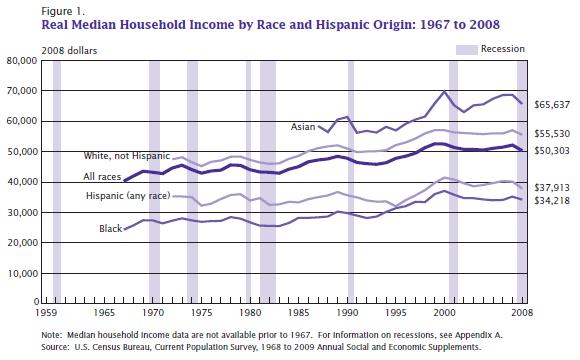
My basic point was that it isn’t fair to compare the “income distribution” of ethnically homogenous regions (like Scandinavia) to ethnically heterogenous ones (like the US), because the latter will always tend to have more “income inequality” simply by virtue of the diversity of the population, while the former will tend tohave a more uniform distribution of wealth because of the similar culture, values, experience, work ethic, etc. The following chart might illustrate this:
Two things Misesesesians hate. Graphs and equality. This thread has both.
First of all, graphs are a mode of empiricism, which we all know is cultural Marxism, and all statisticians are actually Marxists. Except when they make graphs we like. We will take them when we like them.
Second, “capitalist property is inherently inegalitarian” and therefore, egalitarianism is evil, and most likely Marxist as well.
Third, I’ll bet there’s inequality because of all that integrating in the US. Not because of slavery. Because of integration.
I am pretty sure that NAP is about the most egalitarian thing possible.
An appeal to ridicule as well as an unvalidated assertion.
Misesians reject the notion of econometric data invalidating economic laws which are derived via logical deduction from the synthetic a priori action axiom. Instead, Misesians believe that the information gleaned from econometrics can be rationally interpreted through the lens of economic analysis to a certain extent (conditions of cetris paribus never hold in reality).
What’s “cultural Marxism”?
Any Misesian would tell you that economics is a value-free, i.e. positive science. Therefore, when a Misesian makes a proclamation on whether a certain policy or social construct is “evil” they’re no longer acting as economists but rather as philosophers.
You know, these half-hearted attempts at satire would be improved immensely if they even attempted to lampoon what we actually believe in.
What?
“Misesians reject the notion of econometric data invalidating economic laws which are derived via logical deduction from the synthetic a priori action axiom. Instead, Misesians believe that the information gleaned from econometrics can be rationally interpreted through the lens of economic analysis to a certain extent (conditions of cetris paribus never hold in reality).”
I hope this is just sloppy wording on your part, because you are essentially saying, “we reject any evidence that doesn’t fit what we already believe,” which is basically (what I think is) just a vulgar caricature of a methodology I disagree with. I was pretty sure that there’s a little more to very hardline atomostic deduction than that.
“What’s “cultural Marxism”?”
I don’t actually know, but I’ve been called one (a cultural Marxist) quite a bit. I figured you would know. Does anyone here know?
I don’t actually know, but I’ve been called one (a cultural Marxist) quite a bit. I figured you would know. Does anyone here know?
This is what I go by:
This piece cover almost 0 econ and all sociolology / culture. As a non Marx expert - it seems like a good book to go by for cultural Marxism / Mar a sociologist
It sounds like you’re all having a wonderful debate, and I’mma let you finish, but this argument is the most confusing one of all time. Of all time!
Seriously, this has always confused me.
I am reading someone staunchly attacking capitalism. Then, in the middle of the paper is usually a small diatribe about income inequality, how big it is, how it’s getting bigger, and there is always a ominous overbearing tome.
Imagine you are someone who is a frequent attender of horror movies. However, nearly EVERY horror movie you’ve seen, usually incorporates a guy with a newspaper on top of his head. WHENEVER this guy appears, the rest of the audience goes into a sullen, fear-like trance. However, you, obviously, remain fairly confused on the whole matter. So, there’s a guy with a newspaper on his head? Why does he show up in every horror movie I’ve been watching? What is the deal with this? Is there something I’m not getting here? This is beginning to become a pattern…
THE SAME THING HAPPENS TO ME WHEN I SEE INCOME INEQUALITY STATISTICS. They are the “Guy with a newspaper on his head” that appears in every capitalist “horror show” diatribe I’ve read. What. Is. The. Deal? So some people make a lot of money?
?
I hope this is just sloppy wording on your part, because you are essentially saying, “we reject any evidence that doesn’t fit what we already believe,”
How did you get that from what I typed? Is it your contention that evidential statements can only be observations?
which is basically (what I think is) just a vulgar caricature of a methodology I disagree with. I was pretty sure that there’s a little more to very hardline atomostic deduction than that.
This has to be a deliberate misunderstanding of what everyone who has ever had a discourse with you has already elucidated; economic laws derived from deduction cannot be refuted from observation for the same reasons that a mathematical proof of the Pythagorean theorem cannot be refuted empirically. Moreover, because the action axiom is synthetic a prioi (do you know what this means?) it does not require repeated observations to establish its validity, nor is it subject to the constraitns of probability, i.e. it is always and everywhere true. If you still think I’m constructing a “vulgar caricature” of praxeology then I can send you primary sources on the subject.
“This has to be a deliberate misunderstanding of what everyone who has ever had a discourse with you has already elucidated; economic laws derived from deduction cannot be refuted from observation for the same reasons that a mathematical proof of the Pythagorean theorem cannot be refuted empirically.”
No, I understand that quite well. And mathematics are always correct in a closed system. Economics is dealing with something that is, by nature, not a closed system. It can very nicely prove itself over and over again, but that does not mean it applies to anything outside of itself. Just as any theory, it should be tested and observed to see just how far it goes.
Imagine water droplets. We don’t use drops of water to teach sums because its quite possible that one droplet plus one droplet might only make one droplet if they are spaced too close together. Yes, on the atomistic level all the math applies quite well, but it does not tell us about droplets without a number of qualifiers. Does this disprove mathematics as a functional system within itself? No. But it tells us where we shouldn’t be using mathematics, or at least how we should be using mathematics.
Then the question becomes whether or not humans are more analogous to atoms or water droplets. There are a number of ambiguities about using a simple eqaution for humans, such as 1 human plus 1 human = X humans. What does the plus mean? Standing side by side? Intercourse? In the case of the latter 1 + 1 could equal 3. And in the case of the former what exactly is the proximity for the “plus”? Once again, there are spots where it applies and spots where it doesn’t, and that’s just doing arithmetic. Bring in economic equations and theorems and there’s even more ambiguity.
To reject empirical data that doesn’t stand in line with what you believe doesn’t make you more hardcore. And really it weakens your theory to not search for clarity in ambiguous scenarios to see where it applies and where it doesn’t. A synthesis of ideas working in conjunction with each other for further clarity and more precise reasoning would probably make your theory stronger than flat out rejecting everything that doesn’t fit with your current understanding. But hell, that’s the kind of thing you get when “all rights are property rights” or “praxeology encompasses all human action.”
I know I’m replying to a troll (and a very skilled one, at that), but here I go anyway.
Yeah, they are. But praxeology doesn’t necessarily reject empiricism (the notion that knowledge comes only or primarily via sensory experience). It was Rothbard, after all, who considered the action axiom an empirical truth, i.e. a law of reality as opposed to a Kantian law of thought.
What praxeology rejects is positivism, the self-contradictory claim that if a statement is not about an empirically observed fact or a tautology, it is completely meaningless (which of course renders positivism itself meaningless).
Praxeology does derive a priori theorems. But as Mises wrote in HA, “All theorems of economics are necessarily valid in every instance in which all the assumptions presupposed are given […] [but] have no practical significance in situation where these conditions are not established.”
That’s to say, it is important to do empirical work to discover whether the conditions for praxeological laws hold in reality.
In practise, therefore, there’s no reason why an Austrian shouldn’t be comfortable with employing the tools of modern economics to a certain extent. (Since, after all, he is among the few who actually have a coherent philosophical justification for doing so.) He only treats their ability to hit upon truth with a little more skepticism than they have so far been accorded.
What we’ve been doing in this thread is examining the evidence that’s been given for the supposed increasing trend in income inequality. I went through an entire study and took a look at the claims being made, and in the end I concluded it didn’t provide any convincing evidence of that trend.
This is what people who are actually interested in the truth do, you know. We review evidence, compare it against other evidence, and see whether our original hypotheses hold up.
It just so happens that many of the demagogues shouting and screaming about income inequality, so they can acquire more free benefits from the state at everyone else’s expense, have not been doing this.
You know, libertarians actually have a theory about property, about what’s justly acquired property and what isn’t. We don’t simply defend every property title currently in existence.
We generally think property is only justly acquired through Lockean homesteading: you only “own” something if it is the product of your blood, sweat, and tears, or if you acquired it through voluntary exchange with its original owner.
We disapprove of the quasi-feudal power structures, where monopoly rents are coercively extracted by the state and its allies from peasants tilling their own land, that prevail in much of the world today.
(In fact, I recommend you read Chapter 11 of the Ethics of Liberty, where Rothbard basically advocates expropriating land from corporations in the developing world and redistributing it to the poor.)
By the way, all this is more or less the same position the younger Marx took:
I think the evidence does point to that to some extent, yeah. Especially since “slavery” was pretty much a universal phenomenon:
Tunk, check my latest post. We’re almost saying the same thing.
And I’ll get to the integration thing when I have some more time to cite the stuff I have in mind.