Can we please get this over with? Wealth inequality study

I saw this on Facebook today:

http://28.media.tumblr.com/tumblr_lvj6lk2L4T1qj90dro1_500.jpg

Right after that, I saw this website I’m tired of seeing:

http://www2.ucsc.edu/whorulesamerica/power/wealth.html

Can we get together a collection of resources and answers to use whenever this study is brought up?

Here’s what I can come up with off the top of my head:

I’d also like to be able, however, to say “to an extent, you’re right.” In a sense, government creates this inequality in the first place.

  • FED benefits the rich

  • Regulations prevent easy opening of smaller businesses

  • Minimum wage hurts employment

  • Government monopoly status to companies (can we get a nice list of this going?)

Hopefully you can add on some more so that we can have a card to pull out when we see this.

Great, thanks! Anything more?

Nope! Nope! Nothing to see here. Nobody is rich. We’re all hurting. And that bum you saw last week is running Goldman Sachs today. Keep moving along…

What exactly is your point?

Benjamin Tucker’s four monopolies of money, land, tarriffs and patents. I think Kevin Carson has theorized that state infrastructure has acted to externalise to costs of big businesses. ‘Public work spending’ is generally just a give away to politically connected unions - but you will first need to convince them that modern day unions are as bad as modern day corporations.

I know he’s economically illiterate, but Kevin Carson does do a good job at highlighting state benefits to the rich and powerful:

Yes - The Rent really Is Too Damn High!

Welfare State For The Rich - A good article up until the last three paragraphs.

I forgot you’re new here. Don’t mind the pony. She regularly doesn’t have one. It’s part of her charm. You can see threads here, here, and below to see this in action.

Wheylous, you might find this useful…

What exactly is poverty?

I recently wrote an answer on Quora.com, which you may find useful, to the question “What are the libertarian answers to why salaries of CEOs are rising while workers’ wages are declining?”

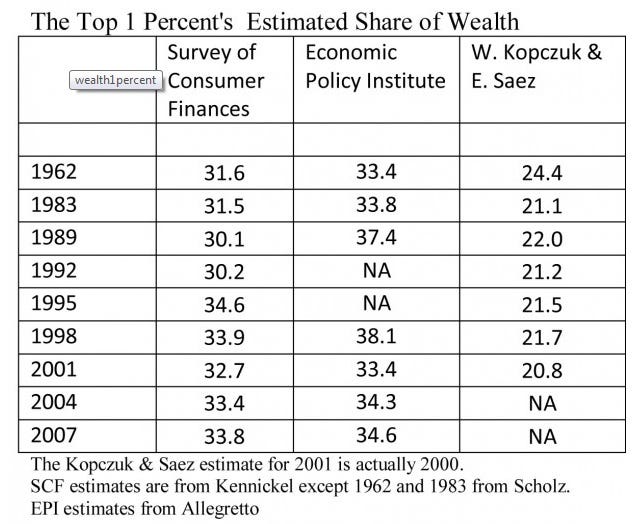
Now, the study you linked to (“Wealth, Income, and Power”) begins by measuring the concentration of wealth (as opposed to income, which is far more dubious, for reasons Sowell points out). And, unsurprisingly, wealth is rather concentrated; it’s pointless to try and deny this. Yet, as they go on to partly acknowledge, a number of studies show that, depending on what numbers you use, wealth concentration in the top 1% has either not been increasing or has been declining:

Interestingly, “wealth” includes only immediately marketable assets like stocks and not, say, houses or cars. Obviously, the rich would do better by this definition. I wonder if there are any studies that measure all assets. Studies of “income inequality” are usually skewed by the fact that the more than 2/3 of income going to the lower income groups consisting of transfer payments are left out of the data. Similarly, measures of wealth might also be compromised.

It’s also amusing how they begin by speaking ominously of the top 1 percent, but when they compare the US to other countries in terms of wealth, they conveniently choose to compare in terms of the top 10 percent. We are living in a bizzare world indeed if anyone making over $100,000 a year is labelled and denounced as a “millionaire”.

They then go on to make a series of unsubstantiated claims, like that apparently greater stock ownership correlates with more social “power”. They also babble in the usual boring, PC way about “equality”:

Presumably they mean countries like our most very favourite place in the whole world on the Mises forums, Sweden. What they fail to mention is, as Per Bylund points out in his essay “The Modern Welfare State: Leading the Way on the Road to Serfdom", that ethnic Swedes in Sweden are about as well-off as American blacks, and don’t make 2/3 of the income of American whites (if you can read Swedish, go to page 58 of this essay for the source). As well, Swedes generally have a high rate of income equality and low poverty wherever they happen to live. According to Nima Sanandaji, American Swedes not only tend not to be poor but also make 55% more income than Swedes living in Sweden. In other words, many of their perks, like their long life expectancy, predate, outpace, and will outlive their welfare state and have more to do with their homogenous population and tradition of social co-operation.

The homogeneity point is particularly important. The United States is an extremely diverse region. For example, consider “the nearly three year disparity in life expectancy between Utah (78.7 years) and Nevada (75.9 years), despite the fact that the two states have essentially the same health care systems.” Asians have the highest life expectancy of 84.9 years, while urban blacks have the lowest at 71.1 years. And yet, all these disparate measures are averaged out in the general US “life expectancy” figure and cast against places like ethnically-homogenous Scandinavia, as if that were a fair comparison!

Many people obsess over the Gini coefficient as well. Yet again, battle is not being done on a level playing field. The US is one country with 50 states with a population of about 300 million. Europe is 29 separate countries with 500 million people. Is it any wonder that the Gini coefficients of the two regions will vary? There’s reason to suspect much of the disparity would disappear if each American state was considered as a country unto itself.

The study goes on to make the same points about income that have already been rebutted. They then say this:

Here’s a chart from the IRS that basically consolidates this:

And here’s a very good response from Americanthinker.com:

So the supposed evidence that the US tax system is barbaric and quasi-regressive is lacking, to say the least. They then go on to measure the impact of transfer payments on the Gini coefficient, which tells you nothing for reasons I already gave.

The last bit compares CEO pay to production worker’s pay. Again, this is extraordinarily disingeuous. Pay qua wages has only been declining because of stupid federal laws that demand you take your pay in the form of benefits. Wages + benefits, i.e. real compensation, has continued to rise uninhibted. As Alan Reynolds writes,

Your study also tries to blame all this on compensation consultants. Reynolds rips that explanation apart:

The last point in your study is an even more incoherent one, attributing the (nonexistent) fall in worker’s pay to low levels of union membership. This is doubly stupid, considering the fact that union membership in the US has historically been low and correlated with a high rate of growth in real income. According to Tom Woods, for instance,

Birthday Pony, we aren’t trying to say that there aren’t cases of severe injustices in the US economy today. Doubtless, many of us would agree that many of the rich now have profited at the expense of the taxpayer by socializing their losses, and definitely belong behind bars.

What we’re concerned with is whether there is an increasing historical trend in inequality, not whether there are plenty of anecdotal cases of it. For that you have to look at objective statistical data, not sensationalist reports on the nightly news.

Hey, I’m trying to post a rebuttal I just wrote to the study Wheylous linked to, but it says my post is pending moderation. What’s the deal? None of my other posts needed to be approved by a moderator.

I knew you’d reply, my faithful Pony. Would you argue that Japan, Italy, and Mexico are better than the US?

My point is that looking at these statistics and getting outraged is not as justified once you break down these statistics and see that they’re very superficial, and that others being richer doesn’t necessarily make you poorer (unless, I suppose, BIll Gates decides to buy all the cabbages at your local stores and thus starves you).

Now that I think about it, ha! That sounds like another argument against capitalism. At any time BIll Gates could easily buy up nearly an entire town and have everyone starve! Does he? No.

“trying”? As in plural? Chill out dude. It means what it says. Your post went through, sometimes they just need approval…and we can see it there now, so obviously it’s been approved. All is right in the world. You can calm down. You honestly don’t see a difference between that behemouth and all your other normal posts? Obviously it’s filled with enough links and graphs to trigger an automatic spam detector. All it does is shove it over to the mod section so a human can look at it and make sure it’s not spam.

You don’t need to keep submitting it. (why do people keep pushing the button after it’s already illuminated to show it received the command?)

Alright fine. I’m perfectly calm, I was just asking.

For whatever reason, some of us are not personally very familiar with the inner mechanics of internet forums. Perhaps there are other fields of study more rewarding.

I don’t want to make this a big thing. I honestly do appreciate your contributions and you bring a lot to the forum with informative and well-cited posts like that. My issue is with someone who obviously has a brain (and one that functions evidently much better than most) not being satisfied with the clear notification that was given, which you obviously read, as your concerned post basically regurgitates what the system tells you.

I have had many posts that got flagged for moderation…(in fact it happens probably at least once a week, as one might be able to guess, given my posts sometimes get as link-filled as your own). So I’m quite familiar with what the system tells you when that happens. The system clearly says “POST PENDING MODERATION” and then follows with a little explanation that the post will appear once it’s approved by a moderator. It takes up the whole screen. There’s no way you can miss it. And as I said, you obviously saw it and read it and understood it.

No one who can read has to be familiar with the inner mechanics of internet forums to understand where their post went and why it isn’t appearing in the forum. It was flagged for moderation and will appear once a moderator approves it. That’s what it says. It doesn’t say there was an error. It doesn’t say your post didn’t go through. It says your post is pending moderation and will appear momentarily. I do not understand what would possess someone to intepret that as “I need to submit the same post more times…try again and maybe it’ll work this time.”

Perhaps my response was a bit more curt than necessary but I hope this explains the source. Apologies if you were offended or hurt by it.

As far as I know, I have a brain and I can read, and I did understand where it went. What I didn’t understand was why it went there because it didn’t say. That threw me off and so I kind of panicked. I have written other long posts with charts that weren’t flagged. If the message read, “Your post contained an abnormal number of links and images and was hence flagged for moderation,” I would have grasped it faster than I did since I’m still rather new here. Thanks for the clarification.

Keep postin

I’m going to post some of the things performed by governments which prevent real wages from rising which are often performed by governments which I don’t believe have yet been posted.

  1. Government spending that is utilied in either unwise ways or for useless things.

The biggest example of this is the military which has trillions of dollars going to it a year, this means that economic developement which could have otherwise been spent going to productive causes is instead spent on tanks and planes to literally blow wealth up if it is ever used. Government of course also spends a large deal on transfer payment and bureaucracy. The fact is that whenever the government spends anything it is likely to be used less efficiently

http://www.youtube.com/watch?feature=player_profilepage&v=mmAgSOgJ7NY

http://www.youtube.com/watch?feature=player_profilepage&v=IHDqxVsIP7c

This negative effect of spending extends itself to healthcare costs and poor services. This is true in almost all countries, whether public or private, that government intervention in the healthcare industry, either through direct control or through regulation/manipulation, either increases costs or decreases quality.

  1. Inequal taxation/tax code

You could argue that this benefits the poorer classes, however the problem is that the tax code has major holes in it, so it’s easy for the up and coming rich to be hurt whilst old money already has the entire tax system wrapped around their fingers

  1. Bad education

This warrants its own category because of the fact that it is so incredibly important. Now the government has played a massive role in education. It has effectively destroyed lower education and significantly harmed higher education. In lower education it has

a. Forced children into schools when they could otherwise be learning a trade/self educating themselves/learning general job skills or even enjoying themselves as opposed to learning either nothing at all or things that they will never actually need! When I think of oppurtunity cost there’s literally very few better examples than the public education system

b. Killed free thought. Because kids today are almost entirely focused on their studies which happen in a very set method throughout their lives, teacher tells class truth, class learns what other people want with no input, there’s relatively little reason why it is that people would maintain independent thought and self reliance when the most important faculty of man, the mind, is being exercised in such a way for the first 12 years of one’s life.

c. Harmed entrepreneurship. Entrepreneurship is all about being independent and using one’s own judgement based upon reason in the economy. How can this happen when people are taught to think in static patterns and rely upon the will of others to tell them what it is to do? Especially when they have no business savvy because, well, they’re in school for much of their lives!

d. Prevented people from actually learning how to learn and to be adaptive. The cirriculum is taught in a specific way, you have to do specific work, there is often little open help, and the kids are already in an apathetic mindset, so of course they don’t learn how to learn, they learn how other people want them to learn. This means that they aren’t exactly prepared for later life or real learning/critical thinking

e. Waste potential and labor training. Most education today is utterly un-vocational, especially in the United States. This means that kids learn, insofar as they do learn, a bunch of useless facts when at very least they could be being taught things surrounding an actual vocation or they could be able to really choose what it is that they want to learn and pursue their interests as much as possible! I can tell you that highschool is little short of a waste for most people. This also means that the division of labor is literally bastardized because people are being given a relatively narrow education when they could be splitting off into different branches.

f. They kill the student’s will to learn. I can forgive for all of the above, it’s only slightly more messed up than most of what goes on surrounding government, but this is something that I can never forgive. By the time that most people are out of school they have no real will to learn anymore except that which they need to for college, they certainly don’t think of learning as ‘fun’ or most likely even ‘enjoyable’, that which they do consider fun to learn are probably things like fast facts. I adore education, I love the act of learning, I truly do. I hated gradeschool but I love learning, and I’m great at doing so idependently, but if I had not had certain revelations and a family that was very pro-education then I would probably not and that infuriates me.

g. They prevent innovation or actual within schools. School sucks, it has no reason to be innovative or work well or for the students. The quality of American education is terrible, and worldwide I can assure you that education is sub-par compared to what it could be. There’s no market mechanism, it’s crap and the entire setup is stupid.

h. They act as indoctrination camps. This allows the democratic machine to be even worse than it naturally is, and ensures that nothing is done about most of this stuff.

http://schoolsucks.podomatic.com/

http://www.youtube.com/watch?v=Bx4pN-aiofw

i. To sum up college education, for the most part it’s somewhat uneffective and expensive specifically because the government offers so much aid. This has also lead to the party school culture over time and generally detracts from what college should be for for 70% of people, getting a degree for a job, not this liberal arts ‘well rounded student’ bull****. Overall, however, American colleges are far better than lesser schools specifically because competition has been allowed

  1. Business Cycles. Pretty self explanatory TBH, it also leads to the problem of properly evaluating the value of labor. Also everything that the government does to worsen/prolong recessions

  2. Minimum wages and wage increases caused by the law either through payrole taxes, benefits, minimum wages, ECT.

  3. Welfare/unemployment insurance. Brings economy under capacity and increase the search time for jobs

  4. False solutions. This means that people work entirely through the government, wasting money attempting to influence it. This also means that anything that the government does will be done less efficiently than it could otherwise have been does through the voluntary interactions of people. Have a problem with healthcare? Form voluntary collectives to provide it. So not only does the government perform the services it controls badly, it prevents better solutions from coming around at all

  5. International tariffs, quotas, subsudies and the like. Fortunately this is fairly uncommon in our day but it still exists.

Now some problems with actually measuring quality of living

How do you truly measure real wages? It’s a very difficult thig to do properly, a problem which is exacerbated by the recent changes in technology which have occured. The effect of the internet on people’s lives can literally not be measured. This also means that the economy has been and is still undergoing serious changes in terms of the labor force.

Also in our day the fact is that the demand for skilled labor has been increasing as opposed to unskilled labor, especially when other markets have opened up for unskilled labor in other areas of the world.


Tonk, here’s the data for Gini by state:

http://www-958.ibm.com/software/data/cognos/manyeyes/visualizations/new/scatterplot/gini-coefficient-of-us-states-2006/1

Here’s the internationl Gini data:

http://en.wikipedia.org/wiki/List_of_countries_by_income_equality

It seems like the overall gini is lower than when broken down by states (going against what you say), though I am not sure what years the data is from and who made the estimate. Note that on wikipedia the gini coefficients are quite different depending on the organization who makes them.

Haha, someone on the page for one of the Sowell videos mentioned class mobility and how it affects statistics and said that talking about a top X percent is

like the statistical misunderstanding which goes “I hear that a man gets hit by a car every 8 minutes in NYC” to which another man replies ‘wow he must get awfully tired of that’

I’d also like to be able, however, to say “to an extent, you’re right.” In a sense, government creates this inequality in the first place.

Ah, there’s the rub. How can we get people to hate the government for the inequality it creates and then at the same time get them to believe that the existing inequality doesn’t need to be reduced?