I’ve realized that I don’t really know what causes unemployment in general (although I can see how unions and the minimum wage contribute to it). What are the main factors that cause unemployment and why?
Either a lack of jobs or a lack of desire to take a job at the prevailing wages for those a person’s qualified for.
Non-natural unemployment is caused when the real wage does not adjust to the market rate for labor. I suggest the book Out of Work, by Vedder and Gallaway. It is possibly the best book on the subject that I have read so far. It’s, at least, the most complete. To give an illustrative look at the core of the problem, take this graph into consideration:
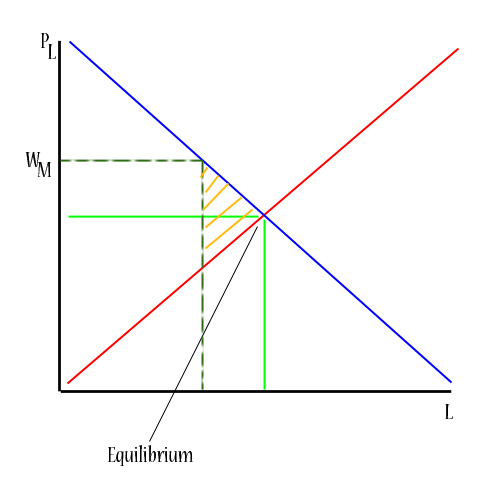
The green line represents the price of labor (it actually represents minimum wage in this case, but the concept is the same). The orange area denotes “dead weight”, or the amount of unemployed due to the high real and nominal wages being paid.
There are three different kinds of unemployment, 2 of which are caused by wage rigidity (structural and cyclical), and one of which is caused by the time needed to find a job (frictional). The latter increases with welfare programs, unemployment insurance, ect, ect. The lower the opportunity cost is for finding a job, the less people will search for jobs, thus increasing frictional unemployment. Again, and this important, structural and cyclical unemployment are caused by wage rigidity and nothing else.
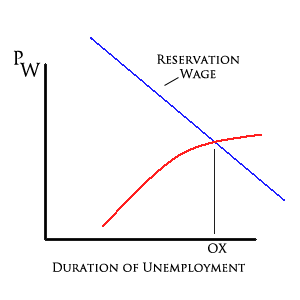
That is arguable in the case of the former. Structural unemployment is defined as “unemployment due to structural changes in the economy that eliminate some jobs and create other jobs for which the unemployed are unqualified.” Basically, the laborer is forced to take on a new skill. This is not caused by wage rigidity (although, it can be aggrevated by wage rigidity, just like frictional unemployment can). Structural unemployment goes through the same principles as frictional, only that the reasons why the laborer are unemployed are different (as opposed to not willing to work, it’s not that the laborer’s skill is no longer relevant). The laborer can choose a lower wage job, with no skill requirement (or a lower skill requirement), or can go unemployed until he or she learns a new skill to get a higher paying job. The time preference is the same for frictional unemployment:
Yes, creative destruction will lead to groups of people who can no longer be profitably employed in one sector of the economy (structural unemployment). They must either take wage cuts, or find different jobs. The latter is really just one kind of frictional unemployment, while the former is caused by wage rigidity; eg, the U.S auto industry.
Laziness. Low productivity. Welfare incentives. Price controls.
This is not true, at all. Let’s say that a worker’s skill is extracting petroleum. Petroleum supply runs low, costs increase, and it’s not cheaper for the consumer to buy natural gas. The worker doesn’t know how to extract natural gas, so it’s difficult for him to compete for a job and get the training. He is structurally unemployed. Or, another example, closer to me: a farmer owns a large amount of vineyards. The profit in wine producing grapes dwindles because there is a shift in consumer demand to beer, and so the farmer’s skills are no longer valuable. He has to switch to another crop or has to change jobs and accept a lower wage, but he is still structurally unemployed until either of the two happen.
Structurally unemployed can be caused naturally. Besides, I’m not sure how “finding a different job” is caused by wage rigidity. That doesn’t make any sense. The problem is that a laborer is structurally unemployed. That was not caused by wage rigidity. He has one option: find another job. Structural unemployment requires that the job no longer exists.
Wage levels above the clearing price, resulting in an unsold surplus of labor.
In times like these the biggest cause of unemployment is, in addition to wage rigidity, the lack of capital. It has been discovered that much of the capital that was used to employ workers was causing losses instead of profit, and so both the capital and the workers have been laid off. But of course there are no new offices or companies to employ the workers. The capital stock must be rebuilt with lower-order capital goods in order to do so.
A project may be shovel-ready, if there are not enough shovels for all workers, some will be unemployed.
Structural unemployment is just another name for voluntary unemployment; ie A person who has marketable skills but is waiting for something better. By that standard, every college student is structurally unemployed, just on a longer time frame.
Finding another job is just another way of saying frictionally unemployed; the farmer’s business has failed, and now he needs time to find another job. Now, let’s take a look at another scenario which is considered to be an example of structural unemployment: The American automobile industry sees a massive shift to the left in the demand for its cars, revenues have fallen, and so must costs. The United Auto Union refuses to take wage cuts, and doesn’t have to, due to government protection; the automobile company must then fire massive amounts of non protected workers, or “outsiders.” Eliminating wage rigidity would mean eliminating both structural and cyclical unemployment.
Structural unemployment is not someone with marketable skills. I’ve already put the definition up. It’s somebody who has been laid off because his or her skills are no longer relevant to the work available. That is, someone who had a job that required a certain skill, that job no longer exists for whatever reason and now that laborer has no marketable skills.
No. Frictional and structural unemployment come about in two different methods. These are defined in basic macroeconomic textbooks.
Frictional Unemployment: "The unemployment owing to the natural "frictions"of the economy, which is caused by changing market conditions and is represented by qualified undividuals with transferable skills who change jobs, is called frictional unemployment.
Structural Unemployment: “Unemployment due to structural changes in the economy that eliminate some jobs and create otehr jobs for which the unemployed are unqualified.”
In either case the reasons why they are unemployed are different, and after they are unemployed one has marketable skills and the other does not.
Yes, what’s your point? That was never in question. The problem is that the difference between frictional and structural unemployment are obviously not understood. Let’s say that the farmer’s vine crop goes bad. He can technically get a job, with his marketable skill (vitaculture), with a larger vineyard that needs labor and perhaps a second manager because the plot is so large. That is frictional unemployment. Structural unemployment is when the wine industry goes down because of a change in consumer preference, and so vitaculture is no longer a marketable skill.
That is not structural unemployment. Structural unemployment is when the person’s skill is no longer marketable. If there is still an automobile industry that person’s skill is still marketable, and so he does not fit within structural unemployment.
His primary skill is obsolete but he is not unemployable. He is only unemployable at his former wage. He could be hired at Walmart tomorrow if he was willing to take a wage cut.
I mean I’ve already addressed the problems with your analysis. People are always marketable, just at different wage levels. Structural unemployment, aka, sectoral shifts, are caused by shocks to an industry, causing some to be unemployed (could be drops in AD, technological progress, ect, ect), but they can always find different jobs. People are unemployed for 2 reasons, 1) they’re looking for a new job, or 2) they don’t want to take wage cuts (or aren’t allowed to take wage cuts).
Of course, but that doesn’t mean that until then he is not structurally unemployed. What matters is the definition of structural unemployment, which I have already given.
This is where you get it wrong. It’s not my analysis. It’s the definition of structural unemployment that you learn in macroeconomics 101.
No, we’re not talking about the person not being marketable, we’re talking about that person’s specific skill not being marketable. That is what defines structural unemployment. A person can accept a lower wage job, but as explained by Vedder and Gallaway there is a certain amount of time that person is willing to wait before accepting a reservation wage. Until that reservation wage is accepted, or that person learns a new skill to get a job with equal pay to his last one, that person is structurally unemployed. It defines why that person is unemployed.
The unemployment can last two hours, it can last two days or it can last two years. The amount of time is irrelevant to the definition.
No, this has nothing to do with it. I have already given you the definition from a textbook. Structural unemployment, by definition, is when someone is unemployed because his skills are no longer relevant. It can be within the same industry. For example, maybe there’s a secretary with typewriter skills but not computer skills. There is a switch to computers, so that person is now structurally unemployed because the typewriter skill is no longer marketable. That person is structurally unemployed. That person can accept a lower wage job, but until the person does he or she is still structurally unemployed.
First of all, there are different definitions of structural unemployment, it’s not the same across the board. Second of all, my point is that these definitions are spurious, and don’t really tackle the crux of the problem/question. I understand you read A definition in A textbook, my problem is with that analysis, and ultimately with yours.
Why isn’t he frictionally unemployed? He’s just looking for another job. A professor at a Junior college goes and gets his ph.D, he now wants a job at a bigger college with a higher salary and becomes frictionally unemployed.
I’m not sure your second argument applies. Structural unemployment is a definition. It’s not set up to tackle any problem or question. It is a category of certain unemployed individuals. Things cause structural unemployment, structural unemployment is not the cause of anything. Your analysis is flawed because you cannot see this relationship.
Apart from the Keynesian “solution”, the Wikipedia article offers a decent explanation of how people are categorized into structural unemployment: http://en.wikipedia.org/wiki/Structural_unemployment
You have not presented any evidence that there are other definitions. You simply say that mine does not “tackle the crux of the problem” (which doesn’t mean anything, since it’s not meant to … it’s a category).
Because frictional unemployment is not caused by a loss in marketable skills. Frictional unemployment is if Laborer A loses his job as a computer technician and then goes to Employer B as a laborer technician. His skills were transferred. Structural unemployment is when Laborer A loses his job as a computer technician and can’t find another job as a computer technician. He cannot transfer his skills, so he must chose a job with a different required set of skills (or lack thereof).