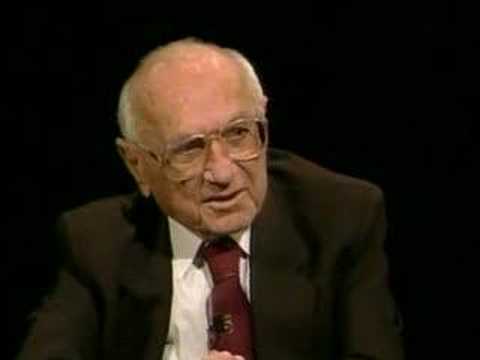
What is the Chicago School’s view of the Federal Reserve? I was skimming through krapmans ‘‘How Economists Got It So Wrong’’ and he said Milton Freidman stated that if the Federal Reserve did its job properly, the Great Depression would not have happend. I was under the impression that Friedman favored the abolishment of the Federal Reserve altogether.
‘‘Monetarists asserted, however, that a very limited, circumscribed form of government intervention — namely, instructing central banks to keep the nation’s money supply, the sum of cash in circulation and bank deposits, growing on a steady path — is all that’s required to prevent depressions. Famously, Friedman and his collaborator, Anna Schwartz, argued that if the Federal Reserve had done its job properly, the Great Depression would not have happened.’’–Krugman
I found this online, but I dont know where the passage is qouted from:
‘‘The power to determine the quantity of money… is too important, too pervasive, to be exercised by a few people, however public-spirited, if there is any feasible alternative. There is no need for such arbitrary power… Any system which gives so much power and so much discretion to a few men, [so] that mistakes - excusable or not - can have such far reaching effects, is a bad system. It is a bad system to believers in freedom just because it gives a few men such power without any effective check by the body politic - this is the key political argument against an independent central bank.’’–Milton Freidman
Is it because he changed his opinion later in his life?
Also, Did economists, as a whole, from the Chicago School predict the current recession?
I am familiar only with views of Milton Friedman and I am not sure how much scholars such as George Stigler, Allan Meltzer or Richard Timberlake agree on these issues with him.
The Chicago school is sceptical about the ability of politically influenced FED to perform its function to increase the quantity of money in order to stabilize the price level. The school has many good ideas such as 100 % reserve requirement and it has done very good research in making studies about correlations between increases in the money supply and the inflation rate.
Friedman advocated some kind of automatic mechanism to increase the money supply by a constant rate of around 4 percent annually to stabilize the price level. In later years, after he had seen the mess that Fed occasionally caused, he became a little warmer towards gold standard (he also became extremely sceptical about antitrust legislation, which he in theory advocated after seeing destructive effects of how firms used it to destroy their competitors). But still he had very high opinion about Alan Greenspan and said that Greenspan proved inflation could be tamed although money supply increased at very high rate.
Apart from the Austrian School, in my opinion the other free market schools are even worse in predicting bubbles and recessions than their leftist opponents, such as post-Keynesians. Just remember what the proto-Friedmanite Irving Fisher said in 1929 about stock prices having “reached what looks like a permanently high plateau”. Friedman’s coauthor Anna Schwartz also denied that there was a stock market bubble in 1929 and wrote that “[h]ad the employment and economic growth continued, prices in stock market could have been maintained”. To be honest, Schwartz has now opinion that low interest rates did contribute to the present housing bubble.
And here is what Milton Friedman himself said about the economic situation in 2005.
Yes, Friedman changed his mind later in life. But, I don’t think he did so necessarily in agreement with Austrian theory, but because he didn’t feel a government-sponsored agency like the Federal Reserve could do the job of central banking effectively. In A Monetary History of the United States he does argue that the Federal Reserve should have responded to the crash by expanding the money supply. Rothbard disagreed, showing how the Fed did expand the money supply, but some Austrians have come to agree to some extent with Friedman. Many free bankers believe that the banks should have been allowed to issue private notes in order to meet demand for money. But, their position confuses me. They distinguish between the demand for bank-issued notes and the demand for base-money, or gold. The increase in demand for money during the Great Depression was a demand for base money, not notes, because of a scare in the devaluation of the dollar conversion rate to gold by part of the Roosevelt administration. I believe that free bankers do see harm in an artificial increase in base money, because then it would be nothing more than fiduciary media - i.e. issuing bank-notes in lieu of gold.
Both Friedman and Rothbard agree that money supply did increase in the 1920’s, prior to the stock market collapse. But many Chicagoans thinks that Fed tried even then to restrain the money supply inflation. Richard Timberlake, for example, writes that “during the 1920s… the whole tenor of Fed policymakers was to hold down on any expansion of credit until the real economy began to respond.”
Both schools agree also that money supply collapsed by about 30 percent in 1929-1933.
But the difference is that Rothbard thinks that FED tried everything it could to increase the supply and every variable that was under its control did increase from 1929 to 1933, but due to collapse of the banking system and destruction of demand deposits, money supply still collapsed.
Friedman’s view is that the deflation in the money supply was almost intentional idea by the Fed whose directors “[i]nstead of using its powers to offset the depression… presided over a decline in the quantity of money by one-third from 1929 to 1933.”
Ben Bernanke sums up the monetarist view pretty well in writing that “during the period in which the United States was on the gold standard, gold flows into and out… were completely sterilized and thus allowed to have no effect on the U.S. monetary base… Monetary contraction between 1930:IV and 1932:Iv was due to sharp decline in the money multiplier, resulting from the series of banking crises.” (Essays on the Great Depression, p. 153)