Ok, so my idiot, statist AP US History Teacher has told my class that a paper currency helps the poor/middle class, while a gold based currency only helps the aristocracy (We have been discussing the Andrew Jackson, who took on the 2nd Bank of the United States). I’ve argued that paper currency is usually issued to wealthy banks/Wall Street before any common people see the money, and they can spend the money freely before inflation occurs, and essentially this hurts the middle class and poor. Does anyone have any more information on this, or any type of article/essay that I could show my history teacher to back up my argument?
Man, this isn’t even the informed anti commodity money argument/position.
Yes, and it’s quite simple, really:
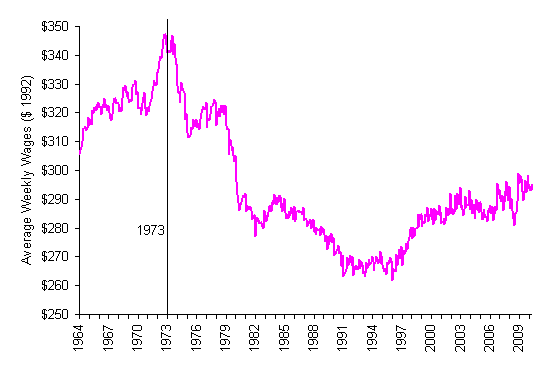
It’s harder to inflate the total supply of money when you (in this case, the government) do not entirely control its supply (as is the case with a commodity standard), and an international commodity standard, such as the previous quasi international gold standard (Bretton woods, which ended in 1973), prevents or limits perpetual inflationism (due to international gold flows).
We see that real wages have been declining, in real terms, since 1973 (coincidence?). Though there was inflation prior to 1973 (which caused the breakdown of bretton woods) which prevented wages from rising to the level that they undoubtedly would have risen to. Additionally, I must also stress the fact that though real wages are declining, we have not actually become poorer (relative to other periods). This is because we can now buy superior goods, goods that did not even exist in the past, and a higher quantity of some goods at lower prices (thanks to technological innovation).
You could splurge $20 and exchange it for the equivalent in Zimbabwen Dollars (7,526.00) and throw the money up in the air whilst telling him to go buy his lady something nice.
Not the most curtious method, but it would be certainly be a great deal of fun and have a dramatic persuassion on the class.