Conversation on Implicit Contracts Between Zavoi and Me. I hope others can give their opinion on the matter. Sorry if the post is messy
**Jeremiah Dyke**wrote
to Jeremiah Dyke, Zavoi
on Tue, Jun 15 2010 4:13 AM
On Implicit contracts
We will have to start from the basis of free markets and private property-I’m not sure I have the ability to clearly defend why we should start from this frame of references versus some other political philosophy.
I’m not sure if implicit vs. explicit contracts is really the issue here, so don’t let it distract you from the main discussion. But if you want to discuss this, let me ask: what if the pilot and passenger stated in explicit terms beforehand
Pilot: I will not force you out mid-flight, nor will I parachute out mid-flight. I will land the plane safely to the best of my ability.
Passenger: I will not attempt to open the plane while we are in flight.
Are such agreements enforceable?
No. enforceable is simply a function of power and submission. The pilot could still overpower the passenger. The key difference between the implicit and explicit contract would be that it is explicitly stated that they will not do such…and when they do, they are subject paying restitution to the heirs of the passenger (maybe a lump sum life insurance).
I would foresee that the majority of explicit contracting would be done between the insurance companies. Therefore, pilot signs with insurance company A that contracts that they will insure his company under the conditions that passengers are safe, he is not mental, etc. A clause would state that if he is found in error and they are sued (which is the case here), then he must repay them. If he refuses, they have the right to force him into labor since he signed the contract and waved that right.
Of course, we could always argue what is so great about a contract
“But here’s the problem with such a position: spoken (and written) language is merely one of many forms of communicative behavior. There is no legally (/ethically/morally/whathaveyou) relevant difference between verbal (“explicit”) and non-verbal (“implicit”) communication; they differ only in their degree of precision.”
This is a great point and one that I’ve been working on in an essay titled “What is a Threat” that I hope to submit to libertarian papers.
“However, I ask you to put yourself in the position of a judge or jury and imagine that a dispute has been brought to you by two people who have no prior relationship and are not members of any such agencies. On what basis do you make a decision?”
“The question then becomes “When should we impose the penalty of blacklisting/shunning/loophole-finding etc.?” You’ve already stipulated that they will have no explicit basis on which to make this decision (since the explicit cases would be handled by the legal system proper).”
Such market remedies would be like the consumer reports for people. Businesses would shun them so as to protect themselves. Consumers/producers may blacklist them like they may blacklist a cereal company that used some racial slur. Only because what they did, murdering for a turnip, charging 1 million for a cup of coffee, etc was beyond social norm. Some would wish to punish them and these are means of punishment.
This is a tough scenario that needs to be addressed…let me muse over it for a day or so.
**Zavoi**wrote
to Jeremiah Dyke, Zavoi
on Wed, Jun 23 2010 5:32 PM
We will have to start from the basis of free markets and private property-I’m not sure I have the ability to clearly defend why we should start from this frame of references versus some other political philosophy.
All right for the moment, but through all these discussions don’t lose sight of the fact that without a logical basis for being a libertarian in the first place, there really is no answer to any of these legal questions, except that which will in fact persuade humans (a.k.a., appeal to emotion or intuition).
No. enforceable is simply a function of power and submission. The pilot could still overpower the passenger. The key difference between the implicit and explicit contract would be that it is explicitly stated that they will not do such…and when they do, they are subject paying restitution to the heirs of the passenger (maybe a lump sum life insurance).
I’m talking about normative enforceability here – the same sense in which you would say that a peasant farmer’s property rights are “enforceable” as against FascistMegaCorp Conglomerated Smog Inc., despite lacking the physical ability to enforce the property rights. Aside from the issue of who is better armed on the plane, should the parachuting-out pilot be regarded as a murderer? (Assuming the explicit agreement beforehand.)
Also, what do the heirs have to do with this? What good does restitution do a dead person? Isn’t my right to life mine, not my relatives’? I want to make sure that anyone who murders me is executed, regardless of whether my family likes me or not – do I have a right to be so assured?
I would foresee that the majority of explicit contracting would be done between the insurance companies. Therefore, pilot signs with insurance company A that contracts that they will insure his company under the conditions that passengers are safe, he is not mental, etc. A clause would state that if he is found in error and they are sued (which is the case here), then he must repay them. If he refuses, they have the right to force him into labor since he signed the contract and waved that right.
That’s all well and good, but again, not everyone is going to have time to make these arrangements. For them, do we do our best to figure out what implicit understandings they’re operating under? Or do we give up and say “If it’s not written, it didn’t happen”?
This is a great point and one that I’ve been working on in an essay titled “What is a Threat” that I hope to submit to libertarian papers.
Threats are a good example of the importance of implicit communication. If I hold a loaded gun to your head, then, despite my assurances that I won’t shoot, you justifiably feel threatened and violated. This is a case where what I communicate implicitly by my actions (pointing a gun at you) is so strong that it overrides my explicit message (that I won’t shoot).
Such market remedies would be like the consumer reports for people. Businesses would shun them so as to protect themselves. Consumers/producers may blacklist them like they may blacklist a cereal company that used some racial slur. Only because what they did, murdering for a turnip, charging 1 million for a cup of coffee, etc was beyond social norm. Some would wish to punish them and these are means of punishment.
This is a tough scenario that needs to be addressed…let me muse over it for a day or so.
(I wasn’t sure if you were going to follow up on this – that’s why I waited so long to respond.)
Basically what I’m saying is that extra-legal enforcement mechanisms (blacklisting, shunning, etc.) are unconstrained by the need to make a logically sound legal argument, and, hence, are a very blunt instrument for enforcing social norms. Everyone would be constantly walking on eggshells in constant uncertainty regarding what behavior might incur blacklisting. Taken to its extreme, this would tear society apart.
Zavoiwrote
to Jeremiah Dyke, Zavoi
on Wed, Jun 23 2010 5:34 PM
Sorry about the quote formatting. The 3rd and 4th paragraphs should be:
No. enforceable is simply a function of power and submission. The pilot could still overpower the passenger. The key difference between the implicit and explicit contract would be that it is explicitly stated that they will not do such…and when they do, they are subject paying restitution to the heirs of the passenger (maybe a lump sum life insurance).
I’m talking about normative enforceability here – the same sense in which you would say that a peasant farmer’s property rights are “enforceable” as against FascistMegaCorp Conglomerated Smog Inc., despite lacking the physical ability to enforce the property rights. Aside from the issue of who is better armed on the plane, should the parachuting-out pilot be regarded as a murderer? (Assuming the explicit agreement beforehand.)
Jeremiah Dykewrote
to Jeremiah Dyke, Zavoi
on Mon, Jun 28 2010 11:06 PM
Also, what do the heirs have to do with this? What good does restitution do a dead person? Isn’t my right to life mine, not my relatives’? I want to make sure that anyone who murders me is executed, regardless of whether my family likes me or not – do I have a right to be so assured?
You are right to assume that placing monetary values on an item of infinite value, your life, is wrong. The point of course is that your infinite value of your life is only your own assessment. Other wouldn’t value your life infinitely. The point of the life insurance policy is simply to serve as a deterrent. If company X knows they must pay multiple millions of dollars to your family members if you are murdered, then they will have a vested interest in your safety. Therefore, company X informs you that you are only covered if you ride with airlines A, B or C…not D. They take care of the contracting for you. Airline D is thus forced to operate at lower profit margins or to go bankrupt.
That’s all well and good, but again, not everyone is going to have time to make these arrangements. For them, do we do our best to figure out what implicit understandings they’re operating under? Or do we give up and say “If it’s not written, it didn’t happen”?
They wouldn’t have to; insurance agencies within a free market could weed out most of the details of contracts and blacklist companies who refuse to cooperate…kind of like “this product is not FDA approved” type of blacklisting.
Threats are a good example of the importance of implicit communication. If I hold a loaded gun to your head, then, despite my assurances that I won’t shoot, you justifiably feel threatened and violated. This is a case where what I communicate implicitly by my actions (pointing a gun at you) is so strong that it overrides my explicit message (that I won’t shoot).
This carries over to my theory of absolute rights to property. If I am on your land, you may shoot me. I won’t enter your land unless you have explicitly agreed (in writing) that you will not harm me unless…(fill in the blank). If you renege on your agreement my insurance company will come after you. If you say it was self defense you must prove that it was to a detective service.
Everyone would be constantly walking on eggshells in constant uncertainty regarding what behavior might incur blacklisting. Taken to its extreme, this would tear society apart.
I truly don’t feel that they would. Initially, like using your credit card to buy stuff over the internet or putting your social security number through a phone, there would be intimidation but I think the market could remedy this by promoting trust…lots of “like a good neighbor State Farm is there” commercials only they would look be for explicit contracting.
There is much kinks I need to work out in my absolute property rights / explicit contract theory, but I think it is at least plausible
**Zavoi**wrote
to Jeremiah Dyke, Zavoi
on Mon, Jul 5 2010 12:42 PM
The point of the life insurance policy is simply to serve as a deterrent. If company X knows they must pay multiple millions of dollars to your family members if you are murdered, then they will have a vested interest in your safety. Therefore, company X informs you that you are only covered if you ride with airlines A, B or C…not D. They take care of the contracting for you. Airline D is thus forced to operate at lower profit margins or to go bankrupt.
Do you support the use of the death penalty against murders? (A fortiori I’m guessing you do, since you’ve said that trespassers can be shot.) If so, do you think that the parachuting-out airplane pilot should be executed when caught? Or do you think that prospective passengers should rely solely upon monetary incentives to induce the pilot not to “kill” them?
In case it’s not clear, my position is: yes, the pilot is a murderer, and should be punished accordingly. Whatever monetary compensation is paid to third parties is beside the point. We both accept that murder is a crime; saying that the passengers should have relied on life insurance is like saying “We don’t need to make murder a punishable crime, since if you want to not get murdered, you should just go around to everyone and make them promise to pay your heirs $X if they murder you.” This is simply not necessary – we all have rights prior to explicit contracts, since a contract presupposes certain rights that may be traded. The right not to be murdered is one of those.
They wouldn’t have to; insurance agencies within a free market could weed out most of the details of contracts and blacklist companies who refuse to cooperate…kind of like “this product is not FDA approved” type of blacklisting.
How can an insurance agency solve legal problems for people who aren’t signed up with it? Can you be more specific? “The market” is not a magic problem-solving fairy dust.
This carries over to my theory of absolute rights to property. If I am on your land, you may shoot me. I won’t enter your land unless you have explicitly agreed (in writing) that you will not harm me unless…(fill in the blank). If you renege on your agreement my insurance company will come after you. If you say it was self defense you must prove that it was to a detective service.
I find it difficult to accept that you actually believe this.
Are you currently (i.e., right now, at this moment) a member of a “contract-delegation” agency? When you go to visit someone, do you first obtain from them a written contract not to shoot you etc.? I’m going to take a wild guess that your answer to both is “no.” I claim that this fact demonstrates that you do not actually think like this. Rather, when you go to your friend’s house, you think to yourself (insofar as you think about this at all, which, for me, is practically never): “My friend knows that I don’t expect to be shot when I enter, and my friend knows I believe that… so there’s no need to say anything.” This is an implicit contract.
If, by chance, you are a member of such an agency, or you do routinely get written promises from all your hosts: well, more power to you, but the fact remains that the overwhelming majority of humanity does not do this, and your theory leaves them in a state of lawlessness vis-à-vis each other until such time as the whole infrastructure can be set up.
I truly don’t feel that they would. Initially, like using your credit card to buy stuff over the internet or putting your social security number through a phone, there would be intimidation but I think the market could remedy this by promoting trust…lots of “like a good neighbor State Farm is there” commercials only they would look be for explicit contracting.
If we end up relying on trust, then we have not actually solved any uncertainty problems by insisting that all contracts be explicit. If we’re going to rely on trust anyway, why not incorporate this trust (e.g., my implicit assurance that I won’t shoot you when you visit me) into the legal system in the first place?
There is much kinks I need to work out in my absolute property rights / explicit contract theory, but I think it is at least plausible
What you have done is posit a huge, complex bureaucracy (the explicit contract delegation business) to solve a linguistic technicality which is, in my view, a non-problem. You understand why I am skeptical of this legal theory?
Jeremiah Dykewrote
to Jeremiah Dyke, Zavoi
on Wed, Jul 7 2010 10:59 PM
Do you support the use of the death penalty against murders? (A fortiori I’m guessing you do, since you’ve said that trespassers can be shot.) If so, do you think that the parachuting-out airplane pilot should be executed when caught? Or do you think that prospective passengers should rely solely upon monetary incentives to induce the pilot not to “kill” them?
Yes, I support the full extension of force to protect your property up unto the point the force infringes on another property. The life that is being taken has forfeited their rights to life by use of said force. This sounds somewhat generic I know and it leaves open much questioning, but I believe a case-by-case can be made from it.
The pilot has committed no wrong by parachuting out of the airplane unless the pilot contracted not to do so. If he contracted not to do so then the stipulations are stated in the contract (otherwise it is simply a promise). If both parties signed the contract then the passenger accepts that there is a likelihood that the pilot could parachute out the door leaving everyone left to die. The passenger understands that the likelihood is small given the predetermined penalty. Monetary penalties are likely to be the most accepted restitution for breaking contracts, but it need not be so. The passengers could require indentured servitude, etc.
You don’t have a negative right to life…it is bigger than that; you have a negative right to your legitimately owned property (of which life is a subset). The murderer has infringed on your right to life by way of infringing on your body, the trespasser has infringed on your right to land. Yet, both the land and the body are property of your will. In the case of the pilot, his right to his plane is as equal as your right to your body that rests on the plane. You can’t simply imply the equality away, this is theft. Thus, you can’t just willy-nilly state that the right of the body on the plane is greater than actual plane itself.
The only way the equality diminishes is when one party contracts a hierarchy. That is, unless the pilot contracts that the life of the passenger takes precedence over the right to do as they will on their plane.
Everyone will not need to rush out and contract with each other not to kill each other; it will be contracted by various insurance or security agencies and it will be done so through the processes of precedent court cases.
Let me belabor the point with an example so that you do not believe I am throwing out the word ‘free market’ as an all encompassing solution.
True, you and you friend will continue your friendship and hanging out under the implicit assumption that he won’t invite you over to his house and hurt you. You will continue in such social norms as most will even when the state and its monopolies are eliminated. Yet, some individual will indeed hurt their friend somewhere. At this point the lawyers from both sides will proceed to litigate at which point it will be decided that an absolute right to property does allow the force against anyone who trespasses upon their property and so the murdered friends’ insurance company will have to pay their life insurance premium to the individuals inheritors without the ability to sue the murder for repayment. This company will immediately add a clause into their contracts that states “anyone under our insurance agency must prove beyond doubt that the use of such force was required, if not they will be dropped from our coverage penalized” Other companies will follow suit.
In the end, an implicit contract will be formed but only through voluntary contract…not default
Zavoiwrote
to Jeremiah Dyke, Zavoi
on Sun, Jul 11 2010 10:41 PM
The pilot has committed no wrong by parachuting out of the airplane unless the pilot contracted not to do so.
With you so far (except that we disagree about what a “contract” is).
If he contracted not to do so then the stipulations are stated in the contract (otherwise it is simply a promise).
This gets to the heart of the matter, why I mentioned the airplane example in the first place. Are promises in general not enforceable? So even if the pilot explicitly says “I will land the plane safely,” you would not regard this as enforceable because it is “merely” a promise? (This issue is not about implicit vs. explicit contracts per se, but rather the more general question of what constitutes a valid contract.)
Monetary penalties are likely to be the most accepted restitution for breaking contracts, but it need not be so. The passengers could require indentured servitude, etc.
(I’m not sure; I for one would go for the death penalty in this case.)
…and so the murdered friends’ insurance company will have to pay their life insurance premium to the individuals inheritors without the ability to sue the murder for repayment. This company will immediately add a clause into their contracts that states “anyone under our insurance agency must prove beyond doubt that the use of such force was required, if not they will be dropped from our coverage penalized” Other companies will follow suit.
I’m confused about this: The insurance company’s relationship is with the murderee in this case, not the murderer. So it has no effect if this company institutes a “don’t kill your implicitly invited friends or else we’ll drop your coverage” policy. The murderer has no contract with this company, so its policies cannot be binding on the murderer, under your theory.
Maybe you’re thinking that both parties might be members of DROs that have an agreement with each other stating that the act of inviting someone onto your property is understood to include a promise not to kill them. Then you don’t need to invoke implicit contracts, because it’s all traceable through explicit contracts (from me to my DRO, from my DRO to your DRO, and from your DRO to you).
But two problems remain. Firstly, what if there’s no agreement between our DROs governing this particular circumstance? It’s impossible, even for an organization staffed with numerous highly-trained lawyers, to anticipate every possible contingency in advance; hence there will always be some situations not covered by explicit contracts. Second is the theoretical issue I mentioned earlier: there’s no essential difference between one form of communication (language) and another (action), so why attribute the force of law to one but not the other?
Jeremiah Dykewrote
to Jeremiah Dyke, Zavoi
on Wed, Jul 14 2010 8:18 PM
This gets to the heart of the matter, why I mentioned the airplane example in the first place. Are promises in general not enforceable? So even if the pilot explicitly says “I will land the plane safely,” you would not regard this as enforceable because it is “merely” a promise? (This issue is not about implicit vs. explicit contracts per se, but rather the more general question of what constitutes a valid contract.)
“True, a verbal contract is not enforceable. But if we want to get down to the nitty-gritty, nothing is enforceable without the use of force. Force is the only thing that can “enforce”. From this point we could state that nothing is dissimilar between a promise and a contract, since both are simply words (either verbal or written).
A promise is a basically a signal of trust. The same way a contract is a more elaborate signal of trust. One party is signaling to the other that you can trust my promise because i clearly stated it. The problem with enforcing a verbal promise is that it is not explicit unless it can be reproduced (And even if it were reproduced it would require a great deal of talking. We can imagine if someone read aloud a contract how long it would take). Therefore, if a pilot verbally stated “I will land the plane safely or _fill in the blank” it may be subject to fault since the language is somewhat vague. If they sign a contract agreeing to land the plane safely with many pages defining the “or else” and what is meant by “safely” then the court has more authority to enforce such a penalty. We can think of a contract as the transferring of property from one party to another until the contract is resolved. Therefore, legally, during the stages of the contract the pilot no longer owns whatever it is he states he will relinquish ownership of until he fulfills the obligation of the contract. The property intermediately belongs to the arbitration or insurance company that wrote up the contract, and will eventually be transferred to the victim. This can become longwinded but I hope it helps clarify.
A reproducible, explicitly written (meaning nothing is left to be implicitly assumed) contract transfers the goods that were reserved for restitution to the contract agency which then transfers it to the victim. It is enforceable because the property held for restitution no longer belongs to the pilot, until the pilot completes (to some degree) the contract
Eventually it is your insurance company that will not cover you if you visit property that is not insured by “no harm” policy. Of course it is not in the interest of any health or life insurance company to have people hurting each other, so every company will want to sign on to a “no harm” clause.
“highly-trained lawyers, to anticipate every possible contingency in advance; hence there will always be some situations not covered by explicit contracts. “
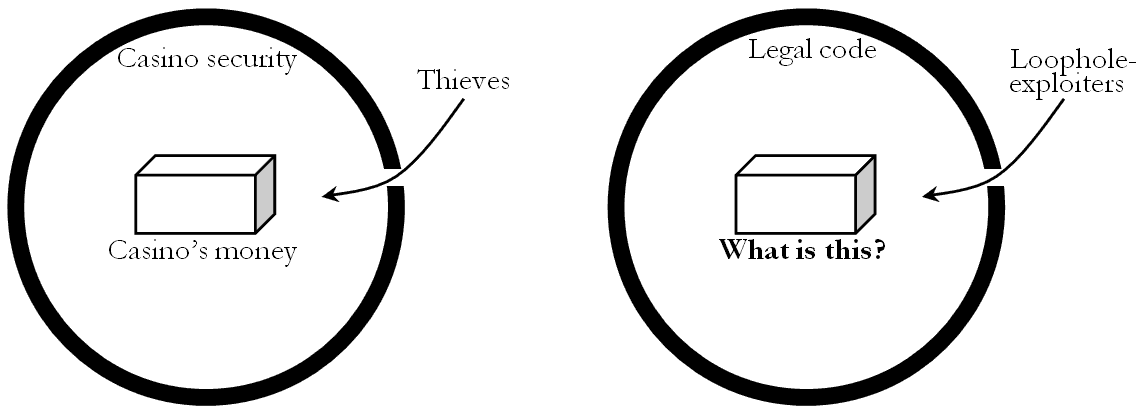
Yes, this is why the blacklist market will emerge. The same is true for casinos. There are always individuals who are extremely talented enough to find loopholes in the casinos security. These individuals are blacklisted and watched closely for and they are punished heavily if caught (not always via public police forces). Yet, it is extremely expensive to perform such heists the same way as it would be extremely expensive to find such loopholes especially since there is also a demand for the insurance companies to hire people to help them close such loop holes (therefore, not any Joe off the street would have the intelligence or money to buy such lawyers) . Insurance companies, if they were smart, would even pay a lump sum to anyone who brings such loopholes to their notice.
“there’s no essential difference between one form of communication (language) and another (action), so why attribute the force of law to one but not the other?”
This a tougher question and I will get back to you sometime on it because it would involve some longwind in my response