Economic Calculation Problem Debunked!??

Smiling Dave

Robbo, mind your manners.

And this from someone who has gone out of his way to demonstrate that that is something he conspicuously lacks. Same goes for some of your other contributors, mind , with a few honorable exceptions. I think the tone of the debate was set right from the start before I even joined this community with the obnoxious ad hominens coming in thick and fast. Dont be surprised if I bite back

Robbo, since you insist so much in this quotation “would give according to their ability and take according to their needs”, do you believe that an economy where there is such a dissociation between production and consumption as this setence implies could be prosperous?

And define “needs”, please.

Dave,

You are quite sure that some people have more than others simply because they are more talented and work harder? Again, you live in a fantasy world. One I’d like to visit some day, since in it Adrian Belew would be a trillionare and there’d be no Lady Gaga; Paris Hilton would live in a cardboard box and my granddaddy’s 12 hours a day in a coal mine would’ve gotten him more than an early grave.

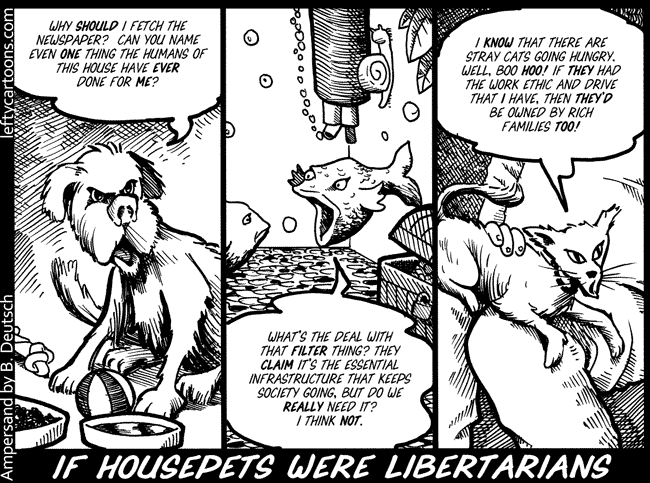
Also: (panel 3 especially)

You make a lot of baseless assumptions made in your post. For instance you say that rich people work, which I guess is true if “work” is extended to include investing money. You assume, and I can understand how this makes sense, that if a person is more talented than another that naturally means that they should have more material goods and services.

You also seem to ignore what even you must consider grave injustices; that some people are so poor that they never get a chance to develop any talents, while others have such wealth that they cannot fail.

I’ll expand more on this tomorrow. Now, sleeep…

Felipe,

It’s 3 am here, sorry. I meant the show itself. The society presented is definitely socialist. Gene’s personal political opions are unknown to me.

  1. You wrote: I’m not making this into a discussion on the LTV, but if you truly believe that every rich person deserves their wealth you are living in a fantasy land. Hell yes most of it is ill-gotten gains. Who does the country (I assume you’re American) you live in actually belong to?

Yes, I’m in America. And I doubt that most wealth is ill gotten. Ill gotten means taking something without giving something in return. And yet I see the incredible amounts of products around, I can but assume somebody must have produced them and gotten wealthy that way. Meaning his wealth is not ill gotten at all.

Now if the question is “What do we do about ill gotten gains?”, it would be throwing away the baby with the bath to say “take everybody’s money away forever, ill gotten or no.” That would be grossly unjust. Also it is unproductive, because it would kill all incentive to work.

Don’t you think cases of ill gotten gain should be treated on an individual basis? Do you think that all members of group X should be killed, if we grant some, or even most, of them are bad in some way? Say country X agresses against country Y. Should we just drop hydrogen bombs on country X to kill them to the last man? While we are at it, should we kill the whole human race because soem members of it are murderous psychopaths?

  1. It is not democratic, but why is democracy good or just? As for why does one person have a billion votes, it is because he worked a billion hours. The ones who have no votes either did not work, or are living in a socialist society which has impoverished them.

  2. You wrote:

Or that they can’t afford it. You seem to take it as given that everyone has money. You do realise there’s a shitload of poor people in the world, right?

And this is not even getting into how the aggregated subjective individual wants of people will not bearing about the same result as a collective democratic decision.

There are poor people in the world, because they are living under oppresive [=socialist] govts. Giving them the money of the wealthy will not change their govt, will it? So you are attacking the symptom, not the cause.

I’m not sure what a collective democratic decision even is. Do you mean that the majority forces its will on the minority? I think that is a bad thing, not a good thing. Do you think a collective decision is not subjective? Do people suddenly change their inner beings and become other wordly angels when they vote?

  1. You wrote: Are you high? How much denial of reality are you capable of? Sure, making people happy is one way. Stealing from them is another. Or did Imperalism not happen?

I didn’t realize we were discussing fraud and theft. I thought we were discussing honest means of making a living, contrasting a free market with socialism. Both will be plagued by crooks and thieves that will have to be dealt with. And that theft can have far reaching effects is true. But so what? We are discussing capitalism and socialism, not theft. [Though from what I gather about socialism, it is sheer theft, until such time as mankind evolves to the superior being you were talking about earlier].

Or maybe it just doesn’t have far-reaching effects even today, that make it possible to exploit people in the third world, by for instance employing them in sweat-shops?

You are making a big mistake about sweat shops. Those who work in so called sweat shops are there of their own free will, very happy to be there. When do gooders mistakenly pressure the shops to close down, the female workers then usually become prostitutes. Do some research. In any case, a thief is a thief whether he lives in a capitalist or socialist country. Not sure why you brought up the subject.

Or is this not something that concerns you, because it is somehow wholly the governments fault, and in a free market system there would be no unequal power relations?

What do you mean somehow? Look at who is running poor countries. Look at the laws in those countries.

In a free market system, absent govt meddling, the power would accrue, deservedly, to the one who pleased the most people, as I explained. When he stopped pleasing them, someone else would, and that new person would get the power.

  1. You wrote: And some things can never be, because there is no profit in owning them.

I fail to understand you. Look around your room at the things you own. Do you make a profit from most of them? From your television, your furniture, your everything? The world is, fortunately, full of things called consumer goods. A rich man may very well buy a waterfall just for the pleasure of looking at it. It happens all the time.

Besides, the only incentive to protect something is still profit.

Not at all. It’s because it is mine, and I don’t want it ruined. Are you careless with your TV because it makes you no profit?

If I make more money by dumping waste on a piece of my own property (or letting someone else do it for pay - consider how nuclear waste is sold to poor countries) I have no reason not to do it.

That may be so, in your personal case. But then, if there were people who cared enough to buy you out, they would preserve the beauty.

As for nuclear waste sold to poor countries, there again we have govt meddling. I doubt the sellers of nuclear waste made the deal directly with the owner of the land. He would never agree. And if he did, that’s his concern. Unless it damaged my property, too, in which case I should be able to sue him, or forbid him to do it in the first place.

  1. The reason is that those countries without a free market and/or a tyrannical oppresive govt starve. [Am I repeating myself? Maybe some of the tyrants merely use socialism as an excuse to grab everything. But Hayek argued that socialism leads to tyranny. It’s a chicken and egg thing, I guess]. As simple as that. Can you name me a country with a free market whose people are starving?

As for people poor in China, give them time to recover from Mao, and give them more freedom. Right now they have an aggressive central bank [=govt], a sure way to impoverish.

  1. You wrote: What I said was that in our current system, investing resources in the construction of a Wii while human beings are dying, human beings that those resources could potentially save, is still a perfectly valid and rational decision.

I don’t get this at all. In a free market, those people would be hired to work in the Wii factory and other places and have food.

The price mechanism cannot take ethical questions into account, such information is not carried. All the entrepreneur sees is that there is a demand for Wiis, and responds.

And that’s all he needs. If there are starving people, some entrepeneur will get very rich feeding them, in a free market.

When there is a need for something, people can work enough to afford it [=create purchasing power for themselves], and thus create demand, and thus a businessman will meet that demand because he wants to make money. Especially the basic neccesities, which are fortunately so inexpensive.

Do you not think that absent govt interference, businesses would flock to poor starving countries to take advantage of the cheap labor, thus feeding them all? And thus making them progressively wealthier? People are already talking about it all the time.
There is no such for “enought wealth he/she cannot fail”, i’ve seen dozens of people that once were quite wealthy and suffered huge losses.

My mother uses to say that money demands respect, if you don’t respect it, it quickly runs away.

Vitor,

You have a cool mama.

This could just as well read “If Housepets Were Communists/Socialist”, but then it would actually make sense. Except the third panel would read, “I know that there are stray cats going hungry, if only i had some way of using someone else’s money and labor in order to feed them.”

Free access to goods is pointless, it serves no purpose. If a good is physically abundant then it will be cheap in capitalism and anyone can easily afford it. If a good is not abundant then it is unavailable to people regardless of our providing it “for free”. Making stuff “free” does not in any way relieve scarcity. But socialism actually reduces productivity, so there would be less stuff to go around. The same goes for wage labor, if society is productive enough so peope only have to work for fun, then they can do so in capitalism. As such a socialist economy does not provide any benefits other than the contentment some might gain from abolishing exchange. The only purpose of promoting “free access” is the belief that this will create a free lunch, i.e. that the goods we currently can’t afford in capitalism will appear out of thin air if we abolish the need to pay for them. Although they vehemently deny this, and might not be rationally aware of it, on an instinctive level all anticapitalists believe that socialism would create stuff out of thin air. They think goods would be just as available as they are in the capitalist economy while at the same time not being rationed through pricing. The choice of the term “access” illustrates this very well. They see goods not as scarce because they are physical objects who are limited, but because we have to pay for them. Obviously that is a contradiction, goods are available precisely because prices limit access to them. The fallacy is taking the availability of goods under capitalism for granted as if they are a fact of nature and thinking that the way we experience scarcity in capitalism is the cause of scarcity, through not being able to pay for stuff. So when you abolish the need to pay for stuff there would be a free lunch. When they attempt that in practice socialists quickly find out that without the rationing function of prices you no longer have the availability of goods that capitalism provided. Then people have “access” to stuff that isn’t there. That’s why store shelves were empty in the Soviet Union.

Also, a non-market economy will necessarily always be a government-run economy. If goods are to show up in stores, something has to allocate them. If markets do not do this, a government has to do it, there is no way around that. Socialists tend to imagine that everyone will happily get along in their utopia and therefore decisions of the central plan don’t ever have to be enforced, that way they can pretend that there wouldn’t be a state. But in practice there would be a state and it would be a centrally planned economy. For instance, who decides to which factory the tin that is used to produce tin cans should be delivered? Obviously a central planner. What if I want to make some changes to that delivery scheme or design one of my own? Could I do that? Of course not, there would be chaos. Somebody would stop me, by force if necessary, and tell me that I don’t get to meddle with the central plan. Well how do we decide who gets to make the plan and tell everyone else not to meddle with it? A government. Even if it is democratic, it would be a state monopoly on the means of production. Democracy requires a state. Who tells the truck driver who delivers the tin where to go? It comes down to the question who’s central plan will be followed. Obviously one plan has to be imposed, and unless all humans somehow agree to the same plan it would have to be imposed on society by a governmental elite. The government would in effect have a monopoly on the means of production. You can come up with all sorts of tricks to disguise that, for example by saying that organization would be ‘self-regulating’, and thus not centrally planned. But self-regulating system still has to be imposed by a state. And it could not be fully self-regulating, somebody would have to type numbers into a calculator and give orders to the economy. That would certainly be a government function. You can imagine that this system will employ some sort of fluffy, democratic decision-making process to guide the actions of the government. But that does not change the fact that it would be a government-run, centrally planned economy. And in practice this “local decision-making” would need appointed officials calling shots, including allegiances and special interests, and thus be mired in hierarchy with struggles over power and bureaucratic privilege. It would be an artificial and fragile democracy, dependent on the whims of people to keep it functioning. And if people are democratic-minded, they will be in capitalism too. So again, socialism offers no benefit, it is mostly an empty vessel that allows people to imagine all sorts of good stuff to manifest out of thin air.

I don’t get where this notion comes from that abolishing exchange would bring about a “new socialist man” who would feel mutual obligations for his fellow man and be universally interdependent. If anything, abolishing exchange will get rid of mutual obligations and interdependency. We can expect people to become more selfish and seclusive, xenophobic and paranoid, if exchange does not make them interdependent. Essentially it would be like an entire society on welfare. Exchange is interdependency, so it just doesn’t make sense that a socialist economy would breed a more social kind of human being, even if we assume that human nature is malleable in that way. The empirical data agrees with me, private philanthropy and mutual responsibility explodes when private property rights are secure and people engage in free exchange, while it clamps down in more welfarist, “free access” societies.

Apfel.

You wrote: You are quite sure that some people have more than others simply because they are more talented and work harder? Again, you live in a fantasy world. One I’d like to visit some day, since in it Adrian Belew would be a trillionare and there’d be no Lady Gaga; Paris Hilton would live in a cardboard box and my granddaddy’s 12 hours a day in a coal mine would’ve gotten him more than an early grave.

Perhaps I wasn’t clear. By talent I mean “the ability to give people what they want”. Adrian Belew had it to some extent, Lady Gaga seems to have it to a great extent. I did not mean musical or artistic talent per se.

Paris Hilton’s papa had talent. That’s how he got rich, giving people a nice place to stay away from home. I am sure he worked like a dog, too. Paris inherited his wealth. I don’t see inheritance as unfair. It is what most to all people want to do with their money, leave it for their kids. It also provides great incentive for people to work, knowing it iwll go to their kids after them. In any case, SOMEBODy had to please a lot of people for Paris to have her money.

I don’t know if your granddaddy lived in a country with a free market. In any case, I did not mean that hard work will automatically bring wealth. I meant that if A works one hour, and B works ten hours at the same thing, B will have more money.

As for the cartoon, yes some people are born into wealthy families, and benefit for free from their parents hard work. I already discussed this earlier, that it is not unfair or a great crime or a reasion to confiscate their money.

You wrote: For instance you say that rich people work, which I guess is true if “work” is extended to include investing money. Investing money involves work indeed. Both in the sense of taking a lot of time, and in the sense of giving people what they want. After all, someone is going to be using the money invested to produce more wealth. He wants that money badly, enough to pay for it.

You wrote: You also seem to ignore what even you must consider grave injustices; that some people are so poor that they never get a chance to develop any talents, while others have such wealth that they cannot fail.

In a free market, those with talent tend to rise to the top even from the basest poverty. Here they call it the American dream, because we had a pretty free market until about 1913 [when it started getting worse and worse]. And it still happens. Look at Cesar Milan, at the Beatles, and many many others.

Vitura answered your q about too big to fail. And even where it true, what is unjust about it? Somebody worked so hard and provided so much satisfaction to the world that from sheer gratitude they made him so wealthy he cannot possibly be poor. I think that’s great. Brings a tear to the eye.

"You also seem to ignore what even you must consider grave injustices; that some people are so poor that they never get a chance to develop any talents, while others have such wealth that they cannot fail."

Answer this question-How is wealth created?

And this from someone who has gone out of his way to demonstrate that that is something he conspicuously lacks. Same goes for some of your other contributors, mind , with a few honorable exceptions. I think the tone of the debate was set right from the start before I even joined this community with the obnoxious ad hominens coming in thick and fast. Dont be surprised if I bite back

Dont worry, you dont bite.

As always Esuric dominates the debate with sharp logic and economic knowledge, kudos to you sir.

I wish I could get into the debate a little more but medical school consumes almost all my time.

The Picard reference is funny because the Federation in Star Trek is a depiction of Gene Roddenberry’s post-scarcity communist system. The first Star Trek with anything like money and trade was deep space nine, started 2 years after his death.

No kidding, Caley, I remember cringing on a couple of episodes because of their derogatory references to ‘money’, among other things.

It’s a communist society, but oddly without starvation or prison camps. That’s why it’s fiction.

Robbo.

This is to your first reply.

“On scarcity - if people bothered to read with more care and attention they would perhaps appreciate the point that when I dismiss the “bourgeois myth of scarcity”…”

-Thanks?

“Point is that, like it or not, you have to some way of prioritising production goals that is socially consistent in order to decide how to allocate a particular factor under conditions of competing end uses - scarcity. “

-Thank You

I am not particularly fussed about the order of these end uses or how these priorities are agreed upon –“

-Too many people are.

“whether by communities democratically deciding on it or by simply leaving it up to the good judgement of production units supplying these input factors. And as I explained that does not mean low priority end uses will be ignored of which I suppose the production of yachts would be an example. It simply means these will be further back in the queue for particular resources and may require recourse to procedures such as technological substitution to met demand . That is eminently sensible as an arragement and I defy anyone to demonstrate how it could not be.”

**-Forgive me if I am demonstrating my sensible ignorance, but somehow “**by simply leaving it up to the good judgement of production units supplying these input factors”sounds like god.

And “communities democratically deciding” doesn’t really mean much to me. For instance, let’s say that at any level of the proposed polycentralized decision making, the democratic vote comes so close that the last vote casted is the deciding vote. Does this mean that 49.9999999999999%, have to deal with what the majority decide. Or does the majority decide what the winning vote ratio will be? Is it ironic that this situation could boil down to an individual’s subjective decision.

**“**I believe, of the world’s most expensive private home being built to overlook the slums of New Delhi or whereever it is. Thats perfectly acceptable if you are the wealthy capitalist who happens to live in this edifice but certainly not if you are a slum dweller living in its shadow.”

Are you the slum dweller? Or are you a wealth leecher? If not the former, shame on you for the insult. If the later, it figures.

“Not only that, most of the paid work that is done in capitalism is actuallytotally socially useless from the standpoint of meeting human needs; indeed capitalism has become the most grotesquely inefficientt and wasteful form of economic organisation ever devised - by comparison with the productive potential it has, ironically, created.

Don’t mean to nitpick, but you do mean state interventionism right? Surely you don’t believe capitalism was devised by some central planner, excuse me I mean “democratically communal decision.”

That I think is the fundamental reason why I cannot get on board with your idea. To me capitalism, is what naturally occurs. I am convinced that humans act, from my own observation.

Which really means that even if you had figured out the ECP, and it could work [which I admit, I cannot fathom] people would have to undergo a major change in mentality to be ok with it.

Think about it, people want what they want, and you are trying to prove to us that if we didn’t want these things we would all be better off. The fact is, we want what we want and we do what we can to get it. As far as I am concerned, you can’t change that.

Even if the state disappeared overnight (fiat and everything), capitalism would naturally come back as people’s wants are satisfied subjectively through barter until money develops.

It’s funny how capitalism is observable and communism is like religion. I know I know robbo, we need to change right?

The anarcho-capitalism standpoint is obviously full of rampant greed. What about the anarcho-communistic approach prevents that? How does it curtail greed? As a starting point, how am I getting the things I need? Is there a place I go?

OK, guys, this will have to be my last post here. Its been fun while it lasted but really it was never my intent to engage in some long winded cut and thrust with ideological opponents who, for the most part, seem far too fixed in their ways to seriously consider anything that falls outside the narrow horizons of their own worldview. I can’t help noticing the overpowering pull that the core ideological dogmas of anarcho capitalism exercise on the minds of its adherents. It confirms my belief that, actually , the proponents of the Misesian calculation argument require the strawman claim that any attempt to break with logic of the market implies some centrally planned governmen-inspired alternative. They are drawn to this position much like flies are to shit. But actually this only serves to highlight the utter fragility of the anarcho capitalist argument - its weak underbelly. So intent and fixed was Mises (and those who think like him) upon attacking a crude caricature of “socialism” in which some mythical “director” was presumed to centrally plan production, that this left him totally unprepared and completely vulnerable to assault from quite another and unexpected direction - anarcho communism

Anarcho communism is your worst nightmare, folks. It is the thing that kills stone dead all the preposterous claims of the anarcho capitalists. Its the self-regulating self-ordering nature of anarcho communism which really holds the key to the complete and utter demolition of the entire econominc calculation argument. We have seen on this forum the frankly desparate and semi comical attempts of the free marketeers to equivocate and insult their way out of a sticky situatuon with the liberal use of ad hominens, non sequiturs and downright misrepresentations. Nice try but it wont work and in your heart of hearts you must know this. Most of you - with a few honourable exceptions - clearly have had no intention of seriously engaging with the argument presented in the paper posted by the OP

So anyway it comes down to this. Much as Ive enjoyed my time here I really do not have the time to continue. Ive debated with anarcho capitalists more times than some people have had hot dinners, to coin a phrase, but it always seems to come down to trench warfare in the end with snipers taking pot shots at each other. In any case Ive got a lot of other more pressing things to do - both personally and on the political front.

So I will have to bid farewell but before doing so may I make a couple of recommendations.

For those of you who want to get more clued up about the anarcho communist alternative to capitalism here are a few links to explore

http://andycox1953.webs.com/ - An excellent site run by my own brother! With a substantial and growing database to boot

http://www.worldincommon.org/ - Check out the theory links. Some good stuff there

http://www.worldsocialism.org/spgb/ - A vast library of articles, pamphlets and educational materials on just about anything you want to search for

http://non-market-calculation.wikispaces.com/

http://www.infoshop.org/page/AnarchistFAQSectionI1

And for those of you brave enough to enter the lions den and continue the debate try http://tech.groups.yahoo.com/group/WSM_Forum/ but I dont rate your chances of survival :slight_smile:

Cheerio

R

Time to give Robin some homework..

I assume in your anarcho communist society, you will be planning to have a modern industrial society. I also assume, you are still going to be using machines and things like farm tractors and buildings constructed with iron girders, and automobiles (or atleast some form of transportation) and you’ll need things like construction machinery and mining equipment. To build all these things you will need steel and iron, which in turn means you’ll need steel mills and mines to get all your raw materials from. How are your anarchy based communities going to acquire the steel without the use of money?

Is each community of anarchists going to build their own individual steel mill? Are you going to build railroads that you don’t own, to ship tons of raw materials to your own local steel mill?
or
Do you plan on placing requests to other anarchy based communities and then they will just ship you whatever is needed by your community after they have built the steel mill that they don’t own, using the railroads that you/they don’t own, and mining or acquiring all the raw materials that you/they don’t own?

Steel doesn’t grow on trees and you can’t just dig it out of the ground. Steel is a manufactured. It is not a generic product. There are many formulas of steel divided into steel grades. There are atleast 13 grades of carbon steel, 9 grades of alloy steel, 24 grades of stainless steel, 9 grades of tool steel. Right there you have over 50 different grades of steel and that doesn’t include the category of ductile and cast irons that have a higher carbon content.

When you build an automobile, you’ll use an alloy steel for the wheel, another type of steel for the body, another type of steel for the springs, another type of steel for the crankshaft and pistons, and throw in some cast iron for an engine block. I’m sure some one could divide up even more but you get the general idea.

Each grade of steel has it’s own recipe. First of all, you have to mine the iron ore that you turn into pig iron and then cook it in a furnace to attain the desired carbon content and then any number of additions are made: aluminum, bismuth, boron, chromium, cobalt, copper, lead, manganese, molybdenum, nickel, silicon, titanium, vanadium..etc to get the desired grade of steel for your application. You are going to have to source and/or mine each one of these individual ingredients depending on your needs. You also have to remove the impurities. Your sources for your raw materials will be scattered all over the globe. Your copper might come from Michigan, your nickel from Australia, titanium from Cornwall in the UK…etc etc.

How can anarcho communists get access to these raw materials? Do you just ring up some anonymous stranger down in Chile and have him ship you a ton of chromium so you can make crankshafts for your lawnmower factory in Cleveland?

What’s to stop everyone from ringing up that same guy in Chile? I don’t see how you can have any claim about reducing scarcity. You don’t claim to have any ownership of anything so then you can’t very well turn down any idiot that thinks he has a right to his fair share of some rare resource that you have available. Since this idiot doesn’t have to show a profit, (as there is no cost to acquiring the raw material) you’ll end up with lots of people that don’t have efficient means of production utilizing scarce resources manufacturing products.

Instead of having abundant supplies of resources you’ll end up with constant shortages of basic needed raw materials. So the likely scenario in your anarcho communist world is the anarcho communist will end up using a much lower grade of steel and just end up rebuilding his engines on a regular basis because of unavailability of scarce minerals or he’ll end up on a waiting list, waiting until the scarce resource he needs becomes available.

Calculation in kind won’t help the mine you’ve been getting iron ore from, when the carbon content of that iron ore vein they were mining shoots up 100% which in turn, means that a longer cooking time to reduce that carbon content which is required (unless of course you decide to start building your cars out of cast iron). So that means you’ll need more natural gas to cook your pig iron. But wait, your natural gas supplier tells you there isn’t even enough natural gas to maintain the amount he delivered you last month let alone increase your supply so your only option is to make less steel if you hope to keep producing the same product.

None of the 4 steps of Robin’s 4 step proposed model, 1) calculation in kind 2) a self regulating system of stock control 3) the law of the minimum 4) a hierarchy of production goals, is going to help you out here, the inventory in your stock control doesn’t allow for any substitutions without taking away from the supplies needed for another commodity.

Robin’s 4 step plan makes the mistake of assuming he’ll always be able to get the same quality and quantities of every raw material that is needed for his manufacturing requirements. There is no way to maintain a self regulating system of stock control. He has no way of knowing what the future supply of all his raw materials will be.

He can’t increase his prices, he has no prices to ration demand. He is still going to have the same number of people expecting him to supply them with the same good he was producing. So the only option Robin has is to shut down production or institute rationing while he completely reorders his self regulating system of stock control to adapt to his new mix of products following his hierarchy of production goals until the next shortage comes along and a new shutdown or period of rationing occurs.

@ Apfel and Robo,

Question about Ancom: The brick making factory is able to produce this year enough bricks for one house. Now there are 10 people who want to have them to build a house this year. Who gets them? How is it decided?

Looking at this thread with fresh eyes I notice two things:

  1. The discussion has moved away from the ECP to anarchist (and Marxist) things in general. I’d like to steer us back, and I think an excellent way would be for one of the ancap people to give a concise explanation as to why Robs, AnarchistFAQ’s or this http://thepiratebay.org/torrent/6285761/Concerning_the_Economic_Calculation_Problem rebuttal is inadequate.

  2. There is a rampant denial of reality going on. Statement claiming that most wealth has been gained fair and square, and that people get rich only through hard work and by making others happy, are demonstrably wrong and show an almost laughable navitety. And it’s anarcho-communists that are accused of being Utopians?

1. And I doubt that most wealth is ill gotten.

You are living on a continent that was stolen, and on which slavery was practised for 400 years. The very foundation of your nation is one of theft and oppression; history is filled with examples of people taking without giving anything (or maybe the beads given for Manhattan count as “something” in an ancap world?) and gaining great wealth doing so. And yet you deny reality and insist that most wealth in the world has been fairly gained, and that those who possess it deserve it.

That money is an incentive to work is an old myth, and scientific studies performed by the IMF of all things have showed it to be false. This video has an amusing summary: http://www.youtube.com/watch?v=u6XAPnuFjJc

And like I said, it’s not a childish idea like “money bad, get rid of money and problem solved!”. It’s a matter of re-designing and changing society do that money is no longer needed. It being anarchism, no one would forbid it or ban it; you could still use it if you really felt like it. There’d just be no incentive.

“Don’t you think cases of ill gotten gain should be treated on an individual basis? Bombs, etc.”

No, and this in no way follows from anything I’ve said, or anything any anarchist has ever said. Reductio ad ridiculum.
Anarchism is very clear on the point that the problems in society need to be dealt with systematically, through changing society.

  1. At least you admit it. If you are OK with a non-democratic system, then we really have nothing to discuss here. Like I said, deep down it boills down to an ethical question.

And what you say about “working a billion hours” is demonstrably false and is a display of sickening ignorance. I truly thought that libertarians and anarcho-capitalists believeing that the rich deserved to be rich and the poor deserved to be poor, and all that comes with it, was a myth coined by your opponents. That no sane person could seriously believe that. Seems I was wrong…

  1. If poverty derives from socialism, why are there poor people in the U.S.? Why where there poor people in Chile after Alliende got booted, and fans of the free market took over, gaining some theoretical assistance from Friedman? Why where there poor people during Thatcher’s reign?

Nor am I saying we should redistribute wealth - I am an anarchist and not a leftist liberal. This is either a straw-man or a confusion of your part regarding whom you are arguing with.

Nor am I talking about voting. Much has been written about the deliberative process, and I suggest you read up on it.

A market is the sum of individual’s subjective choices, and will not result in the same outcome as when people get together and make an objective judgement with the collective good in mind. It is not a matter of becoming angels, it is a matter of a group engaged in democratic deliberation is capable of considering things that an individual cannot, and is motivated by other incentives.

  1. I was discussing the contradiction that a system built on greed will, despite giving people a clear incentive to do so, be one without any theft or fraud. That without a government around to punish people who misbehave, everyone will suddenly stop misbehaving and that such enlightenment will accompany our self-interest that everyone will be honest.

This is a true Utopia for me. I am a realist myself; I think that if you want people to be honest you need to change society so that they have no reason to be dishonest, no gain by it.

Stockbrokers determine a stock’s value by combining it’s risk and it’s payoff – a 50% chance to get $100 and the same chance to get nothing puts it’s value to 0.5x100 + 0.5x0 = $50. Same thing can be done with any risk really, you just weight the payoff with the risk (and consequences). If the dishonest way pays of more, it is rational to choose it. Sure there are moral issues and jaba, jaba, jaba, but those are included in the consequences. Point is that if the potential gain is big enough and/or the risk small enough, people will break the rules! To suggest that this will happe less without a pesky government is insane.

"Those who work in so called sweat shops are there of their own free will, very happy to be there. "

Yup, you are clearly insane. They are there because they have two choices; work there or die of starvation. They are not “happy” by any sane definition. And their “free will” to be there is so strong that many of these shops have guards, often with Uzis, actively beating and threatening people in order to force them to work. You know why that happens? It’s not the government. It’s because it makes sense economically; there is a profit in it.

Again, you are mistaking me for a liberal. The solution to the sweat-shop problem is not to force them shut, that is to treat the symptom. The solution is to treat the disease, i.e. remove the reason for them existing in the first place.

  1. Or one may buy a piece of land just so that one can dump chemicals on it. If the price of the land is less that the cost of the process of taking care of those chemicals, it makes economic sense. And it being his profit, who can stop him?

Or, again, one can pay other people to dump chemicals on their property. If those people are desperate enough, they will agree, just like such people agree to work in sweatshops. You clearly have no ethical problem with this, but in this case it does not matter. Ecological destruction occurs, and everyone involved has agreed to it of their free will.

But then, if there were people who cared enough to buy you out, they would preserve the beauty.

The voice of those with no money does not matter. Nor that of animals or plants. Nor does the voice of those future generations not yet born matter. They are those who will inherit our problems, but there is no way for them to “buy someone out”.

And again, you show the same problematic attitude von Mises had: if people aren’t willing to pay for a clear environment, then they must not want it, and then who cares?

And if he did, that’s his concern.

No, it is the concern of everyone who lives in that community, and everyone who will live there for the next few hounded thousand years.

  1. The United States of America. Sweden. Canada. Germany. Every country in the world. Not everyone is starving, some are very well of. But there are hungry people in all these countries.

OK I get it. When people are prosperous then this is because of the free enterprise system and only the free enterprise system. When people starve and die this is because of governments, and only because of governments. Any evidence for this? Any argument for this?

  1. Wow. I got stupider from reading that.
    How in the world can he “get very rich feeding them” when they have no god damn money. None. Zip. Nada. What is he going to get rich on, their gratitude? It seems to me an anarcho-capitalist is incapable of registering poverty or understanding to concept of being poor. It means you don’t have anything.

Business is already flocking to those countries. But guess what? They had this idea that instead of “making them progressively wealthier”, and thus lose their source of cheap labour, they’d just keep them poor and miserable.

haedros,

Correct. Good thing I’m not a Communist!