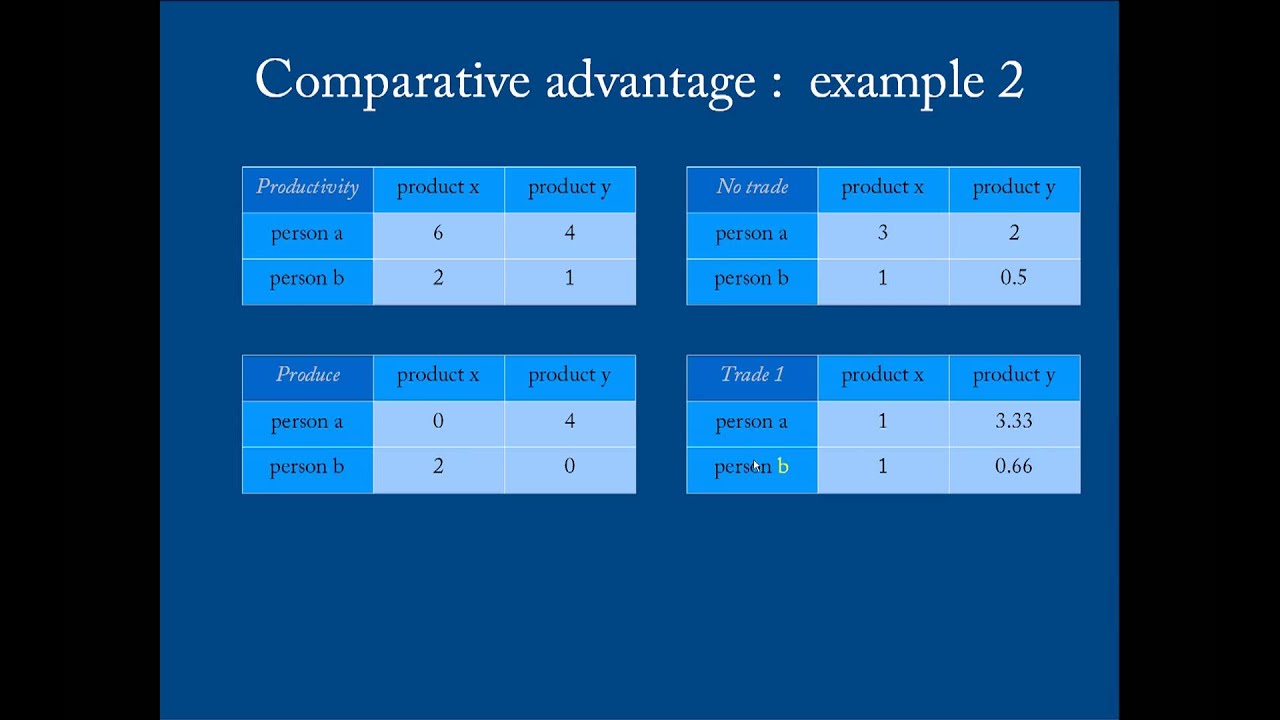
Hi everybody, I’ve recently been studying the division of labour and the law of association(comparitive advantage). During my self study I formulated a pair of self test questions to help excercise my mind ad make sure I’d taken in what I’d read and made notes on. The following is a kind of hybrid question composed from the one I asked myself. I was hoping forum members would enjoy testing their mettle on it. Also, bonus marks for answering the last part related to economic calculation! Anyway, here’s the question, enjoy:
- Suppose we have 2 individuals, Laura and Stewart, who reside in a large grassy field populated only sparsely by a few cows and apple trees. If left for half an hour, Laura can gather 2 apples, and in the same time Stewart can produce 3. As far as milking cows goes, Stewart can produce 1 pint every quarter of an hour, while Laura can achieve the same feat half as fast, producing 1 every half hour.
a) Denote the opportunity costs for producing either good, in terms of the amount of the other forsaken in order to produce it for both individuals. Can they benefit from exchange? If so, use their respective opportunity costs to delineate the range between which the exchange ratio at which both may exchange their goods to make productive gains lies.
b)(i) Explain why, when both individuals are aware of each other’s existence( as opposed to having autarkic conditions), it will be beneficial for them to specialise in the production of one good and under what principle.
(ii) Assume both Stewart and Laura have 12 hours to produce as many goods as possible. Find the amount of goods produced, if both individuals specialise in order to maximise productivity in accordance with the above principle.
c) Suppose Laura wishes to buy 7 pints of milk for 12 aples from Stewart. Explain why this exchange ratio or price is beneficial for both parties. Assuming the trade takes place, compute the resulting distribution of goods for each producer.
d)Increased returns/savings from trade and the division of labour should result, in contrast to when both tried to forsake the labour necessary to produce 7 pints of milk or 12 apples respectively, in order to produce the other good under autarky. Calculate the magnitude of these increased returns/savings, using as a unit of account:
(i)apples
(ii)pints of milk
(iii)hours saved
e)Explain how, keeping in mind that we are examining production perpetuated by the purposeful behaviour of 2 individuals; this example alone, helps illustrate that the claim that production can be considered “separate” to distribution can be considered delusional and meaningless.
f)Explain why and how, in order to generalise the above illustrated Ricardian Law of Association to examples involving more types of goods and more individuals, that we require economic calculation?