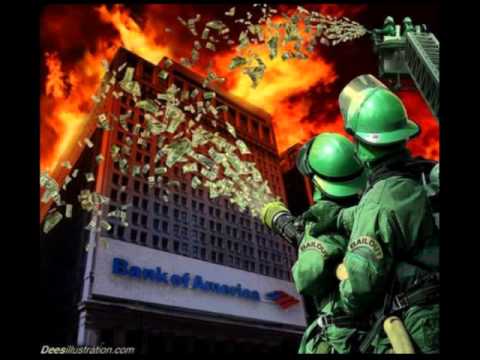
First, for fun, we can start with Schiff’s assessment of Too Big to Fail:
Notice how (just as with the movie everything) is always on the up and up, and it’s just our wise, benevolent overlords coming to the rescue. The way this is written implicitly states that the Second Bank was created because inflation ran rampant without a centralized cartel to manage everything. The reality is the government didn’t have their monopoly on inflation and therefore lacked the capacity to create inflation to finance the War of 1812 and they got scared about not having that extremely valuable tool in their insidious arsenal.
This is just insane. Even the History Channel showed how corrupt the bank was and how much of a conniving figure Biddle was in their documentary on Jackson.
It’s a stalemate argument. It’s the same as when Republicans say “look at what Obama’s done” and people get to reply “He got that from Bush. And things could have been a lot worse.”
The statement as it is made there in the article is just used to give the reader a sense of importance about a dorky bald man whom they’ve likely never heard of.
That’s what the Fed is supposed to be. That was Bagehot’s whole thing in Lombard Street.
But you’ll notice that entire paragraph is meant to lay the groundwork for making the case that the negative opinion of Bernanke and the bank is unfounded and misguided.
Those are basically factual statements. The Fed did bail out large corporations and devise methods of lending money to various institutions and foreign governments. It did lower interest rates to zero. The fact that such a pro-Bernanke propaganda article would freely mention those kinds of things as if they were good or positive is just a sign at how ignorant the public is.
The nice little mention about “stress tests” and “repaid at profit” are lies, however (of course). Statements like that are usually made through accounting slight of hand or loose definitions of terms. Kind of like when GM said it had repaid it’s “loans”. But with the banking industry it’s even easier to hide in the web. Rothbard wrote a whole book on it.
Bingo.
But as a consolation prize, you could point to the predictions they made beforehand and show how incompetent they are.
Partly it’s because they’re more popular with the media, but yes, partly it’s because it’s easier to target them. It’s like when someone with a bad argument builds a straw man so that he might easily knock it down. He’s bringing up these poor opponents so that he can more easily make the case in favor of Bernanke. It’s like a TV host having Nick Naylor on one side, and then inviting an intern to voice the opposing side.
Partly, but also you have to remember every single thing about the way “inflation” is measured is meant to make the number lower. Even everything about the way it’s reported is geared toward this. That’s the whole point about the “headline inflation”/“core inflation” nonsense. They report “core inflation” because obviously, if you take out the two sectors that are most sensitive to inflation, your inflation numbers are going to look better.
Shadowstats.com has become popular in large part for it’s report of CPI data using older methodologies.
Also, here’s an abridged version of Prof. Salerno’s assessment using a specific case, and his full paper is “An Austrian Taxonomy of Deflation” (PDF) and there’s also
An Austrian Taxonomy of Deflation—With Applications to the U.S. [PDF]
Also see here for a list of threads on the topic, and then of course there’s the Mises Wiki.
You’re asking how could Fed loans have not cost the taxpayers anything? I’m not sure how to answer that question. If you’d like info on how the Fed does cost taxpayers, look for relevant articles here.
Menger, Mises, and Rothbard did. You can find mentions of Bagehot in their writings. Of course Bernanke finds it beautiful. It’s like when a fat person is told chocolate is good for them.
Well. To be fair, Greenspan lowered interest rates to 1% for a whole year. Bernanke only put rates down to 0%, and he’s only kept them there for a little over 3 years. So that’s totally different. Yeah, Bernanke’s nothing like Greenspan.
The history of financial crisis. The less intervention there is, the faster the recovery. But ultimately, if you show him a shining example of a crash that was bigger than that of 1929, and ended up being fully recovered within 18 months, and he still says “nope. You’re wrong”, you may as well be arguing with a mule.
Look around. The HUI index is up over 700% in the last 10 years (and that’s a lowball largely because of a recent correction). Gold itself is up around 500%. And just give it time.
What’s more, I honestly don’t think your friend would want to hinge his position on this guy being right.
He’s a shill.
It’s just gobbledy gook to make himself sound like he knows what he’s talking about and is being reasonable. Notice how it’s always a Goldie Locks tone. “Yes, x is bad, but we don’t want to go too y. Blah blah blah here’s a suggested policy that furthers the agenda of the elite.”
Yes. It’s always “it would have been worse.” It’s a failsafe play, until Doc Brown finishes the DeLorean.
It sounds like you’re making multiple assumptions and asking multiple questions. Germany destroyed their currency. The U.S. didn’t. I don’t know what you mean “bounce back” from the Great Depression. It lasted for essentially a decade.
There is no way to know exactly when things will happen economically. If someone could do that they’d have more money than God. (And it would actually be worth something).
Bingo. This is what you’ll find often. Again, I refer to Huemer…becoming informed is costly, and rationality is costly. People don’t take the time to become more informed and make sound deductions because other things are more fun for them, and because not being informed allows them to continue believing whatever they want to believe.
So when faced with opposition, the least costly way to deal with it is do a random search for something that you think reinforces your view (or at least goes against your opponant’s view) and present it as a refutation. You don’t even have to read it. (And often, they don’t).
They never seem to have time to respond to any actual points or criticisms, but they have no trouble finding the time to spout their own beliefs. They enjoy “debate” and “intellectual discussion” until they are actually faced with any sort of actual opposition…then all of a sudden they don’t have time. It’s a self preservation tactic.
It’s similar to the tactic described here, in which the ill-equipped party will attempt to shift focus on something else and in some cases use that as a reason to close the discussion.
Trust me. It gets old quickly. But have fun with it while you can, I guess.