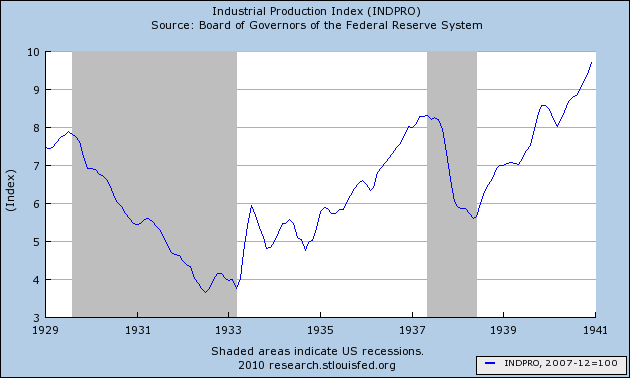
Okuns law is fine and great, but the fact is that we can’t distinguish between real and nominal GDP figures. This is because price indices are methodologically faulty in every way.
I don’t know what this means, so if you could just elaborate. Swaps are derivatives used by banks in order to limit risk and volatility.
Credit Default swaps are intended to eliminate risk,but speculators bought them with the hope that a company would fail. This is because when a company fails the Credit Default increases its value.
This is a pretty good video explaining the role of Credit Default swaps.
Now there is nothing inherently wrong with Credit Default Swaps,but in the right situation Credit Default swaps can help to manifest a financial crisis.
Speculation is the result of inflationary policies which misdirect expectations and capital deployment. Blaming speculation for a crises is like blaming the thermometer for your fever. Also, real GDP isn’t all that important either. China has large GDP growth but it builds ghost cities and empty super malls, the Soviet Union had high GDP but people were starving the streets. The amount of capital investment is important, but the employment of capital and the remoteness of capitalist productions is what’s truly important.
Financial “guru’s” don’t understand economics, so they focus on the effects instead of the structural causes. For example, the international monetary system is a nightmare which has resulted in periodic currency crises and hyperinflations all over the world, nor do they understand the capital structure. They know as much about economics as your average roofer.
wages and salary help to increase income expenditure which in turn help to spur business. Thus the investment on the house may lose out,but the workers who built get paid, and they can use that money to buy comercial goods.
Speculation can be caused by numerous things…just look at the comic book bubble and you will realize that speculation is the norm rather then the exception.
Of course it’s the norm. Intense speculation should be the norm when monetary intervention, extreme regulation, and ruinous taxation is the norm. When the inflation rate is much higher than artificially suppressed interest rates, rational people will try to protect their savings in other ways, usually in security and commodity markets, but also, as we’ve seen, in durable goods (housing) and collectibles.
Consumption and commercial goods merely make up a portion of the economy. It’s the tip of the iceberg which is seen. The average person doesn’t see the actual economy, which consists of billions of intermediary heterogeneous goods, which can be employed in a myriad of ways, durable capital goods which are extremely sensitive to interest rates, and expectations which are altered by continuous price inflation brought about by the interventions. Retail is not really important; this sector is hit later and less dramatically relative to investment.
Sure. It doesn’t really have much to do with it. Now, are these prices bid up by speculation, or by credit expansion finding it’s way into the comic book market? I think it’s the former.
I don’t think more than 1% of the world’s population will take out a mortgage or loan to buy a comic book, nor will they buy comic books as a way to protect the market value of their savings.
Seeing as there has been little to no effect on the comic book market by regulation or credit expansion, there is probably very little in terms of bubbles and busts and the like.
Most importantly, it isn’t a capital intensive good. Low interest rates and cheap credit find their way into capital intensive projects. That’s why most busts are blamed on capital-intensive industries.
If Helicopter/Santa Ben doubled the $ amounts in all bank accounts and in everyone’s pockets wouldn’t we be having a close to 100% 4th quarter GDP growth placing us safely out of recession and onto to the proverbial gravy train?
My point is simple. Wide-scale speculative failures really just mean a lot of individual mistakes. This much we can all agree on, but it doesn’t point us to the cause of the crises. Individual failure is never the cause but always the result (perpetual economic chaos is not the typical condition. If this were the case, then many of us would be dead, and the world’s population would have never reached such a level). The real questions are:
What caused the cluster of error?
Why did the price mechanism fail to coordinate production?
A certain amount of failure is expected; in fact, it’s healthy and required. But total systemic failure is neither healthy, nor required. If you think massive spending can magically repair deep systemic and structural problems then fine, but don’t be surprised when you’re wrong, and don’t say, “no one saw this coming.”
The politicians and central bankers are merely tampering with the thermometer.
Who are you responding to? By highlighting the text and clicking the “Quote” button under the article you’re addressing you can quote the text you’re replying to, like I’m doing right now. (And don’t use “Quick Reply”.)
I wasn’t talking about banks’ capital but doubling EVERYONE’s $ balances + cash. So if not 100%, perhaps 60% GDP growth then? That still wouldn’t be so bad, would it? We’d still be safely out of the recession, and onto new prosperity, right?
But, like I said: I don’t think that this either proves or disproves the Austrian business cycle theory (in fact, it is Hayek who says that empirical evidence can disprove a theory, but cannot prove it). Most business cycle theories, I think, agree that liquidation takes place (at least, naturally; many might think that government intervention can prevent said liquidation with positive consequences).
If you read my previous posts you see I fully expected this. I even joked that perhaps we’ll see US GDP grow by 10% in 2010 and will be outpacing China. [;)]
What does this teach us? First thing, GDP data are quickly and worryingly becoming less reliable indicators. All you have to do is have some moderate inflation to prop up prices a little and stocks a lot or increase money spent on, say, building dams and your GDP will grow no matter how bleak the situation is. Of course analysts know this better than us and they always try to get different and better data but good, reliable information sell at a premium price so not everybody can afford the cost. Not only that but as the rating fiasco in the US subprime market showed us even respected information sources are prone to manipulation. Second thing. Governments all over the world are doing nothing to get out of the corner they’ve painted themselves into. They just can’t because nobody is willing to take short term pain for long term gains. So the trick they are using is propping up confidence artificially. GDP figures have to grow, retail prices have to stay stable (though inflation is starting to be felt quite heavily in a growing number of sectors), sales have to be propped up by either supporting consumers’ loans or providing “stimulus packages” or even both. If people doesn’t lose confidence you can continue doing pretty much whatever you want, even if to be honest modern confidence is very similar to complacency. Third thing: remember Uncle Sam needs to find buyers for his growing mountain of debt. Sure, the Fed could print dollars to buy as much as needed but that leads us back to point two. Inflation can be delayed or masked but eventually the dam will be broken (and right now I see a worrying number of leaks). China isn’t so willing to buy anymore and Japan is in too bad shape to get back to the good days of the golden '80s. That’s why Uncle Sam needs to show his economy is vibrating and growing at a record pace, to find buyers, both at home and abroad.
All in all don’t be taken in by these numbers. Austrian economics are still right and sadly real economy is still in the gutter.