I thought a free society simply meant no coercion and no dictates against private property. How on earth does personal morality come into a relevant part of this issue? It has nothing to do with it.
Really - unless you subscribe to arbitrarily defined “conservative” values held by Hoppe, you won’t have a libertarian society? I am trying really hard to make sense of it here. I don’t support Brazilian style forced integration policies or Indian style affirmative action, but how on earth does that mean that unless everyone fights against there happening to be multiculturalism, society will “contribute to further erosion of property rights”? Or that they hence must be “radical and uncompromising conservatives”?
I don’t care if my neighbourhood is “monocultural” or “multicultural”; I’d simply let whomsoever move in, who legitimately acquires private property there, and won’t make it my business. I wouldn’t use statist coercion against anyone’s personal discrimination, any more than I would personally try to discriminate, in order to safeguard some sense of conservatism.
I just don’t understand how or why Hoppe likes to use his irrelevant personal values into the picture of broader political and economic issues. This man is just a plain and simple WIERDO.
I know nothing about this fellow your speaking of, but if I understand correctly, the discussion is whether or not certain morals are required for a anarcho-capitalist society to function.
Consider it this way. If everybody but you believes that fascism, murder, and theft are moral, they all surround you, and are much more well armed, how well is your society going to work out?
It is not that morals and culture cannot vary in such a society, but they all much have respect for life and liberty and be aware that it is in their own interest to support a free society.
A society ends up being the total sum of the people in it. A society composed of destroyers cannot be at the same time a society composed of creators. Tyrants will try to impose tyranny. Drawing a line around your property does not make him respect it.
I don’t think you understand what Hoppe is saying. I think he is arguing that to discriminate is an act of exercising ones right to his own property, his right to choose. This right to discriminate can only be taken away by violating individual rights, which is what egalitarian multiculturalism is all about.
Is he really talking about just forced integration?
He says that the modern libertarian movement contributed to erosion of property rights, because he feels that private property capitalism and multiculturalism are incompatible.
Unless he means to say that libertarians championed affirmative action and related civil rights laws (which I doubt, since it’s not very libertarian) - I can only assume he is criticizing libertarians for not being “conservative enough”.
yes. he says those words forced integration 10’s of times with a number of explanations in differing chapters.
yes. when it is forced.
He is talking about libertarians that championed affirmative action and related civil rights laws.
From the book I gave in previous post:
“Contrary to the left libertarians assembled around such institutions as the Cato Institute and the Institute for Justice, for instance, who seek the assistance of the central government in the enforcement of various policies of nondiscrimination and call for a nondiscriminatory or ‘free’ immigration policy, true libertarians must embrace discrimination, be it internal (domestic) or external (foreign). Indeed, private property means discrimination. I, not you, own such and such.”
(Conservativism according to Hoppe) “What it means, and possibly only can mean, is this: Conversative refers to someone who believes in the existence of a natural order, a natural state of affairs which corresponds to the nature of things: of nature and man. This natural order is and can be disturbed by accidents and anomalies: by earthquakes and hurricanes, diseases, pests, monsters and beats, by two-headed horses or four-legged humans, cripples and idiots, and by war, conquest and tyranny. But it is not difficult to distinguish the normal from the anomaly, the essential from the accidental. A little bit of abstraction removes all the clutter and enables nearly everyone to ‘see’ what is and what is not natural and in accordance with the nature of things. Moreover, the natural is at the same time the most enduring state of affairs. The natural order is ancient and forever the same (only anomalies and accidents undergo change), hence, it can be recognized by us everywhere and at all times. Conservative refers to someone who recognizes… families and households based on private property and in cooperation with a community of other housholds as the most fundamental, natural essential, ancient, and indispensable social units.”
etc, etc… a whole chapter goes on and on about him explaining his point of view on this.
How many self proclaimed libertarians have no problem with anti-discrimination laws that prohibit a man from discriminating against race, sex, age, etc….? This is what he is talking about.
I don’t think so. And ‘libertarians’ who support forced integration are not libertarians.
Hoppe and friends are ranting about libertarians who reject cultural conservatism. Hoppe and friends are devoted to promote the ridiculous notion that libertarianism and ‘cultural conservatism’ go hand in hand. They are ‘thick conservatives’.
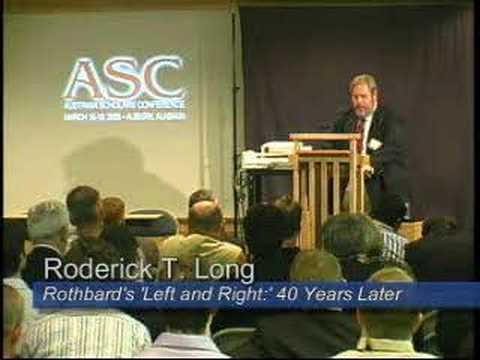
Roderick Long has an interesting lecture on left and right that I think applies to this discussion:
He distinguishes between means and ends, and claims that the end society envisioned by anarcho-capitalists is essentially the same as the end society envisioned by socialists (individual freedom, ability to reach your life goals, human dignity, etc.). This contrasts to the end society envisioned by conservatives (hierarchy, authority, corporatism, etc.).
The difference between libertarian-liberals and socialist-liberals is that socialists attempt to use conservative (statist) means to achieve liberal ends, whereas Rothbardians argue for liberal means to achieve liberal ends (which I think only makes sense).
Yes, but this does not apply to what Hoppe is saying. The liberal ends we are in pursuit of are objective. You can say without a doubt that freedom is better than non-freedom. Hoppe is criticising the misguided libertarians who are libertarians because they are in pursuit of goals which are not objective, but which are mere preferences. For example they think that a libertarian society will be more receptive to nose rings. He is warnning them that with people free to discriminate that will most likely not be the case.
Much like all the “free marketers” in the US Federal Reserve?[;)]
OK fine, I get it, but why then does he still acknowledge as ‘libertarian’ those who support state-sponsored anti-discrimination policies? Does he feel that some of those specific libertarians’ other ideas still make them libertarian? Or is it all a matter of degree how libertarian a man is? Pardon me for getting into semantics, but that’s why my confusion comes in.
Also, how would private property prevent immigration? Wouldn’t it encourage more immigration, because private property ensures better and more beneficial use of resources, and hence encourage more people to set themselves up near other successful private households to do business with them? America had plenty of immigration before either xenophobic lockdowns or reopening up of their nation. And even in many racist or segregated communities of the world, economic realities still forced international or intercultural dealings - blacks were illegally employed as construction workers in South Africa despite white quota laws, and Chinese were still grudginly accepted as workers and managers in old Malaysia. Obviously, there was “necessary” discrimination, like telling that Irish need not apply or giving top jobs only to Anglo-Saxon Protestants, but a true libertarian can still appreciate the end results of such free discrimination, while still not having problems with multiculturalism.
A free society can not prevent individual discrimination or prevent individual choice of intermingling - so while he is right that discrimination will still naturally result in free society, so would it work the other way round. I don’t think free society would lead to the goal of no discrimination (if that’s what these “left-libertarians” intend), but nor do I think free people must necessarilly discriminate, that “true libertarians must embrace discrimination”.
It’s not so much that he acknowledges them first as libertarians. It is this group, that I defined in the quote, that state they are libertarians but then use the government to achieve their ends. It’s gradualist libertarians. Those thinking they can gradually go through government channels, and work within the current system to rid the government. Even on this forum there are libertarians that are openly gradualists. [I’m an abolitionist not a gradualist.]
It’s more their labeling of themselves as libertarians, not him. It’s the label battle. I don’t know if he would actually say they are a true libertarian. The way Hoppe comes across I don’t think he sees them as true libertarians, but stating that always starts in-fighting, debate, etc… on who is a true libertarian.
It is confusing. When it comes to conservative for instance, and I’ve noticed this about Hoppe, he’s battling the labels. He’s trying to strengthen the terms to mean what he means. He has done this with other terms too such as socialism I believe (but I don’t remember where I read that - I know it was a Mises Daily article). He seems to try to turn the terms around on his opposition. The opposition does this too. Liberalism used to mean liberty and now a days it’s kin with communism and socialism. It’s the battle of ideas.
It’s my property and nobody is allowed to cross my yard. I could say that. Others could say that. If, for instance, property rights were allowed to be enforced by the property owners themselves without the threat that the U.S. goverment will come down on the property owners and subvert their property rights such property owners could say they don’t want Mexicans or other southern peoples to travel across their land. They could stop them with self-defense if that’s what they want to do.
sure. a community may well benefit from trading with others from differing communities (immigrants). It’s really the forced integration that he’s talking about which comes from the government. Instead of letting people voluntarily reach out to each other and learn about each other more naturally, the government is forcing people to get together which culturally doesn’t allow for expectations of behavior to develop. Culture provides predictable expectations amongst the society partaking in the culture. Diffferent cultures have different ways and thus the more “alien” or “foreign” a culture is to one group of people the more it is not readily understood what the different cultural individual is doing. More surprising actions happen and this usually develops tension between the people. It is only natural that different cultures are not understood and unpredicatable actions by the individuals will happen. Language is one but how they may greet each other, etc… The inter-cultural interactions happening on the terms of the individuals involved in the meeting is understood better by the people actually involved in the interaction. It’s the same quality of exchange that happens in the free market. Let the people involved in the interaction - interact with each other on their own individual terms so they can learn about each other, not by forcing them to simply get together.
I don’t readily know what you are saying here. Hoppe isn’t saying people have to live separately. Again that would be forced separation. Hoppe is against forced anything (caveat: except in instances of self-defense).
Well I gave his definition of discrimintion which he stated means “you and I”. Each person is unique, creative, and diverse. They are discriminative of each other and no person is exactly alike. That quote of yours is focused on one topic of discussion and in no way excludes people from being able to voluntarily, thus, naturally interacting with each other.