Do you know something about 70’s stagflation and most important how did it ended?
what makes you think we are currently living through another period of stagflation???
in the 1970s it was not uncommon for price inflation to approach double digits. In 2010, it was less than 2%.
Haha, nice one.
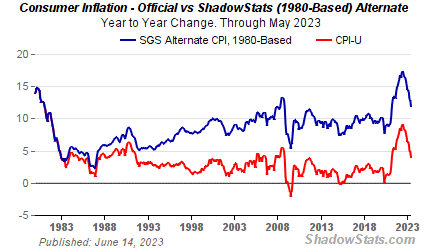
Actually if you look calculate the CPI/ unemployment rate like we used to in the 70s and early 80s, the 00s was a decade of stagflation. The main difference in the CPI is that it is a quasi chain weighted basket, it changes the weight of goods with rising/falling prices to mask an increase in the standard of living. The unemployement rate no longer includes discouraged workers and people who have accepted part time instead of full time jobs. Discouraged workers for less than a year have been relegated to U-6, and for more than a year have been removed all together.
Makes sense since just like in the 70s when the U.S tried to inflate its way out of a recession, the U.S did the same in the early 2000s. The end of stagflation came when Volcker decided to raise interest rates-very high. This got rid of the inflation (it reduced it at least), but caused a very serious recession. The U.S right now will probably go through another 70s-poor growth, high inflation, and high unemployment. The problem the symptoms will be much more serious and there is no way out for the Fed like there was in the early 80s, if Bernanke tries to raise interest rates that much he’ll bankrupt everyone. The government and debt laden consumers have enough trouble paying their credit bills with very low interest rates…imagine the defaults if interest rates were 5-6% higher!
Sometimes I have the impression that all of this money printing has been done by America to force China (biggest creditor) to do moneyprinting as well. And this strategy succeded - China central bank has been printing way more money than the US. If the trend continues, when in the future the chinese printed money will reach like 25 times the US printed money, the US could jump out of the game and leave China to fail with its huge new worthless printed money. Could it be possible?
Stagflation ended when the Fed hiked rates up to 20%. We are currently not in any sort of stagflation so I’m not sure why you’re saying we are.
If US inflation would be calculated like in the Carter era (1977-1981) it’d be over 10%.
And if unemployement statistic would add also people who gave up searching for a job, the present 10% would go to a 20%.
Maybe if one uses the modern way of calculating inflation and unemployment for the 70s, it would suddenly stop being a stagflation period, and would actual be a time of growth and rising living standards…
Indeed, we are at the very beginning of a new stagflation era, since the government still manage to make the people believe there is no recession (despite what we can see around us: prices in the stores we go, unemployed friends, etc..).
Add a few things to Black Numero’s excellent and concise response.
Volcker’s decision to drastically raise interest rates overnight is rightly seen as the thing that a put a brake on runaway inflation in the US. The recession that followed was very sharp but also short lived. The Reagan administration had the “political capital” which allowed it to play this game. It must also be said that the late '70s-early '80s economy was much less debt-dependent than what we have today. Right now cheap credit is seen as ordinary if not a God-given right and many firms are shifting capitalization from balanced (stocks, obligations, loans etc) to simple debt. There’s also the issue of private debt: back at the time saving rates were still good, right now indebtment is the norm. When Volcker raised interest rates savers quickly saw interests on their deposits and investments raise rapidly, more people started saving more thus providing more capital to the economy at large. Now savings are declining and more and more people are getting into debt. Should interest rates be raised it would be extremely painful for a large chunk of the population.
I don’t see the Fed raising the interest rates but I have seen many signals the European Central Bank (ECB) may do this before the Summer. Inflation in Europe right now is a very serious concern and anti-euro sentiment is at an all-time high. Even politicians have started to question the ECB’s self mandated goal: “keep price stability”. Don’t expect a Volcker-like hike: it will probably something like 0,5%-1%, perhaps dilituted in two-three steps. If it works expect even the hard-headed Bernanke to take heed.
So no one sees a way out of our current stagflation?
If US inflation would be calculated like in the Carter era (1977-1981) it’d be over 10%
products and spedning habits have changed quite a bit over the past 30 years. what makes you think the way inflation is calculated should have remained unchanged? please elaborate.
and even if you prefer that version of the cpi, it is best to measure inflation and inflation expectations using a variety of metrics. another way to see if prices are expected to rise as fast as they did in the 1970s is to look at the long-term interest rates on govt bonds. If savers really believed that prices were going to rise as fast as they did during the 1970s, they would demand interest rates to be similarly high so that the real value of their savings was not eaten away over time by inflation. Looking at the data, we see that interest rates on 10-year constant maturity t-bonds peaked in the early 80s around 15%. Today their interest rate is 3.46%.
And if unemployement statistic would add also people who gave up searching for a job, the present 10% would go to a 20%.
Actually, if you just add discouraged workers (workers who gave up looking for a job for job market reasons), then you would want the U4 measure of unemployment and that is only 10.4% as of Jan 2011. If you add persons marginally attached to the work force (ppl that are not working and not currently looking for work but have looked for work in the past 12 months) then unemployment is still only 11%.
http://www.bls.gov/news.release/empsit.t15.htm
Really, to get close to the 20% figure you’re throwing out there you would not only have to add discouraged workers, and marginally attached workrs, but also workers that EMPLOYED part-time for economic reasons (U6), which gets you to 17%. But once you account for seasonal employment trends (like say the end of the christmas season) U6 in Jan 2011 was actually closer to 16%. Not really all that close to 20% if you ask me.
Plus, it should be noted that U6 numbers were not collected until the 1990s, so U6 unemployment during the 70’s could have been way higher that what we’re experiencing now. We just don’t know. It sounds like you are basically just looking for what you want to see.
As long as the political and economical class still continues to avoid a serious debate and half-heartedly stick to the party line “the recovery is here and it’s stronger than expected”, no. Recent government-commissioned polls in Europe showed a vast majority of Europeans is convinced “the worst is yet to come”. I am sure US citizens hold very similar views.
Nobody has the political capital to endure the pain caused by a sharp recession which would be necessary to eliminate the enormous malinvestments which have accumulated. It’s much better to “kick the can” and keep on pointing to inflation-fueled GDP data to show the cure is working. At least the Japanese were more honest and didn’t cook the book as much as the present lot of scoundrels.
@ Student
Don’t you think that a government has a strong incentive to keep price-inflation numbers as low as possible? And is in fact getting better in doing this over time?
I mean I don’t think we need to argue that as soon as the incentive is there, politicians have really no scruples what so ever to actually follow them. But why not make an argument:
E.g.: Bush said about the budget 2002 that it will retire nearly $1 trillion about the deficit over the next 4 years. In fact he predicted that over the next 10 years there would be a $5.6 trillion surplus, nearly wiping out the complete debt. When he said this US debt was at $5.7 trillion. Instead of going to 4.7 Trillion 4 years later it was at $7.7 trillion (This was before the recession set in!). And now it is at over $14 trillion. What do you call that, slight rounding errors?
For Obama’s 10 year plan I’ll just quote:
“As did Mr Bush’s fiscal 2002 budget, Mr Obama’s fiscal 2012 budget delivered on February 14 includes projections ten years into the future. Unlike Mr Bush’s projections, Mr Obama’s projections for the period between now and 2021 do not contain a single budget surplus. Instead they add up to a cumulative deficit over the next ten years of $US 7.2 TRILLION. The biggest projected annual deficit - $US 1.65 TRILLION - is for the fiscal year ending on September 30, 2011. The smallest - $US 619 Billion - is for fiscal 2018. By 2021, the total annual outlay of the US government is predicted to be $US 5.697 TRILLION. That is an increase of 49 percent over the projected outlay for the current (2011) fiscal year. By 2021, the total annual revenue of the US government is predicted to be $US 4.923 TRILLION. That is an increase of 126.5 percent over the projected revenue for the current (2011) fiscal year. By 2021, government revenues are predicted to have risen 2.5 times as fast as government spending.”
http://www.zerohedge.com/article/rick-santellis-meet-press-appearance-113-trillion-future-rounding-error-and-metamorphosis-am
Want to extrapolate Obama’s accuracy based on Bush’s? I really just can hope that Obama was just honest now, because if he would have lied he also would have predicted surpluses of course, but I somehow think that would be quite naive to believe.
Secondly, you try to disprove that price inflation cannot be at around 7-10% because the interest on 10 year bonds are historically low. Not a good argument. They influence each other both ways, not just in one direction. You are presupposing that downplayed cpi numbers have no effect on people/10 years bonds interest rates. I would argue that you are the best example that downplayed cpi numbers work 
Additionally the FEDs goal of QE2 is in fact to push long term interest rates down! So you are looking from one fixed number to the next. http://moneywatch.bnet.com/economic-news/blog/macro-view/qe2-600-billion-fed-move-targets-new-jobs-but-risks-inflation/2747/
I don’t think anyone’s advocating that the inflation rate calculated in the 70s was better because of what composed the basket, but how the basket was composed. Back in the 70s/80s, it was a fixed basket. Now, since the Greenspan Boskin commision in the 90s, its a quasi substitution basket; when the price of one good rises, it is then “weighted” less while its (inferior) substitutes are given a larger weight. This no longer measures a constant standard of living but a declining standard of living and roughly reduces the inflation rate by 3% (according to shadowstats). This is an enormous boon to the federal government for its debt obligations (mainly entitlement programs).
Since the inflation rate has been tampered with over the years, people’s inflationary expectations have diminished. If inflation was reported like it used to and had been several percentage points higher in the 90s and mid 00s, interest rates wouldn’t be nearly as low as they have been. The government’s CPI manipulations have trained people to think inflation has been tamed when its just been partially masked.
In addition, since the 80s foreign nations have gobbled up American debt (both private and government).If there wasn’t such a large supply of foreign capital entering the country, the U.S would not have such low borrowing costs.
Prices Paid vs. Prices Received.