I’ve been having trouble following the logic of AnCaps who condemn democracy yet advocate the complete abolishment of government.
If you abolish the government, does it not become pure democracy? Who will decide the rules of society if not the majority of the people in that society?
If you’re right, why are you worried about it? Either way, democracy wins.
Democracy is just a decision-making procedure. The government consists of the tanks, bombs, policemen, judges, bureaucrats and elected officials who act in the role of a government. Democracy is supposed to permit the majority to dictate the actions which these individuals will and will not be allowed to take.
If the government is abolished, there is nothing to “democracy” about - there are no rules and restrictions on government behavior because there is no government.
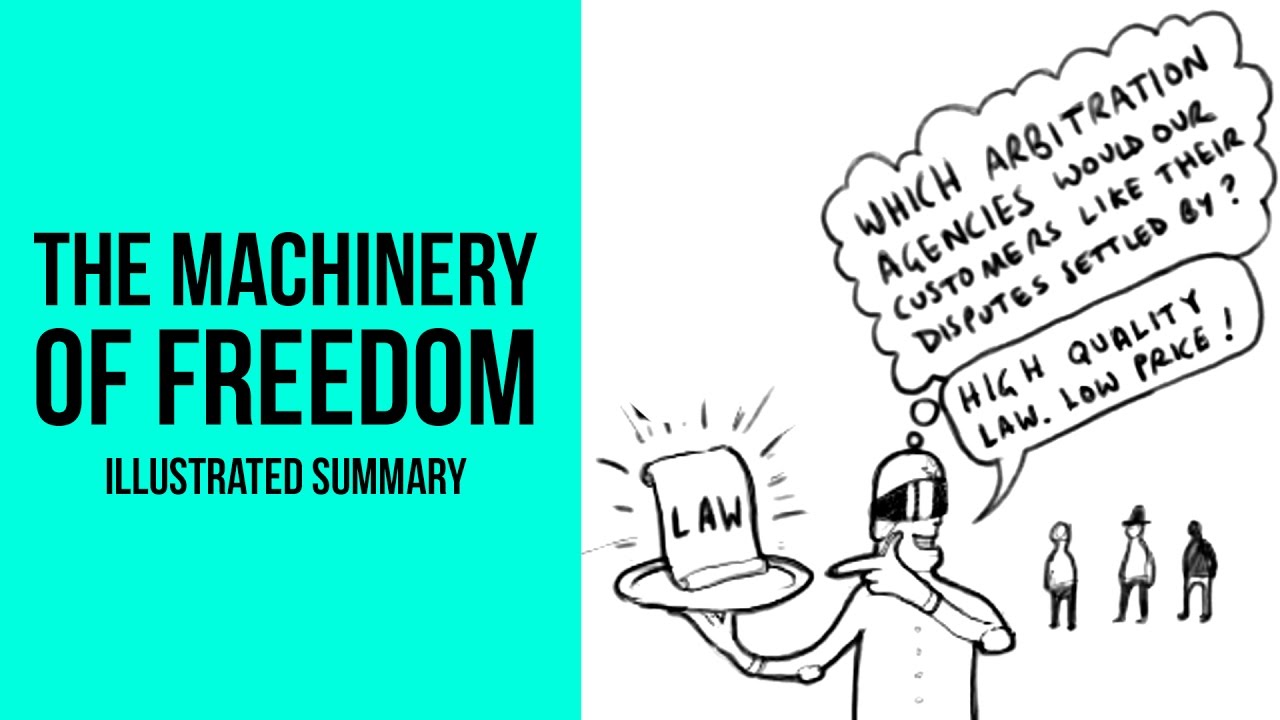
The rules regulating the social order (laws) will be decided as they have always been decided: through real resolutions of disputes whether through the assistance of arbitration (the role that courts today play, kind of) or not.
The market is not based on democratic principles. You do not need the permission of the majority to buy the goods and services that YOU subjectively desire. You don’t need, for exmaple, the approval from 51% of the population in order to buy a flat screen tv, steak dinner, etc. The market satisfies the needs of individuals and not broad coalitions with varying ideas regarding how society should run. Democracy, in short, is just a light version of tyranny.
Well, ya know, Mises does say that the “Democracy is a type of government that attempts to mimic the market.” He goes on and on in Human Action about how the market is basically democracy. It is just not equal democracy as you vote with your money (or labor) and those with less have less say in the order of things than those who have more. Obviously, one with a lot of resources can command more market forces in his favor than one with less.
Political democracy is a way of deciding what kind of government society has. It is not a type of government.
The ideologues on here that say ‘democracy is tyranny’ don’t appreciate the nuances of what it is. It can decide to have no government or it can decide to have communism. Political democracy takes everyones “purchasing power” (to extend Mises analogy) to the same level. Your vote is as good as anyone elses. But, most of the time, democracy is a rhetorical disguise for whatever statism lurks behind the eyelids of said politicians. Once he wins, he’ll have the support of the majority.
Probably kind of the same reason we aren’t much into Keynesianism / utilitarianism
While it’s true democracy sort of mimics the market by people demanding stuff they want and getting it when they want it (hence why democracy may “sort of work” / kind of resembles anarchy) - it doesn’t deal with actual factual action, process, and consequences which is what the market is - the only real consequence of social action - where everythig else just functions as a poorly “subsidized market”.. i.e. voting for this or that “right” or “idea” isn’t really a “thing” as much as it is a deus ex machina - and can’t really corrospond with ever changing unique environments, expectations, actions, contexts, perspectives, etc.
The reality is; there is no “democratic imperative”, unlike human action - which is not a thing, but a process of facts. - the consequences of which happen to be social behavior
The left anarchists tend to like democracy, but think that there is no meaningful democracy now. Since it is controlled by corporations and within the framework of capitalist hierarchy. Democracy in this view is only available when there is socialism and democracy in the working environment. Albeit without the state, which in this view can only serve capitalist ends, rather than democratic or libertarian ends. So ‘democracy’ is a smokescreen to make you think you are participating. When really you are just voting on those who were chosen for you by the media, which is run by private interests.
I think ancaps, on the other hand, feel that existing democracy is a sham in the same way. But that it cannot truly be resolved through socialism or any system, and that society aught to be based as much as possible the ability of individuals to make free decisions, whether democratic or not.
I agree that the “democracy” that we have now is highly corrupted and that there’s nothign really democratic about it.
One of the problems in my mind being that the U.S. was never intended to be a democracy - it was supposed to be a representative republic. I feel that the more “democratic” people try to make our society the more socialist it has become.
Personally I think that the idea and acceptance of universal sufferage has done a lot of damage to the western republics and constitutional monarchies.
I’d like to answer your questions, but I’m not completely sure what you mean by “democracy”, “society”, or “the rules of society”. Could you please clarify? Thanks.
By “democracy” I mean a system wherein the majority decide the rules of that particular system. By “society” I mean an aggregate of people living together in a more or less ordered community. By “rules” I mean the laws of that society (what is allowed, what is not).
Why monarchy , corporations, or whatever may make more sense:
In this way we are dealing with “the king’s justice”, or “the CEO’s decision”, or “the owner’s profit” - in other words profit, justice, value etc are facts / consequences determined by concrete actions) of something that acts, a fact (laws are determined by facts). We can’t vote on “justice”.. there is no mystic commune..
Hell, in the sense that voting itself is not abstract , it is certainly no more or less a determining concept than any and everything else that happens at some particular time; it is just one “thing” at one particular moment that happens in a sea of infinite creative-destructive processes within a realm of incalculble expectations. How it determines behaviour or what ever can’t really be spoken of anymore than me tying my shoe or making a sandwhich - to subsidize a random context and to mark it and turn it into a sacrd “fixed idea” is nonsense…it underscores the world as uniquness and process.
Words and concepts hold up as useful fictions, and nothing more - they are volitile, currency, the unavoidable consequence of social action - they are not “things in themselves”. To be fixated on such buzzwords as “democracy”, “science”, or a million other such nonsense causes and not see them as a useful product of fashion is to possess oneself with some form of Platonism or conservativism - which is a death sentence, as you are grasping at ghosts and deluded by your own mind (which like it or not, is still your own ).
Way to ignore the basic point I made in my original post.
Yes, democratic governments attempt to mimic the market economy in the sense that they allow individuals to express their wills and subjective preferences. The difference, again, is that democratic governments, in order to do anything, require broad coalitions i.e., majority consent. In the market economy no individual requires the consent from any other individual and definitely not from 51% of the population. Individual’s, again in the market economy, are solely constrained by (a) their preferences and (b) their productive contributions to society (income).
This is the highly idealized 8th grade interpretation of democracy. In fact, your vote is only “good” if you vote alongside the broad coalition that controls the state. If you’re not part of this coalition, then your vote means absolutely nothing and you have to wait x years before you potentially get what you want.
@Aristophanes: I responded to your post yesterday but apparently the forum ate it without me noticing.
Mises was a minarchist. I think he was simply incorrect in his friendly views towards a minimal state. A lot has happened since Mises’ time that shows that democracy is not just another form of government, it’s actually the least desirable, most tyrannical and aggressive form of government.
It is true that democracy has the effect of “floating/sinking all boats to the same level” as far as politically uninvolved/disconnected persons go.
It is not at all clear that this results in giving “the little people” more of a voice or say in political affairs.
Democracy intensifies the problem of separating decision-makers from the consequences of their decisions which is the essential problem of government.
The problem with democracy as a form of decision-making arises from the problem of scale - do the participants in the election have an incentive to be informed and invest effort calculating (rational ignorance/rational irrationality)? Caplan explains why the “magic of large numbers” doesn’t solve this problem.
Well he made that decision back in the 40’s, before he could anticipate the possibilities in which computation and automation makes anarchism possible. I bet he would be an anarchist today.
Going with that definition, anarcho-capitalists aren’t opposed to “democracy” per se. They’re opposed to states, regardless of how their rules are decided upon.
Do you think multiple overlapping “societies” can coexist? Why or why not?
Okay, based on this and your definition of “society”, it seems like you’re conflating “society” with “state”. So with all due respect, I think there are deeper issues with your thinking that need to be resolved.
The idea is not to abolish national governments and live in democratic hippie communes. That would still be government. No, the entire point of anarchism is that there are no collective “rules of society”. So there should be no process by which to make such rules. If an area of land is even defined as a sovereign “community”, then it is a state. By definition, territoriality implies statism.
Just a nit-pick on this… territoriality beyond those free agreements which property owners may voluntarily enter into and which solely concern the disposition of the respectively owned properties. For example, a home-owner’s association consisting of contiguous properties surrounded by a wall or fence is not a “state” so long as there is nothing in the HOA agreement which uses coercion to redistribute property, etc.
I point out this nitpick because one of the ways we can envision a forward path to liberty is a kind of “bloodless breakdown” of modern political aggregates into smaller and smaller units down to the level of old-school city-states. Such city-states would not be pure laissez-faire institutions but they would be a damn sight closer than what we have today. And such a world would open up the possibility of experimental communities trying to pilot a true through-and-through private-property social order built on real contracts (instead of fairy-tale contracts like “the social contract”).
Anyway, I’m sure you agree with this but just wanted to point it out for newbies or lurkers.