Well first off, that is a different definition then what you gave before. Secondly if that is your definition then every property owner is in fact ‘a government’ and so too apparently the organized crime families, not that they exist of course. Again you are not working with a fully conceptualized definition of government which is causing errors in its application. If you don’t have a proper concept then you obviously cannot properly apply it.
Does this apply to my family and home? Damn, this whole time I thought I was an anarchist, but I’m actually a government.
I’m a benevolent monarchical figure according to my cat. My rule is just and resolute.
Liberties are any human actions that are willfully free of the restrictive actions of others. The “do not harm” property requires additional restrictions on that set. It is those additional restrictions–like attributing the same nonconflicting set of liberties to each member of a group–that need explaining.
“government could be any body of power (legitimate or otherwise).” No, not really.
Yes, property owners are governments. Why do you think so many anarchists seek to abolish private property, even some left-libertarians (just go to ALL-Left).
Yes.
Patriarch - “The office of a patriarch; a patriarchate; A social system in which the father is head of the household, having authority over women and children; A system of government by males; The dominance of men in social or cultural systems”
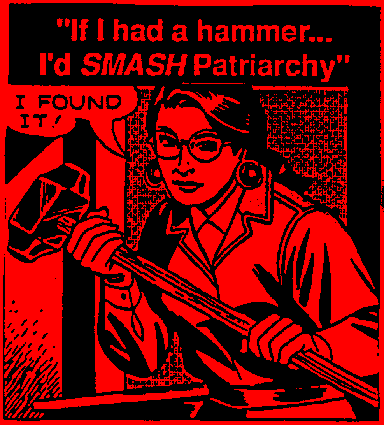
My friend, you are confused. Let me help you.
In contrast to a liberty, a right is a relation between two or more persons, the right-holder and the obligor. The obligator must perform at the rightholder’s bidding do to the agreement made before-hand. A right is created by contract and in doing so the obligator surrenders part of his liberty in exchange for some form of payment or consideration. For example: I have a right to health care means that you [the doctor] have an obligation to provide such treatment. You [the doctor] now lack the liberty to deny my treatment. Here, both parties enter voluntarily into the right/obligation relation. Liberty is like innocence - presumed until it can be proven otherwise.
“Rights” is an ambiguous term. It certainly can mean anything from what a powerful king claims he is “allowed” to unilaterally do to his unwilling subjects, to the simple declaration of a mystic, to a very small set of agreed to liberties. That is, not all meanings even require agreement. Although every notion of rights that I know of does require two or more people (or at least presumed people-like entities).
In the context of Enlightenment and post-Enlightenment thinking–and this thread–“rights” refers to a supralegal concept regarding interactions among human beings, as a foundation to the oft discussed topic of “natural rights” or “human rights”, and as a basis for judging individual behavior, laws, and states. In that context, the foundational concept of “rights” must be “agreements to liberties”.
That is to say, when someone like this poster inquires about where rights come from (or claims their nonexistence), he is not, I believe, asking for a stipulated definition or a derivative concept, that still leaves his understanding floating in air and his acceptance a matter of choice. He wants to know if they EXIST as a matter of reality, regardless of subjective interpretation–in the same way that the floor he stands on, or the air he breathes, exists. That is, he wants to know if acceptance is ultimately unavoidable. The answer to him is, “yes”. The foundation of rights is as mundane as soil. The stripped down explanation to him is as I previously posted. It is a product of the readily observed (and introspected) nature of human beings, and of the material world. It is avoidable only in the same way processed sensory perceptions and laws of consciousness are avoidable. It is ultimately the result of the ability to agree to not interfere with another’s values. Values, action, and agreement being the necessarily underlying concepts. The FACT of rights does not always comport with people’s values and emotions (people often conflating values and rights), but facts simply are. People talking about rights are often not talking about the same thing.
Hopefully this clears some ambiguity, and justifies to you my condensation of the concept of “rights”.
In spite of my prior post, you still for some reason cannot see that I am articulating two DIFFERENT concepts for “rights” and “liberties”. I’m not sure why you think that. Maybe you read my post thoughtlessly (not that I blame you, judging from the quality of so many posts). Perhaps in this context you will rethink my last post and deliver a tailored criticism. I look forward to it.
Thanks for the reply,
“Agreement to liberties” is a completely incoherent idea, completely distorting what rights and liberties are. The idea that you have a right to engage in free acts is completely redundant and pointless. Liberty is to be presumed unless you have a claim against it (A right). Those who argue for natural rights basically fall into the same trap as statists who argue for the “social contract.”
This point doesn’t really have anything to do with the distinction between rights and liberties, its already been discussed ad nauseum on this board. And While I completely disagree, I’m not going to go into that again, I and others have patiently waited for an actual proof of said rights. as of now - nothing.
Yes really. You provided your first definition in which you define government as anyone with power. Then you proceeded to say government is anyone who makes laws and regulations and possesses the ability to enforce them. Clearly there is a disconnect with power and rule making/enforcement. Am I powerless if I choose to not enforce rules? Say someone suddenly came on these forums spouting Marxist propaganda and cursing the forums out. I am a moderator, if I refuse to ban this person, do I lose that power?
Because they are stooges who think that property is establishing a hierarchical system of privileged which would then regulate society to a certain class of rulers. Why you would appeal to their definition of such nonsense is truly confusing to me.
i argue for natural rights and don’t fall into that trap. Natural rights aka I use my own intellect to understand reality and anybody that initiates physical aggression doesn’t provide me the choice/chance to go on in the way I want to.
Any body of power doesn’t necessarily mean anyone with power.
Who cares, the point is still made? Conflating government with state makes you seem just as stooge-ish as those conflating private property, family, organised religion, etc… with government with state.
Thats not an argument for natural rights at all, its not even an argument. Why ought I provide you with the choice/chance to go in the way you want?
yes it is.
it doesn’t matter
Well if the people don’t have the power then how does the body?
Oh wonderful we are going to get into another discussion about how the State isn’t supposedly the government. Honestly, if you don’t care then there is no point in discussing this further.
Anatomy of the State
$5, I suggest you give it a try.
Good points.
Contractual Agreement. Example; I want my up-start hockey team in the LNH, to do so I need permission from the owners, the authorities… the government. They have the power not I.
Wow. You get it backwards yet again. A government isn’t necessarily a state, the state certainly is a government.
Notice its not entitled “Anatomy of Government.”
Power can not be formulated simply by two people to agreeing to something. If person A doesn’t have property rights and person B doesn’t have property rights, property rights cannot magically spring forth because of contract between the two. One must first have the power to be able to establish it in a contractual agreement.
The State is the government, the government is the state.
I noticed you have not read it which is probably the reason you are having this problem of proper conceptualization and application.
angurse writes ‘a government’ and laughingman ‘the government.’
because you are talking past each other.
A Government is the body within a community, political entity or organization which has the authority to make and enforce rules, laws and regulations.[citation needed].
Typically, the term “government” refers to a civil government or sovereign state which can be either local, national, or international. However, commercial, academic, religious, or other formal organizations are also governed by internal bodies
'the government ’ is terminology associated with politics, and refers to state government.
Nice strawman. Never said they could. Explain how the owners of the LNH, who have the authority and make and enforce the rules (i.e. govern) don’t compose a government.
The government? Which government? The state? Which state? (Notice you didn’t actually refute “a” point I made, rather you’ve fallen back into more affirming the question, quite stooge-ish.)
I noticed you have a poor understanding of words.
I’m still waiting to hear how layers administrators, boards of directors, board of trustees, boards of governors, etc who make and enforce the rules, (thereby governing) somehow aren’t a government. If you read MNR’s little book you’ll understand how they aren’t a state and only a state.