Immigration and Growth (I'm confused)

I took intermediate macroeconomics a few semesters ago before I really got into Austrian economics. Those of you who’ve taken intermediate macro know that you spend quite some time on the labor market, the production function, and the productivity of labor. The neoclassical analysis concludes that immigration is a major cause of long-term economic growth.

You’re taught that (the production function has constant returns to scale), in the short-run, an increased supply of labor reduces real wages as additional workers are spread over a fixed supply of capital, which, in turn, reduces the marginal productivity of labor. The total level of output, though, increases, as production is a function of both labor and capital. This, in turn, implies that as the supply of labor increases, the marginal productivity of capital must therefore increase (higher interest rates). As the marginal productivity of capital rises, the stock of capital will expand which, in turn, will increase the productivity and demand for labor in the long run (higher real wages).

Mass immigration is often considered to be a major cause of U.S. economic growth. Austrian capital theory also claims that an increased labor supply will elevate interest rates. But now the problem reveals itself.

The neoclassical conclusion (immigration causes long term growth) only holds if we assume capital to be a homogenous blob which is perfectly substitutable. In such a world, increasing the homogenous capital stock would indeed increase the marginal productivity of labor across the board. But once we drop this assumption (homogenous capital) we realize that it would increase capital accumulation only in the lower phases of production, which would make society relatively poorer. The only way it could lead to long-term growth is if the immigrants, for whatever reason, had a lower time preference, that is, if they saved more. This would extend the structure of production and increase future returns (once the roundabout methods of production are completed).

Therefore, once we look at capital as a structure, with heterogeneous and complimentary goods, we must conclude that immigration actually leads to economic contractions. This is clearly incorrect. My reasoning must be faulty; I’m missing something.

I do not believe that immigration lead to an increase of the stock of capital. Rather the contrary.

Let’s assume a simple structure of production with only two phases: lower and higher. There is a definite demand for the goods of either, and demand is unchanged (assume). Every such good can be produced by many combinations of labor and capital. The optimal proportion is, according to standard micro, given at the point where MPl/MPk=Pl/Pk (MP is marginal productivity, P is price, l is labor and k capital). Cool.

Now immigration of cheap but unskilled labor crowds the lower phases. With the supply of labor having zoomed, and its price plummeted, the new equilibrium for a producer of goods in the lower structure would be to convert capital to labor, i.e. to sell some capital and acquire cheap labor, up to the point where the marginal productivity of each component per dollar would again be equal. It seems clear that this would make capital “fly” toward the higher stage, not the lower. Thus, immigration allows for capital on the lower phases to be freed for use in the higher stage. There. Immigration brings wealth, to the chagrin of Hoppe.

Okay, too be clear, we’re using a production function where inputs are perfectly substitutable, within a structure of production consisting only of two stages. Already this is problematic, but I’ll go along with it.

The shock to the labor supply would increase the marginal productivity of capital (a higher rate of profit/higher time preference). There would be a lot more laborers per each individual unit of capital, in the face of very high profits (since labor costs fall dramatically). This would expand the supply of capital in the lower phase of production (we have to remember that production is a function of both capital and labor), as highly profitable firms will try to expand production in order to gain market share.

Your analysis only makes sense if we assume that the inputs are truly perfectly substitutable, that is, that the firms can, if they wish, produce with only labor, or with only capital. In such a condition, yes, firms would only employ laborers since that factor price is much lower relative to the price of capital. But I don’t see why capital would flow to the higher phase. Why wouldn’t both phases just use labor?

But again, the higher rate of interest, and the high profits obtained by the lower phase of production (relative to the higher phase(s)) would draw capital towards the lower phases. The rate of profit in the higher phase would be much lower relative to the lower order, and as such, cannot pay the elevated rate of interest. This problem is only magnified if we assume more than one higher phase of production.

Again, the implication, according to Austrian analysis (real world analysis where capital is heterogeneous and complimentary), is that immigration makes society poorer; but this simply cannot be the case.

To my mind the best way to interpret the impact of the arrival of an immigrant is to look at his profit and loss statement over time. is he a welfare sinkhole? or rather, does he ‘add value’ via participating in the division of labour?

Wouldn’t the economy grow if the immigrants saved and contributed to the economy? I am trying to do a thought experiment with the “how an economy grows and why it doesnt” style island economy lol. If the three islanders are joined by three immigrants on a boat, the islanders can loan out saved fish (or produce and loan out nets) in exchange for more future fish. If the immigrants were productive and were able to pay back their loans as well as add to the islands stock of fish savings, there would be more potential for investment in future capital goods as well as more human capital available on the island.

I don’t know if this helps or not, but I am just thinking out loud lol.

Well, I’m not interested in other exogenous variables which alter the model. The welfare state automatically makes population growth and immigration a burden on society (to a certain extent). I’m more interested in pure theory.

Yes, if the immigrants had a lower time preference, that is, if they saved more than they consumed, then immigration would expand the structure of production and make society wealthier. But there’s no reason to assume that they have a low time preference since they’re usually poor (live hand to mouth).

Now, if we assume that firms can only produce at a given ration of capital and labor, than any immigration rate will not affect production at all: capital is still unchanged, and hence labor is still employable up to the current level. In this strange world, immigration as such changes nothing.

In the likewise strange scenario, which I assume, that infinitesimally small gradations of capital and labor are fully interchangeable, than we agree that every change in the supplies of labor/capital, among other things, would change the optimal structure of production.

Now, it would appear clear that every change from the firs scenario to the second, would make the replacement of capital by labor possible. In the real world, some labor can be used to substitute some capital. That tends to be truest in the lower phases, where unskilled labor is hardly better than a simple machine. Thus interchangeability is possible. It would certainly not occur, in the real world, that such interchangeability be infinitesimal, but it exists, and that is rather enough for the general analysis structure to hold.

As for why would both phases use more labor, it is simple to see why: you have a given supply of labor and a given supply of capital. Both will be used as much as possible. When an infusion of labor makes the price of labor drop, and make it worthwhile to substitute labor to capital, as much as possible. To be fairer, it would pay to substitute labor to capital up to the point where the ratio of productivities in both phases equates. Than, if we assume that the labor infused is unskilled and unemployable ( or employable at a higher cost due to training needs) in the higher phases, it would seem clear to me that some capital would migrate towards the higher phase, simply because labor can now substitute for it in the lower phase but cannot in the higher one.

Now, when people speak of “profit attracting capital” they do not mean economic capital: they mean the means of productions. We must not make the mistake of taking “profit attract capital” in the literal sense where other factor are not attracted by profits! Thus the higher profits in the lower phase will attract means of production. Which ones? Shall it be and inflow of capityal, or labor? And since we assume a given supply of both, which shall flow out? We saw that it would pay to employ labor, and free capital for the higher phase. The flow of labor and the outflow of capital shall stop when the ratio of relative productivities n both stages equates.

Adding many stages of production and capital and labor classes (up to an infinity of classes, as in every machine/worker being unique) does not change the analysis one bit: it only make sit more complicated, with labor flowing into some stages, capital flowing into some others, and both flowing into some intermediate stages. In the real world an influx of trained labor will make the analysis applicable only to the higher phase, not to the lower.

So I can still not see how could one pretend that immigration lower the standard of living. How can one say that an increase in the factor of production could possibly lower production?! Even Hoppe, no friend of immigration to be sure, fully agree with that and only holds against immigration its psychological costs, which many people would pay to not endure.

Wouldn’t the employers of the immigrants be able to save more due to the lowered wage rate? This would make their (the immigrants) time preference irrelevant would it not?

Not to mention the extra money made available in the form of lower prices, and the extra savings and capital formation (or consumption) that could lead to.

No, immigration, or increasing the labor supply in general will, ceteris paribus, elevate the rate of interest. High profits are the result of high time preference (interest rate); it doesn’t reduce it. Again, the time preference, in the aggregate, determines the “shape” of the structure of production.

Also, I don’t want to debate this anymore. I’m looking for an answer to my question, I don’t want to focus on the basics.

I realize the fallacy that is, when referring to a blog of homogenous capital, though the argument does make sense. If we assume an aggregate, there may be available capital funds and savings that wasn’t there before. When all of those soldiers came back from war and were injected into the market economic growth boomed to recovery. Another example (Though bad one) is that the housing bubble would have been economically impossible were it not for massive amounts of immigration. In this case a huge about of durable goods resulted, just as a result of a bubble sadly. The point I want to present is that new labor has a massive productive effect on any economy. If that productivity is misguided systematically by intervention, thats a different point.

Still it sounds like you won’t be satisfied with examples but you are looking for a concrete logical explanation of the problem you presented, I too would be interested in an explanation.

On another note,why do we assume that capital accumulation would occur in the lower phases of production first? Why can’t immigrants contribute to the maintenance and growth of the already pre-existing capital stock?

Un-related to capital we havn’t even begun to explore yet the benefits of a more complex division of labor, and we have also ignored comparative advantage in our equations above. What effects those points specifically have on capital are curious.

Any how I went on a tangent. This gentlemen I think has done some work and research on the topic. If someone here can’t answer perhaps we could ask him the specific problem you presented?

I think you mean high time preference results in high productivity, but not necessarily high profits. Unless again we are talking market aggregates, but that is the issue you originally take note of.

An example of this would be, immigrants who came here to build homes didn’t build them with the technological limitations of their native country, but instead immediately adopted local practices, technologies, methods, tools and so on and so forth.

This debate linked below is interesting, but he didn’t mention capital accumulation specifically so I don’t know how beneficially it will be to the problem presented.

http://www.mscd.edu/news/debate/

Ok I will back off for a few and wait your followup.

Interest rate = what businessmen call profit.

So here’s the super crude explanation. A higher population leads to an increased demand for final goods and services, which increases prices (relative or absolute terms) in the lower phases of production. This increases the interest rate (an increased demand for final goods and services means a reduced savings rate) and investment flows towards the lower phases, since they have higher profit margins (their prices have risen relative to the higher phases of production). The higher phases may see increased revenue, but their profit margins shrink as the interest rate is elevated. The structure of production becomes shorter and wider, that is, entrepreneurs adjust their investments until the normalized rate of profit (interest rate) is equal at every phase of production (of course, not this simple in real life). There’s vertical integration (two firms becoming one).

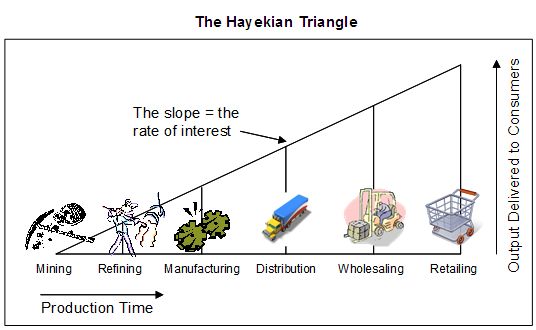
Again, think of Hayek’s triangle: money flows from bottom up, and production flows from top down.

A higher time preference = a shorter structure of production, and can also cause recessions and unemployment (if there’s rigidity).

Merlin, I’m still thinking over your response by the way,

I’m making some huge mistakes here.

I am wondering if Desoto would help here.

Also one mistake you made:

To the contrary, Higher time preference does not create a shorter structure of production, its the other way around. A high time preferences paths the way for more roundabout processee’s. High time preference(Savings) will be met with the growth in the length of the structure of production. See Desoto Chapter 5.

Instead of using the Hayekian triangle, which make specific stages look all equal, though this is not the case and capital accumulation occurs in a heterogeneous fashion(Remember) different ways over various time periods for different industries, purposes and functions. Some industries need to invest their capital stock into transportation(Food), others do not for example(Software).

Here is a chart from Desoto, does this change your outlook on anything?

I think there will be a lag time and a period of increased cost of first order goods. Even with technological alleviation the lower order goods are getting produced out in accordance with the ecology of the market that existed before the mass immigration. You said yourself, not enough things are being produced to satisfy the new population, this will drive up costs of first order goods, and interest rates will also go up, as there is now a dis-proportionate ration between people and capital stock.

There is going to be lag time for factories and capital goods to be produced in order to adequately provide for the new population HOWEVER, that doesn’t mean that the pre-existing populations standard of living goes down necessarily. It could mean that new innovations are made way for the sustainability of consumer satisfaction.

What happens is first off, as you said interest rates go up, time preference appears low now that the ecology has changed. The high interest rates will encourage savings. This plants the seed for the long-term growth. In the short term profit does it’s job. New methods of of creating first order goods with shorter production stages are brought into the picture to alleviate the immediate demand. This will obviously mean a sacrifice in quality, but we also must remember that the previous factories and more lengthy methods of production are still operating. They will have the opportunity based on new profits to pay for conversions of their existing capital goods, allowing for a higher output. THe conversions maintain the existing capital stock, and augment it. The conversions are great because not a lengthy period of time is needed, as opposed to building an entire new factory.

We also cannot rule out that imports of first order goods will rise. Another point we are missing in our equation is other competing geographical regions, imports and exports. The market will find an equilibrium, of the cost of living rises to sharp that will deter further immigration. It also may encourage imports from neighboring geographical regions, even the regions where people were immigrating out of. So since we are focused so deeply on one specific geographical region we neglect observe that the market is attempting to find an equilibrium across all geographical locations, it is not aware of borders.

So there is short-term relief created on the market and possibly some sacrifice on quality. Neighboring geographical locations also play a roll in bringin about stability. Long-term releif will come and we all know capital accumulation takes time. And finally, with the existing capital goods ecology still in tact we always seem to forget the final but most important thing. Entrepreneurship, and innovation(Which is always left out of modern macro). To satisfy demand existing producers(Especially ones who were succesful) will innovate ways to create shortcuts further bringing satisfaction even faster. All driven under the profit motive.

I feel that modern macro tries to treat everything like a system we can come to expect, but the market cannot be expected. Suprises are brought forth via innovation every day.

In the long run a more complicated division of labor benefits everyone. What we are discussing here is a short-term discrepency.

I’m quite sure that a high time preference is expressed by an increased preference for present goods (consumer goods) relative to producer goods (future goods), i.e., a lower rate of savings, which collapses the structure of production. Also, I don’t like De Soto’s work, from what I’ve read. He likes to talk about the Ricardo effect which literally makes no sense (to me at least).

This will drive the prices of consumer goods up, that is, it will increase the money receipts for the lower phases, while, at the same time, elevating the rate of interest. Since the higher orders receive money later, their profit margins will fall, even though their revenues may have increased (because of the elevated rate of interest). Hayek says that specific capital goods will be dragged away from the higher orders towards the lower orders along with vertical integration.

Here’s Hayek:

This is the over-consumptionist doctrine.

The high interest rate is the result of a higher aggregate time preference (a lower savings rate); the interest rate represents the aggregate time preference. The higher interest rate will induce additional savings, but only to preserve the alterations in the structure of production towards shorter methods. That is, if savings does not rise as a result of the higher time preference (interest rate) then the interest rate is not high enough, and must therefore rise and adjust to its appropriate level, which will further collapse the structure of production. According to your reasoning, economic growth is simply a matter of continuously elevating the rate of interest, which could easily be perused by a deflationary government mandate. The point is that you want the interest rate to accurately reflect the true time-preference of society.

I’m assuming a closed economy; I don’t want to complicate the already complicated issue at hand. But, if there is economic expansion, then imports may very well rise because of the increased purchasing power of money (deflation), but this would lower the cost of living, not elevate it.

Err your right, high time preference is intensified desire for immediate consumption.

I see

Yes yes I understand the PTPT, you keep repeating it to me and have been since your first response to me as if I didn’t understand it. I understand it quite well, I can only guess your mis-understanding me and/or I am not adequately explaining myself.

At any rate I am simply tossing out idea’s to help you bounce idea’s around but rest assured I do understand the PTPT.

What your saying is that the market in the end will reset itself to a point thats actually BEHIND where it left off, before the immigration started. And that the equilibrium is the difference between the highest stage of production, and the now new shorter stages of production, somewhere between there.

In essence your saying the economy will walk backwards due to the increased size of population. I guess I could concede that point, knowing that any massive injection of anything in a market will bring it off balance. Still is there no gain or benefit to be had from a more complex division of labor(in the long run, assumign the new population could be sustained)? And wouldn’t the long-term effects, after the adjustments have been resolved eventually be greater?

I havn’t the slightest idea how you derived that from what I said. I wonder if I mis-worderd something but I’m not implying that altering the schedule of subjectively derived consumer preference on the deliverability of goods would be better then if left alone. I’m assuming you think I am saying that if we make an infinitely long structure of production that we would necessarily magically be wealther. In essence we would, that is what capital growth is. It’s intricately intertwined with time, as you stated earlier. BUT only to the extent that present consumption was made available adequately to consumer satisfaction. It’s not like we can force 100% savings and tell everyone we’ll be super rich in 100 years (After we’re all dead). If thats not what you mean I’d like you to clarify how it’s my position where I advocate a simple alteration in interest rates will bring perpetual prosperity.

Higher order goods operate at the same time as lower order goods. It is not the case that we must wait every 5 years to get a new batch of corn. These individual process’s occur simultaneously. For a single year all stages of production are in action, and resources are being allocated to all of them. IT’s not that stage 1 acts for one year, while everyone else sits on the sidelines waiting for him. Don’t forget that.

No your not, this is about immigration, the very problem implied a non-closed system.