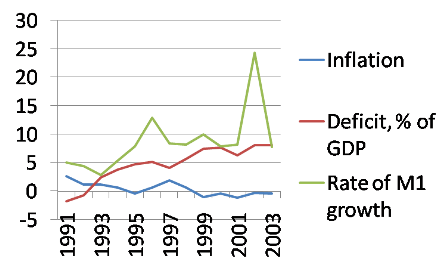
I’ve been reading a fair bit of the Mises Daily, and Bob Murphy in particular is adament there will be a large increase in prices in the near future. Here is Paul Krugman claiming that large increases in the M1 will not result in large price inflation. He sites Japan (image below). Here is another Krugman piece today.
The principal source of inflation is the fractional reserve lending system. For that to work, banks have to find creditworthy borrowers. There doesn’t appear to be many of these on the horizon.
I was under the impression that it’s very well possible that deflation could occur pre-cluding inflation or even hyper-inflation?
I don’t like to jump the conclusions, though. I’m still confused as to what is going to happen, but if hyper-inflation were to occur, I think we’d be “lucky” if it happen over the span of a decade and not a few months, though :\
Correct me if I’m wrong, but if the monetary base gets larger at the same time as productivity goes up, wouldn’t the newly printed money just reallocate resources wastefully (lowering the would-be higher purchasing power of ordinary people, and especially people with savings) and isn’t that a form of price inflation? When goods should be cheaper but they stay at the same price?
I’m probably wrong though, I’m one of the noobs on the forum. [;)]
Maybe it’s working differently in the US but here in Europe inflation, despite government assurances, is already a reality. It started to pick up momentum around March. I am not an economist but I keep an eye out when shopping for groceries or buying supplies I need for work and prices, after this Winter flat spot, are picking up speed again despite very bad economic datas (and I can assure you in some sectors like textile they are bloody serious). Ever since inception of the Euro we have been caught in a stagflation, with steady price increases and anemic GDP growth. Now it’s getting serious.
Of course macroeconomic datas may tell a slightly different story but I’ll be honest with you: not only I am not seeing that drop in prices usually associated with crisis/recession/depression/whatever, I am seeing a steady increase in prices. Which in my little world stinks of inflation to high heavens.
Indeed. Gas prices have risen from about 1€/liter to 1,35€/liter, even though demand for gas should’ve dropped at least slightly.
That sort of confuses me since the ECB did not throw money around just as recklessly as the Fed, did they? I was under the impression that “stimulus packages” were pretty mild in Europe compared to the US. Do you have an idea why it is us who are now being hit by strong stagflation?
It’s one of those things that I can’t remember where I read it, but I do believe that I’ve read articles about the Euro “stimulus” packages being much smaller in size to the US–BUT of a much larger relative size. I think you need to research the true size (relative to the infuriating US stimulus “size”) of the European stimulus before you can answer your question, because I was under the opposite (of your) impression.
Either we’ll have 25% bank loan rates or double-digit inflation. Krugman always seems to deny that Zimbabwe actually exists. I think his map of Africa has a hole where Zimbabwe is, actually, given that he actually believes that expanding the monetary base at that rate won’t cause inflation.
I am pretty sure I read an article on mises.org detailing money supply increase by the main central banks for the year 2000-2007. If I remember correctly between 2002 and 2007 the ECB actually increased its money supply considerablymore than the US Federal Reserve and the Bank of Japan. Which coupled with anemic growth rates (despite much “creative accounting”) explains pretty well the stagflation we’ve been in.
Inflation in Europe is pretty much a very well guarded secret. When our medias and economists talk about “inflation” they always refer to questionable Consumer Price Indexes (CPIs) whose parameters are varied continously to according to the need of the moment. Nobody, not even outspoken critics of the ECB, ever mentions monetary inflation. And while the US may need inflation to keep afloat banks and keep fighting wars we need inflation to keep the welfare state afloat. I have already related how in Italy you can ask the government for something called Cassa Integrazione if you employ enough people: basically the State will pay your people to stay home or work very reduced hours. In short you can close shop when you are out of work without enraging the unions, the taxpayers graciously footing the bill. This may not be listed as a proper bailout plan but when its monthly growth between October and April is around 450% you can well imagine the sums involved. And it gets worse: the States need to make up for reduced incomes to pay for schools, pensions, health care, EU sanctions etc. Money needs to come somewhere.
Yes, I agree with that. Finding relevant information regarding the US monetary situation is awkward enough, but it seems to be nearly impossible for Euro stats.
What I found indicated that M1 has nearly doubled since 2003. That’s a growth rate of 15-20 percent per year. Interestingly, there has been no acceleration in M1 growth since the onset of the financial crisis. Then again, M1 does not track actual money creation, but rather the amount of money circulating in the hands of the public, right? So it may take a while for big increases in the money supply to show up.
As for your Cassa Integrazione, we have the same thing and yes, it’s being widely used and expanding right now. This alone might be enough to cripple the economy for years to come. I don’t see how anyone could have considered this a good idea given the in-your-face obvious negative incentives it provides.
Consumers are deleveraging, companies also… Everybody tries to reduce debt/increase savings. Banks don’t want to lend because they cannot find much creditworthy clients. It’s all deflationary. Lot of money has been pumped, however loss of consumer/company equity on the other side has been even greater. Money has been only going to speculative investments (stocks/commodities), but that will be reversed if CPI inflation does not show up. However, all that cash sitting has lot of iflationay potential if psyhology changes.