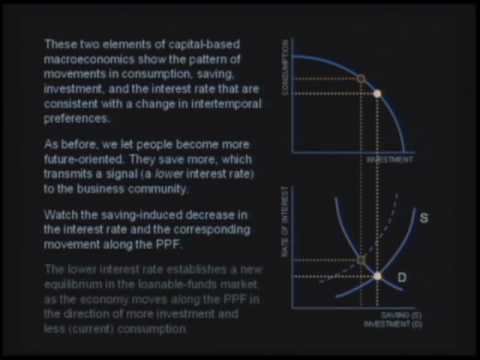
Investment vs. Consumption

Sounds to me like a perfectly reasonable question, given what Keynesians like Krugman honestly say in the pages of a national newspaper such as the New York Times.

Evidently there’s still a difference there…because I’m sure plenty of people would have no problem explaining the answer to the latter two.

No. It isn’t “exactly what ABCT says.”

Bingo. Just like without looking at the economics of “By increasing the wage at which employees can legally be employed, you ensure that the working public will have a certain economic standard of living, proportional to the level of their wage relative to the average wage,” it sounds good…but is complete nonsense. Much like the poster analyzed here looks good, but again is total idiocy. Anyone can throw around fancy terms and complex sentences with polysyllabic words and jargon. That doesn’t make it an intelligent statement no matter how “good” or “smart” it sounds.

If you’re going to create specific scenarios, you’re going to have to give a plausible explanation as to how the economy you’re talking about got there.

Please describe exactly how prices and wages became perfectly inflexible.

I’m sorry…Are you seriously arguing that “a sudden decrease in consumer spending” all of a sudden prevented prices from dropping? You’re definitely going to have to explain that. What exactly is stopping me from selling something for less, again?

No, you’ve only made yourself look like more of one…perhaps if you can somehow provide plausible explanations to the questions I just posed, and prove that your scenario isn’t virtually the same as “Let’s assume everyone craps out unicorns on a daily basis…”

“Sounds to me like a perfectly reasonable question, given what Keynesians like Krugman honestly say in the pages of a national newspaper such as the New York Times.”

It’s not a reasonable question at all. The fact that you compare it to what the Keynesians say and at the same time claim that Keynesians are at a very low standard of discourse is evident of this.

“Evidently there’s still a difference there…because I’m sure plenty of people would have no problem explaining the answer to the latter two.”

Irrelevant to what I’m trying to say. The inability of people to answer the questions in the modern day can’t get past the fact that such a question is made to sound implausible. If economics were taught more seriously in school and in society, just as basic politics are, then people would have little problem explaining that.

"No. It isn’t ‘exactly what ABCT says.’

Forgive me, it’s comparable to the ultimate implications of ABCT

“Bingo. Just like without looking at the economics of “By increasing the wage at which employees can legally be employed, you ensure that the working public will havea certain economic standard of living, proportional to the level of their wage relative to the average wage,” it sounds good…but is complete nonsense. Much like the poster analyzed here looks good, but again is total idiocy. Anyone can throw around fancy terms and complex sentences with polysyllabic words and jargon. That doesn’t make it an intelligent statement no matter how “good” or “smart” it sounds.”

This is entirely irrelevant to the discussion. This doesn’t change the nature of the way Hoppe asked the question or the intention behind this and just further goes on to display that plausibility can often be dependent upon the exact use of diction. Hoppe is being inherently disingenuous.

“If you’re going to create specific scenarios, you’re going to have to give a plausible explanation as to how the economy you’re talking about got there.”

Why? I’ve just shown how money could create wealth. Even if we relax the assumptions to “relatively inflexible” this is still a big factor.

“Please describe exactly how prices and wages became perfectly inflexible.”

Widespread stubbornness on behalf of people. I.E a generally expressed human preference.

“I’m sorry…Are you seriously arguing that “a sudden decrease in consumer spending” all of a sudden prevented prices from dropping?”

No and I don’t even understand how you got that from the quoted passage

“No, you’ve only made yourself look like more of one…”

Oh have I now?

"perhaps if you can somehow provide plausible explanations to the questions I just posed, and prove that your scenario isn’t virtually the same as “Let’s assume everyone craps out unicorns on a daily basis…”

Unicorns don’t exist and the human body is incapable of producing them within itself. Wages exist and people’s preferences have an influence over them.

Done.

Your whole point is that question A is like question B and C, because nobody can answer them. I tell you that the average person wouldn’t have a problem answer B and C, and now you tell me that’s irrelevant.

I didn’t set up the analogy. You did.

Wha? Then what the heck is your point? All you did was jazz up the nonsense position with some technical jargon and then claim it all of a sudden makes sense and that anyone who wasn’t an idiot would find it perfectly reasonable. So I did the same thing, and then stated how just because you put lipstick on a pig, that doesn’t mean it all of a sudden turns into a woman.

All Hoppe is doing is taking Krugman’s argument down to it’s core. His whole point is to illustrate that getting bogged down in technical arguments is unnecessary…all you have to do is illuminate the core argument. And your whole argument here is:

“That’s not fair!!! Hoppe is cheating! You can’t take the lipstick off the pig and expect anyone to be able to defend their argument that it’s a beautiful woman! You have to keep it dressed up and argue the finer points of the gown! It’s the Keynesian’s pig, they dressed it up. It’s inherently disingenuous to dress it down.”

Lovely. You’ve shown how a frog wouldn’t bump his ass when he hopped if he had wings. How useful.

Um. Perhaps because you literally said:

…prices and wages are perfectly inflexible downwards. […] The only thing that occurred to bring about this state of affairs was a sudden decrease in consumer spending…

Can you prove unicorns don’t exist?

Your whole point is that question A is like question B and C, because nobody can answer them. I tell you that the average person wouldn’t have a problem answer B and C, and now you tell me that’s irrelevant.”

No. You evidently don’t understand what I’m trying to say. It isn’t that no one can answer them, it’s that the whole question is posed in such a way so as to mislead. It is a poor and misleading question. It is thought stifiling and, as I said, anti-economic. It’s sad that this was posed or reposted as something that is supposed to prove a point since the question is clearly meant to imply that Krugman would have no response to it, that he would just turn red and stutter out something that isn’t relevant to the conversation.

The fact that the whole debate comes down to the “technical details” that Hoppe sought to avoid shows that it’s an idiotic question on every level except as a statement to insight dogmatism, which you could see on the video.

By extending this type of question phrasing to other questions which are perfectly obvious when they are asked in plainer way I hoped to have more fully displayed this. For instance if asked the bullet questinon above, someone would look inherently more foolish (even if they appeared ultimately to be correct) than if they had been asked, for instance “How can bullets fired from guns at extremely high speeds hurt people”?

“Wha? Then what the heck is your point? All you did was jazz up the nonsense position with some technical jargon and then claim it all of a sudden makes sense and that anyone who wasn’t an idiot would find it perfectly reasonable. So I did the same thing, and then stated how just because you put lipstick on a pig, that doesn’t mean it all of a sudden turns into a woman.”

No I didn’t. Once again, as you suggest, you do not understand my point and I underlined and bolded exactly where you are incorrect. I didn’t say that it made sense, I said that it sounded much more plausible, just as above if we use different and roughly equivalent diction then you make something sound better or worse. People are not perfect conduits for truth who are unaffected by how something is asked.

My point is ultimately twofold:

  1. Hoppe’s question is nothing short of intellectually bankrupt with how misleading it is. What infuriates me more is that it’s a stupid question since the reason Hoppe gives for posing it since any answer comes down to the very technical details he claimed he wished to avoid. This does not apply to the question “how can a change in the money supply alter a society’s wealth?”. This is a perfectly legitimate question.

  2. If the question is posed with the can then I have just shown the ultimate theoretical basis for how it is that the answer could be that increases in the money supply can positively affect society’s wealth is not entirely outlandish. Considering that all of Mises’ theorems were derived from the ERE, which is infinitely more absurd then anything I stated. From what I posted above if we relax the assumptions and make wages relatively inflexible instead of perfectly inflexible then we end up with a similar conclusion.

“That’s not fair!!! Hoppe is cheating! You can’t take the lipstick off the pig and expect anyone to be able to defend their argument that it’s a beautiful woman! You have to keep it dressed up and argue the finer points of the gown! It’s the Keynesian’s pig, they dressed it up. It’s inherently disingenuous to dress it down.”

Lol no. See above. I am asking that Hoppe treat something fairly, not doing whatever awful things he’s doing to that poor pig.

“Lovely. You’ve shown how a frog wouldn’t bump his ass when he hopped if he had wings.”

Yep. That’s what I’ve done. How perceptive of you.

"Um. Perhaps because you literally said:

…prices and wages are perfectly inflexible downwards. […] The only thing that occurred to bring about this state of affairs was a sudden decrease in consumer spending…"

All that brought about the recession was a decrease in consumer spending. The decrease in consumer spending was the initial catalyst. If we consider this along with relatively inflexible wages/prices we end up with what I said. If you have any knowledge of the Keynesianesque argument I’m working with then you should understand this.

“Can you prove unicorns don’t exist?”

Nope. Can you prove prices aren’t relatively inflexible?

I also see that you conveniently didn’t respond to the section on ABCT. It’s not so fun when we turn an absurd question on ourselves.

Aight Dave, it’s your turn:

So it would seem that our discussion comes down to two issues: Say’s law and the efficacy or lack thereof of government policy in theory (neither of us denies that in practice it’s gonna f*** up)

Say’s Law

Now forgive me, because this is going to be a bit of a tangent, however it may clarify my position.

In Human Action three very important things that Ludwig Von Mises talks about are:

A: The tendency of classical economists to conflate the functioning of the barter and money economies. They act similarly in some ways, but differently in others.

B: (As an extension of this) The ability of changes in the money supply to have real affects on the economy. For instance much of the work Mises does with inflation in the book deals with how the creation of money does alter business behavior and does redistribute wealth and spending in the long run.

C: The need to incorporate real factors into praxeological theorems. If we apply this to Keynes then we can interpret Keynes’ work as trying to take economic theory away from some unrealistic classical assumptions. This is why I sympathize with Keynes even though I disagree with him, and much of my sympathy comes from the spirit Mises is embodying above. Indeed in this same vein the following quote from that part of the general theory I read really stuck out to me:

“Obviously, however, if the classical theory is only applicable to the case of full employment, it is fallacious to apply it to the problems of involuntary unemployment—if there be such a thing (and who will deny it?). The classical theorists resemble Euclidean geometers in a non-Euclidean world who, discovering that in experience straight lines apparently parallel often meet, rebuke the lines for not keeping straight—as the only remedy for the unfortunate collisions which are occurring. Yet, in truth, there is no remedy except to throw over the axiom of parallels and to work out a non- Euclidean geometry. Something similar is required to-day in economics. We need to throw over the second postulate of the classical doctrine and to work out the behaviour of a system in which involuntary unemployment in the strict sense is possible.”

Now I have heard from multiple sources that Keynes stramanned Say’s law, and from what I have read of his opinion on that subject it would appear to be the case if only because he grazed over the issue, however, it would appear that this isn’t necessary. Let’s apply Mises’ own insights outlined above to some of the defenses made for Say’s Law above.

“The same principle leads to the conclusion, that the encouragement of mere consumption is no benefit to commerce; for the difficulty lies in supplying the means, not in stimulating the desire of consumption; and we have seen that production alone, furnishes those means. Thus, it is the aim of good government to stimulate production, of bad government to encourage consumption.

Now once again, the fundamental issue concerning Say’s law is this: Can monetary demand cause an increase in production? To me the answer would seem to be a resounding “yes”. This is ultimately because, as we both agree, businesses run and labor works to make money. If the goods aren’t there to immediately back up the money then firms make profits in the short run and will increase output if they can. Just as a brief example, let’s say that a hot commodity that a lot of people by is Snood. We increase the money supply and give some people a lot of money. Well the demand for Snood has just gone up. Because the prices of inputs won’t rise until demand has increased, there is a brief period during which Snood can buy more inputs and increase production. Thusly an increase in demand, unbacked by an immediate increase in production, will spur production. Do you believe that the laborers making Snood will refuse the increase in their paycheck because production hasn’t increased? In the short term their real buying power increases because all prices in the economy haven’t adjusted yet.

What is the problem with what I am saying?

So for instance when you state

“So if we are to tackle the problem of lack of demand, we must do it by making it possible for people who cannot demand now to be productive so that they can demand.”

All that is needed for one to demand in the moneyed economy is for one to have money. So if we give him money then he can indeed demand.

“Say’s law proves that there cannot ever be a surplus of demand over production. Even Keynes admits that. His only quibble was that demand might be less than production in the aggregate, or so he thought.”

Once again, I don’t understand this. If we increase the money supply then demand for goods in general rises, if only nominally. So long as prices don’t rise immediately there will be a real increase in demand. What do firms do when demand rises ceteris paribus? They produce more. If resources are relatively well employed then bidding between firms will quickly bid up prices and production in general will end up approximately back where it started. If resources are relatively unemployed, however, then a sustainable increase in output is possible.

Part of the reason I bring up barter is this: In the barter economy you must produce before you can consume exactly because you trade good for good. There is no way to spur demand without spurring consumption, however in the moneyed economy demand exists as a result of money, therefore money demand can be stimulated by increasing the availability o money.

On the matter of government and aggregate demand:

“If the problem is that the manufacturers lack purchasing power, and we have to give it to them, that can only be done by taking away purchasing power from someone else. So that aggregate purchasing power is not increased by govt taxing or spending.”

I disagree with this because if there are a large deal of idle resources then inflation won’t occur with an increase in the money supply (up to a point). As we both know the causal factors that lead to inflation include bidding over resources in response to the new nominal demand for goods.

“Maybe we are talking about some scenario where working people have just enough to buy what is made, and want it, but there is a pool of unemployed who cannot buy anything. And no one will hire them, because wages are too high and will not go down ever. This would be Keynes scenario of a frozen situation where the economy is not in equlibrium [= full employment]. So if the govt put in an order for more cheese, the cheesemakers would hire the unemployed to make cheese, even though they are asking for too much money, and every day they work is a net loss for their boss. I don’t understand how this is possible.”

You said you were tired when you were writing this. Government demand on the market is treated the same as demand by anyone else by the firms involved. If the government offered the cheesemaker enough money then he would indeed hire the unemployed and produce cheese.

“Now I think about it, if wages are sticky and too high, that means by definition of “too high” that someone who employs the unemployed at the wage they insist on will lose money every day they are working for him. How can all the taxes and govt spending in the world change that, or convince the employer to hire people so that he can lose money every day?”

In conjunction with what I said above it’s important to remember what is called the “tax multiplier” in modern macro. It’s not an unrealistic assumption that some amount of income is not spent, so if we think of Y as total spending (income=expenditures) Y=C+I+G. C=a+b(Y-T) (a can be zero and this still works) where b is the MPC and (Y-T) is disposable income then we see that, because a portion of income is saved, Y will be increased if we increase T and then move all that spending into government spending then we have effectively increased demand and overall income. I’m blanking on the exact algebra here, but it comes out to state the tax multiplier (the amount y increases as a result of an increase in taxes and a proportional increase in spending) is exactly 1. Y increases by the same amount as T and G. Let’s go back to the cheesemaker.

Now let’s say that people will spend 50 dollars on cheese if their total income equals a thousand dollars and that it doesn’t matter who recieves this income, they will in total buy 50 dollars in cheese (yea I know I’m treating people as automatons but we’re talking about AD which is a fallacious and aggregate in the first place and we’re dealing with a micro example for a macro issue). Now if the government comes along and taxes people for 100 dollars of income and then spends that income on cheese, then the demand for cheese has gone up by a hundred dollars and the cheesemaker will increase his demand for labor and inputs accordingly (once more we’re working on the idle resources/sticky wages assumption). Because the total of 100 dollars will be spread out amongst the populace over this period and their total income will rise once more to a thousand dollars, then private demand for cheese will once more be 50. Therefore we have increased demand by increasing taxes. Demand is now 150 where it was previously just 50.

Now I’m not defending the MPC, but the basic idea here should be fairly clear. Because demand increases by the amount of taxes and overall private sector income is inevitably increased back to the old amount, real AD has been stimulated by tax/spending increase. This is a simplistic model for sure, but to claim it could never function to some degree is foolish.

“I always heard that Keynes solution to sticky wages was to print money to reduce the purchasing power of the currency, and thus reduce the real wages [= purchasing power] of labor, even though they will stay the same nominally. I grant that I am not familiar with the intricacies of his proposals. Did he have some ideas of how to convince employers to lose money willingly?”

I’m in the same boat that you are in terms of a general understanding that Keynes believed this while never actually reading this. However this would not cause firms to lose money, but rather for real wages to fall. Firms would pay according to new demand, while paying workers at the old wage. It makes sense for the firms to do this ceteris paribus. The question is then; does it make sense for the workers?

I feel I answered 7. plenty of times above.

Any feedback would be appreciated. Say’s law in particular is something that I seem to be criticizing too easily to have a real grasp on it.

Also, sorry this ended up so long. My fingers tend to type freely as well. Don’t feel the need to necessarily address everything I say. My major points are

  1. Increasing money income will almost always result in an increase in real demand since firms function to make money and labor to buy goods. This differs from the barter economy

  2. Government can theoretically increase demand through fiscal policy because the income taken away from the private sector is put back into it while increasing demand for goods and the ability for firms to hire.

The reasons are elaborated to no end above.
  1. I might go into the obvious here, because I’m not sure where exactly we diverge, right at the start or at some advanced stage.

  2. That quote from Keynes, while indeed dramatic, is Keynes straw manning the classicals. They understood very well the existence of involuntary unemployment, what he calls non Euclidean geometry. In fact, they used Say’s Law to explain it. That’s just the opposite of Keynes version of their position, that they assumed Say’s Law to deduce that there is always full employment.

Here’s a quote from Say’s famous Chapter 15:

And, vice versâ, wherever, by reason of the blunders of the nation or its government, production is stationary, or does not keep pace with consumption, the demand gradually declines, the value of the product is less than the charges of its production; no productive exertion is properly rewarded; profits and wages decrease; the employment of capital becomes less advantageous and more hazardous; it is consumed piecemeal, not through extravagance, but through necessity, and because the sources of profit are dried up.*45 The labouring classes experience a want of work; families before in tolerable circumstances, are more cramped and confined; and those before in difficulties are left altogether destitute. Depopulation, misery, and returning barbarism, occupy the place of abundance and happiness.

Bottom line, he knew very well about involuntary unemployment, in fact about deep depressions such as we have not even experienced. And he explains their existence using his law, that demand comes from production.

  1. OK, now to your first topic, about increasing money income will increase real demand in a money [= not barter] economy.

The classical view is that demand can only increase by someone producing more, say, coffeee beans than before, which will allow him to trade for more things. With the 100 pounds of beans he made last year, say, he was able to trade [directly or indirectly] and get food and clothing for all his family. This year, when he produces 200 pounds of coffee beans, he can buy all he bought last year, plus a computer and some video games.

A key point here is that cateris parebis, everyone else has their demand unchanged. The fellow who makes tea, the baker, etc, they can all keep on buying whatever they used to. [In the coffee industry, the price might drop because of what he did, and thus perhaps the coffe makers ability to demand will go down. But experience has shown that although the profit from an individual bean goes down, the increased volume more than makes up for it. All the great fortunes have come from mass producing at a low price, not from making less at a high price].

Now let’s see what happens when money is printed. To simplify, let’s imagine one person printing ten million dollars, and keeping it all for himself. Of course, his personal ability to demand has risen, just as if it would have had he inherited a rich uncle. But has demand in the aggregate increased? Is everyone able to buy exactly what they used to, and this one person able to buy more?

The answer is no. His increased demand comes at the expense of other people’s decreased demand. To see this very clearly, assume he uses his new money to buy up half of the available supply of firecrackers, and he lights them all up at his party. Everyone else who wants firecrackers will have to pay much more for them, due to the laws of supply and demand. When they go to market, the supply has fallen, so the price has gone up. Which means right there that their purchasing power with respect to firecrackers has gone down, another way of saying their ability to demand has gone down. When these people finish their shopping, there will be two groups. One will have bought the same amount of firecrackers, paying more for them, meaning they have less of something else in their shopping basket, say spaghetti. The other will have bought the same amount of everything else, but will have bought less firecrackers. In either case, their ability to buy, their demand, has gone down. The same amount of money gives them a shopping basket with less content. This has to happen by simple math. When the total price of the basket goes up, people cannot buy the whole basket with the old amount of money. Something has got to give. Their purchasing power, aka their demand, has gone down as a direct result of the new millionaires artificially [ = not by his production] increased demand.

At first, this loss of demand will only be felt by those who are trying to buy that product that our new millionaire has gobbled up. But as time goes on, it will be felt by everyone, as I’m sure you know. The Cantillon effects.

EDIT: One may argue that the fellow who made more coffee beans is also increasing the price of computers, because he can now demand them, and the increased demand raises the price for everyone else. Which is true. However, the rising price of computers is offset by the lowered price of coffee, since he has increased the supply of coffee. Bottom line, the shopping basket will cost the same. Contrast this with the fellow who printed more money. He has not produced anything, so nothing will fall in price. But he has raised the price of firecrackers. Thus the shopping basket will cost more.

  1. Now for your second point. I think you are saying that if someone decides not to spend all his money, nor to invest it, but simply to leave it unspent in his wallet, then that money in his wallet is “wasted” as far as creating demand. If he doesn’t spend that money, he is obviously not demanding anything with it. So that if the govt taxes away that unspent money [and in the new situation of this new tax he continues to spend all that was untaxed, just like before], and the govt spends the tax money on, say, unbought spaghetti sauce, why we have increased demand for spaghetti sauce, by spending all that money that used to lie there in the wallet. The spaghetti factories will thrive where previously they languished. They will hire people to make more sauce after they sell their unsold inventory, thus increasing employment. This will create a virtuous upward spiral, more employed, more demand, and onward and upward out of recession.

I just saw Mises discussing this very issue. Human Action, Chapter 20, section 9, the subsection that has the heading "The Role Played by Unemployed Factors of Production in the First Stages of a Boom".

We can continue if you want after you see his take.

Sorry it took me a little while to get back to you

Now back to Say’s law when we consider inflation:

When you claim that an increase in the money supply will increase the prices of goods in general you are relying upon an economic theorem whose application (or lack thereof) in the current situation determines whether or not Say’s law applies. Now let’s look at the steps in this proof under the Keynesian assumptions of high unemployment, sticky wages (downward), and low demand and contrast them with an economy at relatively full employment:

  1. Inflation occurs and some individuals receive an increase in their money income. This induces them to spend more than they otherwise would and so demand in general goes up

  2. Firms see demand for their products rise. Here we will assume a perfectly competitive economy. I understand that there are flaws in the concept of perfect competition, but nonetheless it will help to better reflect my point since it speeds up the entire process and gets rid of awkward intermediate steps. The same general event should occur regardless of the exact market structure. Prices do not immediately rise, instead firms are attempting to charge as low a price relative to cost as they possibly can, however demand for their goods has risen, therefore the price need not immediately rise, instead in the revenue=P*Q equation, Q may simply rise. Firms will then increase their demand for inputs in general and this includes labor. At this point the full employment and below full employment circumstances diverge.

3A. Firms increase their demand for labor. However, because labor is already mostly employed and the quantity of labor in the entire economy hasn’t increased, this will merely have the effect of increasing wages since the labor supply curve is relatively inelastic and vertical. This in turn implies that output will be relatively constant and all prices in the economy including wages will just rise by approximately the same level as the increase in the money supply. We end up back where we started along with the aforementioned redistribution in income.

3B. Because there is a decent quantity of unemployed labor the labor supply curve will be relatively flat at the going money wage. This means that more labor can be utilized as inputs in aggregate. Therefore the increase in demand by firms for goods primarily increases output sold with relatively small increases in prices. Since many people are unemployed at the current wage, we can employ them and increase output with the increase in demand by firms. The supply curve for goods in general are flat at current prices, not vertical or heavily upward sloping. Inflation results later after we reach approximately full employment, but if the assumption of sticky wages is correct then this should not affect employment adversely.

Therefore it would seem the theorem which states “an increase in the money supply will increase prices” needs relatively full employment to work While differences from industry to industry and the employment levels in specific markets will affect how right or wrong this is even when the economy is below full employment, the fact is that when we are outside of full employment an increase in the money supply will, ceteris paribus, cause a greater increase in quantity, and a lesser increase in price increases than if we were at high levels of employment.

What error am I making here? I have displayed how “demand can create its own supply”, as Keynes put it, and it would seem to me that this is entirely praxeological. Please point the error out to me. I have a hard time believing that I could possibly be critiquing Say’s law so easily

If there indeed is no error then Say was indeed wrong. You do not need to produce before you can consume, rather the increase in consumption will, under some circumstances, spur an increase in production which in turn increases supply and goods produced. Producing before you can consume will make consumption possible, but in the moneyed economy demand works roughly just as well.

Now on to 3:

The narrative here is quite similar to the narrative above, although it has an immediately greater distortional affect in terms of how it shapes production, nonetheless it alleviates the recession (if only temporarily, I argue that when the government spending is cut off it just ends in another, possibly deeper recession).

Where you misunderstand me is here:

“So that if the govt taxes away that unspent money [and in the new situation of this new tax he continues to spend all that was untaxed, just like before]”

No. If the government taxes a million dollars out of the economy, and then spends every cent of that money, the private sector is just as wealthy (in purely monetary terms) as it was before the tax was enacted, however demand for goods in general will have gone up, since now whatever people would have initially spent will still be spent, and demand from the private sector will be just as high, but this time demand in general has increased from here what you describe will occur.

Now what’s important to note here is that Say’s Law has been invalidated. If you buy into the narrative even being possible, even if it is only temporary, then demand has revitalized supply. What is more is that within the more simplified models of the current mainstream and the classical economists the recession has ended. It is not until we employ capital theory that we see the flaws which inevitably occur

What is ironic is that the section by Mises that you cite is a fitting critique, not for fiscal policy which is entirely backed up by taxation, but rather for the monetary policy which we are discussing in the other section. However, once more I was critiquing Say’s Law, and arguing that government spending can alleviate a recession.

The crux in the government spending argument fully backed up by taxation is that, because so much must be spent to revitalize the economy due to the small multiplier, a large portion of the economy begins to adapt into the production that government demands. The goods government wants to be produced are produced, not what consumer’s desire. As soon as the spending stops then you end up back in a recession. So long as spending continues you are less wealthy than you would otherwise be. Therefore the only solution that wouldn’t induce a recession would be to slowly wean the economy off of the federal spending, however the intermediate period in the economy would then still be entirely wasteful, and so in overall income you would likely be better off just waiting for the economy to readjust.

Once again this is entirely a constrained model. There are other important factors, mainly dealing with actual political incentives and the non-homogenous nature of the economy, which ultimately make this model ineffective in the real world, yet under a more constrained model it would appear the claims I have been making are perfectly true, the most important of which is that Say’s Law isn’t a law the economy actually adheres to.

And once again I encourage you to disprove this statement. Mises made it very clear that he thought an understanding of Say’s law was the test of any true economist, so disproving my claims should be incredibly easy and I am at a loss for why my simple arguments don’t (to me) have a simple rebuttal.

Edit

In before the forum lock!

Neo, I wrote a long reply and it got erased. So let’s cut to the chase.

I see a few weak points in your argument. First, let’s call the people who get the new money Group A. we’ll call Group B everybody else but the idle workers. Then we have Group C, the idle workers.

Lets call the things everyone likes Good Stuff, and the things everyone doesn’t like, and was only produced because of malinvestment, Junk.

In 3b, you assume Group C will increase supply when they get jobs. If they increase supply of Junk, we clearly don’t want that, do we? [See the Mises link in previous post]. And if they increase supply of Good Stuff, that means they will get paid. In other words, Group C increases aggregate supply, but also increases aggregate demand at the same time to the same extent. So yes, if we find them productive jobs somehow, aka making Good Stuff, they will benefit.

The problem is, how do we get them those jobs? Because Group A increased its demand when it got the free money, but that raised prices for Group B, causing a decrease in demand on their part. Aggregate Demand has not changed, and so the workers will not get hired. You assume that giving Group A free money will somehow not increase prices of the Good Stuff they gobble up. But there is no rationale for such an assumption.

Maybe you mean that after Group A buys some Good Stuff, the manufacturer of Good Stuff will think, “All I have to do is make more at the same price with this cheap labor from Group C, then sell to Group B, and voila! Increased production. And I will have sold more than ever. Demand has risen!”

But why didn’t he do that on his own, before any new money was printed? Why didn’t he just go out and hire Group C, knowing they will produce and get paid and buy Good Stuff with their paychecks, and increasing his profits since he is selling more? Obvious answer: they are not worth the wage they want, that’s why he didn’t hire them. And they will not become worth the wage they want just because they make more Good Stuff. On the contrary, if he loses a dollar an hour by hiring them, the more they work, the more he loses.

Short version: Aren’t you assuming they are asking too high a wage, [else why they are unemployed], and then turning around and assuming they are worth hiring?

If they lose someone a dollar per unit made, say, by working for him, and that’s why they are unemployed, he cannot make up that loss by increased volume. Just the opposite.

  1. I think it’s disingenuous to call things produced by malinvestment “Junk”. You have to remember that for the most part malinvestments are projects which take too long to complete at the current rate of time preference. What is produced is demanded by consumers and usually to a fairly high degree, it just isn’t as valuable as the other things it could be doing. It’s a small point, but it’s just that things that are produced as a result of the boom are still useful to some degree or other, they are not complete, or usually even near total wastes. This is particularly true about the final products as a result of these projects.

  2. I thought I made it clear that I agree with you that malinvestment will result and that this will just result in another recession. With this said I think that it’s clear that some “good stuff”, or at least “better stuff” than what is produced with the malinvestment will be produced.

“But why didn’t he do that on his own, before any new money was printed? Why didn’t he just go out and hire Group C, knowing they will produce and get paid and buy Good Stuff with their paychecks, and increasing his profits since he is selling more? Obvious answer: they are not worth the wage they want, that’s why he didn’t hire them. And they will not become worth the wage they want just because they make more Good Stuff. On the contrary, if he loses a dollar an hour by hiring them, the more they work, the more he loses.”

I fundamentally disagree with this. Nominal demand might have just decreased because people were afraid of losing their jobs and so they hoarded money, or some individuals indeed lost their jobs and didn’t have any money to spend. What people really demand might not have changed at all, just the nominal demand reflected in the demand curve firms actually see. Because demand has really picked up with the end of the recession the producer of Good Stuff sees real demand increase. It’s not just the demand for “bad stuff” which decreases during the recession. Demand in general decreases because of the uncertainty and because of the fall in employment.

Edit

“Short version: Aren’t you assuming they are asking too high a wage, [else why they are unemployed], and then turning around and assuming they are worth hiring?”

No. If we assume that that has changed is money demand then what needs to happen is that relative wages and prices need to decrease. This is what happens in classical models (or the modern strawman of classical models) perfeclty.

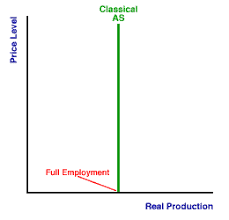
The chain is like this: Demand in general decreases from (pulling numbers out of nowhere) 100 billion to 50 billion. This means that demand for labor falls by half at current prices. However, wages are perfectly flexible downwards so all wages fall by half as well, as do all prices. This in turn means that the real wages stays the same. It doesn’t matter how much you spend, wages and prices will adjust extremely quickly to the same point. This is why the classical aggregate supply function was vertical:

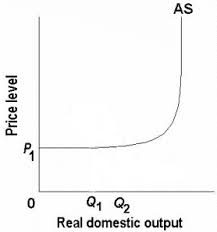
Whereas the Keynesians see that wages are not flexible downwards. This is why they aggregate supply looking like this: horizontal below full employment near vertical around/at full employment:

All that might have changed is nominal demand, people might actually want everything to the same degree but because the recession hit they are spending less.

This is my biggest problem with the normal Austrian conception of the recovery. The recession in any world with reasonably sticky prices is not a good place for the economy to recover because what can happen after the recession persists to long is what de Soto calls “a secondary recession” where because ABCT we run into a more mainstream business cycle where demand has just declined in general. Now the answer to this is not government intervention, but it does put a damper on the idea of extremely swift market readjustment that many Austrians hold.

Not sure about some things in your model.

  1. What happens first, hoarding or recession [and how do you define recession]?

  2. If recession is first, why did it happen?

  3. If people really want stuff to the same degree [as when?], why don’t they use their hoarded money to buy it? In fact why did they hoard at all, instead of going out there and buying?

Now a question not about your model, but about reality.

  1. Is there empirical evidence for existence of sticky wages? What about in the absence of unions? Would it be correct to say that unions are the cause of recessions, because they keep wages from falling when they have to?

  2. Do you think only Keynesians see that wages are sticky downwards when there are unions in the mix, and that they will hinder recovery? It’s a commonplace:

http://mises.org/daily/3764

http://mises.org/daily/3138

Why do we keep using the term recession if GDP is not any sound indicator of “economic growth”?

  1. It could be either. As I said this fits in perfectly with de Soto’s (who you cite) idea of a “secondary recession” that is initially caused by ABCT. In this way Austrian and Keynesian business cycles are not exclusive. As I have expressed elsewhere I think that a truly free market recession is possible, but by no means probable, nor do I believe it would be that extreme.

  2. It could have been ABCT or one of the other reasons outlined above

  3. Well I suppose that you could think of this as a collective goods problem. If everyone is afraid that they will lose their job then they will hoard for the future. Because no one individual can noticeably influence the economy, it is rational for each person to do this. However, if everyone does this then the recession will just get worse and more people will get laid off. So it might make sense for every individual to hoard while it makes sense for the group to spend.

So if we assume (yea another dumb simplifying assumption to get across a point) that everyone in the whole economy thinks like I do then I would cut my income in half into

A. Things I really need and am willing to buy even if I am worried about losing my job

B. Things I don’t feel I really need and which I will abstain from buying because my money is better saved if I feel I might lose my job

Now my preferences have not changed, but new data has arisen which I have to plan for.

  1. Off the top of my head I don’t know of any. I have to say that I would be amazed if there wasn’t, because that’s the core of modern macro. If there really is no evidence for it then most economists are literally insane. With this said I don’t know how much of this evidence is really viable in the free market vs. state action debate since almost all collected data would have to come from samples where actors were expecting a government which actively acts to increase prices in general and increase aggregate demand. This would mean that actors wouldn’t expect, nor have any reason to think that prices would fall. As I have stated: government action in this recession increases or keeps constant the need in government action in the next recession.

Finally I would be amazed if prices weren’t somewhat inflexible naturally. It makes sense. As Keynes remarks unions and labor will always object to some degree to a decrease in the nominal wage, just as they will always happily accept increases in the nominal wage. I have also recently heard a line of argument that basically says that workers in general are less likely to object if a small number are fired instead of pay cuts across the board.

Unions, in the way they have traditionally acted, certainly exacerbate recessions under most circumstances. They are by no means the sole cause, however. This is why it astounds the hell out me that people like f***ing Krugman would lament and cry over the death of good ol’ American unions while shouting about how we need the government to intervene in the macroeconomy because of sticky wages ><

Krugman’s intellectual grandfather would give him a good thrashing with the… Keynes… If he heard him talk like that! (Ooooooh that one’s gold…)

Also it’s important to note that whatever Keynes thought, modern Keynesians do not agree that wages will adjust in the absence of unions. They are far to negligable a part of the economy for that to explain modern conditions.

  1. I think that Keynesians really emphasize it, although de Soto (as I mentioned previously) in particular really emphasizes the issue out of the Austrians. Rothbard also brings up classic point against government fiscal policy, most of which I agree with, even though I remember feeling that some of the relationships he outlined seemed poorly phrased/awkwardly outlined. AGD was one of his first works, although it was nontheless brilliant for it. In some cases I think that Austrian economists underemphasize or just ignore price inflexibility, yet this is by no means a universal tenant of the school, particularly not classically

Also, whatever happened to Say’s Law? I still don’t understand why increasing demand cannot increase supply.

@shackleford,

Because the basic concept behind a recession (a decrease in productive activity and employment caused by economic errors) is still perfectly valid. We need not link our definition strictly to NBER definition of the term.

  1. About Say’s Law, and increasing demand increasing supply: where did that increased demand come from?

If from increased production, meaning someone got a productive job and earned money he could spend, then clearly the increased production is what created the ability ot demand. if we talk about a self employed person, it’s more obvious. Jones is a carpenter, he makes a table [increased supply], and can now sell it and get money [= increase his ability to demand] and buy stuff [=demand]. So clearly increased deamnd is a consequence of, and has to be preceded by, increased production. That’s the essence of Say’s Law.

If the increased demand came not from increased production, but from printing money, then that increased demand for the person who got the money will cause a decreased demand [=purchasing power] for someone else, since all money printing is ultimately a redistribution. Thus there is no net increased demand.

  1. You are saying people can be unemployed even if their being hired makes money for the employer?
  1. I feel like we’re going in circles here. I feel that I have adequately explained that this statement:

“If the increased demand came not from increased production, but from printing money, then that increased demand for the person who got the money will cause a decreased demand [=purchasing power] for someone else, since all money printing is ultimately a redistribution. Thus there is no net increased demand.”

Isn’t necessarily true. If a quadrilateral figure’s sides meet at 90 degree angles then we know that each side will be equal to the opposite side, yet if the 90 degree proposition isn’t true then this need not be the case.

I have shown how an increase in the money supply can do more than to just redistribute income and how it can increase real output, indeed we seemed to be in accordance that this could happen in the previous couple of posts (indeed, in order for the passage by Mises to be true inflation must increase real demand and output). As soon as a drop in AD, accompanied by sticky wages occurs, then the proposition would seem to be somewhat (not entirely) false.

I don’t want to believe that you are question-dodging, Dave.

  1. Under almost all circumstances no. The only circumstances that this would be true under would be ones where hiring this individual would cause indirect adverse side effects. For instance the way that unions are able to increase their member’s wages on the free market is by making the cost of dealing with the strike and finding an adequate number of replacement workers higher than just dealing with the union.

Neo,

Once we grant 2, that if there is money to be made hiring someone, he will be hired, then if we assume unemployment that means there is no money to be made hiring the unemployed. Meaning hiring them will result in a loss of, say, a dollar per unit of output. So when wages have not changed, and proices charged for the product have not changed, how can you say [in point 3b in an earlier post] hiring people will suddenly make more money just because they make more things? On the contrary, that will increase losses.

In other words, I’m saying your hypothetical point 3b where increased demand will increase production contains a contradictory assumption. First you tacitly assume wages are too high to make a profit [that’s why there is unemployment. If a profit can be made at those wages, the workers will be hired, we just agreed], then you say they are not too high. So there is no such case in the real world.

That being so, every case of printing money is a redistribution.

Short version. I was not conceding your case 3b and thus admitting demand can create supply. I was in the middle of a Socratic dialogue to show you 3b cannot be.

“So when wages have not changed, and proices charged for the product have not changed, how can you say [in point 3b in an earlier post] hiring people will suddenly make more money just because they make more things? On the contrary, that will increase losses”

Because demand increases. If we consider the case of a perfectly horizontal supply curve then the price is fixed but demand can change the quantity of output. As people are willing to pay more for a certain larger quantity of the good then more will correspondingly be produced. Once again, remember that revenue is P*Q, not just P. Therefore revenue can increase while price is constant. If wages are sticky downwards and unemployment is high, then by consumers attempting to by a greater quantity of goods, if demand increases, then this will increase the derived demand for labor and more labor will be employed, and more will be produced.

What is wrong with this?

“First you tacitly assume wages are too high to make a profit [that’s why there is unemployment. If a profit can be made at those wages, the workers will be hired, we just agreed], then you say they are not too high. So there is no such case in the real world.”

What happened to the assumption of sticky wages? As soon as you acknowledge that wage stickiness relative to demand has something to do with recession recovery then you have admitted that demand has an influence upon supply.

Prices can only be too high relative to degrees of demand. This principle is something of the cousin of the quantity theory of money. A million dollars for an egg is not a high a price if the normal income is hundreds of trillions of dollars. Meanwhile wages are not too high relative to certain levels of demand. If demand is higher, then the wage is no longer too high.

Put another way, what will motivate someone to increase his production just because more people want it? He has to turn a profit from those people wanting it. And if wages are sticky, and were too high, meaning there is no money to be made hiring, when does that change?

Now if you are saying that inflating the money supply will lower real wages, and thus the employer can turn a profit hiring people, what has that to do with increased demand? The increased nominal [but not real] demand, as well as the drop in wages, are two seperate byproducts of inflating the money supply. You can have one without the other. For example if the govt declares a fine of a million dollars for hiring, then there will be increased nominal demand [=more paper money to spend], but no one will get hired. In asense, wages have not dropped for the employer, because hiring someone costs him a million dollars, a very high “wage” [=cost of employing].

So that one might argue that under certain conditions inflating the money supply may lower real wages, thus allowing a profit from hiring [until other costs of production rise from the inflation, and until demand has to drop because higher prices for everything else don’t allow to buy what this guy is making, and ignoring the malinvestments eating away at the economy, and assuming the stickiness of wages is for nominal wages, but workers aren’t picky about getting lower real wages], thus unfreezing the economy, but it’s a huge stretch to call that demand creating supply.

It’s kind of like saying disease creates supply, because if there is an epidemic people are weaker and easier to enslave, thus increasing production. Bu the relation is not organic and intrinsic, like increased production creating increased demand as explained by Say. It’s more of a Rube Goldberg connection.

If workers are stupid, and etc etc then production will increase.

I see my fingers are losing control of the keyboard, loads of typos. So that’s it for tonight. Looking forward to continuing if you wish.

Well, look at this. Neo’s and my back and forth has been anticipated by Murray Rothbard.

Hume goes on, in proto-Keynesian fashion, to claim that the invigorating effect of increasing the supply of money occurs because employment of labor and other resources increases long before prices begin to rise. But Hume stops (as Keynes did) just as the problem becomes interesting: for then, it must be asked, why were resources underemployed before, and what is there about an increase in the money supply that might add to their employment?

As W.H. Hutt was to point out in the 1930s, deeper reflection would show that the only possible reason for unwanted unemployment of resources is if the resource owner demands too high a price (or wage) for its use. And more money could only reduce such unemployment when selling prices rise before wages or the price of resources, so that workers or other resource owners are fooled into working for a lower real, though not lower, money wage.

Furthermore, why should idle resources, as Hume implicitly postulates, reappear after the effects of new money have been fully digested in the economy in the form of higher prices? The answer can only be that after the price increases are accomplished and a new equilibrium attained, wages and other resource prices have caught up and the “money illusion” has evaporated. Real resource prices return to being excessively high for the full employment of resources.

Clayton -