@Dave
“What has this to do with sticky wages? Because before the increase in the money supply, the workers are willing to work at the current wage, but the employer doesn’t want to hire them, because he will lose money. If he paid the waiters a dollar per service less, and dropped the price of his steaks by a dollar, then he would get more custom and will profit by hiring them”
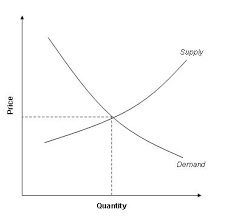
While I think (hope) you have the idea I don’t think that you have conveyed it very well here. If we reduce it down to a tale of two supply and demand curves, the first in the market for stakes, the second in the market for waiters:
What happens during a business cycle is that the demand for steaks (and all goods in the economy) shifts to the left. Corruspondingly the the demand for labor shifts to the left. The sticky wages hypothesis is ultimately that equilibrium in the labor market occurs slowly when the demand for labor decreases. In order for the labor market to return to equilibrium the wage must decrease. However, because prices in general have decreased the real wage has risen. This in turn means that the real wage at any nominal wage has decreased and so the supply of labor shifts rightward exactly at that point where the real wage and the quantity of labor is the same. This is what must happen to return in equilibrium.
What inflation in this instance does is that it prevents demand from shifting in the first place. If in one year Aggregate demand shifted to the left and spending was half what it once was, then ceteris paribus wages and prices must fall by half, but let’s say that prices are extremely sticky and no prices fall. Well then if, in the next year spending doubles, then we find that we are right back at equilibrium because prices don’t have to adjust from their previous equilibrium conditions.
What inflation does in this case is it returns us to that equilibrium position without ever leaving it. If people suddenly save half their money, and then they are given as many dollars as would make up that loss of spending and they spend all that money, then we do not leave that equilibrium point. Now there will be increases in inflation after dissaving occurs because the money in circulation will increase, but this inflation in and of itself will not do this because approximately as much money in circulation as was taken out will be put back into the system. The real money supply doesn’t matter. If the FED prints of 10 trillion no one knows about and doesn’t spend it then this will not affect prices one iota. If as much new money is put into circulation as was taken out in savings, then no adjustment must occur, as opposed to the long and painful process that must occur if prices are sticky.
“Before any money was printed, why didn’t the employer hire all of Group C? You are positing that the only thing missing was people who could afford to buy steaks at the current price. But when he hires Group C, they themselves will then have money to buy steaks, because they now have jobs, and they will buy them, and he will profit. So why didn’t he hire them all right off?”
It all has to do with the the marginal value of labor. In real wages Group C is asking for too much in wages relative to what they produce with the spending increase. With the increase in the money supply returning spending up to their old levels he will once more be able to hire.
@Clayton
Your argument doesn’t deal with a decrease in demand in general. For any specific industry you are perfectly right, but not for the economy as a whole. If people would prefer to save a larger portion of their income then demand for USPS, as well as all other industries, will fall whether these industries are valuable or not. This has already been discussed.
“As Hoppe asks, how can little slips of paper make us richer?? If this is true, and the central banks of the world all have an unlimited capacity to create slips of paper, there should be no poverty in the world at all, we should all be absolutely filthy rich.”
A huge purpose of central banks is supposedly to combat cyclical trends in the economy. It’s impossible to deny that if the recession (or the conditions which caused it) did not arise then we would be richer. Most economists would (wrongly in my view) argue that we are indeed much richer because central banks have lessened/ended recessions in the past. Central banks can only do so much to increase wealth, just as a single productive innovation can only do to make us richer, and it can only do this under specific conditions.
You just posted a video showing how an increase in slips of paper can make us poorer, perhaps intrinsically the idea that they could make us richer isn’t that absurd. Analysis is required to determine this one way or the other.