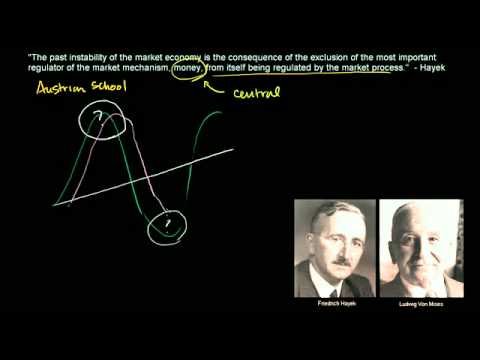
Kahn Academy is an education initiative begun by Salman Kahn. Kahn Academy has made 1000’s of good videos about math, science, and videos about economics and finance. Kahn Academy’s youtube channel put out a video about Austrian Business Cycle Theory today, and I was really excicted. But when I watched the video, I was so disappointed. The video does not represent ABCT correctly and misses the most important and basic points of the theory. Here’s the link to the video: http://youtu.be/aQD_pxNg81k
If you feel so compelled, please watch the video and send a message to the channel telling them that the video was wrong so they can hopefully change it. Maybe write a comment on the video too if you like. Here’s the message I wrote to the channel (did I do a good job?):
Dear KhanAcademy,
While I’m glad you made a video about Austrian Business Cycle Theory, it was actually not quite correct and entirely missed the essence of the the theory.
The criticism made by the theory according to the video is that central bankers’ monetary policy reactions are delayed. This is not true. The criticism made by ABCT is that the monetary policy tools themselves cause the business cycle.
Savings is a primary factor in ABCT, but they were not mentioned in the video. In a nutshell, savings represent a pool of resources that can be used for investment in an economy. When the amount of savings rises, banks have more loanable funds which causes interest rates to fall. These lower interest rates allow entrepreneurs to engage in long-term investment projects that would have been too costly at a higher interest rate. These projects are sustained by the pool of real resources that have been saved, and sustainable economic growth is achieved. If people don’t save, interest rates are higher which discourage investment. This is a good thing because the pool of real resources could not sustain many investment projects, and the higher interest rate encourage savings which can then lead to lower interest rates and sustainable investments.
However, when a central bank floods the market with newly printed money to lower interest rates, the pool of real resources has not changed. Long-term investment projects are undertaken because of the low interest rate, but there are not enough resources to sustain the projects because there was no increase in savings/the pool of real resources. As resources are consumed by the new investment projects, prices rise and make the investment projects more costly. As the entrepreneurs look for more loans to cover their now costlier projects, the loanable funds dwindle and cause interest rates to rise. Soon enough, the unsustainable investment projects (malinvestments) are exposed for what they are, and they must be liquidated. This is the recession which comes from an artificial increase in credit through the printing of money (or fractional reserve banking) and not through savings.
I didn’t mention consumer time preference or the structure of production and how they are coordinated with savings, interest rates, and investment, but I believe I explained important parts of the theory. I suggest looking up an explanation of the ABCT by Dr. Tom Woods on youtube. He has very good explanations. Here is a good, quick video that is about 8 minutes long: http://youtu.be/5K4Os5eXPw4
I hope you take this into consideration and correct/expound upon what was presented in the first ABCT video. If not, many people will misunderstand ABCT, which is not the aim of KahnAcademy. Thank you.