Link that lecture if there is one. It sounds like a riot.
Johnathan,
As far as I know, Paul Krugman has never written an econometric paper in his life. Krugman is exclusively a theoretical economist. And some of his early contributions were to theoretically demonstrate how increasing returns to scale can be used to explain intraindustry trade. And his work did have policy implications that could potentially support “infant industry” style arguments, but Krugman himself never supported these. In fact, Krugman has been a vocal advocate for free-trade many times.
Again, I take it you are not directly familiar with Krugman’s work? At least check out his Nobel Prize Lecture before you criticize him for things he hasn’t done.
http://nobelprize.org/nobel_prizes/economics/laureates/2008/krugman-lecture.html
I don’t believe you are interpreting Mises correctly. Maybe if I quote some who says exactly what I said more directly.
The very definition of capital deepening is an increase in capital intensity.
Where does it say that the amount of capital in an economy has increased? All of that just suggests what I said; the amount of capital available to investors has increased, not aggregate capital.
On Krugman, in one of his posts on macroeconomic theory he himself agrees that he has used econometrics to prove several of his theories correct. I am currently searching through the NYT and his blog to find that article/post.
Capital deepening MEANS an increase in the amount of capital in the economy.
You are misinterpreting the quote. Capital-deepening in the stages of production. Right. That’s what I said to begin with; capital is being made available through savings. Of course that the amount of capital per capita will increase in the capital-goods sector if capital is being transferred from savings to the stages of production. My point still stands.
This is an interesting quote from Krugman ( http://krugman.blogs.nytimes.com/2009/09/11/mathematics-and-economics/ ):
Math in economics can be extremely useful. I should know! Most of my own work over the years has relied on sometimes finicky math — I spent quite a few years of my life doing tricks with constant-elasticity-of-substitution utility functions. And the mathematical grinding served an essential function — that of clarifying thought. In the economic geography stuff, for example, I started with some vague ideas; it wasn’t until I’d managed to write down full models that the ideas came clear. After the math I was able to express most of those ideas in plain English, but it really took the math to get there, and you still can’t quite get it all without the equations.
 I don’t believe the quote says that all. In fact it says that a lower interest rate will lead to a lengthening of the production period (i.e. capital deepening). And capital deepening is simply defined as an increase in capital intensity. There was no mention by anyone about this being only the case for capital goods sector.
And infact, that comment kinda makes me think we need to spell this out a bit. Lets just think about this for a second. Here is a graphical representaiton of the stages of production known as the Hayek Triangle.
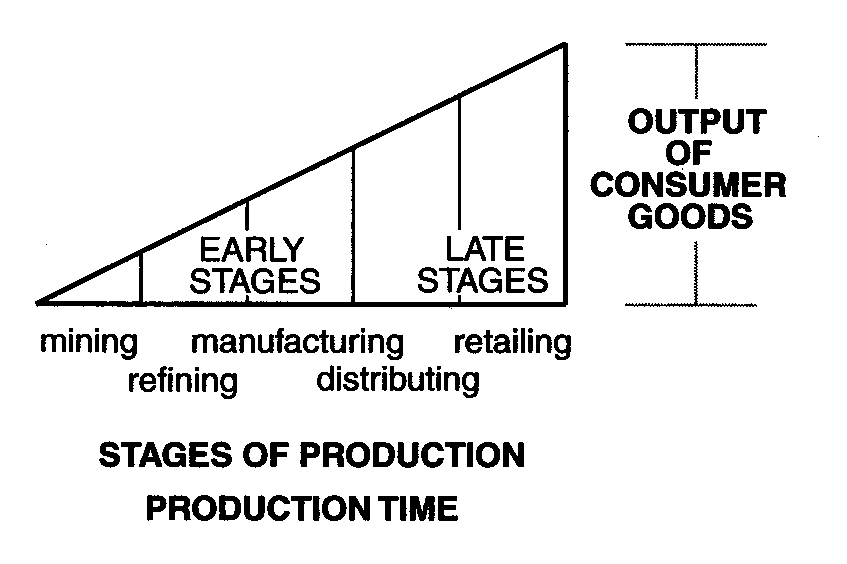
If the interest rate falls, this means that people are willing to forego consumption now for consumption later. The lower interest rate drives down the competitive gross profit margin in each stage of production. That is, for each stage input prices are bid up in relationship to output prices. the cumulative effect of this relative-price adjustment increases with increased remoteness from the final stage. Accordingly, resources are shifted out of late stages and into early stages in response to the lower time preferences. As illustrated here…
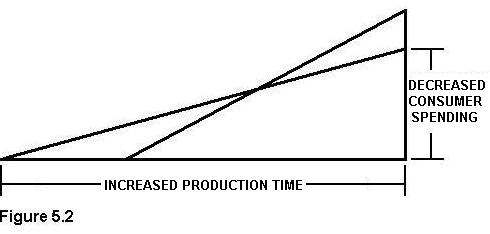
Now, as entrepreneurs invest in early stages of production they will be purchasing a lot of capital goods for building factories and the like. This is why capital per worker in the production of consumer goods increases.
Now I think that’s all I have in me. I hope that makes sense. If not, I have posted three different links that I believe support what I’m saying. But since I don’t even think the production period is a useful concept, I don’t think I can put much more energy into discussing it. Hope this helps! Have a good evening.
Johnathan,
Just so we’re clear. You do know that econometrics is not simply mathematics applied to economic subjects. Correct?
I never said that was untrue. You are arguing along a tangent of what I originally posted, which specifically said that the amount of capital in an economy grows when interest rates are decreased (specifically, it suggests that the Austrian theory believes that lower interest rates directly lead to an increase in capital in an entire economy). None of what you are saying suggests that this is true. Capital intensity increases, but this is because the capital, which has been saved instead of consumed, can be borrowed and used to lengthen and widen the stages of production.
EXACTLY. (Bolding in the quote is mine.) Lower interest rates does not cause an increase in resources, until after each successive stage of production is completed. Roundaboutness leads to an increase in capital (through the production of capital-goods father away from higher stages of production), not vice versa.
You have yet to disprove what I have been saying. I think you are actually ignoring what I’m saying, or you forgot the context behind the argument. None of what you have said suggests that the amount of capital in an economy has grown as a direct result of a low interest rates. The original quote:
“Earlier … Samuelson fell into the similar error of asserting that economies with a lower steady-state interest rate had more capital…”
I have taken plenty of econometrics classes, thank you very much. But, Krugman’s quote says math, not econometrics.
I watched that whole lecture and I don’t see what is so special about it. Boring as hell. Maybe it is impressive to some old ricket that believes perfect competition or something. My guess is that he was given the prize for obsessively attacking the perfect competition model, which is obsessively hated by socialists.
What has he done? None of his work is original whatsoever. He’s a political shill who’s more interested in his own legacy then he is in economics; his policy advice is dangerous and potentially disastrous. Why would anyone take time out if their day to further familiarize themselves with Krugman? We learn about his stolen theories in international eco.
Austrian economics is simply marginal economics before the so-called Keynesian revolution, which later broke off into monetarism, only to create the synthesis–neo-Keynesianism. Keynes, Hayek, Mises, and others all used the Wicksellian framework when explaining business cycle fluctuations. Hayek showed that Keynes misunderstood the Wicksellin framework and the indirect transition mechanism as laid out in the Treatise, forcing Keynes to retreat on almost all of his positions (except for inventory adjustment mechanisms). Main stream neo-Keynesians don’t include time, don’t understand the entrepreneur, don’t include the structure of production, try to work around uncertainty with probability theory, and believe capital to be a homogeneous blob. So I don’t really know what you’re talking about. The Solow model is not Austrian: Austrian capital theory is about more than providing enough savings to cover depreciation and population growth, it’s about the elasticity of the structure of production, and the kind of capital goods produced.
Of course most mainstream economists will find many austrian contributions “wanting”, since the austrian theory is quite explicity about the limits of knowledge that an economist can have, what is very, very frustrating for those who want to “guide” the resources of society in a “wiser” manner than the market.
Good comment, Jonathan. I’m glad it got through!
I weighed in, too, although my comment is still pending moderation…
Thank you Dan for linking to my archive.
To “A fan in NY” and “M”, You should know the “crazies” in the Austrian tradition helped revolutionize economics with subjective marginal utility value theory (Menger), and did so for the BETTER (unlike Keynes), played a huge role in developing time preference and capital theory (Bohm-Bawerk and Fetter), connected monetary theory with subjective value theory (Mises), predicted the Great Depression (Mises), took the lead in the calculation debate over socialism (Mises and Hayek), and predicted the present crisis (Peter Schiff was only the most televised Austrian to do so). Meanwhile the “respectable and sane” Keynes and Krugman believe burying bottles of cash in coal mines would have a net salutary effect on the economy (for an overview this and other gems to be found in Krugman’s Keynesianism read http://mises.org/daily/3583). And yes, Paul Krugman really did voice support for a housing bubble as I demonstrate in this article: http://mises.org/daily/3539
Last link is dead.
Thanks. Fixed.
I think it is because the Lew Rockwells of the world think actively engaging the government in mainstream publications and institutions would be nothing short of selling their souls. Note the constant criticism of CATO for their seminars featuring government officials (Oh no!). I respect the fact that many around here view compromise with the ‘enemy’ as only turning to the advantage of your opponents. The historical experiences of the German Liberal Party and Bismarck are marked as an example. The Ludwig von Mises Institute seems focused on educating the masses, and to that extent they have been largely successful, but I think the alienation of any non-purists is just going a bit too far. If CATO and LvMI would work together rather than have their stupid squabbles I think the liberty movement would really get going.
As an aside, I am curious as to what Lew Rockwell does for a living. I know that he was a political staff member for Paul but that was years ago, what does he do now? I am pleased with the efforts of the institute and gladly donate, but I am curious as to whether or not my money is going to paying its staff members to write blogs. (This whole post probably sounds hostile to Mr. Rockwell, that is not my intention)
Your comment is probably too late, Lilburne. It’d be glorious if they accept it, though.
By the way, check out the first Comment of the Moment on the side bar of the blog (the one by Servius). Not a bad comment to be featured on the blog.