I’m confused as to how that law would be enforced. You could get a few animals and let them graze on the land and say it’s in use. Speculators stabilize price increases, not just in property, but also goods such as food. For instance, lets say you’ve got a piece of land currently out in the middle of nowhere, not worth building on at the present time, but it looks like the city is moving in that direction. The property value will slowly increase as the time before building on it would be profitable decreases, because carrying prices for holding onto the property will go down. This would give people in the area advanced notice and help them plan accordingly rather than be surprised by suddenly sky-rocketing prices when it becomes worth it to build.
Speculation is about allocating supply in time. If speculators expect that prices will be higher in the future, it is because demand will be higher in the future, and therefore it is their role to reduce supply in the present and increase it in the future to restore equilibrium.
Hmm, what if there is some poor people that wanted to plant something in that land? Maybe they should go try making money or getting food at some place else that is more efficient?
Poor people generally rent any land they use to grow crops anyway. Why would an investor holding onto the land prevent this? My family currently owns farmland we’ll eventually sell, but in the mean time we rent it out to make some money on it in the short term.
If a person is buying land and holding onto it ignoring any profit that can be made in the present they are an idiot.
Then they can propose a lease agreement with the owner. If he rejects it, then 1) that is his moral prerogative, in any event, and 2) he has determined the lease is not financially justifiable over simply letting the land lie fallow.
The law operates on the assumption that non-owners know better what to do with land than the owner himself. That is a ridiculous assumption. Any attempt to mandate a use of land can only result in a diversion of resources from more profitable activity. It is the old “what is unseen” fallacy: the land reformers see idle land and think what a waste!–we should have a bunch of families tilling the soil! In fact, they may be better off trading their labor for money from an employer and buying groceries from a store rather than trying to scratch out a living from the land.
Thanks for the replys, it is all making much more sense now. Also, can someone recommend me a book that is just about speculation? Or some article or somewhere that goes more deep in the subject of speculation, like speculation in the stock market, and about people trying to push the prices of stocks up so they can sell it.
That’s the “pump and dump” phenomenon you see where corporate officers are paid in stock options instead of cash. There are externalities all over that, including IIRC an IRS rule limiting cash payments to senior exec’s. In reality, the market tracks sales by insiders, and any supposed benefit from the “pump” part evaporates pretty quickly. This is also why short sellers are integral to a properly functioning market.
If you want a good overview on the stock exchange, read Burton Malkiel’s “A Random Walk Down Wall Street.” There is actually very little asymmetry of information in a truly free market. So if you’ve got an executive who’s trying to dump all his shares, then people start asking questions and buyers start walking away, so the exec can only sell a portion of his holdings and even if he’s engaged in pumping and dumping, he can’t reap the benefit fast enough before the market responds to the scheme and starts driving share prices lower.
Usually, the reason for this is State distortion of the market.
In some jurisdictions, property taxes are capped in the percentage they may increase per year. In some jurisiditions, property is not re-appraised for tax purposes unless it is sold.
In that case, it would make sense to buy land and hold it.
If the land is truly unused, the someone could homestead it and claim it. Of course, governments don’t allow people to do this.
In a true free market, speculator would be making legitimate arbitrage by buying undervalued land. However, there would be no tax laws giving them an incentive to leave their land empty.
If someone moves into it, uses it and claims it, they should be able to. You own what you can use and protect. Nothing else. In a stateless society, there’s no such thing as a durable title. Some company or other might claim it is, but in anarchy there is no rightful ability to enforce it.
People have been quick to defend speculation, as its necessary for the price system to function. However, land speculation is actually different than other forms of speculation though.
In the libertarian sense land that has never been used is unowned. Any person who claims to own this land is not a market actor, applying his labor in a productive way, but an exploiter, hoping to extract rent from those actually willing to work.
The state is built upon exactly this preemption of land. The feudal state claimed to be the owner of all land, forcing others to submit to their conditions if they wished to work the land to support themselves. Its important to recognize that this is differet from a person hiring farm hands to work their land because the farmer legitimately owned the land before hiring the farm hands, where as the state did not.
In the English colonies in the Americas huge tracks of wilderness were given to speculators. Who turn around and sold them, still as wilderness, to others. At the time Land speculation was America’s most important “industry” and it was all backed by government violence trying to extract tribute from anyone who wished to work the land.
Exploiting nature is not a privilege, it is a right. Any use of nature that is not detrimental to another person’s use is allowable.
This truly is a case of the seen and the unseen. What is seen is that the state prevents people from owning wilderness at length, but what is unseen is that without the state they would not be able to own it at all.
What if the guy has built fences around the land and say he likes the land like that and he will sell it when the price is high. Does that count as homesteading? Someone has the right to go there and use the land?
Well, I’m not obligated to go checking in every PDA to see if some old fence/wall actually represents current ownership. Hadrian build a wall too, but it doesn’t represent a current title. Again if you’re there using it, defending it, or even if you’ve used it recently, that will likely be evident. If it looks like you’ve just been holding it for a few years though, a fence ought mean little more than any natural barrier, easily swept aside with human ingenuity if necessary, or just gone around.
Mutualist or geoist? I didn’t realize that the Mises community was so diverse [:)]
But anyway, does that mean, for example, if someone goes on vacation for a month, leaving his house vacant, and he finds a person using and claiming to own the house, that his own claim to the house is invalid?
He doesn’t need to be necessarily either. Just a natural rights guy: you control the property if you homestead it, you lose it if you abandon it.
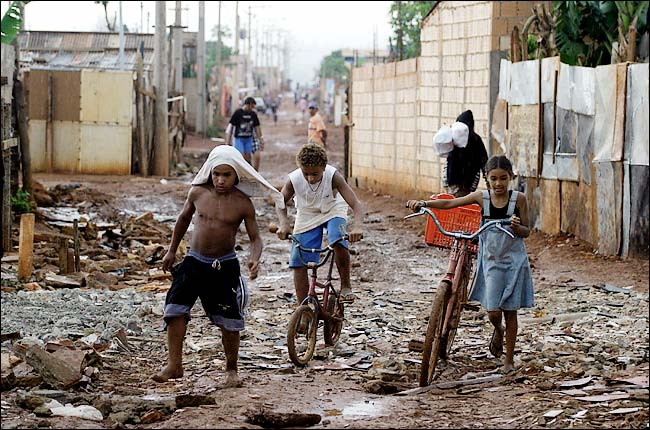
Anyway, I don’t see how the situation in Brazil is about speculation, unless we’re talking about some situation in the cities or something. In Portugal, we have more than 50 times their population density and we don’t have people dying of hunger in the corners. I might suggest you to look just how big Brazil is in a map. You have guys there with larger areas of land than an entire Portugal for many decades now. They only use a tiny bit of it, and they sometimes even participate in conquests to the next guy’s land – this is about power. Their politiceans are also the most corrupt bunch you can find anywhere; the governors there displace people as they please. They have big and modern cities, and then around them you have vast areas where people live like this. Lack of land is the least of their worries.
What if someone homesteaded the land, used it and some time later sold it to someone that like the land unused. Does someone have the right to go there and use the land?
If the land is unused, then it can be homesteaded. Giving someone money for land you intend to neglect is foolish. That you did so has no bearing on anyone else.
As for the mutualist/geoist question: I have sympathy for both, but came to these ideas prior to knowing much about them. I started on this forum, via Ron Paul, before I knew about them, too, when I was still a minarchist. As I’ve gone on, I’ve come to see the idea of absolute land ownership as incoherent and indefensible. So, I don’t believe in it anymore.
If X amount of land in a given city is zoned residential, and that X amount stays consistent for a X amount of time in an artificial market demand -that exceeds the X amount of the available zoned residential land capacity- to facilitate the liquidity of the certain market, which of the available land will go in so-called value first?
But the guy who bought it like to see the land unused, he likes too see the nature growing in there. Wouldn’t he have the right to mantain the land like that until someone offer a good price for the land or he dies and passes the land to someone else, or he dies does not have any relative to pass the land and someone goes there and homestead it?
If you’re willing to spend the money to secure the land and maintain that security, you can let it lie fallow. If you leave it there without defenses or just some decaying fence, when one day you visit it you have no right to evict the person who built a home on it. It’s fine to have a nature preserve, if you have the resources to actually preserve it.