When is poverty lowest? When is welfare highest?
Dang! Those were my exact words.
Friedman is a monetarist who told Pinochet to invest in public infrastructure and pension bonds.
When is poverty lowest? When is welfare highest?
Dang! Those were my exact words.
Friedman is a monetarist who told Pinochet to invest in public infrastructure and pension bonds.
You can either watch the Free to Choose miniseries or not. Milton Friedman makes my point. If you choose to not try and learn then that is your choice.
The problem with you picking and choosing is that you rely only on correlation. You have no theory to intrepret the data you see. Others in this thread have addressed your specific sources. I have no need to do this when others have done so. I do not pick and choose. You do. You are the hypocrite.
Besides, why debate me when you could watch debates with Milton Friedman. Oh, I know why, because you are intellectually lazy.
No one is advocating running up 200% inflation and 50% tariffs, like Chile in 1973. The differences between Austrians and everyone else aren’t that extreme.
This is a response to Mustang’s graphs:
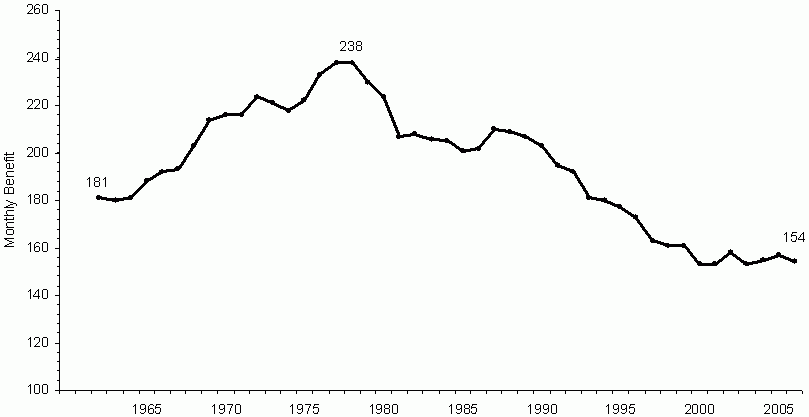
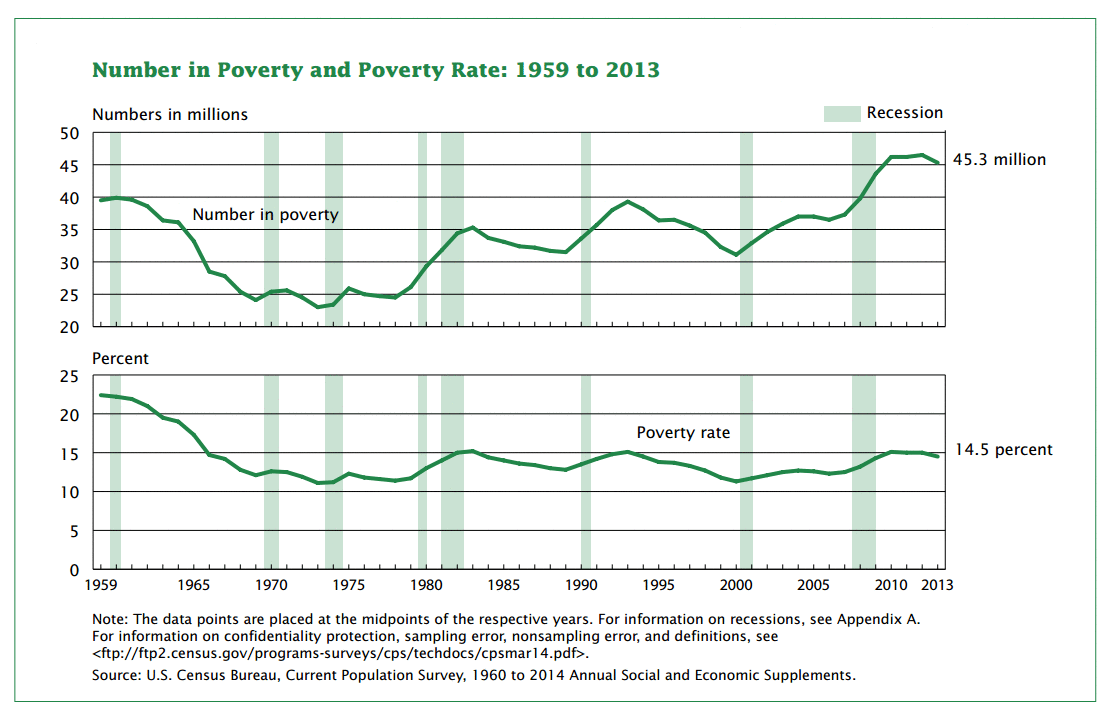
How is “poverty” defined in that study? I’m assuming in purely relative terms since the global maximum (of welfare spending) occurs during the stagflation crises (i.e., one of the worst economic periods in U.S. History).
Has to be absolute poverty. Relative poverty is like 20-30%.
It says it’s from Census Bureau data. As you noted, even during high unemployment and slow growth, poverty was lowest in the mid 70s.
As I said, kids playing with powerful guns… 
But apparently you’ve just implied that you are the trolling type.
So how about you answer my question - why should I go back to talking about the argument, when you don’t seem to be playing fair?
Autolykos, ya got me.
Anything else?
Who, the statisticians you referred to? The CPI is more or less set by the central bank inflation target. More than a few of them agree that monetary policy wasn’t great in the 1970s and that inflation targeting works better.
No, economists mining reams of data looking for correlation nuggets which they polish into causation pearls (of stupidity). All without giving a smidgen of thought about their (faulty) methodology. 99% of quantitative economic research studies (ones with formulas, numbers, and charts) over the last few decades (including the ones you’ve been refering to here) is utter pseudo-scientific crap – an embarassment to the human intellect, yet well paid for by central bankers and central planners far and wide.
EDIT: Bob Wenzel explains this much more eloquently in his recent speech at the NY Fed.
I’ll agree that quantitative studies are flawed, and that UI increases unemployment if you ignore the multiplier. If that is the end of the discussion, so be it.
A lot of people use theory the wrong way. Theory doesn’t prove anything, even tautologies. Theory proves a fact holds under certain assumptions, and it’s up to us to determine whether these assumptions hold in the real world.
As an Austrian economist, none of this is relevant to you, however. Like you said, value is subjective. Whether or not government programs create jobs is irrelevant as long as you hold that holding a gun to a person’s head to pay taxes is immoral. I actually agree with you there. In fact, not only would it be illegal for me to hold a gun to your head for any reason besides self defense, but the death sentence isn’t allowed for tax evasion.
If what you were trying to ask is, “do you support the government putting people in jail to pay for public goods?”, then I do agree, and we can discuss the observable effects of these public goods. Alternatively, if you can propose a system that does not involve the use of force, we can talk about that. Lastly, you can argue that public goods don’t exist and I will burn my dictionary.
From reading Rollback (I’ll check to see where he got the source from), I can tell you that from 1900 to about 1965, the poverty level declined from 90% of the population to around 10%. From 1965 to 2009 (give or take a year - can’t remember exactly), welfare spending per recipient quadrupled, yet poverty stagnated.
Maybe those values are in nominal terms.
The data in the chart above is from the HHS.
ed: I noticed .gov links aren’t parsing; very funny.
All human interactions can be divided into two realms: (1) voluntary, free, economic, and (2) coercive, aggressive, political. Each of us stands before a choice: Which realm of human interaction will I employ as means toward reaching my subjectively valued ends?
The benign descriptor “public” in “public goods” is nothing but an Orwellian doublespeak – a screen meant to cover the fact that someone’s ends have been attained through human interactions from the 2nd realm. The equivocation between a public company such as IBM (1st realm) and a “public good” (2nd realm) is mind-boggling.
The faulty pseudo-scientific studies, showing how 2nd realm (“public”) interactions produce more of X than 1st realm (“private”) ones, only exist to throw further dust in the eyes of the moral human agent. Today’s economists surrounding the parasitic politician, are yesterday’s priests surrounding the parasitic king – both paid to burn the heretics questioning the 2nd realm interactions of their masters.
The beauty of Austrian Economics is that it proves that the moral (1st realm) is also the BEST for producing the most of what each of us subjectively values the most.
Perhaps you should burn your dictionary.
You forgot 3) the “I didn’t pay my legal agency fees and now they’re trying to take my stuff” realm. Nothing voluntary about that.
Those parasitic roads and parasitic medicaid abortions parasitic children’s healthcare are really nice for some people, though.
I think I’ll just cross out the public goods entry and put “parasitic statist lies”, thanks.
That was option 1.
That was option 2.
We’re on option 3.
Nope, that’s still realm #1, voluntary. You’re mixing “voluntary” with “I get to do whatever I want whenever I want, voluntary contracts with other humans be damned.”
By your logic, the restaurant refusing to give you a second pizza (you are very hungry, you see) when you are only willing to pay for one, is also outside the 1st realm.
Not unless I voluntarily hand over my money to the LA when they come demanding it.
Yep. If you don’t like living in the US, you’re free move to another country. Just like you’re free to leave an LA’s turf at any time.
No, because the restaurant isn’t using force against me.
What is the basis on which they are demanding that you give them your money?
I don’t know. Probably whatever basis they feel they can legally get away with.
ed: Before this goes further off the deep end, let me get to the point. Policing is a coercive institution. Every (workable) idea for a society involves police. I’m not saying they’re a bad thing. I’m saying that they’re necessary.
Then you got yourself a property conflict. Both sides would be well within the 1st realm if they decide to resolve it in arbitration/court, or let their defense agencies resolve it for them through arbitration/court. If not, at least one party of the conflict has decided to move onto the dark side (2nd realm). Still, no need to invent a third option.
Defense, a sense of safety is a good demanded by humans, just like food. One could say that food would be even more neccessary (demanded) than safety, yet we don’t conclude that therefore it must be provided by a 2nd realm monopoly.
Now that you’ve admitted you’re not proposing a coercionless hippydom, we’re on the same page.
Back to discussion options 1 and 2?