So, I don’t think Lincoln was a good president by any means, in regards to him using his power to oppress the south and start an unnecessary war, resulting in a country in ruin, recession, war debt, and thousands dead, but why do people on Mises classify him as the worst president ever and a “classic example of authoritarianism”. What did he do that was so bad? I need some facts here because it is hard arguing against Lincoln to most people and I don’t want to be dismissed as “Racist” or something else idiotic. In regards to Wilson starting Prohibition, involving us in WWI, paving the way to the IMF and League of Nations, starting federal income tax, and creating the Federal Reserve, how could Lincoln possibly compare? I’m not questioning anyone so don’t get mad, I simply don’t know and actually would like to be informed as to why people hold Lincoln in such low esteem. Thank you.
First off, Lincoln had his own income tax - it just didn’t stick. Second, look at what he did to Maryland; there’s a reason their anthem’s extremely pro-Confederate.
You know… the stuff you just mentioned?
|
Deaths in American Wars |
|
|
Civil War |
618,000 |
|
World War II |
405,000 |
|
World War I |
112,000 |
|
Vietnam War |
58,000 |
|
Korean War |
54,000 |
|
Mexican War |
13,000 |
|
Revolution |
4,000 |
|
Spanish-American War |
2,000 |
|
War of 1812 |
2,000 |
So instead of considering why other people are blind to simple observations, you’re questioning why we think Lincoln was a horrible human being?
That is why I hate asking questions on here. I said I didn’t know any facts and was simply asking for some. I know it is the other people and I am not questioning anyone on here. I even said that. I just wanted facts to back up my claims, and since I don’t have them, I asked you.
Sorry for being 16 and wanting to learn some stuff, bro. Don’t get all hostile. If you use your reading skills and look at what I said, I even mentioned I was simply asking. “I’m not questioning anyone so don’t get mad”. Grow up and stop looking for fights.
Oh, and yeah, I mentioned that stuff, but I had no numbers or solid facts, and thought there must be other reasons if he is compared to the likes of Wilson and FDR. If I was questioning you, why would I say specifically I wasn’t, and more importantly, why would I ask for facts so I could join your side in disliking him for educated reasons.
lewrockwell.com is the place for you, son. do a search oover there
Thanks smiling dave.
Check out the video I made, which just made it on the LewRockwell blog. Whoo-hoo!
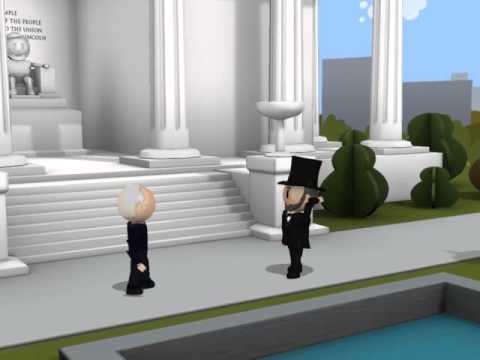
That video is great hahaha. Great job! Thanks for the link, it answered my question very well, too.
Atleast the South paid their soldiers in the same rank the same wage… if you were a private, you were paid a privates wage, regardless of whether you were black, indian, mexican, or white, same would apply to other ranks.. The Union army was the side that was discriminating by paying their black sodliers less than their whites. Also, The Confederates had more minorities as officer rank.even an indian as a general… just look up Stand Watie. another example is Colonel Santos Benavides.
Lincoln is almost the father of central power. That’s a big reason why he has been deified. It’s been slapped on that he wanted to free the slaves AND that there were no other options to consider; and those two together is the mythical story to support central power.
In reality, Lincoln was a giant corporatist (railroads) and there had been a political battle over tariffs for years. Lincoln was an outspoken racist and he supported a change in the constitution to enshrine slavery into it.
In his first inaugural address Lincoln clearly outlines that he’s not interested in the slavery issue but that he is interested in tax collection, and if States keep paying their taxes, that there will be no invasion:
I have no purpose, directly or indirectly, to interfere with the institution of slavery in the States where it exists. I believe I have no lawful right to do so, and I have no inclination to do so.
[..]
The power confided to me will be used to hold, occupy, and possess the property and places belonging to the Government and to collect the duties and imposts; but beyond what may be necessary for these objects, there will be no invasion, no using of force against or among the people anywhere.
Naturally, they didn’t print the first inaugural address in his temple, but his second.
And then there’s the issue of all the unconstitutional and immoral things he and the North did during and after the war. This is not at all to say that the South didn’t do bad things (starting with their support for slavery), but the deification of Lincoln, the North and central power is horrendous in the face of it.
For example:
General Sherman [who served as a General in the Union Army during the American Civil War (1861–65)] set out to eradicate every single Indian in a genocidal manner.
With this attitude, Sherman issued the following order to his troops at the beginning of the Indian Wars: “During an assault, the soldiers cannot pause to distinguish between male and female, or even discriminate as to age. As long as resistance is made, death must be meted out . . .” (Marszalek, p. 379).
Most of the raids on Indian camps were conducted in the winter, when families would be together and could therefore all be killed at once. Sherman gave Sheridan “authorization to slaughter as many women and children as well as men Sheridan or his subordinates felt was necessary when they attacked Indian villages” (Fellman, p. 271). All livestock was also killed so that any survivors would be more likely to starve to death.
[..]
By 1890 Sherman’s “final solution” had been achieved: The Plains Indians were all either killed or placed on reservations “where they can be watched.” In a December 18, 1890 letter to the New York Times Sherman expressed his deep disappointment over the fact that, were it not for “civilian interference,” his army would have “gotten rid of them all” and killed every last Indian in the U.S. (Marszalek, p. 400).
Just absolutely horrendous stuff.
These are the kind of people who are praised in (public) schools. The American state, which is a global superpower in near-perpetual war, needs a mythology and this is the sort of thing you get.
If you’re looking for audio, DiLorenzo has some great lectures about Lincoln.
- Lincoln’s Tariff War
- Abraham Lincoln and the Triumph of Mercantilism in America
- Lincoln vs. the Constitution
Especially check out the last one for the details how Lincoln was truly a tyrant.
Also, Lew Rockwell has an archive on Lincoln.
Don’t take it personally. We all get a little short sometimes. Keep asking questions.
(Lincoln and Dick invented greenbacks like Colonel Saunders invented fried chicken)
About 15 years after his death, started the Lincoln-myth making – and also the style of conspiracist book-sellers indiscriminately and uncritically plagiarizing and regurgitating other people’s work, but mainly of each others’ since there wasn’t and isn’t much actual work around, to steal from. In the 20th century this tale-telling and gas-passing multiplied exponentially: people who never seen the inside of the library, never did any research on the subject, put together books (because there is money in them books) and displayed their ignorance and impressed the village people while making some dough and perpetuating the lie.
Sarah Emery – who learned much of what she knew about the bankers’ conspiracy from B.S. Heath, the grand-daddy of above mentioned book-compiling style – opened the line and popularized the wishful fantasy perhaps more than anyone else:–
“But the great leader, Lincoln, was not to be baffled; he loved the people better than Shylock, and justice better than oppression. From the constitution he read, ‘Congress shall have power to declare war.’ Again he read, ‘Congress shall have power to coin money.’ Then to the world he declared that Congress would coin money, and that the government, at whose head stood the fearless Lincoln, would not submit to the infamous demands of Shylock.” --‘Seven Financial Conspiracies that Enslaved the Amerikano People’
Painting the picture of the “fearless” champion of the people that he discovered some hidden or forgotten knowledge about printing and spending into circulation Treasury notes; and also that the “great leader” was an opponent of banks and banking (fractional reserve, note-issuing banking). As for Lincoln’s reading the Constitution:-- it seems he only heard about it, or paid attention to it when weeks after he, on his own, declared war on the South, Congress reminded him that he had no right. With “a labored and lawyerly vindication of his own course of policy” Lincoln expected that Congress “become but a mere office wherein to register the decrees of the Executive” --the Congress approved
Reality check:–
-
Issuing treasury notes was no secret or forgotten
-
Lincoln was no friend of the people
-
Lincoln was NOT an enemy of Banks
-
Lincoln would have signed the Federal Reserve Act
To support my argument:–
- Abraham Lincoln was President-elect in December 1860, and probably paid some attention to what the out-going Congress and President did. And that Congress and President (James Buchanan) issued $10,000,000 Treasury notes in that nick of time. This was NOT something new, or unusual. This was the second issue under Buchanan, and up to that time the US Congress authorized or regulated Treasury notes 80(eighty) times. Lincoln was in politics since the 1830s, so he must have, should have, and actually did know about Treasury notes. In the 1840s at one time $30-some million of Treasury notes were out, which in those days constituted more than one half of the Federal budget. The practice (of issuing Treasury notes) was very well known, very well debated inside Congress and outside of Congress.
An Act to authorize the Issue of Treasury Notes, and for other Purposes. [Approved, December 17, 1860]:–
http://memory.loc.gov/cgi-bin/ampage?collId=llsl&fileName=012/llsl012.db&recNum=152
Section 10. And be it further enacted, That in place of such treasury notes as may have been paid and redeemed, other treasury notes to the same amount may be issued: Provided, That the aggregate sum outstanding under the authority of this act shall at no time exceed the sum of $10,000,00: And provided further, That the power to issue and re-issue treasury notes conferred by this act shall cease and determine on the 1st day of January, in the year 1863.
Which means, that, according to this Act, President Lincoln was authorized to re-issue these Treasury notes in 1861 and in 1862, as fast as they returned to the Treasury. Of course, 10 million is not much to finance a war; so he would have needed to legislate a larger number (and the Act of July 17, 1861, was a re-enactment of the Acts '57 and '60). If Lincoln had needed anybody to learn of the secret, his very own police minister and goon squad leader, Secretary of State Seward, was Senator Seward in '57 (when $20,000,000 of them notes were approved) and participated in the Treasury note debates, and in co-operation with Senator Fessenden added an amendment to the bill.
Within the hearing of Mr. Seward, the mid-wife of the Treasury note bill (Mr. Hunter from Virginia) said in the Senate(Friday, December 18, 1857.):-- “if you adopt such a rate of interest as will keep these notes at par with specie, they will circulate along with specie, having the same value.”
To which Mr. Seward replied:-- “I am very happy indeed to find that there is no substantial disagreement between the honorable Senator from Virginia and myself in regard to the questions which have been discussed between us, and that our views of the operation of the bill are precisely alike.”
If only, those who painted this picture of Lincoln and Chase sitting around in the gloom room – “what to do ? what to do ? we have a war to conduct and have no money ! and the (big-bad) bankers want high interest rates and refuse to give coin ?!” “Ah!, to the rescue!, sent by some providence!, a Dick!, or a tailor!, or some Still well, or whoever, to en-licht-en us about this hidden-secret, knowledge of al-Chemy (a.k.a. Kemikal Ali?) of printing Treasury notes by the millions and circulating them as currency; U! Reeka !!” – have bothered to read something other than just what was plastered on the inside of the out-house door …
-
- On December 26, 1839, young Representative Lincoln spoke (“with the forked tongue and crooked counsel of the New York politician”) against the Sub-Treasury:–
“Again, as to the contractions and expansions of a National Bank, I need only point to the period intervening between the time that the late Bank got into successful operation and that at which the Government commenced war upon it, to show that during that period, no such contractions or expansions took place. If before, or after that period, derangement occurred in the currency, it proves nothing. The Bank could not be expected to regulate the currency, either before it got into successful operation, or after it was crippled and thrown into death convulsions, by the removal of the deposits from it, and other hostile measures of the Government against it. We do not pretend, that a National Bank can establish and maintain a sound and uniform state of currency in the country, in spite of the National Government; but we do say, that it has established and maintained such a currency, and can do so again, by the aid of that Government; and we further say, that no duty is more imperative on that Government, than the duty it owes the people, of furnishing them a sound and uniform currency.”
Mr. corporate lawyer Lincoln was FOR a privately owned --because when he uses the term “National Bank” he means a Biddle bank-like, private institution–, nation-wide, currency-issuing bank, using the credit and indebtedness (bonds) of the Federal government as the foundation of its operations. Mr. Lincoln was all FOR a 3rd Bank o’ the U.S., but President Tyler vetoed the idea, twice! So, I dare to say that had he been around and president, Lincoln would have approved the Fed Res Act. Not only that, but in 1863 Pres. Lincoln did have a chance to show his colours in real life, not just in theory, and he did (show his colour); he signed the National Currency Bank “Act to provide a National Currency, secured by a Pledge of United States Stocks,” which produced a banking system and currency, based on national indebtedness, and “secured all the benefits of the old United States Bank … as if the Bank of the United States had been divided into many parts, and each part endowed with the life, motion, and similitude of the whole, revolving in its own orbit, managed by its own board of directors, attending to the business interests of its own locality; and yet to the bills of each will be given as wide a circulation and as fixed a value as were ever given to those of the Bank of the United States in its palmiest days. … These institutions all originate among the people in their own localities, and are not created by the Government. The Government simply authorizes the investment of capital in the loans, and the use of the bonds representing the loans as the basis of a sound circulation.”
Abraham Lincoln was part and parcel of the Whig group which, after a bloody nose from Andrew Jackson, and a kick in the balls from John Tyler carried on the struggle to turn the United States (for common defence and mutual benefit, for which Thomas Jefferson composed the Declaration of Independence) into a feudal empire, controlled by a financial elite. “For three decades a union of the South and West prevented a restoration of the centralized banking system. Not until the planting statesmen withdrew from Congress, and the storm of the Civil War swept minor gusts before it, were the ravages wrought by Jackson repaired by the directors of affairs in Washington.”
- The quote (from '39) also indicates that Lincoln was no friend of government-issued currency; no friend of the idea of a Government-owned Federal Reserve System, just as he was no friend of the sub-Treasury concept (the idea that the monies of the federal government should be kept in sub-Treasury branches all around the country). He used Treasury notes as the United Kingdom used exchequer notes: as a war measure, and as a way to bail out private banks when they suspended honouring their promises to pay.
United States notes and war debt were means to an end:-- to finance a war and to establish a Government-bond-based, currency-issuing, private banking system. This plan was foretold by Secretary Chase in December 1861, and also, more clearly, in the House of Representatives, on February 3rd 1862 for example: “to create an enormous and endless public debt, to be interwoven with every political, social, and business relation of life; to subjugate the States and the people perpetually to the Federal Government, and therefore never to be extinguished” --Mr. Lincoln did not object, he signed the Act.
An ingenious plan: they wanted to set up a nation-wide, currency-issuing banking system, using government bonds as capital to bank on. To facilitate this plan, the Government had to sell bonds, but, bankers did not want spend coin to buy bonds; so the Government issued legal-tender notes with which to buy bonds (and purposely flooded the country with notes until bonds could be purchased at half price); then individuals used these debt-instruments to set up National Banks (more than 2,000 of them, as opposed to the 1,400 before the war) and issue National Currency. To add injury to insult, the people had to pay interest on these National Currency notes.
In February 1861 the U.S. Federal debt was $69 million (two week’s pay from each family could have retired this debt); in February 1866 the Federal debt was $3,000 million ($87 per head, at the time when the trans-continental railway was built for a dollar a ten-hour day). This debt became the foundation of banking institutions and of the currency commonly referred to as US dollar, and has not been paid since, only increased; and Mr. Lincoln would have had no objection
Why was the Russian Fleet sent with orders to serve Lincoln?
Why did the Czar gamble war against all Europe to protect Lincoln?
What were Europeans armies doing in Mexico, led by the French? And did they retreat instead of taking advantage because of the Czar?
Of course the war should have been avoided.
But… was it only a pure American matter? Was Lincoln in control? Were other influences/powers countries or powerful interests affecting the situation?
Was Lincoln the same man his whole life? Did he change?
Let’s not forget there still is a big different between Greenbacks and Federal Reserve Notes.
And…Why the fear of talking about his solution for slavery, sending the blacks back, maybe with a small help/compensation? Why is it so unthinkable, if it was wrong to bring them here, logic compels to at least offer them the chance to return home for free.
My vote for worst POTUS in terms of direct responsibility would be Franklin Delano Roosevelt. In terms of what he was ultimately responsible for and total economic control, it would be Woodrow Wilson. In terms of getting the ball rolling on the American Empire, that would be Lincoln.
http://www.statepress.com/2011/02/17/lincoln-killed-the-united-states/
Fantastic job on that video, by the way. Really, really great work.
Already got its own thread, but…
It’s not the he’s any worse or any better then any other president. It’s that he’s been falsely built up more so then other presidents. The higher you stand, the further it is to fall kind of thing.