…and everyone my age is now graduating college…
With how much debt? And what acquired skills?
Good luck to you, Bert.
…and everyone my age is now graduating college…
With how much debt? And what acquired skills?
Good luck to you, Bert.
Ha, those are two things that deter me from going back. Watching people accumulate debt and with that debt not being able to find a job that they are even satisfied with. I see it too often with friends and family, they went down those paths, and at their age I don’t see them any happier. I find it amusing when I get asked curious questions why I haven’t gone back. One of which seems to be surrounded around the idea that since I don’t go to college I don’t want to learn - I think I’ve learned more by my own books and personal experience than what a college could offer (to be honest the only thing that seems appealing about going off to a college is a new environment away from home and pushing your physical body and mind to the limit - I can do that without the debt). Secondly is the myth that you have to go to college, everyone bought into it and they don’t know why. I’ve come across many people, even when I was in high school, who planned to go to college with no clue what they wanted to do. I thought it was a bit foolish. Seems the people I know who are living rather financially stable on their own chose the most unorthodox and hardest paths compared to others.
Hopefully I do have some luck on my side.
This quote by Leonard Read may be fitting. From The Free Market and It’s Enemy:
Unless a reader shares my premise, he will not respond to my reasoning; nor will it be possible for him to arrive at my conclusions. He may have his eye set on a star I do not see or, if seeing, care nothing whatsoever about. I side with Thoreau on this, “… perhaps it is because he hears a different drummer. Let him step to the music which he hears, however measured or far away.” If the music another hears be fame, or fortune, or power, or ease and retirement, or longevity, or anything less than individual emergence, I leave the reconciliation to those with an itch for reform; it isn’t, as they say, my cup of tea.
The reflections which follow are not aimed at swerving anyone from whatever life purpose he may have set for himself. That’s his affair, not mine. Instead, these brevities are offered to those whose ideological and spiritual premise approximates my own: that man’s earthly purpose is to expand one’s own consciousness, as nearly as humanly possible, into a harmony with Infinite Consciousness or, in lay terms, to realize, as best one can, those creative potentialities uniquely his own. The lyrics to the music I hear have a clear refrain: the supreme purpose of life is “to hatch,” to emerge, to evolve.
or in a more simplistic manner, to quote Joseph Campbell (a significant influence of mine),
Follow your bliss.
No tyrannical, miserable government ever rises to power by promising people tyranny and misery
By “pssvr” on Reddit (he might have paraphrased it)
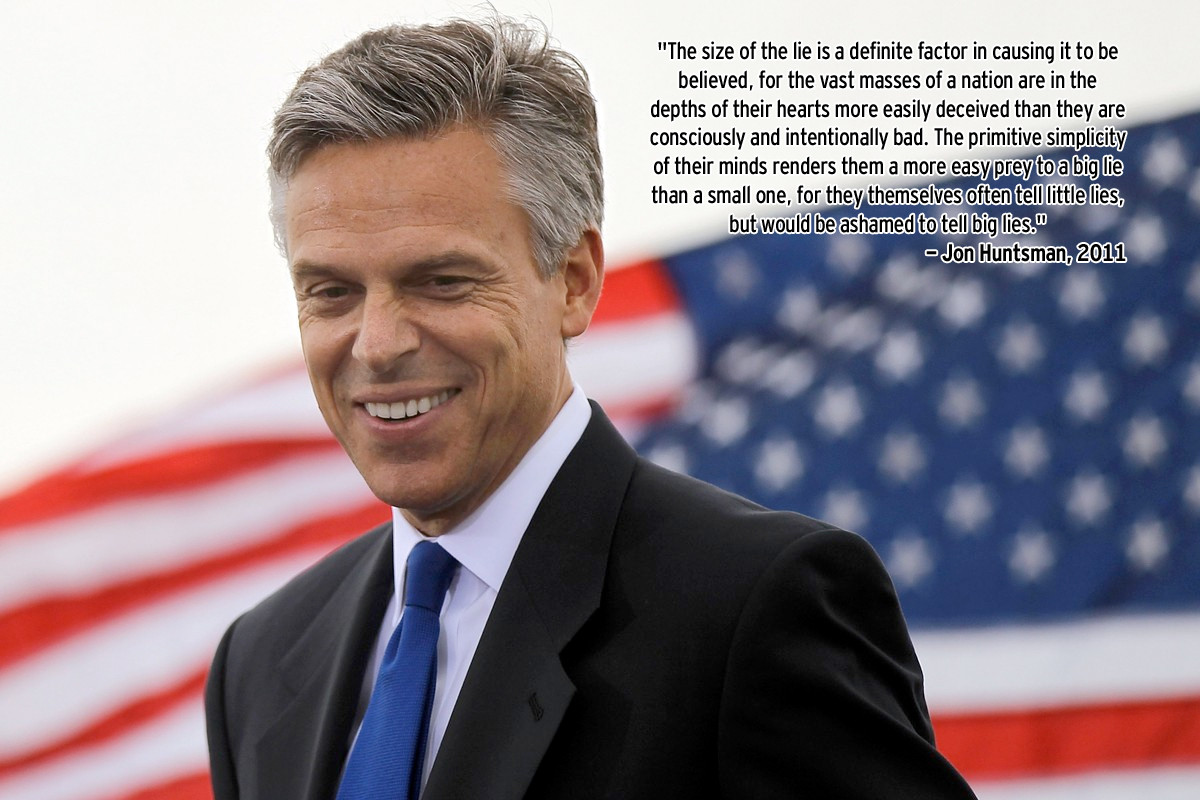
Wow. Sounds like John Huntsman and Adolf Hitler have something in common.
Aaaaaand there goes Godwin’s Law.
Nice quote:
“A Government Big Enough to Give You Everything You Want is Powerful Enough to Take Everything You Have”
Something I made last night from The Power of Myth.
Started reading The Law and found this absolute gem:
Collective right, then, has its principle, its reason for existing, its lawfulness, in individual right; and the common force cannot rationally have any other end, or any other mission, than that of the isolated forces for which it is substituted. Thus, as the force of an individual cannot lawfully touch the person, the liberty, or the property of 2 The Lawanother individual—for the same reason, the common force cannot lawfully be used to destroy the person, the liberty, or the property of individuals or of classes.
You’re just now reading The Law? That entire work is quotable, every paragraph is worth something.
My The Rational Optimist quote collection from the What are you reading?-thread:
Though we no longer coerce men for their spiritual good, we still think ourselves called upon to coerce them for their material good: not seeing that the one is as unwarrantable as the other.
I find that my disagreement is mostly with reactionaries of all political colours: blue ones who dislike cultural change, red ones who dislike economic change and green ones who dislike technological change.
Merchants and craftsmen make prosperity; chiefs, priests and thieves fritter it away.
The great drive to universal suffrage, religious tolerance and female emancipation began with pragmatic enthusiasts for free enterprise, like Ben Franklin, and was pressed forward by the urban bourgeoisie as a response to economic growth.
By 1500 BC you could argue that the richest parts of the world had sunk into the stagnation of ‘palace socialism’ as the activities of merchants were progressively nationalised.
The Malthusian crisis comes not as a result of population growth directly, but because of decreasing specialisation.
In that sense, the decline of the Roman empire turned consumer traders back into subsistence peasants. The Dark Ages were a massive experiment in the back-to-the-land hippy lifestyle (without the trust fund).
As they spilled out of their homeland, Arabs brought luxury and learning to an area stretching from Aden to Cordoba, before the inevitable imperial complacency and then severe priestly repression set in at home. Once the priesthood tightened its grip, books were burned, not read.
In the past, when societies gorged on innovation, they soon allowed … their bureaucrats to write too many rules, their chiefs to wage too many wars, or their priests to build too many monasteries.
China went from a state of economic and technological exuberance in around AD 1000 to one of dense population, agrarian backwardness and desperate poverty in 1950. …it was the only region in the world with a lower GDP per capita in 1950 than in 1000. The blame for this lies squarely with China’s governments. … China’s best moments came when it was fragmented, not united.
The greatest beneficiaries of European political fragmentation were the Dutch. By 1670, uncommanded by emperors and even fragmented among themselves, the Dutch so dominated European international trade that their merchant marine was bigger than that of France, England, Scotland, the Holy Roman Empire, Spain and Portugal – combined.
The message from history is so blatantly obvious – that free trade causes mutual prosperity while protectionism causes poverty – that it seems incredible that anybody ever thinks otherwise. There is not a single example of a country opening its borders to trade and ending up poorer.
They could find no evidence that aid resulted in growth in any countries. Ever.
In 1978 China was about as poor and despotic as Africa is now.
the birth rate was more than twice as high in countries with little economic freedom (average 4.27 children per woman) compared with countries with high economic freedom (average 1.82 children per woman)
Wind turbines require five to ten times as much concrete and steel per watt as nuclear power plants, not to mention miles of paved roads and overhead cables. To label the land-devouring monsters of renewable energy ‘green’, virtuous or clean strikes me as bizarre.
Some things are finite but vast; some things are infinitely renewable, but very limited.
The science of ecology has an enduring fallacy that in the natural world there is some perfect state of balance to which an ecosystem will return after disturbance.
Few of the inventions that made the industrial revolution owed anything to scientific theory.
Though they may start out full of entrepreneurial zeal, once firms or bureaucracies grow large, they become risk-averse to the point of Luddism.
we may soon be living in a post-capitalist, post-corporate world, where individuals are free to come together in temporary aggregations to share, collaborate and innovate
Tomorrow’s largely self-employed workers, clocking on to work online in bursts for different clients when and where it suits them, will surely look back on the days of bosses and foremen, of meetings and appraisals, of time sheets and trade unions, with amusement. I repeat: firms are temporary aggregations of people to help them do their producing in such a way as to help others do their consuming.
Yet if innovation is limitless, why is everybody so pessimistic about the future?
I cannot recall a time when I was not being urged by somebody that the world could only survive if it abandoned the foolish goal of economic growth.
The pessimists’ mistake is extrapolationism: assuming that the future is just a bigger version of the past. As Herb Stein once said, ‘If something cannot go on forever, then it will not.’
The premise on which much of the environmental movement had grown up – that cleaning up pollution would prevent cancer – proved false.
Take the year 1830. Northern Europe and North America were much richer than they had ever been. They had enjoyed more than a decade of peace for the first time in more than a generation and they were brimming with novel inventions … Yet was the mood of 1830 optimistic? No, it was just like today: fashionable gloom was everywhere.
Throughout the half-century between 1875 and 1925, while European living standards shot up to unimaginable levels … intellectuals were obsessed with imminent decline, degeneration and disaster.
The generation that has experienced more peace, freedom, leisure time, education, medicine, travel, movies, mobile phones and massages than any generation in history is lapping up gloom at every opportunity.
Campaigners … took precisely the same approach to threshing machines in 1830 as their 1990s equivalents would take to genetically modified crops: they vandalised them.
Some of the vociferous and numerous opponents of the Liverpool to Manchester Railway, which opened that year, forecast that passing trains would cause horses to abort their foals. Others mocked its pretensions to speed: ‘What can be more palpably absurd and ridiculous than the prospect held out of locomotives travelling twice as fast as stagecoaches!’ cried the Quarterly Review. ‘We trust that Parliament will, in all rail ways it may sanction, limit the speed to eight or nine miles an hour.’
Robert Southey … would have been at home in the modern environmental movement, lamenting world trade, tutting at consumerism, despairing of technology, longing to return to the golden age of Merrie England when people ate their local, organic veg, danced round their maypoles, sheared their own sheep and did not clog up the airports on the way to their ghastly package holidays.
The endless modern laments about how texting and emails are shortening the attention span go back to Plato, who deplored writing as a destroyer of memorising.
the models that predict rapid global warming take as their assumption that the world will prosper mightily, and that the poorest countries on the planet … will by the end of this century be about nine times as rich as they are today. Unless they are, carbon dioxide emissions will be insufficient to cause such rapid warming.
The Copenhagen conference of December 2009 came worryingly close to imposing a corruptible and futile system of carbon rationing, which would have hurt the poor, damaged ecosystems and rewarded bootleggers and dictators.
Lol. to me No Treason is entirley quotable  and great opening, Bert. I will probably post that quote on my wall on evilbook..
Isn’t that crazy!
Yeah, I’m reading it just now. More good stuff:
When, from the seclusion of his office, a politician takes a view of society, he is struck with the spectacle of inequality that presents itself. He mourns over the sufferings that are the lot of so many of our brethren, sufferings whose aspect is rendered yet more sorrowful by the contrast of luxury and wealth. He ought, perhaps, to ask himself whether such a social state has not been caused by the plunder of ancient times, exercised in the way of conquests; and by plunder of more recent times, effected through the medium of the laws?
Geez, this is a gold mine!
Socialism, like the old policy from which it emanates, confounds Government and society. And so, every time we object to a thing being done by Government, it concludes that we object to its being done at all. We disapprove of education by the State—then we are against education altogether. We object to a State religion—then we would have no religion at all. We object to an equality which is brought about by the State then we are against equality, etc., etc. They might as well accuse us of wishing men not to eat, because we object to the cultivation of corn by the State.
If ‘intellectual property’ was real property, the government would not be interested in protecting it.
-Mike Peinovich
“If you see a man approaching you with the obvious intent of doing you good, you should run for your life.”
Henery David Thoreau
Even the poor student studies and is taught only political economy, while that economy of living which is synonymous with philosophy is not even sincerely professed in our colleges. The consequence is, that while he is reading Adam Smith, Ricardo, and Say, he runs his father in debt irretrievably.
Wherever I found the living, there I found the will to power; and even in the will of the servant I found the will to be master.
That the weaker shall serve the stronger, to that it is persuaded by its own will, which would be master over what is weaker still: that pleasure alone it is unwilling to forego.
And as the lesser surrenders to the greater that he may have delight and power over the least of all, so even the greatest surrenders himself, and for the sake of power stakes - life.
That is the surrender of the greatest - that they face risk and danger and roll dice for death.
And where there is sacrifice and service and loving glances, there is also the will to be master. By secret paths the weaker slinks into the castle and even into the heart of the more powerful - and there steals power.