Study is a category of action; knowledge is a category of action and awareness. Awareness is primary. Action is primary. These other speculations regarding the “real” substructure of awareness and action are secondary and derivative. You can spin it until you puke from dizziness but the fact remains that choice is choice. That’s why we call it choosing. Everyone knows what it is. If you can’t seem to figure out the difference between clockwork and your own sense of volition, that’s your problem.
Here’s a couple of interesting video’s. The first one I think is wrong, but wrong in an illuminating way. Or rather we could interpret him as right but with a modification… urgh, its complicated ok !?$%!!
The second one I think is right, in so much as it is another way of saying what myself and Clayton and others have been saying (approximately)
ok here we go !
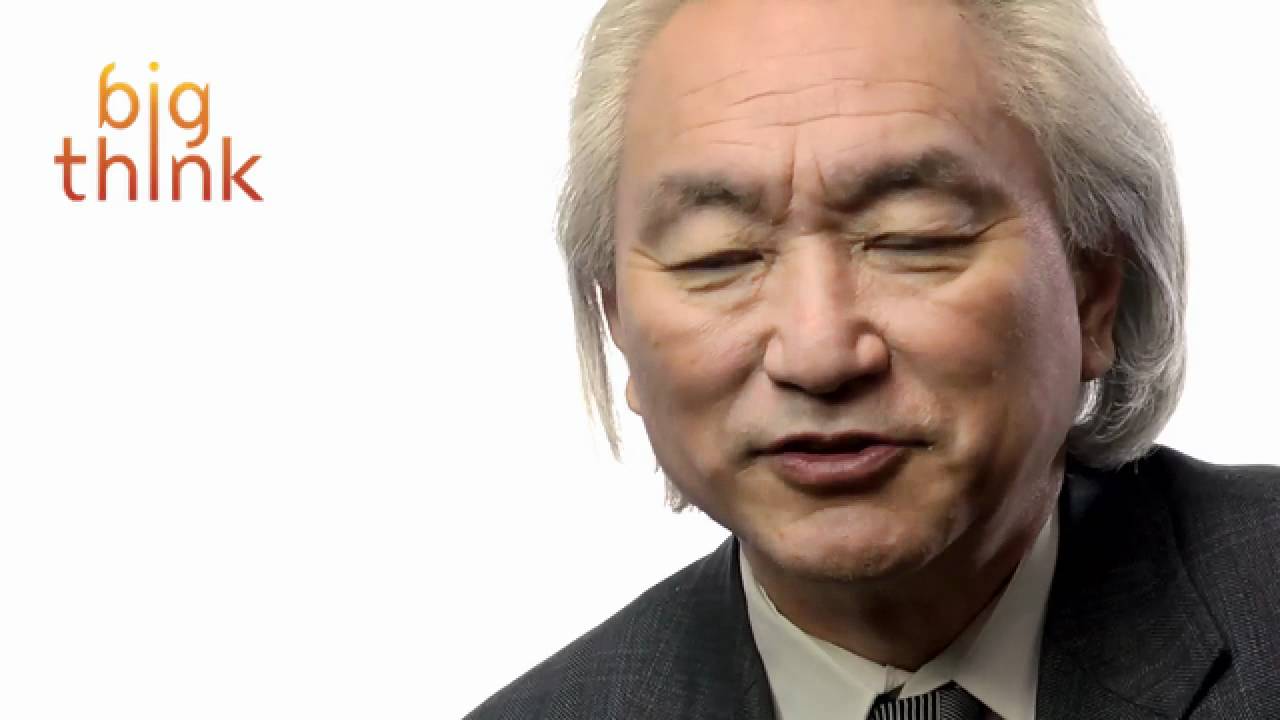
Michio Kaku: Why Physics Ends the Free Will Debate
First he describes the pre-quantum (i.e. newtonian) deterministic framework, which in his interpretation would lead to the assesment that free will is illusary, and that murderers where predestined to eventually murder based on the initial conditions of the universe. Then he attempts to rescue ‘free will’ by the introduction of quantum indeterminancy, which is to say that there is no fully specified destiny for our little electron friends. Thus he seems to be allowing ‘free will’ as a real phenomenon on the basis of the real physical quantum indeterminancy. However, I would argue that the problem here is why would we want to assosciate as such my will, moral agency, choices etc, with what this or that quantum element randomly chooses to do. Another way of thinking about this is that determinancy and indeterminancy kind of miss the point on free will, determinancy would seem to shed ‘free will’ because everything is preordained, and indeterminancy seems to shed ‘free will’ because there is a dice-thrower beyond the veil that effects your brain so you behave differently… . On the other hand, Kaku makes the interesting and important point, that it is our inability to predict outcomes for vastly complicated aggregate such as a brain, (he says no one can determine your future events based on your past history), that means we can be said to have free will.
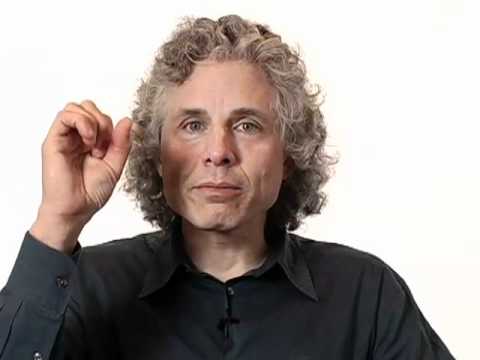
Ok, so now listen to Pinker,
He dismisses dualism, he sees mind as emergent of physical processes of the brain. He recognises the vast complexity of the brain, and hence how hard it is to predict. Then he recognises a continuum between more reflexive and more deliberative/volitional behaviours. The volitional behaviours use a lot of brain, the mind will have self awareness and will think about choices, it will have the feeling that it can choose. Here we find where to locate ‘free will’. It may not mean what it meant 100years ago and before that, when people knew less about the world, and less about philosophising about the world… but we have ‘free will’ that it makes sense and is usefull to talk about. We recognise complexity, we recognise the phenomenon of the ‘illusion of will’, i.e. feelings of self awareness and seeming volitional possibilites, and we consider the external challenges to predicting the brain… and why can’t that all add up to ‘free will’. I think that is the ‘free will’ we have got now and have always had.
I think Kaku’s position is unreasonable. The use of QM or other statistical mechanics can never establish whether the universe is fundamentally deterministic or not. In fact, there is the perfectly valid Bohmian interpretation of QM where particles have precise positions (“beables”, not observables); for example, an electron in a ground state hydrogen atom is stationary instead of being smeared out.
The quantum element only seems to us to be random at this point. We may discover later that they are in fact going where they need to go. Just as we can see that plants breed. They (plants, jellyfish, cells) don’t have consciousness as we think of it, but they somehow manage to do what they need to do in order to propagate their own existence. All things multiply.
To say that a certain ancient gas cloud releasing in space in a specfic way somehow managed to cause a person to murder simply because the conditions over which the ages chose to form the circumstances did so as it did is a little too far of a leap of logic. Correlation isn’t causation. Circumstance is what creates morality, but it doesn’t necessarily cause action. Morality creates choice and choice creates the dilemma of action (moral choice; free will).
I whole-heartedly agree with everything Pinker said. I think that speculation about quantum randomness only muddies the waters. Besides, Kaku is a tool.
I would augment what Pinker said by eliminating the word “physical” (which I think is actually a puzzlingly meaningless word, especially for how common it is to throw it about these days) and, instead, use the word “causal” - the mind is the result of causal processes, nearly all of which reside within the confines of the skull. And I especially agree with Pinker’s note that we can’t even make sense of the dualist position, that is, it is an inherently acausal position. You can’t reconcile causality and acausality.
However, I think that Pinker would agree that much of human language is inherently dualistic. We speak of our own internal states as if there is some kind of genie pulling levers within us (I always think of the tiny alien inside the head of that old dude in the original MIB in the morgue scene). And for the purposes of praxeological analysis or any other kind of scientific analysis that is not directly concerned with the investigation of the causal theory of consciousness itself, the only way to avoid muddying the waters with extraneous bits & pieces of the current theories of consciousness is to adopt the mantle of methodological dualism.
It should be understood that - if taken in the woodenly literal sense - MD is unintelligible for the reasons already mentioned. But methodological dualism is not intended to be a substitute for a theory of consciousness, it is just a methodology for utilizing the already-existing intuitive theory of consciousness (dualism) within language that is “good enough” for any discipline that is not specifically concerned with the analysis of consciousness itself. However our consciousness works, however awareness arises, whatever the causal mechanisms of action and purposeful behavior… thus-and-so. That is methodological dualism.
What, I take away from Kaku, is he finds ‘free will’ in the one persons inability to predict anothers behaviour (in full perfect detail on a scientific basis). So whilst we might argue that the universe is ‘deterministic’, as you suggest is credible, yet in a deterministic universe, can we precisely predict scientifically the behaviour of others ? I think we have enough complexity organised in brains to make that a reach. I think Clayton had lots of good points on that topic. Complexity, and predictability seems to bind together where Pinker and Kaku agree (they do both agree that there is room for ‘free will’ as a concept in our language) even though Kaku talks about quanum mechanics, and Pinker doesn’t mention quantum mechanics…
You can spin it until you puke from dizziness but the fact remains that choice is choice. That’s why we call it choosing.
I completely agree. Just like fairies are fairies, and the spaghetti monster is the spaghetti monster. That’s why we call them fairies, and the spaghetti monster.
Everyone knows what it is.
I keep pointing out that this is your root problem. Nobody knows what “it” is. Nobody knows what you’re talking about, in fact you’ve gone out of your way to say you won’t explain it. When you say a person has free will, what do you mean by “a person”, and “free will”? Is there a kind of will that is separate from the “free” kind? Is the will completely under the control of the consciousness?
If you can’t seem to figure out the difference between clockwork and your own sense of volition, that’s your problem.
It’s funny to watch you project, and sad at the same time, like watching a toddler run into a window. Your statement here is more appropriately applied to you. You can’t seem to state what you mean by free will, so nobody has any reason to think we know what you’re talking about, and especially no reason to think you know what you’re talking about.
Anyway, regarding determinism, I’m not arguing whether our actions are determined by physics from millions of years ago. I’m saying the unconscioius is responsible for decision making, and the consicous is responsible for experiencing the output of those calculations. Thus, since the unconscious was processing input and developing its decision making algorithm before the consciousness ever had any influence, we can’t blame the consciousness for experiencing the output of the unconscious. And we can’t blame the unconscious, since its development began without influence from our consciousness.
I’m not saying Einstein was determined to be a genius because someone stepped on a butterfly a million years ago, which may or may not be true.
Not to derail anything here, but are you guys open to the possibility that consciousness is not created by the brain? I have been following this thread off and on for a while now and most of you guys seem to be set on the notion that the brain creates consciousness, may I ask your opinions as to why you believe that?
I refrained from posting something like, “unconscious may be a collective almost aetheral entity.” Not to trivialize the discussion, but there are a few examples that tend towards this interpretation. Conscious thought is yours, but unconscious thought might be a collective thing.
may I ask your opinions as to why you believe that?
As long as you don’t ask Clayton. He will take offense to that. Where are your manners, asking someone to explain their perspective on something everyone is expected to believe.
As for me the world itself is irrelevant. What I mean when I talk about the consciousness is the brain activity responsible for experiencing the output calculated by the unconscious brain.
@hashem: You are obfuscating the issue. “Should we get the blue curtains or the brown? What’s your choice?” ← What is this sentence asking?? Grab anyone off the street and ask them whether this sentence is intelligible, that is, whether they understand what it is querying? Choice is nothing but preference acted upon. The microscopic physical states which combine to form purposeful behavior are not relevant to the gross fact of choice. It is what it is.
How clever, that the person refusing to clarify should accuse the person seeking clarification of “obfuscating the issue”. Everyone agrees on what a curtain is, and nobody is saying the human brain is incapable of caluclating input and outputting choice. But scarcely anyone agrees on what the bible means, or what is meant by “a person has free will”, and so many people are involved in getting to the bottom of these complicated issues.
The microscopic physical states which combine to form purposeful behavior are not relevant to the gross fact of choice.
What in the world are you talking about? Of course they are. By your logic the microscopic parts of computer chips are irrelevant to the gross fact of stuff being output to your monitor. And yet there is a massive industry devoted to objectively studying and enhancing the productivity of those chips.
It is what it is.
What is important is what is meant by “it”. Until people agree on what is meant by “a person has free will”, a conversation about people having free will is silly. We might as well be talking about the color of the invisible spider on our heads, because “it is what it is”.
On a more serious note, this could give rise to a great meme: “It is what it is, your argument is invalid.”
EDIT: How could I have missed this comparison…People’s general understanding of free will is that the monitor (consciousness) is responsible for the calculations of the computer (unconscious). They see the effect coming from the monitor, and assume it caused the output. So when the monitor displays a graphically violent scene, they want to punish the monitor, without ever looking deeper to see that the monitor is only DISPLAYING the output which was already calculated without its control by the computer.
Nothing more than that people choose. As I pointed out before, human choice cannot be acausal because we live in a causal Universe. All human action arises within this Universe and presupposes causality (Mises HA, Ultimate Foundation, see quote above). I don’t think that those who advocate for an “absolute free will” can even give an intelligible account of what it is they are asserting to be the case.
But humans choose. We call this exercising the will. And we do so freely (as in, not like an eyeblink or perspiration).
The other kind of free will (action outside of causality) - which you seem to be occupying yourself with strawmaning me on and then refuting - isn’t even intelligible.
And most of them are blowing smoke to obfuscate and muddle the issue, just like you. There really isn’t anything complicated or difficult here. People choose. Choosing is different than sneezing or simple automatic/involuntary actions within the brain that would be described as “reflexive” or “unconscious” by comparison to choice. Hence, humans have free will.
But human brains are not designed by human beings. They simply are. You are simply born with a brain. You don’t have to understand it (and as I’ve argued above, you can never completely understand it) in order to experience it. So, to follow your analogy, it’s like being born with a computer monitor with some mad-scientist, rube-goldberg electronical device attached that makes it work. You don’t need to reverse engineer the circuitry in order to meaningfully talk to your fellow human+monitor beings about what you see on the display. The gross facts of the display are what they are irrespective of how the underlying electronics work.
No. See above. We can have a meaningful discussion about the gross facts of a built-in monitor display without specifying in detail the underlying mechanism. And it’s a good thing, too, otherwise, human communication could never have got off the ground. Choosing and purposeful behavior will be among the very last things that brain scientists will be able to throw light on from a neurological point-of-view. The aspects of the mind concerned with, for example, face-recognition and shape discrimination are fantastically complex and will require immense amounts of research before we actually understand how they work. But those aspects are solitary examples out of a trillion others … the combined effects of which bring about the highest aspects of human behavior, such as choice.
You do realize the magnitudes we’re talking about here? The human brain has roughly 100 billion neurons connected by roughly 100 trillion synapses! By comparison, there are only 200-400 billion stars in the Milky Way galaxy.
So, if we had to specify which circuits are firing and how they all combine, causally, when a person exercises “the will” before we could actually communicate with one another about the will, well, we’d be screwed. Your view of communication forms a vicious circle… you can’t talk until you have the circuitry to talk but once you have the circuitry to talk, you’re too complex to talk.
All of that is really irrelevant to any question of social order. Humans are capable of violence and also of non-violence. Human choice is affected by social facts (in other words, the expectation of retaliation or reward from peers). The very warp and weave of the social order is the constant push-and-pull between individuals in an inexplicably complex network of retaliation and reward, cooperation and defection, trust and betrayal, etc. Oh I forgot, those words are all as meaningless as the Invisible Pink Unicorn because I can’t give you an electrical diagram showing how their causal relationships operate in terms of quarks and protons.
Again I’ll point out, this is your root problem. We’re not talking about the consciouness (the monitor) when we talk about will. We’re talking about the unconscious, the computer, which calculates the output—a mere fraction of which is known to the monitor.
Speaking analogously, you are conflating the monitor and the computer. You see activity on the monitor of an iMac and say, “It could have displayed X, Y, or Z, and it displayed Z, therefore it chose to display Z”, misattributing the calculations of the computer(s) to the monitor. But the monitor isn’t the cause of that output.
A person identifies with his consciousness, so when we talk about “he did X”, we mean “his consciousness experienced X”. That doesn’t mean his consciouness caused the output it experienced. The solution to this misattribution error is to acknowledge that there are at least two categories of brain activity, conscious and unconscious.
This could be considered one of those situations where I should be offended by your ignorance. I could tell you to google it, or I could explain that outputting is the process of producing and transfering.
“People” don’t choose. Neither their entire person, nor their consciousness, chooses. It is the unconscious brain which does the calculating you call “choosing”. This is by no means contradicts causality, which position you’re misattributing to me.
I find this notion of consciousness as ‘pure monitor’ troublesome.
1). If ‘consciousness’ does nothing but supply the epiphenomenal effect of ‘feeling’ what is going on in relation to you, given a context of choices always being made by an unconscious, you are therefore describing a system wherein choices are made without recourse to reflective and embedded knowledge (i consciouse awareness)! and then that conscious awareness is just an empty ‘report’. Does it seem credible to anyone that if the mind has the capacity to refer to itself in it surrounds (i.e. to be conscious) that it would not use this facility to play a MAJOR role in determining the choices it makes?
you say dogmatically that people don’t choose, just a part of the brain of people choose (talk about splitting hairs). but somehow because the part that chooses doesn’t have the feature of employing self-awareness i.e. consciousness … well, I don’t see any evidence for any of that.
As has been posted in the neuroscience literature, those early experiments showing odd potentials, and issues with self reported timing of choice making, don’t hold up under scrutiny to bear out your kind of model of the mind. The conscious mind, realising it will be having to do a task could feasibly (perhaps even could be expected to?) set up an unconscious potential to act as a preparede state, which is queing up the necessary mental/physical responses that would be necessary to deliver the decision at the moment the consciousness will make the decision … to me at least this kind of analysis, if no better than the prior, is certainly no worse ! (and I think it better)
Google: blindsight. It will help you reconcile some of your misunderstandings about conscious awareness. Basically, some people have the conscious awareness of vision disabled in the brain, but the unconscious brain is still able to process information transmitted from the eyes (e.g. they can avoid obstacles in a path, even though they are consciously unaware that their eyes are seeing the obstacles).
given a context of choices always being made by an unconscious, you are therefore describing a system wherein choices are made without recourse to reflective and embedded knowledge (i consciouse awareness)!
This is quite confusing… Please rephrase or something…?
you say dogmatically that people don’t choose, just a part of the brain of people choose (talk about splitting hairs).
This is immensely important! The physical body, or consciousness—the things people are probably referring to when they say “a person” or “I”—don’t choose, it is the unconscious brain which processes input and calculates output (aka “chooses”).
Regarding the BP experiments, I didn’t invoke them as evidence. I was just responding to baxter’s citation of them.
All blindsight seems to show is that quite complex behaviours can be produced by the unconcious, but this says nothing about the decisions and choices that the conscious mind can make, (and it doesnt say that the conscious mind does not make choices). It seems like with blindsight, you would be right to say that the particular movements of going around the obstacles which in normal people happens under a context of conscious choice, in this person do not, and so in this person, only the larger-meta choices like 'i will do as the experiments say and walk this corridor) are properly ‘chosen’ in a context of ‘free will’ whereas the submovements are not. This would be nothing different in kind (only degree) when compared to the notion that praxeologists are surely comfortable with, that commonly something like makin an appointment to see the doctor is a conscious choice and a praxeological act, whilst the reflexive raising of the knee when the doctor strikes, is an unconscious reflex and is not to be considered a praxeological act under ‘choice’ and ‘free will’.
I’m curious though, lets say I haven’t convinced you, have your opinions on the dominance of the unconscious as ‘choice making’ influenced your attitudes towards praxeology, economics and libertarianism as it is commonly understood ?
I’m curious though, lets say I haven’t convinced you
Are you asking whether your influence has been made known to my consciousness? To be quite honest, I’m not sure to what extent my unconscious brain is processing and reacting to your input.
have your opinions…influenced your attitudes
I trust this is the same question as “have your opinions influenced your actions”
My conscious awareness of the opinions output by my unconscious have not determined my actions, though they may have influenced them via influencing the unconscious. To be sure, the opinions are not “mine” in the sense that my consciousness causes them, although it experiences them.
Lol, yes, I guess I’m asking you about whether the opinions that are not yours…(but that it makes more sense to ask you about than to ask anyone else about them), changed?
Do you think praxeology is useful true? Is Austrian Economics well founded?
Petitio principii - this is the very point in contention. When someone says, “I chose to go with the blue curtains instead of the brown”, he is not making a statement about the hidden machinery in his brain that is the causal precondition to the act of choice. Rather, he is speaking of choice as we all experience it, an unanalyzed whole in the flow of time and conscious awareness.
And to return to the issue of determinism/causality, you keep strawmanning me as if I’m trying to deny that there are causal preconditions to conscious choice. Of course there are causal preconditions and I will even go so far as to say that the causal preconditions are exhaustive, else causality itself breaks down. Most people would understand this as “determinism” but I think that determinism is metaphysical masturbation… the fact that every event in the Universe is fully causally related with every other event in the Universe has nothing to do with Fate. The human condition is one of uncertainty and indeterminism irrespective of how things would appear from the point-of-view of an Omniscient being.