Tesla dies in 1943. FBI raids his apartment, seizes all his papers, classifies them. Two years later, USG has supposedly developed an “atomic bomb”. None of the footage of “nuclear” explosions is credible, in my opinion. The government has zero incentive to be open about nuclear technology, including releasing genuine video footage of it. Whatever we see in this footage is doubtless fabricated even if nuclear technology operates substantially as we are informed that it does.
We’re supposed to believe that they developed the atomic bomb in a matter of just a few years. Just like the Moon landings, they got it right the first time, every time. But Edison had to try 10,000 materials before finding a durable filament material for the ligh-bulb. Just goes to show that government really is more efficient than the private sector. Anyway.
Oh, I’m with you there. Tesla is one of my absolute favorite historical figures. After public education thoroughly demolished any love for reading I would have had when I was younger, I happened to buy a biography on Tesla. It was fascinating. It was the first thing I read that sparked my interest in reading. I actually owe it to my high school chemistry teacher that, although forced to stick to the curriculum, would often say and show things in standard theories that didn’t make sense and basically say, “Hmm… oh well,” in a way that made the thinkers question standard theories. I owe a lot to him actually. On the last day, one year he showed a video on Tesla, and basically said, “Supposedly, this guy didn’t understand electricity as well as Edison.” That is how I became interested in Tesla.
Then, after learning of how brilliantly simple his theories were, and how the big money (granted special privileges by government, no less) didn’t want to see his ideas reach fruition, and how intellectual property laws screwed the man behind essentially all of our modern electrical world, and his genuine want for a better and more efficient world was lost due partly to his over generous and kind nature, and to top it all off, the government confiscated literally tons of his work (still never released to this day, even though his ideas and theories were wrong and of little value O.o), I began to question the motives of government seriously for the first time. [I apologize for that huge run-on]
I think the world has really been compromised on ignoring (and never really being exposed to, thanks to the state) his questioning of Einstein’s theories, especially the theory of gravity, and his ideas on radioactivity. He thought these (and all phenomena, really) could be explained and expounded better by electromagnetic theory.
The world wasn’t ready for his genius, I suppose, although we need it now more than ever.
Indeed, Einstein has become almost theological. However, I don’t entirely blame Einstein - at least he had the intellectual honesty to admit it was possible he had got it all wrong with relativity, particularly GR. Compare that to the Orthodoxy since - Hawking and the rest will not tolerate for a moment even the suggestion of the possibility that Einstein was wrong. Questioning Einstein is treated as a neophyte mistake… the whole issue is already “asked and answered”.
I believe that a lot of the mischief is actually due to Henri Poincare who was a mathematician and not a physicist. The mathematics of relativity theory are essentially Poincare’s. What Poincare understood is that Riemannian geometry is, in a very deep sense, more “natural” than Euclidean geometry. What makes relativity so hard to understand for the average person is that it is essentially a translation of the Newtonian (Euclidean) laws of physics to Riemannian geometry. But where relativity goes astray is in reifying Riemannian geometry by saying things like “space is curved” or by asserting things like space and time are “two aspects of one thing, spacetime”.
Space is never curved. Space is not physical to begin with, it is a category of conscious awareness! It is how the human brain “arranges” the physical facts. It’s like saying “the geometry of the planetary motion warps the sky and this explains why they move in these weird paths in the sky”. No, it does not warp the sky, it’s just that when you translate from the “natural” geometry of planetary orbits to the phenomenological geometry (the sky from our vantage-point), you go from simple curves (ellipses) to complex curves (the apparent motions of the planets trace complex curves in the sky).
Something similar happens in the mathematics of relativity except that it is harder to visualize Minkowski space than ordinary space whereas it is easier to visualize planetary orbits than their apprent motions in the sky.
Speaking of space, and Einstein, and some of the silly hypotheses perpetuated, here are two of my favorite quotes on the subject, by Nikola of course:
“I hold that space cannot be curved, for the simple reason that it can have no properties. . . . Of properties we can only speak when dealing with matter filling the space. To say that in the presence of large bodies space becomes curved is equivalent to stating that something can act upon nothing. I, for one, refuse to subscribe to such a view.”
“Supposing that the bodies act upon the surrounding space causing curving of the same, it appears to my simple mind that the curved spaces must react on the bodies, and producing the opposite effects, straightening out the curves…”
I do believe Einstein had some great ideas, and that he understood a lot. Of course, as you pointed out, those that followed him ignored the fact that he wasn’t very sure he actually had it right. And they ignore that he did not rule out the idea of an aether, but merely ruled out the notion of the “classical aether,” the one that might have properties like permittivity, pressure, etc. He and Tesla were somewhat in agreement here, I think, although they may or may not have realized it.
Speaking of, I never really liked the general dismissal of any possible aether in the first place, and the standard interpretation of the Michelson-Morley experiment is another wrong-turn in science and a now dogmatic (or as you put it, nearly theological) response.
I would love to be able to read Tesla’s Dynamic Theory of Gravity (that I bet the state has locked up somewhere still, unfortunately).
Exactly. Space is not a thing, that is, it is not a causal agent of its own, unless:
This is a condition required by the principles of conservation - if mass, energy, etc. are conserved, then it must be the case that any action causes an opposite and equal reaction; else, there could be an inexhaustible entity that acts on its environment without ever depleting its own energy store.
This is what angers me about how they teach physics. They just state stuff like “every action has an equal and opposite reaction” but never bother to give the reasoning behind these ideas. It’s just that way. It’s “obvious”. Newton said so. “If we’re going to do the physics of this Universe, this is the accepted starting point.” Or some mumbo-jumbo like that.
My understanding of all EM theory up until Maxwell (Tesla learned EM pre-Maxwell) was that it followed the “fluid metaphor” of electrical phenomena. All the equations describing electro-magnetism are formally identical to those of fluid dynamics and the “hydraulic metaphor” is still used today to help students visualize the role of the resistor in “restricting” the “flow” of electricity around the “circuit”. The capacitor “stores” electrical charge while the inductor “stores” energy in the magnetic field. And so on.
The mathematics of waves are generalizable across multiple disciplines in physics and it was this area that Tesla was most expert in and - in combination with his fearless experimentalism - was the source of many of his prescient insights and ahead-of-its-time inventions. But he rejected the relativistic idea of light as a disembodied wave (which I think traces back originally to Poincare who was not an experimentalist but did derive his own physical equations), a wave that is not a waving of something.
The more I think about it, the more I think that waves are an ineradicable chicken-and-egg problem. You can’t have a wave unless there is something that is waving (e.g. water-molecules). But if there’s something there (a water-molecule), we can only become sensible of it’s “somethingness” if it is not eternally static, that is, if it moves/changes. And if it moves, then there will be displacements caused by its changes and these displacements will, again, result in waves at a smaller scale (within the water-molecule itslef), which indicates another “smaller-scale” ether, ad infinitum.
Now, I don’t believe the Universe infinitely sub-divides, at least, not in the usual sense of simple, Zeno-style sub-dividing. It could be that the Universe is continuous but not every interval is accessible. There are good mathematical reasons for wanting to say something like this. But I think that relativity theory is basically cheating by simply legislating that light is the “ultimate wave”, a wave which is not propagated by any medium but is its own medium (metric of space itself).
He wrote prolifically and compulsively documented his ideas, especially after the fire that burnt down his lab. There is no doubt he at least sketched the basic outline.
First issue: Intentionally buried. It is absolutely inconceivable to me the conditions under which a desperate and ancient people would go to the insane amount of effort required to bury a holy site. One online source mentions that they “buried it very carefully” as can be judged by the way the dust is packed around the stones. WTF? Not only did they bury it, but they did so carefully? And we’re supposed to believe this is a genuine archaeological site?
Look at the pillars. The Stonehenge pillars are puzzling but they do not defy all belief. Gobekli Tepe has these “T-shaped” pillars - are there smaller predecessors known from other archaeological digs?? Doubt it… - and they were supposedly working with tools even more primitive than what the Egyptians had access to! And note that the Egyptian monuments at least have some credible pedigree in the vast, widespread temple works which had clearly built a big market in archtecture and stone-work. But where is the 11,000 BC megalith market in Southern Turkey??? It doesn’t make a shred of sense, none of it does.
But the thing that just slaps me in the face is the way the top stones are fitted onto the vertical pillars. In Stonehenge, the cap stones are ill-fitting to the pillars - it is clear that whoever placed those stones atop the pillars was just barely able to do so. It was all they could muster just to get one big-ass stone on top of some other big-ass stones, forget about chiseling them into razor-tight joints. But the stone joints at Gobekli Tepe are awe-inspiring - they are nothing short of Egyptian (or Renaissance, perhaps?). You couldn’t slide a razor blade between the top and bottom stones. Yet these hunter-gatherers did this incredible feat with nothing but other stones to smash the pillar-stones into shape!! And we’re talking about multi-hundred-ton stones here, so it’s not like you could just casually move them around while on the ground until you got the joint just right.
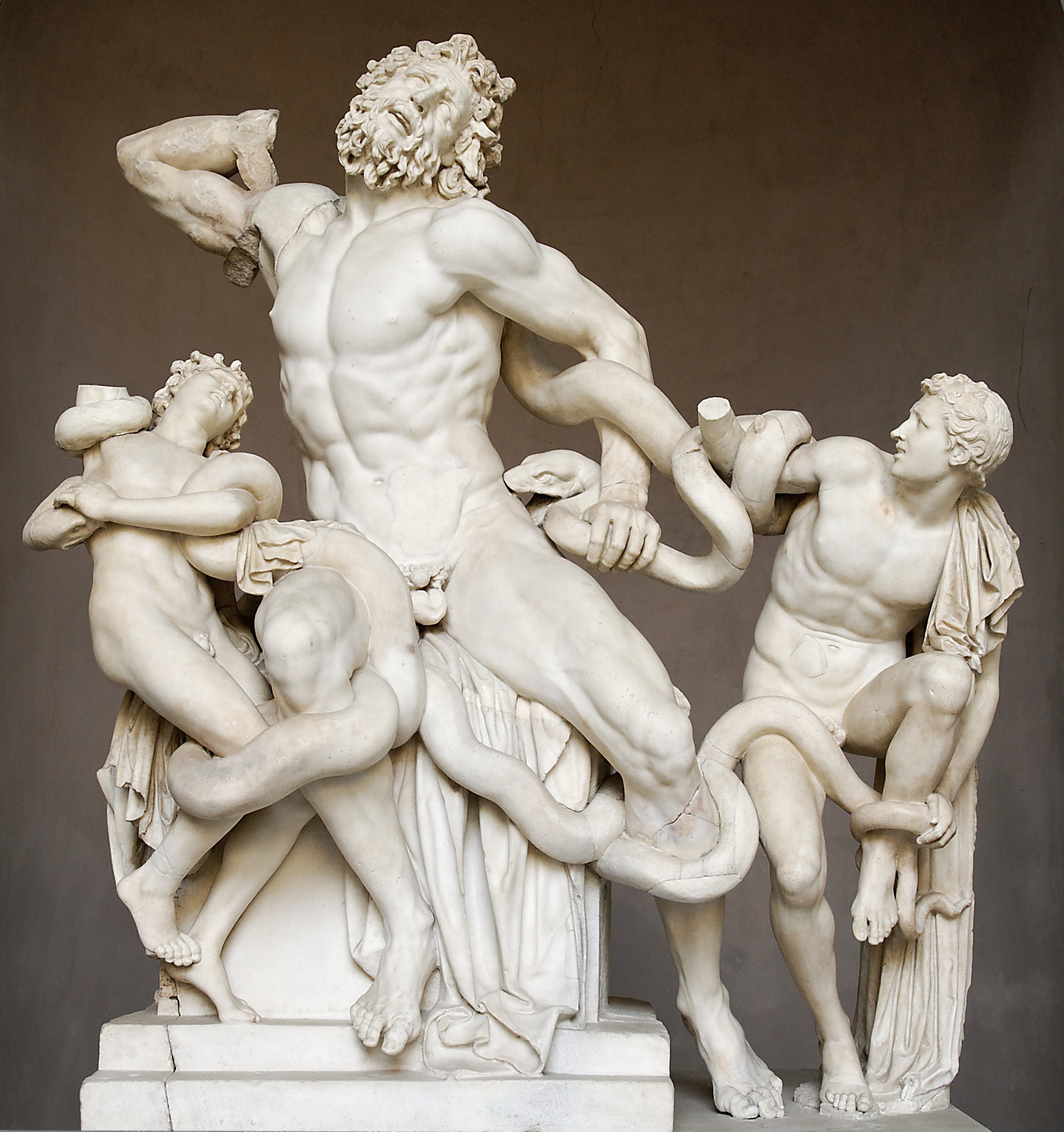
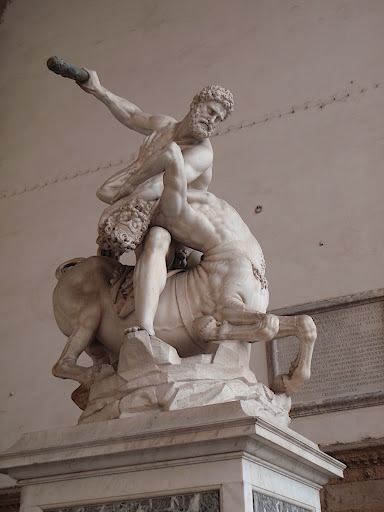
The Fomenko hypothesis really has me wondering. We know for a fact that some statues attributed to the ancients were in fact Renaissance fakes. And this trend probably only increased with time. For example, we’re supposed to believe that this:
Why would someone bother to do this, you might ask? Well, there are a thousand possible reasons. Michelangelo did it to make a name for himself (and it worked). The Renaissance forgery market in general may have been driven by, as Fomenko mentions, the need of the Italian city-state rulers (“kings”) to try to superlatively outdo each other in how ancient and spectacular their lineage and pedigree was supposed to be. In the case of Gobekli Tepe, the Church stood to benefit - news articles covering the site a few years back were headlining things like “Ancient location of Garden of Eden found” on the basis of reliefs on the Gobekli Tepe stones that depict seprents and men and women, and so on. Of course, this does not stoke the fires of zeal among the faithful…
Weird idea I had last night just before falling asleep. A steel ship floats on water by “displacing” as much water as is just equivalent to its weight. What if you built a really large “boat” intended to float on top of the Earth’s atmosphere? I’m not sure if gas follows the same buoyancy law as liquid but I can’t think of any reason why it shouldn’t.
While searching to see if anyone else has had this idea already, I found this interesting statement: “The Earth is neutrally buoyant with respect to the ether.” Hm.
I don’t know much about ether theories, but I’ve been repping Thunderbolts of the Gods for years. Cool to finally see someone who finds it interesting, and you’re a Tesla fan to boot. You’re wrong about almost everything, but I feel you’ve redeemed yourself somewhat with these posts (playful tones don’t always carry well through the interwebs :/).
Edit: On perusal, my enthusiasm may have been a bit misplaced and I wouldn’t want to suggest that LvMI is anything less than an academic organization of the highest standards. Oh well. But I think NPA has the right idea… they just need to work on… spelling, grammar and… argh!!!