Working through this:
It’s fantastic!
Clayton -
Working through this:
It’s fantastic!
Clayton -
Clayton -
I’m digging this: https://www.youtube.com/watch?v=tXhtYsljEvY
Yet another guy who understands the incoherence of infinity, the Axiom of Choice, and so-called real numbers.
Interesting, “my views and opinions” link from his homepage, which I hoped would lead to some texts on this issue, is broken. I hate videos when it comes to learning ideas 
ON EDIT: ha, the wayback machine to the rescue: http://web.archive.org/web/20110725051201/http://web.maths.unsw.edu.au/~norman/views.htm
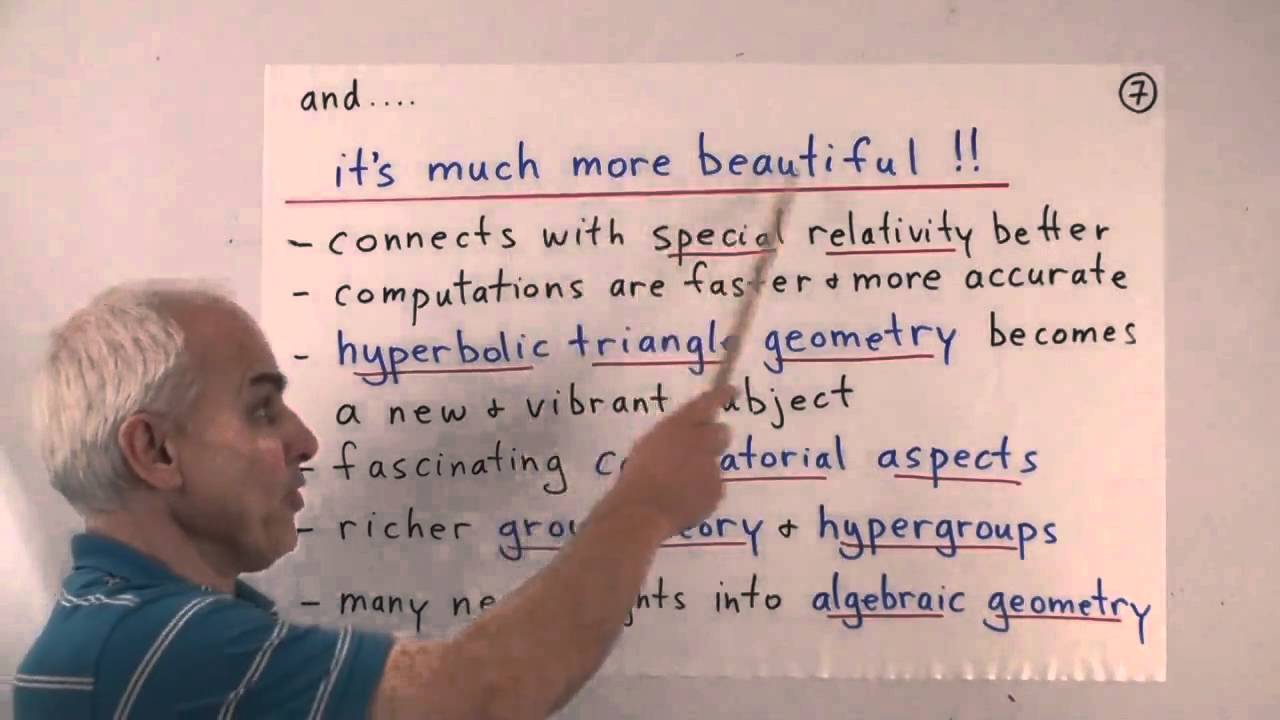
I skipped part I because I’m already familiar with the problems in standard theory but I watched the part II. He’s right that we don’t have ways to do generalized operations on numbers specified as algorithms (e.g. to compare equality) but part of that comes with the territory (deciding if two functions compute the same value is an uncomputable problem). He is very even-handed in acknowledging the possibility of resolving these issues and that is actually the whole reason I am studying this guy’s theories on universal hyperbolic geometry. I’m convinced that there is something “natural” and/or “fundamental” about hyperbolic geometry (in the complex plane, however… but first I need to learn hyperbolic geometry in the real plane). Basically, I think we need to build the equivalent of a Turing machine… but made out of waves. My interest turned to hyperbolic geometry because of the astounding relationship:
ex = sinh x + cosh x
The exponential is the only function whose derivative is itself. And it is composed of two functions who are mutual derivatives:
d/dx sinh x = cosh x
d/dx cosh x = sinh x
Why does this matter? Because if you want to build a computer purely out of mathematical objects, you need a geometry that exists in two states simultaneously, not one. The problem with ordinary geometries is that they describe dead, eternal, static form - like the floorplan of a house. But that is not how computation is. Computation “moves”, like time moves. What makes a digital computer move is its table of “next states” that are based on the present state.
The derivative is a natural kind of “next state” function - it is a function itself and implied within it is the “future” of its antiderivative. If you have f’(x) = x, then you know the future of f(x)… it is x2 (+c, of course). But then, that function has to have a “next state”, as well. So the most compact way to represent this is a pair of functions that are mutual derivatives. Say hello to cosh(x) and sinh(x), who happen to sum to the most remarkable function I believe in all mathematics… ex.
Clayton -
I love where you seem to be going with this, Clayton. And while this may or may not be valuable to your goal, I’d love to throw out there, since φ is my favorite number (see my username), the fact that:
sinh(ln φ) = 0.5
&
cosh(ln φ) = 0.5 * (5^0.5)
where φ is Phi, the golden ratio.
The number 5 shows up very often in dealing with phi, but I think you know that (from a video you posted here some time ago).
One caution on citing 0.5 as evidence of “5 in φ”… while 5 is present through the square-root of 5 and through the fivefold symmetry of the pentagon (which has phi built into its geometry), the 1/2 = 0.5 is purely happenstance based on the choice of a base-10 numeral system… in base-16, for example, 1/2 = 0.8
I wasn’t aware of the beautiful relationship sinh(ln φ) = 1/2… that’s amazing. There are also links between φ and pi (something that the Egyptologists always pooh-pooh in connection to the possibility that the pyramids encode both pi and phi):
Phi = 1 - 2cos(3pi/5) (there’s that 5!)
Not to mention that the arctan function encodes the Fibonacci numbers (which, as you well know, converge to phi in the limit of their successive ratios), while arctan(1) can be used to construct the most beautiful definition of pi (the Leibniz formula):
arctan(1) = pi/4 = 1 - 1/3 + 1/5 - 1/7 + 1/9 …
In my view, there must be a very fundamental connection between these objects that is obscured by our often klunky and obtuse mathematical methods.
One of the subjects I want to better understand is p-adic numbers. I’m pleased to find that Wildberger takes a favorable view of p-adic numbers, despite his (well-founded) rejection of the so-called real numbers, which are actually contradictory and irrational.
One of the connections that I suspect is that perhaps these beautiful expressions are actually conveying numerical relationships in a more fundamental numbering system than what we use today… something like p-adics. 3.14159… 2.7182818… 1.618… there is no connection in the numerical expressions themselves. But perhaps in a more basic, natural, fundamental numbering system these relationships would be nearly “geometrical”; visualizable in the numerical expressions themselves.
What originally motivated me to consider this is the use of two’s complement arithmetic in computers. Anyone who’s worked with two’s complement for some time can attest that it is, in some deep sense, more “natural” than ordinary binary (which is the base-2 equivalent of decimal real numbers). You do not need two separate definitions of addition and subtraction… you only need to know how to negate a number and then add. Basically, it gives you “negative numbers without the need to use a minus-sign”. Negativity is encoded right into the numbers themselves. The benefit is that this cuts the circuitry in half in an ALU (that’s why it’s used). If that’s all it bought you, that wouldn’t be reason enough. But it turns out that when you multiply and divide two’s complement numbers, they retain their proper meanings.
But then, two’s complement is really just a subset of 2-adic numbers. The 2-adic numbering system allows you to express not only positive and negative whole numbers without a minus sign, but arbitrary precision fractional numbers without a decimal point. Now, there is a “decimal point” (or binary point, to be pedantic) but it turns out that you can put 2-adic numbers in a “canonical form”. Furthermore, the standard division algorithm requires a “guess and try again” approach to finding the answer. The 2-adic division algorithm is deterministic… first, you invert one operand, then you multiply (both operations are deterministic and require no “guessing”).
But I want something more than this… I believe that the complex domain is, in some sense, the most natural mathematical object. So, what I would really like is a numbering system that allows you to not only add, subtract, multiply and divide in a natural manner (2-adic gives you this), but also allows you to take the square root of -1… then multiply that thing by itself and give… -1. All with exactly one multipliaction algorithm.
I believe that ex is somehow tied up in this, particularly as it decomposes into the sin() and cos() functions, and the sinh() and cosh() functions.
F0(x) = x0/0! + x4/4! + x8/8! …
F1(x) = x1/1! + x5/5! + x9/9! …
F2(x) = x2/2! + x6/6! + x10/10! …
F3(x) = x3/3! + x7/7! + x11/11! …
sin(x) = F1(x)-F3(x)
d/dx(sin(x)) = cos(x) = F0(x)-F2(x)
d/dx(cos(x)) = -sin(x) = F3(x)-F1(x)
d/dx(-sin(x)) = -cos(x) = F2(x)-F0(x)
sinh(x) = d/dx(cosh(x)) = F1(x)+F3(x)
cosh(x) = d/dx(sinh(x)) = F0(x)+F2(x)
ex = sinh(x) + cosh(x) = F0(x) + F1(x) + F2(x) + F3(x)
eix = cos(x) + i sin(x) (Euler’s equation)
eix = F0(x)-F2(x) + i * [ F1(x)-F3(x) ]
setting z = i*x:
cos(x) = cosh(z)
i sin(x) = sinh(z)
(see here)
So,
ez = cosh(z) + sinh(z)
In other words, hyperbolic def’n is the same for ex and ez (real and complex).
And for the magnum opus, we substitute the def’ns of cosh/sinh above:
ez = F0(z) + F1(z) + F2(z) + F3(z) = F0(x) - F2(x) + i * [ F1(x)-F3(x) ]
the proof of relationships between ex, cos(x), sin(x)
Clayton -
Euler’s identity:
eiπ+1=0
Wildberger points out that the decimal expansions of numbers (is it even helpful to call them numbers?) actually hide information. It seems plausible that there is a simple relationship among these “numbers” that has been inaccessible merely due to the handicaps present in the mainstream approach, including the tendency to consider the decimal expansions as in some sense primary. Freed from such obscuring constraints, a layman might stumble upon a new mode of mathematical expression wherein Euler’s identity looks as simple and obvious as 1 + 2 = 3.
This makes me wonder if an entirely visual representation of mathematical language could be the answer.
I think this is essentially what classical geometry really is. However, quantization is undisputably useful. It’s almost not an exaggeration to say that the modern era is little else but the expression of the power of quantization. Sadly, standard decimal arithmetic is fatally flawed.
Clayton -
The hope I hold for a visual (pure diagrammatic) approach is that, for instance, sin would in all cases remain directly represented as a ratio between sides of triangles. In this way it may be possible to create a single diagram off of which Euler’s identity could be simply “read,” even by a child, as simply as one reads a map.
Since I think that humans are designed to think fundamentally in terms of the visual/spacial mechanics of physical objects (and agency, but that’s probably irrelevant to math), the ultimate in clear and concise mathematical representation - the clearest possible system resulting in the deepest understanding for humans - seems it would be one where everything was represented visually/mechanically, to whatever extent this may be possible.
So how do you denote the difference between a 30-60-90 and a 15-75-90 triangle? People can’t be expected to eyeball the difference nor to apply calipers to a page in order to read it.
But in the spirit of your ideas…
Clayton -
Cool link! Someone in the comments said that visual proofs can never really be full proofs and that they can only sketch the way toward a proof, but the same is true of word proofs. In fact, a proof is merely a set of steps done for the reader so that they see the answer as indisputably obvious. A proof to a mathematician will look like nothing of the sort to a student who is unable to see each step as obvious. However, it is true that most of the visual proofs on that page were more like sketches (the 2pi>6 proof is an exception).
As for quantities, yes, nothing can beat arabic numerals for that, so there’s no reason to discard them in a visual system.
Yeah, I hate that kind of pedantry - a proof is something that is sufficient to convince a human brain. You can reduce proofs to rigorous formal steps leading from axioms to propositional theorems but you don’t have to.
Actually, I think some visual proofs are so compelling that they essentially convert what would be a “proof” if constructed with propositional deductions into a definition. A common visual proof of the Pythagorean theorem is what I have in mind:

Just stare at it for a few minutes and you’ll convince yourself that not only is it correct and not only does it prove the Pythagorean theorem, but you can tell merely from visual inspection why it must prove the theorem.
Clayton -
Tooling around with sinh and cosh this afternoon:
ez = [ cosh(z) ] + [ sinh(z) ]
ez = [ F0(z) + F2(z) ] + [ F1(z) + F3(z) ]
Now, it turns out that:
e-z = [ cosh(z) ] - [ sinh(z) ]
So,
e-z = 1/ez = [ F0(z) + F2(z) ] - [ F1(z) + F3(z) ] = F0(z) - F1(z) + F2(z) - F3(z)
Now, what this means is that if we set X = ez, then:
1/X = F0(z) - F1(z) + F2(z) - F3(z)
The ln(z) is slightly tricky in that you have to choose a specific “branch” of the log function (I’m shaky on some of the details but I understand that the function is extremely tolerant). Possibly with some exceptions, we can eliminate the parameter z completely:
X = F0(ln X) + F1(ln X) + F2(ln X) + F3(ln X)
1/X = F0(ln X) - F1(ln X) + F2(ln X) - F3(ln X)
Why I think this matters is imagine that we have some encoding of a number X and we want to invert the number. The above two equations may provide a clue to the structure of such a number. That is, merely by switching the sign of F1 and F3 (the sinh component), we get the inverse of X.
The reason for wanting to eliminate z is so that we do not need to express the number in terms of complex quantities unless required… whatever ez sums to may be plugged in here. Any positive real X will have real ln X. Only in the case that X is negative or complex will ln X be complex. So, we might be able to construct an encoding of the reals using this form, even though we have proved its validity and generality using complex variables.
Now, imagine a four row matrix:
[ x0 x4 x8 x13 … ]
[ x1 x5 x9 x14 … ]
[ x2 x6 x10 x15 … ]
[ x3 x7 x11 x16 … ]
These are the numerators of the F0-F3 functions. We can encode positive, negative, real and complex numbers with this matrix, as well as we can invert the number encoded by this matrix simply by negating rows 2 and 4.
Setting x = 2 and then choosing coefficients would give us an encoding formally equivalent to binary over each row:
[ a0x0 a1x4 a2x8 a3x13 … ]
[ b0x1 b1x5 b2x9 b3x14 … ]
[ c0x2 c1x6 c2x10 c3x15 … ]
[ d0x3 d1x7 d2x11 d3x16 … ]
I have chosen to use four series of coefficients (a0, a1…), (b0, b1, …), … to illustrate that I believe that each of these four “binary-like” encodings can be linked to F0-F3 somehow.
As you can see, I’m still groping around. It’s not a cohesive theory.
Clayton -
Epic proof is epic. I spent a few hours a while back trying to find a perfectly obvious visual proof of the Pythagorean theorem, but didn’t find anything. If I ever build a house I’m going to have a room like that with four identical, perfectly right-triangular sofas on rollers. Although a picture can deceive (like that one with colored triangles in the above link), physical objects cannot so easily.
Although a picture can deceive (like that one with colored triangles in the above link), physical objects cannot so easily.
Oh, but they can. Especially, soft objects, like sofas. I am willing to bet you could not tell if sofas had 89 degree angle or 90.
They’d have hard frames 
Hilbert rallied the troops with his battle-cry “No one shall expel us from the paradise Cantor has created for us!”
To which Wittgenstein responded “If one person can see it as a paradise for mathematicians, why should not another see it as a joke?”
There is something incredibly compelling about Cantorian set theory. Modern set theory is a joke.
Clayton -