Madame Blavatsky... the Universe as an acting being

What are the equations of biology? Either this criticism is denying the phenomena or it is accepting the phenomena and choosing to ignore them. Not knowing the equations that describe phenomena is not a basis for rejecting or ignoring them.

The importance of plasma phenomena is obviously underrated as there is a “terrestrial bias” within modern science - the tendency to assume that the most important physical facts are the physical facts we can observe in our local environment. Upwards of 99% of the mass in the universe exists in the plasma state, IIRC. Does 99% of astrophysics concentrate on plasma phenomena? I think it’s completely the other way around.

Clayton -

^^THIS.^^

Upwards of 99% of the mass in the universe exists in the plasma state

How do you know? :wink:

@Andris: I don’t know how they have figured that number but it is uncontroversial with mainstreamers. Of course, mainstreamers also believe that 95% of all mass in the Universe is only visible through its “gravitational effects”, aka Dark Matter/Energy. Go figure.

Clayton -

That’s exactly my point. Why do you choose to believe one figure, but not another?

Oh, because I know how they arrived at the figure for Dark Matter/Energy and it’s just… pure bullshit.

Clayton -

Standard astrophysics/cosmology is almost entirely garbage:

Dark matter/energy is embarrassing science. Why do they keep pushing this stuff??

As an example, I’ve watched at least a half-dozen videos of sundiving-comet-CME events. There is a definite pattern. The comet is pulled in to the Sun and moments later (in fast-forward time), a massive CME erupts on the 180-degrees opposite side of the Sun. Standard model says “that’s not possible, a comet isn’t big enough to significantly affect the Sun and whatever effects the comet does produce could not have traveled to the other side of the Sun in such a short time”. Their excuse for the pattern is that “CMEs happen all the time… it just so happened that the comet hit at about the same time as a CME was firing off for unrelated reasons.”

But this is based on the non-electrical theory of comets… that the electrical charge of comets is immaterial. The EU theory, on the other hand, shows that even a small body - such as a comet - can accumulate a massive charge, particularly as it rapidly moves through the electric field of the Sun. The electrical discharge of the comet in the EU model will be immense and its effect on the Sun will be considerable. Being as the cometary impact is primarily an electrical event and that electrical energy travels nearly at the speed of light, the effect of the comet can move to the opposite side of the Sun almost instantly. The charge disturbance requires equalization to bring the Sun back to equilibrium… this is what the comet-induced CME is, it is the Sun returning to electrical equilibrium.

I’m a non-expert. I am no physicist, let alone astrophysicist. But the correlation is so obvious that even a child can see it. Yet the gray-faced establishment scientists insist that you’re just hallucinating. What the hell is going on!

Clayton -

On the prior post - why are they pushing this? - I’m going to reiterate a theory I’ve posited before. I think that the atomic bomb is made up. It’s science fiction. The conception of the Sun as a gigantic fusion reactor is part and parcel of reinforcing the myth of the atomic bomb. This is why the Establishment is suppressing science that will lead to the deconstruction of this basic error. There is no price too high for their precious one world government.

Radioactivity, of course, is very real. So where’s all that energy coming from, if not the “decay” of the matter itself?

We know that the decay rates of several elements vary with the sunspot cycle. Whoa! I was taught that radioactive decay is the result of the gradual decomposition of an “unstable” element into a “stable” element… so that means that an element chooses how stable it is based on the solar sunspot cycle?? Something doesn’t add up. If radioactivity is solely a structural phenomenon (a consequence solely of matter changing from one configuration to another and emitting energetic particles in the process), then the sunspot cycle should factor nowhere into it.

Everything resonates based on its geometry. If you cut a string to some length, stretch it taught, then pluck it, it will vibrate the air and cause sound waves to move through the air. This is resonance. And it works backwards, as well (so-called sympathetic vibration): If you sing the same pitch that the string produces when plucked, the vibrations in the air caused by your vocal cords will impart energy to the string and it will begin to vibrate.

Electrical resonance is no different. If you cut a quartz crystal to just the right thickness, it will vibrate sympathetically to a specific electrical frequency. This is the basis of a “crystal radio”. Similarly, crystals are used in “reference oscillators”… such as the quartz oscillator in low-end watches. Radio antennas - such as the antenna in your cellphone - are also resonant and, when coupled with special oscillator and detector circuits, allow the reception and transmission of electromagnetic waves.

We know that atoms are not actually atoms, that is, they are not actually indivisible (the meaning of the Greek word “atom” is … indivisible). Atoms can be split and they have an internal structure. In particular, atoms have geometry, that is, dimensions. They resonate on the basis of those dimensions. This is, in fact, the basis of the atomic clock. It uses the same principle of resonance as a quartz oscillator… only at much higher frequency as the atoms being excited are of much smaller dimensions.

So here’s my theory: radioactive phenomena are the consequence of the fact that certain elements (the so-called “unstable” elements) act not only as extremely high-frequency antennae but also as frequency transducers. A frequency transducer can convert energy from one frequency to another. All atoms are ultra-high-frequency* antennae (if you vibrate them at their resonant frequencies, they will absorb energy and begin to throw off electrons and photons) but what makes the “unstable” elements unique is that they can spontaneously convert the ultra-high-frequency radiation in the environment into radiation that we can observe (radioactive particle emissions).

So what causes radioactive decay? Well, as the “unstable” atoms are transducing energy from ultra-high-frequencies to frequencies we can detect, they are “rattled around” and become less efficient transducers. The decayed form of the atom - lead or whatever it may be - is when its transducing capacity has been reduced to zero and is now “stable”, that is, not a transducer anymore (like any non-radioactive element).

What are these ultra-high-frequencies? Well, they are just like any other frequency… just too high to detect with modern equipment. They are generated by the Sun and emitted in all directions. They may also be generated by the Earth’s core and the cores of the other active planets. They may play a not-yet-understood role in gravitation.

Why believe in ultra-high-frequencies? Isn’t it better just to explain the phenomena in the standard way? The advantage of the frequency explanation is that it reduces the entities in accordance with Ockham’s razor. In the ultra-high-frequency theory, we just have higher frequency vibrations of the same sort we’re already familiar with and we do away with the nonsensical idea of matter “turning into” energy or matter being “the same thing as” energy.

Clayton -

*Note that UHF is already an in-use acronym and denotes a specific band of RF below microwaves but above VHF (very-high-frequency)… I mean to denote frequencies that are much, much higher than anything already part of the standard model.

Note that UHF is already an in-use acronym

I suggest über high frequency, with ÜHF as acronym, for the frequencies’ range you meant :slight_smile:

OK, I think I’ve worked up enough nerve (or boredom) to lay out my wildest theory. This is as far as I go over the rainbow or down the rabbit hole or whatever you want to call it.

Now, this isn’t as crazy as it sounds. The Electric Universe people (Thornhill et. al.) say that the Sun is not actually a solid body the size of its photosphere… what we see when we look at the Sun is - if they’re right - just the ionospheric layer of an otherwise completely ordinary planet. If you could somehow plunge a probe through the million+ degree corona without burning up, when it came to the photosphere, the probe would just go right on through and into the Sun’s “atmosphere”.

The Sun and the planets together are traveling in a spiral through space… that is, the Sun is following a “line” and the planets orbit around the sun kind of like how the shielding of a coax cable wraps around the center tap. But if you think about it, there is no reason the planets must orbit the Sun… particularly if another planet could begin exhibiting star-like properties and contesting the Sun’s primacy in the Solar system.

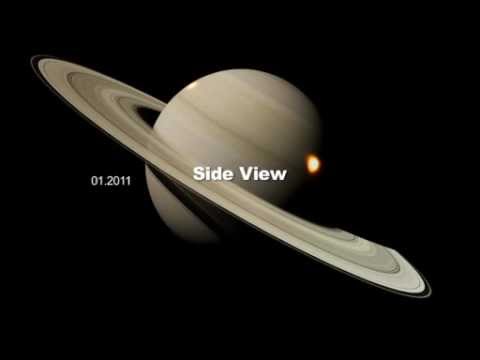
Check out this video of a bizarre heat storm on Saturn in spring of this year:

Is Saturn the anti-Sun? Here’s another reason to think that Saturn is the anti-Sun. We know that the Earth is on a 26,000 year “wobble” that causes the precession of the equinoxes. But why? As always, the mainstreamers are ready with reams of equations that prove that the gravity wells of the planets work out “just right” to cause this motion. In other words, they don’t know.

But if the Solar system is inherently electrical, then it must be in resonance with something else. 80% of stars are known to be binaries. It is possible that the other 20% have a binary that simply isn’t visible. A binary star system provides the possibility of charge exchange… an ultra-low-frequency resonant electrical circuit. But astronomers have searched the skies and are convinced that our star is supposedly a lone ranger… the nearest stars are so distant that any orbital period between them and the Sun would be on the order of millions of years, not 26,000.

But there could be a 26,000 year charge exchange cycle between Saturn and the Sun. This would explain what the Sun is in electrical resonance with: Saturn! We happen to be seeing our system during the period when the Sun is at the height of its brilliance. As time progresses into the next 13,000 years, Saturn will become what the Sun is today and the Sun will become what Saturn is today. A dark, lonely outlier.

OK, there’s nothing wild about this except that it would send any real astronomer off, shaking his head.
Here’s where things get really wild.

I think the Solar system is much, much more sohpisticated than present science understands. There are these complex RF signals coming from Jupiter… they look a lot like a clock pulse in a computer circuit. On, off, on, off, on, off. They shift and change over time. Sometimes, they exhibit this frequency sweep that just sound really bizarre.

If you look at the solar system, you will see that Jupiter stands between the Sun and Saturn and is the most massive body in the solar system besides the Sun. Its moons also emit complex RF signals. Jupiter also has an X-ray pulsar near its north pole.

What I’m proposing is that those signals aren’t just byproducts of some processes that happen to cause radio-waves to be emitted. I’m proposing that these signals are encodings and that these encodings are actually the “nervous system” or “brain” of the Solar system. Jupiter is the CPU … it is actually telling the Solar system what to do and it is regulating the resonant circuit between Saturn and the Sun.

What we are looking at in the Solar system is more like a highly engineered radio circuit than like a bunch of rocks randomly whirling around through empty space.

So, this opens the question: was it engineered by somebody? I think we can say that there is a self-propagating selection-principle in operation on the grander scheme of things. To exert influence, you have to emit signals into space (think of Jupiter). To emit signals requires energy. So you have a circular problem. Systems that emit “the right” signals can harvest more energy and can exert more influence with their greater available energies (think of how much influence the center of the Milky Way exerts in space, as compared to the influence that the Sun exerts in space). So, I think there is an “evolutionary” answer to the problem but in a very non-standard sense.

We need to better understand the role of radio signals (and other electromagnetic phenomena) in “coding” the behavior of stars and planets. I think the complexity of astronomical phenomena has been under-appreciated because they evolve so slowly, even by the standards of biological evolution. Nevertheless, I believe that the complexity within astronomical phenomena must rival that of biological systems… that is, I believe our solar system has a “DNA” as it were.

Clayton -

Clayton,

I can say without a doubt, of all the people I’ve encountered over the Internet in my life, you are the one I think I’d most enjoy taking out to dinner to have a conversation with in real life. The things you say honestly click so well in my mind, as I have had serious doubts about the official story on astrophysics for a few years now. The theories I had on it were very primitive, but you introducing me to EU theory has done wonders. I am just posting saying I greatly applaud you and am thankful for your posts. I have to say, I always look forward to your posts, on anything really, but especially this thread. Fantastic stuff, a thousand times over.

Thanks for the positive feedback.

I’m only just getting started on the EU stuff but the entire Universe makes a hell of a lot more sense once placed in the electrical context.

I haven’t really explored it yet but Thunderbolts has a forum which you might find interesting.

Clayton -

Have you heard Jeffrey Wolynski’s theory of planet formation? The video starts slowly, so SPOILER: planets are old stars.

@AJ: I have contemplated that idea and I wonder if we could mix both models - perhaps Uranus and Neptune are prior anti-Suns? That is, perhaps the primary of our solar system hasn’t gone “… Sun, Saturn, Sun, Saturn…” but has gone "… ?, Sun, Neptune, Sun, Uranus, Sun, Saturn, Sun, … " Or, perhaps there has been a more complex alternation.

I really believe that we need to extend the theoretical work that Kepler began in his Harmonies of the World. This would be a far more worthwhile investment in the theoretical physics front than this absurd pissing contest over who can find the smallest, most bizarre particle… or “shadows” thereof. Basically, I’m thinking of applying Fourier analysis or other, more complex forms of analysis (Markov, even algorithmic) to analysis of a) orbital resonances, b) the heliospheric current sheet and the magnetospheres of all the planets and their moons to the extent we can reasonably estimate them and c) RF, X-ray and other emissions from the planets (also, the roles of asteroids and comets). The goal would be to discover the “electrical circuit diagram” of the solar system. How is energy stored? Where is it coming from and where is it going to? Can we discover any very-long-period resonances? Finding a credible explanation of the equinoctial precession would be a good starting point.

Clayton -

Basically, I’m thinking of applying Fourier analysis or other, more complex forms of analysis (Markov, even algorithmic) to analysis of a) orbital resonances, b) the heliospheric current sheet and the magnetospheres of all the planets and their moons to the extent we can reasonably estimate them and c) RF, X-ray and other emissions from the planets (also, the roles of asteroids and comets).

Do not forget to use HMM and MCMC. Seriously, where would you get the raw data? Just curious.

Well, I think that the solar observatories give us a great starting point and the terrestrial magnetic and ionospheric observatories (HAARP, etc.) give us a great picture of the Earth. So, we have very detailed pictures of the Sun and the Earth. We can receive RF signals from Jupiter a lot of the time and I believe we can also pick up signals from Saturn. My understanding is that these are the “big hitters” - Sun, Earth, Jupiter and Saturn.

At this point, we understand so little about the workings of the Solar system that I think that mere statistical correlation studies could glean a lot. For example, tracking the incidence and nature of CMEs versus sun-diving comets. But I think there are lot of potential correlata that we haven’t even thought of - perhaps there are correlations between Jupiter’s radio emissions and solar activity? At the very least it seems like the Sun should influence the processes responsible for Jupiter’s RF emissions. The Earth also is very RF active so it might be useful to record Earth’s RF emissions from a satellite (or perhaps it’s possible to record them from the ground, I don’t fully understand how they capture these emissions).

We can’t directly observe the electric or magnetic fields surrounding the planets but I was just reading on Thunderbolts that light passing through magnetic fields is perturbed… perhaps you could track the magnetospheres of Jupiter and Saturn by observing the spectra of background stars as the planets pass near them. This would be an investment but orders of magnitude less expensive than LHC.

Another place to look is pulsars - do “radio-bright” pulsars have any detectable influence on the solar system? I’m thinking that we should just plot all of this kind of data into a gigantic database and start doing NxN searches for correlations with supercomputers. For example, we know sunspots go up and down in an 11-year cycle… can we find any other signals that move up and down in 11-year (f) or 22-year (1/2f) or 5.5 year (2f) cycles, etc, etc. Most importantly, we should be looking for cross-phenomenal correlations… a change in X-ray patterns over here correlates with a change in magnetic field patterns over there. This has nothing to do with building a causal theory but, rather, building the raw data required to begin to construct a causal theory. We haven’t even taken the first baby steps yet. Somebody needs to start, IMO.

Clayton -

Clayton -

Some notes on cosmology

There is no good reason to suppose the Universe is of finite age. Even if the Big Bang model is correct (and there are good reasons to think it is not), there is no reason to suppose that this epoch is not just one of a limitless number of prior epochs.

It is more pleasant to suppose that the Universe is of infinite age because then the question “how old is the Universe?” is dispensed with entirely - it has no age, it is ageless. And assigning an age to the Universe does not resolve the problem of origins in any case because, if we supposed that the Universe is a particular age, the question immediately arises: why this age rather than that age?

Exactly the same may be said in regard to the extents of the Universe.

In regards to what is, that is, what exists, we must separate between two senses: the first sense is that of subjective awareness of existence, that is, conscious experience of the world. The second sense is more ambitious and is the common fascination of philosophy: what really, really is. That is, what sorts of assertions may be made about the Universe which will never in the course of future human thought and study of the Universe be found to be in error or requiring amendment or appendage?

In the absolutist sense of “existence”, there is an implicit search for the Absolute, the omniscient awareness of the case-in-fact from the smallest to the greatest. This is intimately connected to the desire to find the characteristica universalis - that language which is so natural, so divine, so necessarily the case that to utter a subject in the language is to close all further discussion of the matter. From this perfect language, the ambitious philosophers have hoped to construct the final justification by which man may dictate to man, ex cathedra. “Thus the Universe Hath Said. Thus Thou Shalt Do.”

The humbler, common sense of existence is less ugly and martial - it is oriented toward the practical investigation of what exists insofar as it is useful to man’s ends.

When pondering the nature of the Universe, we are necessarily limited to metaphor when speaking of anything that lies outside of our immediate ability to sense. And even our senses are a mechanism that presents a metaphorical picture of the world to the mind. The common conviction of the objectivity of waking sensation is far stronger than justified. This is easily illustrated with auditory, visual and cognitive illusions and foibles in the human mind.

When we speak of an “atom”, for example, we have no idea whether what we are speaking of is, in fact, a mathematically smooth shape of the variety that atomic physicsts like to draw or whether it is something more complicated which responds to stimuli in a manner that we cannot differentiate from the mathematically smooth shape which we attribute to it.

Turning now to metaphor, let us conceive of an amorphous medium of indefinite extent, analogous perhaps to a terrestrial gas or water or even a homogeneous solid. Let us suppose that this medium is “what exists”, that is, the root final substance out of which everything else is made. No investigation can be made into what this medium itself is composed of because it is the most basic thing - there is no answer to the questions “what is it made of?” “what are its properties?” and so on.

Since we have not stated the form of the medium, there is no reason why it should be organized in any particular way - just as there is no reason for the stones in a riverbed to be arranged in a pattern like a stone wall or a brick building and, therefore, they are never observed to be so arranged. However, if we displace something in the medium, it must create two effects - a deficit of the medium from where we displaced it and a surplus in the medium where we displaced it to.

The most universal tendency in physics is the tendency to equilibrium. Everywhere, we observe that equilibrium is the inexorable endpoint of all processes. If we apply the principle of equilibrium to our metaphorical medium, we see that the surplus and the deficit must result in motion… the deficit must be filled in and the surplus must be eased.

I will give the example of gas pressure to illustrate.

Let us conceive of a single gas particle enclosed in some volume. This particle exerts a pressure against the walls of the enclosing vessel. Physicists tell us that the properties of the gas are distributed everywhere against the enclosing vessel so that it is a mistake to think of the particle like a very small tennis ball that creates the illusion of pressure by banging very rapidly around the vessel walls. All we can rightly say is that the pressure is correlative with the particle’s presence in the enclosed volume and that if we open the box to observe the particle, we will find that it does have some definite location in space. How the particle exerts the pressurizing influence on the walls of the enclosing volume is not answered by modern science.

If we remove the enclosing walls of the volume and ponder the behavior of the particle, we must say that if it were still enclosed it would be exerting that much pressure on the enclosing vessel walls. We can say this for every size of container in which we can imagine trapping the particle. Since we have supposed that the Universe has no extents, this process continues ad nauseum.

Now, let us imagine not a single enclosing volume, but an infinite grid of enclosing volumes, extending in all directions. For the sake of illustration, we can take the enclosing volumes to be cubic in shape. Now, let each enclosing volume contain a single gas particle and, further, let each wall of an enclosing volume be so weak that any non-zero pressure will result in its immediate collapse.

Now, let us snatch a gas particle from one volume and remove it at infinite speed to another enclosing volume some distance away. What will ensue*? We will see a cascading, inward collapse of enclosing walls, spherically around the volume which is now void and, simultaneously, we will see an exploding, spherical collapse of enclosing walls around the volume which contains an excess gas particle. At the expanding, circular plane where these two spheres intersect, we should see the emergence of a flow that is more insistent than the rest of the expansion fronts of the implosion-sphere and the explosion-sphere, respectively, as the “over-pressure” front of the explosion sphere is that much more encouraged by the “under-pressure” front of the implosion.

If we assumed that all the effects of the collapses and gas expansions took place at infinite speed, the two spheres would expand exactly to meet at a single point - as soon as the volumes shared even a single enclosing volume in common, the pressure of the dual-sphere would instantly equilibrate to the standard pressure of 1 gas-particle per enclosing volume.

As we reduce the speed of evolution from infinite to some finite speed, the spheres will “overlap” to an extent - the slower the speed of evolution of gas pressure, the greater the overlap. Also consider that equilibrium would be reached soonest near the plane of intersection of the spheres, causing them to be “fat” at further distance from the plane of intersection. Note that we are explicitly ruling out any kind of wave mechanics within the gas itself as this would lead to an indefinite continuation of the implosion-explosion as the pressure would not be maintained at exactly 1.0 anywhere.

This metaphor, I believe, is applicable to all phenomena at every scale. The lines of force exerted by a positive and negative charge in proximity of one another, for example, conform very closely to the geometry I have just described.

Hence, I believe that the metaphor of an inscrutable medium, perturbed by excess and deficit is of significant use. This is no cheap claim about “what the Universe really is”. The Universe is whatever it is but its behavior at any scale can be usefully described by this metaphor. It is my view that every variety of wave mechanics is ultimately employing this powerful metaphor. What is crucial is to keep in mind that it is a metaphor.

Clayton -

*Note that I am reasoning as if the collapse of an enclosing wall requires the passage of time.

a mathematically smooth shape of the variety that atomic physicsts like to draw

Last time I’ve seen a drawing by an atomic physicist it was a Feynman diagram - and it was not smooth at all. Did you mean pictures of atomic orbitals? Those are smooth for sure. But they are not intended to illustrate an atom… You didn’t mean Bohr model, did you? :slight_smile:

Sorry about nit-picking, I enjoy this thread anyway.

Yes. I believe they do give the geometry of the atom depending on how the electrons resonate in the outer-most shell.

Clayton -