A friend of mine thinks this is an argument against free markets: “markets need to be controlled otherwise market crashes (like those caused by the housing bubble) are inevitable. Banks will give out credits that people won’t be able to pay and when the banks go bankrupt, everything goes bye bye”. Any good arguments against his position?
How is that a case against free markets? If anything, it’s a case for free markets, as market crashes are caused by government inflating the money supply.
So are you saying market crashes can’t be caused by banks giving out money to people in exchange for IOUs that won’t get paid in certain circumstances?
Is your friend a German person living in the 1930s?
Just stick to the argument that it is the expansion of the money supply causes the bubble in the first place–that money has to go somewhere. Federal Reserve Banking means that we are consigned to boom and bust cycles.
On his blog Mr. FSK writes a lot about this topic, and since I got here first I shall be the one who recommends you read about the Compound Interest Paradox.
On a sidenote, it fascinates me how people can advocate market controls for anything. How does your friend plan to ‘control’ the housing market. Price and rent ceilings? Central allocation of houses? A lottery?
This can lead to problems for the banks and debtors involved in it. But I don’t see that this will lead to a market crash.
The argument with the inflated money supply is the one you should investigate.
Fannie Mae and Freddie Mac are the ones that have $5 trillion in liabilities due to mortgages, and these are GSEs (government sponsored enterprises). The idea was to “put people above profits”. A couple of recent articles on it: one two
Nothing goes “bye bye” except the contracts and bad credit. The house still remains. It’s not like when loans go bad, houses disappear into the 6th dimension.
Our markets get to massive bubble status, due to governmental intervention. A free market would arrest bad practices much faster in my opinion. Only the government can keep bad business and bad schemes going beyond what should be their natural life expectancy.
From the point of view of the person who got foreclosed on their mortage, the house did in fact go bye bye. His downpayment and home equity literally vanished into thin air.
Due to the bust, housing manufacturing is down. Small housing manufacturers are going broke. The big corporations will survive the bust.
In a true free market, housing construction would occur at a constant rate, rather than boom/bust cycles.
Real wealth is destroyed in each economic cycle. Either property is outright destroyed, or resources are diverted from the productive sector of the economy to the parasite sector. For example, during the Great Depression, farmers intentionally destroyed their crop instead of selling it for a pittance.
It’s the usual “broken window fallacy”.
(So I’m “Mr. FSK” now?)
By the same argument, the first time home owner who is shopping and comes across the foreclosed property, the house appears magically out of thin air?
I get your point, but the home owner was making a business deal. He engaged in financing a major capital purchase with credit. It’s no different than borrowing to start a business. If times get tough, or you invest in the wrong product, or work to sell or buy at the wrong prices, your equity and such may go “poof”!
I don’t get it. But I’ll address you anyway that you would like.
He or she was addressing me.
Ah, I see. His popularity is leading to confusion amongst his followers, who are now legion across the internets. I suppose there are worse problems to have.
Did you read the details of the latest housing bailout bill? $4B was allocated for state governments to purchase foreclosed homes. First-time home buyers are not getting bargains! The State is purchasing the cheap houses! It’s almost like the State is formally entering the window-breaking business.
You could argue that homebuyers should have been aware of the corrupt nature of the economic system. Therefore, it’s their own fault that they got cheated by the financial industry.
The individual homebuyer loses his home. The financial industry receives a bailout. In the meantime, they take possession of the house and sell it to someone else.
In a true free market, the price of a house would represent the fair free market price. Do you blame the homebuyer for not noticing the bubble? Do you blame the corrupt economic system for distoring the market? It’s hard to tell whether the bubble is about to pop or if it will continue inflating a few more years. Buying before the pop is obviously a bad move. If there’s still a few years of bubble inflation coming, then buying might be a good idea. Individuals don’t get the same perks as insiders.
It is true that if you’re aware of the corrupt nature of the economic system you can profit. Individuals don’t get the same perks that large banks get, so you’re limited in the amount you can do.
I’m male and not transgendered, in case you were wondering. Plain “FSK” is fine. I may give up my anonymity in a few years, trying to reach a mainstream audience.
My blog is getting around 100-150 Absolute Unique Visitors per day. It’s not super-awesome, but it’s a decent start.
I’m not sure it’s a broken window fallacy. Military Keynesianism is an example of the broken window. What you’re talking about sounds like straight up fascism.
Government controls the money, regulates the banks. If anyone failed it was government.
Time to start using free market money!
Yes. Its in a bank’s self interest to not give money to people who wont pay them back.
Banks can get cheap credit from the Fed, but in order to get it they need borrowers, so they lend to anyone. This works out great for them, until people stop paying them back. Kill the Fed and every bank will crash, because every bank is bankrupt and only survives thanks to the fed, but then a sound banking industry will form from the ashes.
Yes, the best argument is simple, it’s called long term demand vs. short term demand. When the Federal Reserve lowers interest rates, it pushes up demand since it makes credit more available for consumers. This new demand creates rising housing prices, which is an incentive for businessmen to step up the building of houses. However, the inflation that comes with all the new credit changes inflation expectations of banks. Since banks want to hedge themselves for inflation, they will begin to raise rates beyond their previous low rates. Since less credit is made available, the demand is dampened, which forces housing prices to rapidly fall as demand slows down and there is an excess supply.
This can be [somewhat] represented on this graph:
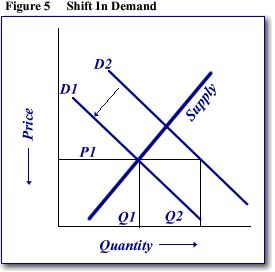
So let’s say the Fed lowers rates, providing more credit, and thereby pushing demand from D1 to D2. Prices obviously rise and homebuilders begin to build more homes to make a profit. But as inflation heats up, banks hike rates, which lowers demand back to D1. This causes home prices to spiral downwards.
The reason the housing bust is as bad as it is, is because banks were profiting a long time by giving loans to people who could not pay them back and then selling those homes for more than the loan was worth. However, as demand fell, prices fell, and a whole lot of banks ended up with falling levels of credit since a lot of people cannot pay back their loans, the houses are falling in price, and a lot of other people are refusing to pay back mortages that are “under water” (that is, the loans are worth more than the house). Housing demand will likely fall even more, meaning banks will be losing more credit, which will force an even bigger “credit crunch” spiraling our entire economy into depression.