The economics of the current “minimum wage” laws and your “minimum standard of living” proposal-assuming that it is legislated by government- are essentially the same thing- price floors. Price floors cause surpluses which are produced means of further production which are not being productive.
What does a price floor do?
In order for a price floor to acheive the ends for which they are advocated, the price floor must be set at a level such that it is greater than the price that a good would earn but for that price (ie. If gas sells for $6 a gallon, it wouldn’t change things if the price floor is set at $0.50 a gallon; the point of a price floor is to set a minimum price for a good that is higher than the market price for it.)
What are the effects of a price floor?
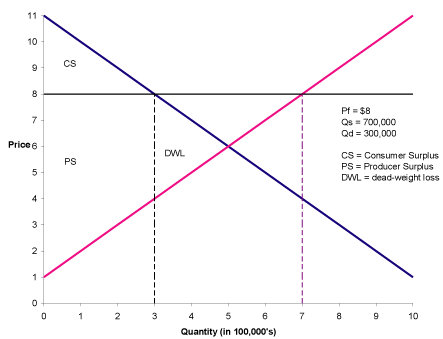
The effects of a price floor can be shown accurately by a graph, elaborated by explanation of the graph and the laws which govern the result.
Observe the graph:
Observe the following:
Along the vertical axis, prices are marked and increase incrementally the higher up the axis.
Along the horizontal axis are quantities and increase incrementally the farther right of the axis.
The red line (The Supply Curve): Represents the Supply of goods that suppliers are willing to bring to market at each price per unit of the good.
The blue line (The Demand Curve): Represents the Demand of goods that consumers are willing to buy at each price per unit of the good.
To elaborate further, at the market-clearing price-also known as the equilibrium price- consumers will buy 500,000 goods at $6 per good; and suppliers will supply 500,000 goods at $6 per good. There is no surplus of goods (where supply brought to market exceeds demand for that good) nor shortage of goods (where demand for a good exceeds the supply of that good brought to market).
The black line: Represents a price floor set at $8.00
Observe where the price floor intersects the supply curve: At $8.00 per unit, 700,000 units of the good will be supplied.
Observe where the price floor intersects the demand curve: At $8.00 per unit, 300,000 units of the good will be demanded.
Instead of having a market clearing price, there is a surplus- more goods are brought to market than are demanded by consumers (in this case, 400,000 more units of the good are supplied than is justified by demand.)
The origin of these curves
Demand Curve: This curve is drawn from the Law of Demand which states that, ceteris paribus, a lower price will lead consumers to buy more units of a good, while a higher price will lead them to buy fewer units of a good.
Supply Curve: This curve is drawn from the Law of Supply which states that, ceteris paribus, a lower price will lead suppliers to sell fewer units of a good, while a higher price will lead them to supply more units of a good.
Relation to the minimum wage/minimum standard of living.
Simply put, the minimum wage is a price floor leading to a surplus. Under this scenario prospective employees are the supply, of labor, and prospective employers are consumers of labor. Since a price floor is set there will be a surplus of goods- labor that is brought to market that is not demanded by producers- so long as this floor exceeds the market price for each unit.
Clarification
There is no such thing as a “unit of labor.” By using labor I mean “productivity.” If someone can only bring an employer $15 per hour, but minimum wage laws (or minimum standard of living laws) state that- I’m exaggerating to make the point- employers may not hire someone unless they pay them $30 per hour, then the employee will be either fired or not hired; It makes no sense for an emplyer to hire/keep an employee who costs an additional $15 an hour if the employee can only produce $15 an hour- producers want to cut costs.
As follows, in order for someone to be hired, the prospective employee must be willing to be paid less than their productivity allows.
If you are not talking exclusively of money, but also including fringe benefits (vacation time, health care insurance, etc.), rest assured that the same economic laws apply.
Regarding Trade
The most important question of this part of your proposal, regarding minimum standard of living, is “Compared to what?” You answer this, somewhat, by shifting the focus from producers to countries. Countries do not trade (eg. The United States is a land mass extending from the Atlantic Ocean to the Pacific Ocean.); Individuals trade. There is a question of measure to be decided: eg. If the minimum standard of living is to be assessed relative to the highest PPP, such a policy would kill billions of people.
Hope this helps!