A small aside question:
Let X be any statement-interpretation. Do you believe that if X follows from your premises, then X?
A small aside question:
Let X be any statement-interpretation. Do you believe that if X follows from your premises, then X?
Zavoi:
The final “…then X” in your statement is shorthand in logical/mathematical parlance for “X is true,” is it not? So to me that statement says, “If X follows from my premises, X is true.” So no, I am not saying that. I am saying that “X follows from my premises” is the only meaningful/coherent (and non-trivial) way to interpret the statement “X is true.”
Note: I am essentially arguing for a first-person version of the coherence theory of truth. The non-first-person version discussed in the link would render “X is true” as really meaning “X follows from the premises,” whereas the first-person version I believe is the only appropriate one at this level of analysis specifies “X follows from my premises.”
The standard view most people seem to have is based on the correspondence theory of truth, in which statements of “truth” are rendered as “X corresponds with reality” or “X is a matter of fact.” I believe the correspondence theory of truth to be incoherent (pun only partially unintended) at sufficiently deep levels of analysis (such as the level we are now discussing), although it is generally useful and convenient for everyday discussion.
Thanks for the interesting link, Neoclassical.
I am not saying that “X follows from my premises” is a private thought or private language. I don’t believe we think in words, so I don’t believe we think that sentence when we draw such a conclusion. I am just writing that in words because, well, I have to explain the idea here somehow.
Could you just say a word about what relation you believe the link has to the passage you quoted?
On the contrary, I avoided saying “…is true” in my statement because “X is true” is just shorthand for “X.” The only reason why we have the word “true” at all is so that such sentences can be made grammatically correct. Debating the meaning of “truth” is like insisting that we define “it” in “It is raining.” See the deflationary theory of truth. Although, that is not so much a theory of truth as it is an anti-theory-of-truth theory of truth.
Strictly speaking, we still have, at least from your perspective, “X is true” ↔ “X follows from my premises”, which holds by your definition.
But more to the point, to put it in more concrete terms: Suppose upon reflection you realized that “Snow is white” follows from your premises. Would you become convinced that snow is white? If you realized that “Santa Claus exists” follows from your premises, would you become convinced that Santa Claus exists? And can we say the same substituting “Snow is white”/“Santa Claus exists” for any other statement (or statement-interpretation, if you prefer)?
Exactly why the private language argument is relevant.
AJ, do you believe insane people arrive at truth, simply because their beliefs occur within their own first-person subjectivity?
Right, and my conception is deflationary in that sense of being an anti-theory-of-truth. Note that I’m not debating the meaning of “truth”; I’m recommending that we avoid it at this level of analysis in favor of more useful terms. I didn’t mention the deflationary theory of truth above, not because my conception isn’t deflationary in that sense, but because there are many other deflationary theories of truth that I want nothing to do with.
ETA: I believe the reason deflationary theories of truth came about is because of a deeper problem: verbal propositions are not evaluable as notions, only interpretations are. Once we ditch the impossible endeavor of trying to analyze verbal propositions as verbal propositions (OK at shallow levels of analysis, problematic at deep levels), none of these “theories of truth” or even “anti-theories-of-truth” will be needed, because the word itself is an artifact of language.
I’m not defining the word true, I’m recommending that we get rid of it entirely (at least at this level of analysis).
Yes, that’s generally what it means for people to convince themselves of things: to realize (correctly or incorrectly) that those things follow from their premises.
Neoclassical, you’re have to clarify. I’m not talking about a private language as it’s defined in the link.
Also, given what I wrote above, yes, provided their logical reasoning faculties are intact, insane people indeed arrive at conclusions that follow from their premises (can we stop using the word “truth” in this discussion?). Not “truth” - as I deem that term meaningless unless it means “follows from my premises.” Their premises probably include things like, “The voices in my head must be trusted!” And of course they can make logical errors just like the rest of us, concluding things that also don’t actually follow from their premises.
There we go. You have just asserted the completeness of your own axiomatic system. And that makes you certifiably insane.
Methinks you misunderstand: I’m simply clarifying definitions. Do you believe anything that doesn’t follow from your premises, Zavoi?
EDIT: Ah, I see what you’re probably thinking. Notice I didn’t say you couldn’t revise your premises if they lead to silly things…but note how the process works: “Santa Claus exists” would not necessarily seem silly at all to someone for whom it actually followed from their premises. It only seems silly to us because it (radically) doesn’t follow from ours. More likely, someone will find that “Santa Claus exists” follows from their premises, but later sensory input (new data! new premises!), if they bother to consider their old beliefs in light of the new data, will result in something different following from their premises. So it’s nothing too insane in that respect anyway =)
Regarding the Liar’s Paradox, Curry’s Paradox, and Godel’s Incompleteness Theorems, you’ll find that an entirely visual conception of thought, for instance, undoes most or all of their significance. These paradoxes rely on the notion that words and symbols are evaluable rather than their actual mental interpretations. Hence these cannot be used as evidence against my conception, which rejects that notion. I realize this seems pretty out there, and if you don’t want to look at it, that’s fine.
The base question underlying “all of this” (including the link you gave) is whether words and symbols are evaluable, or whether only mental interpretations of them are. If you’d like to discuss that, I would be glad to.
No, unless my deductive process is mistaken. But I can still entertain the notion that some of my beliefs may be incorrect, and this notion is not obviously contradictory. Just because I can’t understand the limit of my understanding, that doesn’t mean that I can’t understand in the abstract that my understanding is limited.
It’s not that “Santa Claus exists” is a universal reductio ad absurdum to bring down any belief system. After all, it could be us that are mistaken. But you have stated that Santa Claus exists if it turns out that the belief “Santa Claus exists” pops out from your premises; and furthermore, that very statement itself pops out from your premises. Therefore, according to the theorem, upon reflection you will realize that you already (i.e., not just in some hypothetical world, but right now, from your current premises) believe that Santa Claus exists – and any other statement, for that matter. P⊢(P⊢S → S) → P⊢S.
I don’t want to debate this issue too protractedly, because it’s so far removed from any political implications, and this is, after all, a politics forum. But I’ll bite a little bit.
Is your problem with the part where they go
?
I’m saying there’s nothing I can usefully consider other than my belief, at a sufficiently deep level of analysis. In other words, I’m speaking from an agnostic stance about the existence of the real world (which changes the meaning of “exist” in the sentence as well, so it’d be something more like, “It follows from my premises that it’s useful to believe the perception that I might, for instance, one day be able to meet Santa Claus or to get presents from him if I’m good.”).
If you’d like, lets talk about the liar’s paradox “This sentence is false” that Goedel (which I believe Lob’s theorem requires) is essentially a formalization of, as that will be a lot simpler to discuss and illustrate the difficulty I see. Only thing is, I am saying, as above, that we can only coherently talk about what follows and doesn’t follow from the premises. So the sentence becomes “This sentence doesn’t follow from the premises.” (Or in the deflationary theory perhaps “Not- this sentence.”)
Even in its original conception, though, my main concern here is that words are tools to express thoughts, yet it’s not altogether clear that it’s possible to think this thought (or a thought corresponding to a Goedel sentence for that matter), and certainly no one can show or explain what this thought would be (at least I haven’t seen clear to imagine this alleged thought).
I’m saying we can’t evaluate sentences, only sentence-interpretations (thoughts), but does anyone really interpret this sentence completely into thoughts before evaluating it, as they would with “Cats are carnivores”? No, they seem to analyze it entirely formally, as if the words and the thought are equivalent (or in fact that “thought” is not even relevant). This seems a case of the tail wagging the dog. I suspect this is because many have believed that we think, or at least logically reason, in words. I completely reject this notion that it’s even possible to think fundamentally in words, although they certainly play a useful role in our thought process. Since I reject “thoughts=words,” I find both the natural language analysis of the liar paradox and the formal symbolic analysis of Goedel sentences to be hollow and trivial, if not outright nonsense.
If you disagree with me that we don’t think in words, that would be a better thing to debate - and that would also have more relevance to, for example, praxeology. (If we don’t agree on this, I suspect nothing else on the above will work as a discussion.)
The statement doesn’t have to be about Santa Claus; it could be about mathematics, or even your own mind.
If “X” is shorthand for “X is true,” and “X is true” can only be meaningfully interpreted as “X follows from my premises,” then, in your view, “X” is logically equivalent to “X follows from my premises.” Isn’t this what you’ve been saying?
Firstly, Gödel’s statement is not “This statement is false,” but “This statement is not provable.” So, in fact, Gödel’s sentence is precisely what you just said: “This sentence doesn’t follow from the premises.” Indeed, if you try to do this with “true” rather than “provable,” then you end up with a contradiction – which shows that you cannot define truth without resorting to a meta-language (Tarski’s theorem). Hence the need to discard “truth” as an attribute.
But Gödel’s theorem (and Löb’s theorem) does not require a definition of truth; they only require a definition of provability, which you seem willing to accept as a coherent, definable notion.
A Gödel sentence is ultimately just a statement about numbers; although it may be too long and complicated for a person to understand, it is in principle understandable.
Of course we must use words to talk about thoughts, but that doesn’t mean that the theorems apply only to words and not to thoughts.
The syntactic substitution operation (e.g., what goes on in “The result of substituting ‘Cats’ for ‘X’ in ‘X are carnivores’”) is just a convenient way of talking about (via isomorphism) a particular mental operation. You have a mental concept of “cats,” and a mental concept of “being carnivores,” and you combine the two concepts to see what you get. For example, if you have a bunch of animals and some meat to feed them, you ask yourself (in thoughts, not in words) “Which of these animals are carnivores?” You answer this question (again in thoughts, not words) by substituting each animal-concept into the being-carnivore-concept.
When we perform the clever syntactic “quining” maneuver to get a sentence to refer to itself, we are attempting to evoke an analogous thought that refers to itself, via an analogous mental substitution operation:
The letters on your screen are not really the object of inquiry; they are merely a guide towards it.
I do agree with this. I’m sure we’ve all had the experience of having trouble expressing our thoughts.
Yes. (Or if we end up needing to use the Goedel sentence, G = “G doesn’t follow from the premises of the theory T.”) Now above you wrote:
When you wrote that, I assume you meant as an underlying assumption that “truth is a norm of assertion.” Or in other words, there’s no need for the word “true” except as a grammatical device or clarifier, because it is inherent in the act of uttering a statement as a statement that it is purported by the speaker to be accurate.
Now it still seems there should be no objection to including the word “true” or similar terms in some instances, as long as it is fully understood by all parties that this is nothing more than a clarifying device, and adds no actual information or meaning. Hence we can say “X follows from the premises” is just a roundabout way of saying “X”. Please stop me here if this is incorrect.
If you agree with the above, it seems that “This statement doesn’t follow from the premises” can be rewritten in longhand form as “That this statement doesn’t follow from the premises, follows from the premises.” Converting, we get: “This statement follows from the premises, and this statement doesn’t follow from the premises.” However, this is just a garden variety contraction.
Possible objection: I made the above substitution with the promise that the change could not be construed as adding any actual information or meaning, just clarification, and yet now the result is that a Goedel sentence is merely a trivial self-contradictory statement. Therefore I must have added actual information or meaning after all, because the conclusion reached has changed.
Answer: The issue of whether Goedel sentences are trivial or not is the very issue in question. Worded more relevantly, the issue of whether the Goedel sentence will turn out to be trivial once clarified is the very matter in question. Hence even if the above substitution is only clarifying and does not add any actual information or meaning, it can still change our conclusion as to the triviality of Goedel sentences if we weren’t seeing the matter clearly before.
Now I can imagine that the above might be wrong. Even if so, I believe the following criticism of Goedel sentences is correct:
Can you truly conceptualize it, other than formally? Strange as it may sound, I am saying that it is not possible (or no one ever seems to explain how it is possible) to think the thought that corresponds to “This sentence doesn’t follow from the premises.”
Unless I’m forgetting some other odd sentence forms, all other types of sentences that are well-formed and non-contradictory seem to be conceptualizable in some not-purely-formal way, at least to anyone who claims to understand them. Since this is the case for all other types of sentences, the underlying obvious fact that “words are just devices for communicating thoughts” is normally not referenced at all, as it simply doesn’t matter because we are otherwise always dealing with statements whose thought correspondents are clear to all parties. It normally does not need to be pointed out.
However, in these rare cases where the thought correspondent of the statement is not obvious, it seems the burden is on the speaker to clarify or add some explanatory remarks as to how to form or identify the corresponding thought, since the thought is tacitly purported to be both actually thinkable and obvious from the words as stated. (If you say the same applies to concepts like Riemann’s “point at infinity” or just the idea of infinity itself, I would agree - what I am saying may support mathematical constructivism/intuitionism to some degree or other.)
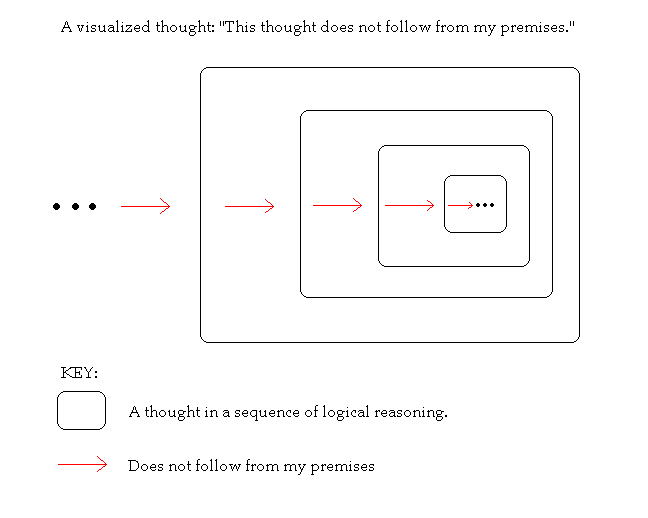
I am very glad you see this, Zavoi. This is more or less where I’m at. And here is my central claim: a thought cannot refer to itself, or if it can, no one seems to be able to tell me how. For example, the first obvious way in my mind, since I seem to think primarily in pictures, would be to conceptualize it as follows:
Note this is an infinite regress in pictures with no end in either direction. There is no defined point of evaluation, as far as I can tell, even if we can really say it’s possible to think it at all (depends on whether it’s possible to really think “infinity” other than formally).
Of course, a reasonable objection to my posting the above picture is that it’s a strawman: “That is not what I meant by ‘This sentence does not follow from the premises’.” But then I must ask, “What did you mean?”
And naturally, no one said we had to conceptualize it in pictures, but my question remains as far as how is one supposed to conceptualize it. In the absence of guidance, I can only try and fail to interpret these words into thoughts so many ways until I say, “All right, although it may appear to be obvious what you mean by that because it’s a well-formed sentence, it’s actually not obvious what you mean when I take it to the level of thought. So I can only await clarification.” Again, for most statements that I claim to understand, the understanding itself gives the answer to my concern. Here is a rare exception, so it seems the speaker of the statement would need to clarify.
Agreed so far…
Is this your view? Is this your impression of my view? This is the view that I’m “accusing” you of having.
All right, make yourself comfortable.
Part 1: Mental substitution
Refer to what I wrote earlier about the animal-feeding example. The thought that “The result of substituting ‘Cats’ for ‘X’ in ‘X are carnivores’ follows from my premises” is a thought about a thought, not a thought about a sentence. It only appears to be about a sentence because we have to use sentences to talk about thoughts. We use syntactic substitution as an analogue for mental substitution. But your mind can perfectly well use mental substitution to form thoughts by combining concepts, as you do when you feed the animals.
Part 2: Gödel’s theorem in math
(Part 2 doesn’t depend on Part 1, but Part 3 depends on both.)
Let’s leave minds and thoughts to the side for now and concentrate just on Gödel’s theorem as it applies to math – it will come in handy later. (I don’t know if you know this already, so I’ll be relatively brief.)
Gödel’s goal is to construct a statement asserting “This statement is not provable in Peano Arithmetic.” It’s fairly easy to construct a formula template ¬Provable(#φ) that asserts that the formula φ is not provable. But if you naïvely try to construct the Gödel sentence by replacing φ with “¬Provable(#φ)”, then you end up in an infinite regress, and you can never finish writing the formula.
But Gödel figured out a way around this, by defining a series of formulas:
Notice that “The self-substitution of Penultimate(_)” is just Ultimate() itself, so Ultimate() asserts that Ultimate() is not provable.
This trick is known as diagonalization.
Part 3: Mental self-reference
This corresponds to the naïve method of constructing the sentence. I.e.: “The statement ‘The statement “The statement … is not provable” is not provable’ is not provable.” You can never finish making that statement, just as you can never finish thinking that thought.
We can instead use the diagonalization method to construct the thought. All the ingredients that were required in the math version, are also available in the mental version:
The resulting thought is something like: “The result of self-substituting the ‘The result of self-substituting the _-concept does not follow from the premises’-concept does not follow from the premises.” Does this make sense?
From this, it is a short step to Löb’s theorem.
Unless someone is dying to know the ending, we should move this to PM if this goes on much longer.
Why would you move it to PM?
Because it has nothing to do with politics? But you’re a moderator, so I’ll defer to your judgment.
That was my impression of your view, or if you don’t like “follows from the premises” then just use the word “true” and substitute it above to dissolve the Liar Paradox. In any case, I see that this section may be moot with respect to Goedel sentences because they are not strictly equivalent to the Liar Paradox (although I still think it applies to the philosophical controversy over such paradoxes - Curry’s Paradox, etc.).
Note: I am not using the “a thought can’t refer to itself” argument to prove that my “follows from the premises” argument is correct. I am saying that it is only from the perspective of the former that I can coherently say the latter, so I would like to discuss the former claim irrespective of the latter, as we are doing presently.
I can picture “Unknown thing is a carnivore” (possible mental image: fuzzy/shadowy creature-thing eating meat on a regular basis), but is that really the same as picturing “X is a carnivore”? I ask not because I know the answer off hand - I’ll have to think more about this - but to stimulate discussion or other reader’s thoughts.
Agreed, as long as by mental substitution you mean replacing the variable with an actual value.
Thank you for writing out the math so carefully, Zavoi. You have saved me some trouble, because I was going off some apparently poorly-worded Wikipedia entries and other sources of a popular understanding of Goedel’s theorem. Essentially you are saying that there is another way of conceptualizing Goedel sentences besides the way I diagrammed, and that that way is in fact spelled out in the proof using the diagonalization lemma.
While I am still skeptical that a thought can refer to itself no matter what tricks are used (although I do agree that a thought can refer to another thought), I must now turn to consider this new candidate as a possible way of forming a thinkable thought in my mind, and it could take some time for me to assess it in light of my views. This is analogous to my position on objective value and objective ethics: I await a conception that is coherent. Every theory presented must be evaluated anew.
Meanwhile, I have another set of questions to throw into the mix for anyone who is interested:
The Goedel number #φ is a composite of prime numbers that is effectively a set of “instructions” for getting φ. This might work if we are also assuming as in the Peano axioms that there are an infinite set of natural numbers, then I would turn to the question of conceptualizing infinity. Can we really do it? Is it enough to imagine something increasing without bound? I realize going down that road leads to some inconvenient places like ultrafinitism…
You might say, “Why bother (and what does this have to do with political theory)?”
To me, these questions relate directly to praxeology. If everything I do is an action in the praxeological sense, that means every thought I choose to think is an attempt to experience more happiness. Or put another way, if I consciously think something (for example if I picture something), it is implicit in that thought that it is potentially useful for me to “act as if” [useful for me to act as if it is the case].
So “X” means “I deem that X is useful to act as if.” Of course, anything that follows from a set of thoughts that I deem are useful to act as if (i.e., premises), is itself useful to act as if, at least provisionally [but provisional usefulness is usefulness]. If this seems to contradict what I wrote in previous posts, please suspend judgment as I clarify this more below.
Now the human endeavor of doing mathematics (assuming axioms and deducing from them) is also action, as is every individual act of stating/thinking axioms deducing the results that follow. Hence, rather than some ill-defined “truth,” it is implicit in each statement I make in doing mathematics that I deem such statement useful to me (useful for me to “act as if”). There can be nothing relevant to any single human action (including a single thought) except its deemed usefulness to the actor (in the broadest sense). This leaves no room for thoughts to be “true,” or even “accurate” or “correct” without these words merely being considered as terms referring in one way or other directly and exclusively to the notion of usefulness. The different words merely attempt to indicate the type and scope of such usefulness.
Strict mathematical formalism, as I understand it - where symbols are manipulated without checking to make sure they actually correspond to thoughts that are possible to think - seems to turn Mises’s conception on its head. I see you are saying that this is not the case with Goedel’s theorem, and I can no longer say I await an explanation - now I have to stop and evaluate the explanation you have given. However, there are other concepts in math that some have contested as being more or less “impossible to think” or “pure formalisms with no content.” Existence proofs, infinity, proofs by contradiction, etc. This is a minority viewpoint, but it seems to me relevant to consider it in terms of praxeology, as Mises’s conception seems to include mathematics as a branch of praxeology.
This is not to say we must correct any mistakes in math to further political theory or praxeology as a whole. But rather that if praxeology advances, any mathematical results that seem to contradict it could indeed become relevant to the larger debate over methodology, politics, economics, etc. In other words, I think there is some sense in which praxeologists must eventually take on all these fields at once, lest errors in one established field be held up as evidence against the new praxeological conceptions. Likewise, if errors can be identified in other branches of praxeology that are already established, and these errors can be shown to have arisen from a misunderstanding of the larger field of human action as Mises conceived of it, that would provide a powerful “in” for praxeological ideas.
Well I’m much more optimistic now that I know you, at least, see things in this way. I have not heard anyone acknowledge the thought aspect of this before. As far as I can tell, most thinkers seem to equate thinking with words, usually with their own pet exceptions, but no one seems to go the full way.
Regarding your passage here, as I alluded to above, I am not fully convinced that we can just assume it’s possible to conceptualize “_-concept”. Perhaps Goedel’s result contains an obvious way to do so (I’ll need to study it more), or perhaps it relies on another concept - like infinity in the Peano axioms - that is itself unthinkable. Or perhaps I am barking up the wrong tree =)
Summing up, I now have something to chew on as a possible conceptualization of Goedel sentences. Re: Loeb’s theorem, I don’t think it will apply in a non-trivial way to what I have stated above, because I am not creating an axiomatic system; I am experiencing sensations and starting my analysis with an “empirical” model based solely on data. The data are not axiomatic, because they are not assumed but rather directly felt hence it wouldn’t even mean anything to “deny” them (so “data” is a slight misnomer). The models I create based on the data (the “real world,” “other people,” etc.) would be premises of a sort, but to say “X” or “X follows from my premises” means to me more like, as above, “I (provisionally) deem X useful to act as if.”
So why all the talk about “X follows from the premises” and now I say something a little different? Am I contradicting myself? No, I am speaking at different levels of analysis, with different pieces of my views included or not included based on where I believe the reader is at. In most cases and at most levels of analysis, I deem X “useful to act as if” because X follows from my premises (or my models, or if you like, my "useful to act as if"s - note how this can include mathematical axioms). One thing I did fail to touch on in previous posts are cases where I speak directly of my private sensations (example: X = “I am in pain.”). These can be viewed as exceptions, depending on how things are phrased, or not: it’s still the case that, if I am in pain it’s useful for me to act as if I’m in pain, albeit perhaps trivially so - it seems to me purely a matter of word usage.
Philosophers; we’ve been babbling incessantly for over 5000years, but have we really said anything? I guess it depends on what you mean by “say.” Or what I mean by “mean.”
^
That I have “preferences” in some foggy mentalese sense is not at all “self-evident” to me.
So you really are just a robot spamming articles you’ve not really processed?