quite funny actually, I was known as ‘that kid with the long hair that supported fractional reserve banking.’  The article that made me really interested in it was this article by White and Selgin and of course talking to Roger Garrison about it as well. (I did not know Garrison was a free banker until these last few days).
Then The Theory of Free Banking by George Selgin is a must read.
Yup, im reading that, good book so far… Selgin is a smart guy and is very overlooked here
If you happen to think the Austrian framework is the most sound, keep in mind that Selgin himself doesn’t consider himself an Austrian (he’s an “eclectic”), and a lot of his propositions are based on Friedmanite doctrines that most Misesians consider fallacious.
well also keep in mind that Mises was for fractional reserves, after reading the majority of ‘Theory of Money and Credit’ I find it odd to consider Mises an anti- frac reserves person or a person that leaned towards having 100 reserves than having FRB, which if you wanted a person that considers himself Austrian that agrees that Mises was for FRB from the Mises Institute, I would suggest giving Garrison an email. Hans Sennholz was also for FRB. In the book, “Man of Principle,” White has an article titled, “Mises on Free Banking and Fractional Reserves,” which the book was a gift to Sennholz on his 70th birthday. (he is the ‘man’ of principle.)
So i do think that FRB is very consistent with Austrian framework. I cant speak for Selgin, but I would consider him Austrian…He gave the Austrians justice in the recent Hayek-Keynes debate at LSE…
What part of TMC gives you that impression?
If you are equating Mises’ support for unregulated banking with support for fractional reserves, you are mistaken. Mises wanted unregulated banking so that fractional reserves/fiduciary media would be minimized or eliminated via competition. See this quote from Human Action:
"…freedom in the issuance of banknotes would have narrowed down the use of banknotes considerably if it had not entirely suppressed it. It was this idea which Cernuschi advanced in the hearings of the French Banking Inquiry of October 24, 1865: "I believe that what is called freedom of banking would result in a total suppression of banknotes in France. I want to give everybody the right to issue banknotes so that nobody should take any banknotes any longer."
People may uphold the opinion that banknotes are more handy than coins and that considerations of convenience recommend their use. As far as this is the case, the public would be prepared to pay a premium for the avoidance of the inconveniences involved in carrying a heavy weight of coins in their pockets. Thus in earlier days banknotes issued [p. 447] by banks of unquestionable solvency stood at a slight premium as against metallic currency. Thus travelers’ checks are rather popular although the bank issuing them charges a commission for their issuance. But all this has no reference whatever to the problem in question. It does not provide a justification for the policies urging the public to resort to the use of banknotes. Governments did not foster the use of banknotes in order to avoid inconvenience to ladies shopping. Their idea was to lower the rate of interest and to open a source of cheap credit to their treasuries. In their eyes the increase in the quantity of fiduciary media was a means of promoting welfare."
Banknotes are not indispensable. All the economic achievements of capitalism would have been accomplished if they had never existed.
Mises here is obviously favoring the notion of fiduciary-media fostering banknotes being reduced or eliminated by virtue of competition among unregulated banks, and obviously disagrees with the notion that an increase in the quantity of fiduciary media can promote welfare.
Furthermore, Mises’ entire macroeconomic corpus stresses the maladjustments that fiduciary media cause, and nowhere does it endorse the Fisher/Friedman “equation of exchange”/“money velocity” or “monetary disequilibria” doctrines that Selgin et al rest their case on.
Actually I take part of that back. He may have endorsed the notion of monetary disequilibria, at least in 1912.
Can you actually substantiate your claims, Daniel?
Mainly,
“and a lot of his propositions are based on Friedmanite doctrines that most Misesians consider fallacious.”
Can you name the economists who don’t think Selgin’s method is sound? Just because he doesn’t call himself an Austrian doesn’t mean he thinks Misesian economics is useless. Funny enough, before he publicly said that the Mises Institute was VERY fond of Selgin. Politics, oh how I hate thee.
What does most Misesians mean? Internet posters? Or austrian macroeconomists? I know of more modern day Austrians who support free, fractional reserve banking with no central banks. Garrison, Horwitz, Lawrence White, Mises, Yeager, Selgin (his monetary framework is very-much inspired by Mises/Hayek macro), Jerry O’Driscoll, Mario Rizzo, Kevin Dowd, and Richard Ebeling, off the top of my head. I know of plenty Rothbardians who support regulated 100% reserves banking, but most aren’t macroeconomists
Worth reading:
“Therefore the dangers of credit expansion were not very great as long as the credit expansion was the business of private banks and private businesses subject to commercial laws. As long as the surplus banknotes could be returned to the bank of issue for redemption, there was a check on credit expansion, and there couldn’t be credit expansion of any considerable extent.”
"The quantity of fiduciary media in circulation has no natural limits. If for any reason it is desired that it should be limited, then it must be limited by some sort of deliberate human intervention -that is by banking policy.
Of course, all of this is true only under the assumption that all banks issue fiduciary media according to uniform principles, or that there is only one bank that issues fiduciary media. A single bank carrying on its business in competition with numerous others is not in a position to enter upon an independent discount policy. If regard to the behaviour of its competitors prevents it from further reducing the rate of interest in bank-credit transactions, then - apart from an extension of its clientele - it will be able to circulate more fiduciary media only if there is a demand for them even when the rate of interest charged is not lower than that charged by the banks competing with it. Thus the banks may be seen to pay a certain amount of regard to the periodical fluctuations in the demand for money. They increase and decrease their circulation pari passu with the variations in the demand for money, so far as the lack of a uniform procedure makes it impossible for them to follow an independent interest policy. But in doing so, they help to stabilize the objective exchange-value of money. To this extent, therefore, the theory of the elasticity of the circulation of fiduciary media is correct; it has rightly apprehended one of the phenomena of the market, even if it has also completely misapprehended its cause."
Ludwig von Mises
In a free market, nothing would distinguish a “bank” from any other firm or individual. Both a “bank” and your neighbor would be free to issue promisory claims to property to be valued (discounted) by the free market. The language and content of the current Full/FracRB debate is based on the premise of a prince giving special privilege/subsidy to a cartel of firms called “banks” – yes, even during the so called periods of “free banking”.
I cant access Mises’s’Theory on Money and Credit’… I read it at the Mises library but im getting my copy shortly… also this quote from human action:
"…freedom in the issuance of banknotes would have narrowed down the use of banknotes considerably if it had not entirely suppressed it. It was this idea which Cernuschi advanced in the hearings of the French Banking Inquiry of October 24, 1865: "I believe that what is called freedom of banking would result in a total suppression of banknotes in France. I want to give everybody the right to issue banknotes so that nobody should take any banknotes any longer."
is not representing Mises’s views… If one reads the things before the quote Mises says:
“It is a mistake to asscioate with the notion of free banking the image of a state of affairs under which everybody is free to issue banknotes and to cheat the public ad libitum. People often refer to the dictum of an anonymous American quoted by Tokke…” ( your quotation on Human Action is what Tokke said, which does not represent what Mises views)
Folks, a banknote isn’t a property claim, no matter how many times Rothbardians state otherwise. The words “X promises to pay the bearer Z dollars on demand” indicate a promise to pay, and nothing more. The language is that of a debt contract, not a bailment. And such has been the understanding of common-law courts since as long as banks have been around (for the English history in particular see my SSRN paper “Those Dishonest Goldsmiths”).
And no, I don’t call myself an Austrian, or a Misesian, or a Friedmanite, or anything else. I prefer just being a Selginite or Selginian (or whatever) and trying to get everyone else to be one. Of course, if you also ike thinking for yourself you will refuse to join my school, or any other..
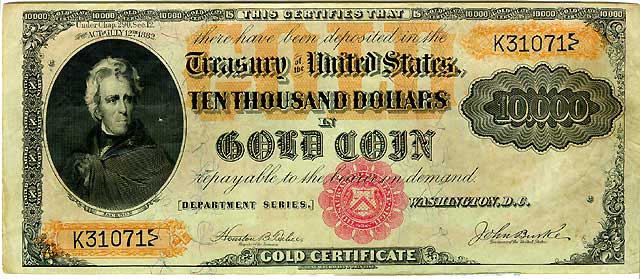

I know right, how ironic 
Not an ordinary one, because it includes extra language that goes beyond a mere promise to pay something on demand.
This could be said about any property claim/title on the market. So according to your line of reasoning, there need not be any property claims on the market, but only debt contracts. The market is an exchange system of debt contracts.
Does it really, DD5? Does your car title say that the seller “Promises to pay you one car on demand”? Does it not expressly declare that you are the true “owner” of particular car X? Why don’t you run out to your car and see.
I anxiously await your report.
[quote=“Isaac “Izzy” Marmolejo”]
I cant access Mises’s’Theory on Money and Credit’… I read it at the Mises library but im getting my copy shortly… also this quote from human action:
"…freedom in the issuance of banknotes would have narrowed down the use of banknotes considerably if it had not entirely suppressed it. It was this idea which Cernuschi advanced in the hearings of the French Banking Inquiry of October 24, 1865: "I believe that what is called freedom of banking would result in a total suppression of banknotes in France. I want to give everybody the right to issue banknotes so that nobody should take any banknotes any longer."
is not representing Mises’s views… If one reads the things before the quote Mises says:
“It is a mistake to asscioate with the notion of free banking the image of a state of affairs under which everybody is free to issue banknotes and to cheat the public ad libitum. People often refer to the dictum of an anonymous American quoted by Tokke…” ( your quotation on Human Action is what Tokke said, which does not represent what Mises views)
[/quote]
Yes, you’ve posted the same out of context quotes just a couple of weeks ago, and the response is the same although you are probably not interested in it. Mises advocated free banking for the same reason that Rothbard advocated for free banking as a 2nd best solution, (see Mystery of Banking). That’s not exactly a “free banker” according to the Selgin/White “tradition”. In fact, since Selgin moniors these discussions, why not ask him directly why he thinks Mises advocated for free banking.