Even though I am an ardent libertarian, I believe that designating certain areas to conserve nature is wonderful.
I’d like everyone’s opinion on national parks and other environmental services.
Even though I am an ardent libertarian, I believe that designating certain areas to conserve nature is wonderful.
I’d like everyone’s opinion on national parks and other environmental services.
If parks are worth the cost, then people will get together in foundations and buy the parks to designate them for conservation. But if we enforce that through the state, we impose the cost of our preferences on somebody else. For example the price of land for homebuilding will be higher, which hurts low income families the most. So essentially that’s saying “I want to force the poor to pay for my preference to have parks”.
I understand your argument, but if it wasn’t for the government, I truly believe that nature’s most beautiful creations would have been destroyed. I feel that this is more or less a protection of “private property” for us and for future generations. There are no foundations large enough to buy the grand canyon, Yosemite, etc.
I though Teddy Roosevelt did a great job by creation the Yellowstone national park.
what do you mean there is no foundation large enough to buy national parks?
What’s beautiful to you might not be beautiful to others. How do we resolve this conflict of subjective values?
Why would the parks need to be bought? Also, what would the price be, since you have implied that you know what the price would by stating that no foundation could afford it?
Well, there are no foundations large enough to do those things because the state crowds them out of existence. In a free market there would be. And environmentalism is not a matter of private property, but of collective property. Who are we to impose on everyone, including future generations, that they should have forests instead of material wellbeing?
The irony is that anticapitalistic regulation actually hurts the environment. Sure, without bureaucratic environmental regulation some of natures creations would have been paved over to build factories. (Because that’s their most valuable use.) But it is wrong to think that destruction of the environment can never be reversed. Many free market countries have seen their environment improve in the last half century.
Essentially what the environmentalists are saying is that we should stay poor for the sake of the earth. But that will cause us to destroy the environment for a longer time. The only true environmentalism is the free market. We should pave over as many forests as necessary to create progress and move on to less environmentally destructive technologies. Once we are rich there will be so many forests that we don’t know what to do with them. People in a hundred years will wonder why we delayed humanities welfare for the sake of maintaining environmentally destructive production methods.
Are you suggesting that in order to “save” somthing, we have to not use it? I think the opposite is true. If entrepreneurs wanted to profit from a resource (whatever that may be) they would manage that resource wisely for profit opportunites in the future as well as in the present. This is obvious when you consider chickens and cows. This would include vast forests as well.
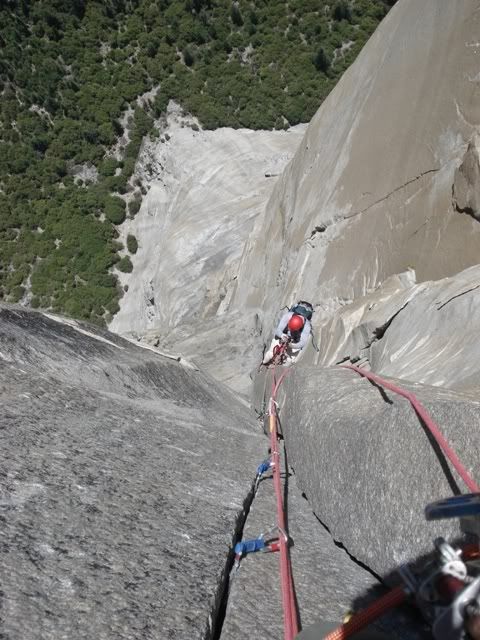
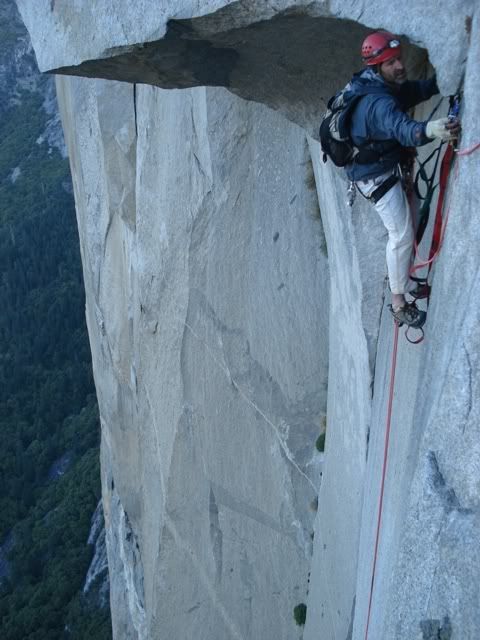
I love National Parks but I do wish they could have been established without the government. First time posting an image so lets see if it comes out…a couple shots from a past visit to Yosemite.
Looking down the Nose…
cleaning the Great Roof…
The rangers are a serious waste of our tax dollars, in Zion they use IR to catch campers smoking weed around the evening camp fire.
In Yosemite my bud got tased for running away from them after a base jump.
In the Tetons they…well actually the few I ran into were pretty decent
Whitney has some quota system where I could travel all the way there then not be allowed on wother the tourist goat path or the North Fork trail.
In Africa the only places were big game is not declining are private hunting reserves. The system is so successful it is notwbeing considered as the last hope for saving White Rhinos, since all previous attempts (including arming park rangers with automatic weapons) failed miserably. One disgusted traveller even went as far as saying “the best and cheapest place to buy rhino horn and ivory is a police station”.
But without bothering Africa let’s take a closer look to home. I live near a number of national parks. For decades they’ve been the last preserve of Brown Bears in the Alps. A few years ago some bureaucrat had the brilliant idea to introduce a large number of the beasts from Slovenia, about twice as many as the indigenous population. To say this has been a disaster doesn’t even come close. During quarantine the beasts were only fed sheep carcasses instead of a more balanced diet, closer to what they eat in nature. They weren’t “trained” to fear the vicinity of man. The end result is what you may expect: they have taken to raiding herds. No problem, said the bureaucrats, we’ll refund you. Of course they immediately started turning down requests by putting the blame on “stray dogs”… which needless to say leave behind bear pawprints and consume meat in the same way as bears. Those are some strange mongrels! Right now they are traveling around at whim, killing sheeps and even raiding garbage bins inside villages. It’s pretty obvious the bears are out of control and to make matters worse, it seems the radio collars they were fitted with don’t work.
One local man reported to the proper authorities seeing a bear near his house. Impossible, they said, there’s no signal from a radio collar. This man then proceded taking plaster casts of the pawprints and then to snap some pictures of a bear, so clear experts were able to say it’s a young male. He sent the pictures to various local newspapers. No reply was forthcoming from Parks Service. The same “Stray dogs” ate a donkey not far from my home last year. It was news for a few days and then forgotten. According to my sources this “stray dog” met an untimely end about ten days later. The thing got me so p***ed off I even considered reapplying for a gun permit and getting a proper rifle.
And this is just one case of mismanagement. I wouldn’t trust these people to run a flea circus, let alone give them the money to carry out these ridiculous experiments.
Lol, that sounds like quite an experiment! Where do you live? Which state? I hope you got a gun to shoot down those stray dogs!
You are saying that building a factory might be more worthwhile. But for whom? For the owner of the factory maybe, but it will not be necessarily worthwhile for the rest of the population. For example the factory can make a lot of money by selling resources to other countries. But the citizenry of the native country will barely see a dime out of this. They will however lose a great natural reserve.
Well, there could conceivably be such local imbalances. But society as a whole will be better off. In the real world these things even out though, everybody gets richer.
As others have posted, “most beautiful” to whom? To you, of course. But who says the rest of us are obligated to agree with you?
Furthermore, if “nature’s most beautiful creations” were under threat of destruction, you’d think the people who find such beauty in them would put their money where their mouths are, instead of wielding the club of government to beat down those who disagree with them.
And why is that, exactly?
Who owns the land on which the factory is built?
Otherwise, I guess an issue there is whether any of the population could be said to have homesteaded any use-rights over that land already. However, externalities aren’t use-rights.
“Losing something” only makes sense if you possess it in the first place. Externalities aren’t possessed by anyone, really.
Subjective valuations aside, what incentive would there be to “destroy” these places? I mean, if the grand canyon wasn’t protected, do you really think someone would fill it in to build a shopping mall? Mountains are expensive places to develop land, and the remoteness of most natural treasures would make them unattractive locations for commercial real estate outside of travel and resort industries which would obviously thrive on the maintenance of a natural state. Ironically, the most glaring man-made object in the grand canyon is the federally owned Hoover Dam.
I’d love to see how one can use the Grand Canyon for anything but tourism.
The problem with turning a natural reserve into an industrial complex is that the natural reserve gets destroyed in the process. After a factory was erected in that place, it costs A LOT to turn the place again into a natural park again. Its like you rent an appartment, turn it into a mess and then just leave. I don’t think it is fair.
That’s just not true. Once a population is rich it is no problem to recreate environmental beauty. Environmental degradation is not a one way street. Forests, wetlands, animal habitats, this can all be created just fine. It’s wrong to think of the environment and technological growth as mutually exclusive. That’s this dogma we all were programmed with in government school. But it’s just not true. Environmentalism is wrong.
Look I agree with you that environment can be created. Forests can be planted, rivers can be cleaned. It does cost a lot of money and time. If something like that gets destroyed it costs a lot to recreate it. Perhaps there has to be a condition under which a natural reserve can be converted, and that condition is that the individual that does that leaves a deposit large enough to clean the area and recreate the natural reserve afterwards.