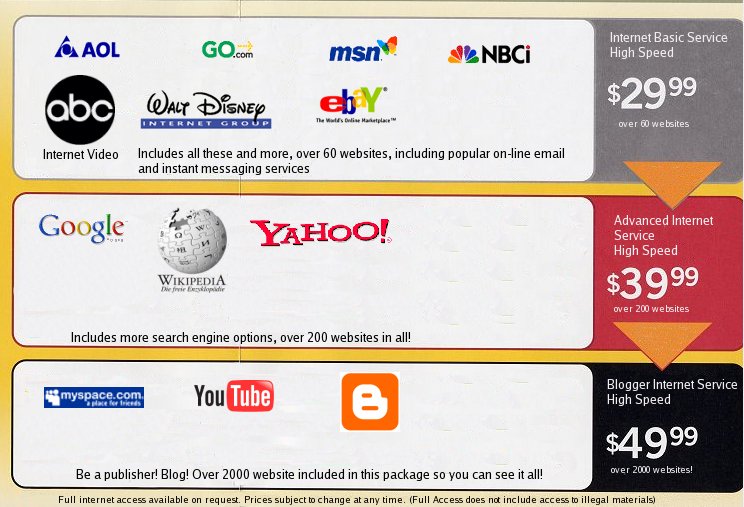
What do you make of this? I guess the fear is that ISPs will limit access to particular sites, and charge per Kb, Mb, etc used. Charging per kb used makes sense.
An example of what could happen without regulation:
It’s just more of your typical net neutrality bullshit. Avid users want to push the cost of their hobby/business onto other less invested users.
And tiered access would lower subscription costs and improve benefits overall, because it would mean that either sites are subsidizing ISPs to provide access to their site at a cheaper cost to the end user, or that they are footing the bill for a better network to provide access on. Both of these are beneficial to the end user.
I’ve seen this one before. Very little substance to this, it only appeals to the emotions.
If ISPs were going to charge for tiered service like this, why aren’t they doing it already? Any net neutrality bill will be used to give the government more control of the internet. After all, the internet allows to spread the message of liberty. They’d love to have control over our main tooll.
That image is scary. I think the powers that be are regretting all this freedom and competition we have here. They’ll look for any excuse - cyberterrorism, pornography, equal access, net neutrality - to regulate away freedom of speech. It’s already happened with radio and TV, so I expect we’re headed for a battle.
The problem is that the internet is categorically different than TV or radio in a more profound way than simply being more distributed. TV, radio and other “dumb” media act as a simple pipe or conduit that transmits data from one end to the other. By contrast, at each end of a computer network communication channel is a general-purpose, programmable computer. Since computers are “smart”, that is, they can be programmed to intelligently handle data, it is always possible to subvert any controls which are imposed on such a channel. Cryptography, steganography, web proxies, internet relay, peer-to-peer, onion routing, open DNS, and so on are all examples of the many ways in which the internet frustrates any attempt at end-to-end media control. The only way to “control” the Internet would be for the State to manufacture, license and control every piece of digital hardware anywhere, ever. That’s impossible. Controlling the Internet is impossible. TPTB can stomp and scream and throw a big hissy fit but they can’t control the Internet.
I think companies would not charge per website. There are billions of websites.
No one would pay per website and the company that does not require this would always take marketshare from competition.
No regulation is required. Any company charging per GB, in this day and age, would lose competitive advantage. And if all companies do this, there is suddenly money on the table for old fashioned internet.
For instance: I pay extra 5 bucks for extra high speed and priority when lots of people use internet. Means: up to 20 mbp and never less than 11 mbp all the time.
“The only way to “control” the Internet would be for the State to manufacture, license and control every piece of digital hardware anywhere, ever. That’s impossible. Controlling the Internet is impossible.”
Wow, that makes me feel a lot better.
The internet may not be “dumb” media, but I am what you would call a “dumb” internet user. I know nothing about cryptography, steganography, etc…not even what those terms mean. In other words: me have computer, me go on website, me happy. Can the average user depend on the the internet-savvy to keep the nets open? Should I be doing my homework now so in 30 years I can create my own digital hardware to get around the system? Hacking into security systems seems easy on the pages of Ender’s Game - even a six-year-old can do it! - but I’m sure stuff like that’s harder in real life. I am headed back to college in the fall as a sophomore. Should I consider majoring in computer science, seeing as it might be one of the more useful things I could study at a very pro-state school?
@Leo: Well, the more savvy you are, the more tools you will be able to leverage to your own use. That said, the average user will never become more savvy, they want point and click. Your question basically boils down to “can the government throw enough roadblocks in the way of the average point-and-click user to control the Internet?” and I think the answer is, still “no” depending on how narrowly or broadly you interpret the word “control.” The government already makes it extremely difficult to get hold of child pornography over the internet (or any other medium) and also, with varying degrees of success, has managed to keep prostitution ads from being able to freely flow over Craigslist, etc. But when you delve into the details, you realize that where the government has the most success is in areas where the masses assist (snitching, reporting) and its successes have almost nothing to do with technical measures, that is, controlling the hardware/software of the Internet itself. If you look at China, for example, they have thrown an entire army of government employees at the single task of filtering and controlling Internet access but the so-called “great firewall of China” is full of holes. It only works to the extent that it does because the Chinese government can exercise dictatorial power if it needs to (basically, you can go to jail for violating the “intent” of the Internet filter, an idea which is alien to Western law). But, in the end, it always remains technologically feasible to circumvent the most vigorous filter by simply encrypting or otherwise masking and hiding the true nature of Internet traffic. As soon as you allow hardware to connect to the network over which you do not have total control, it is really impossible to prevent “unauthorized” uses.
There are two reasons we will never see such draconian levels of control. 1) Gadgetry… we love our tech toys and these are always hackable, extensible hardware outside of the control of government. 2) Porn. We love our pornography. Any system of control effective enough to control politically incorrect speech would end up being utilized by the evangelical community to attempt to restrict pornography but no way in hell are we going to let anyone interfere with our porn surfing. So, policies which would grant sufficient control to stifle politically incorrect speech will never be realistically possible.
The only way for ISPs to have power would be for there to be an artificial barrier to entry to become an ISP. Guess who’s the only entity who can create those?
It’s so funny (the suggestion of limitation of output for higher pay), because all ISPs are doing is providing more for the same price constantly. Here in Holland you just have to wait 6 months and at some point they’ve upgraded the speed again for no price-increase. Why? Because of competition of course.
But I guess there are some places where the regulation of so strict that ISPs can offer the bare minimum. Naturally people blame the ISPs and the ‘free’ market.
“2) Porn. We love our pornography. Any system of control effective enough to control politically incorrect speech would end up being utilized by the evangelical community to attempt to restrict pornography but no way in hell are we going to let anyone interfere with our porn surfing. So, policies which would grant sufficient control to stifle politically incorrect speech will never be realistically possible.”
If only it were the other way around and everyone loved their politically incorrect speech, while porn was something that only a few eccentric weirdos were interested in.