NY Fed's best forecast: "We can't forecast"

A new paper by the NY Fed:

The Failure to Forecast The Great Recession

Experience shows that what happens is always the thing against

which one has not made provision in advance.

– John Maynard Keynes1

Our best plan is to plan for constant change and the potential for instability, and to recognize that the threats will constantly be changing in ways we cannot predict or fully understand.

– Timothy Geithner2

How Bad Were the Forecasts for Real Activity?

Economic forecasters never expect to predict precisely. One way of measuring the accuracy of their forecasts is against previous forecast errors. When judged by forecast error performance metrics from the macroeconomic quiescent period that many economists have labeled the Great Moderation, the New York Fed research staff forecasts, as well as most private sector forecasts for real activity before the Great Recession, look unusually far off the mark.

One source for such metrics is a paper by Reifschneider and Tulip (2007). They analyzed the forecast error performance of a range of public and private forecasters over 1986 to 2006 (that is, roughly the period that most economists associate with the Great Moderation in the United States).

On the basis of their analysis, one could have expected that an October 2007 forecast of real GDP growth for 2008 would be within 1.3 percentage points of the actual outcome 70 percent of the time. The New York Fed staff forecast at that time was for growth of 2.6 percent in 2008. Based on the forecast of 2.6 percent and the size of forecast errors over the Great Moderation period, one would have expected that 70 percent of the time, actual growth would be within the 1.3 to 3.9 percent range. The current estimate of actual growth in 2008 is indicating that our forecast was off by 5.9 percentage points.

Using a similar approach to Reifschneider and Tulip but including forecast errors for 2007, one would have expected that 70 percent of the time the unemployment rate in the fourth quarter of 2009 should have been within 0.7 percentage point of a forecast made in April 2008. The actual forecast error was 4.4 percentage points, equivalent to an unexpected increase of over 6 million in the number of unemployed workers. Under the erroneous assumption that the 70 percent projection error band was based on a normal distribution, this would have been a 6 standard deviation error, a very unlikely occurrence indeed.

Three main failures in our real-time forecasting stand out:

  1. Misunderstanding of the housing boom. Staff analysis of the increase in house prices did not find convincing evidence of overvaluation (see, for example, McCarthy and Peach [2004] and Himmelberg, Mayer, and Sinai [2005]). Thus, we downplayed the risk of a substantial fall in house prices. A robust approach would have put the bar much lower than convincing evidence.

  2. A lack of analysis of the rapid growth of new forms of mortgage finance. Here the reliance on the assumption of efficient markets appears to have dulled our awareness of many of the risks building in financial markets in 2005-07. However, a March 2008 New York Fed staff report by Ashcraft and Schuermann provided a detailed analysis of how incentives were misaligned throughout the securitization process of subprime mortgages—meaning that the market was not functioning efficiently.

  3. Insufficient weight given to the powerful adverse feedback loops between the financial system and the real economy. Despite a good understanding of the risk of a financial crisis from mid-2007 onward, we were unable to fully connect the dots to real activity until 2008. Eventually, by building on the insights of Adrian and Shin (2008), we gained a better grasp of the power of these feedback loops.

However, the biggest failure was the complacency resulting from the apparent ease of maintaining financial and economic stability during the Great Moderation. Perhaps most important, as noted by some analysts as early as the 1990s, these adverse consequences of the Great Moderation were most likely to arise from the actions, judgments, and decisions of financial market participants:

Longer stretches of economic growth imply greater leverage and complacency and thus, greater financial problems when recessions do occur.

–William Dudley and Edward McKelvey3

But, no need to be alarmed, now they’ve learned their lessons and these errors will never be repeated again.

In any other field (pretending to call itself scientific) these activities would amount to blatant curve-fitting, i.e. “explaining” reality with models that only “work” looking back, having no predictive powers whatsoever. Real scientists would laugh bozos like these straight out of the conference room.

EDIT: Just saw that Wheylous (and ZeroHedge) had beat me to this in the Low Content thread. Nevermind, this is good enough for its own thread.
Yeah, forecasting is… very terrible. Though I don’t entirely agree with your analysis. Meteorology is a very real science which is extremely terrible at forecasting beyond a very narrow horizon. I think “real sciencists” would be reasonably impressed with economics given the inherent difficulty in modelling non-linear dynamic systems.

MI, apparently no outcome exists that would shake your faith in this curve-fitting charade that you call econometrics. To a real scientist it is perfectly obvious that there is absolutely no knowledge (sublimation, robustness) contained in these models.

z1235,

Didn’t address my counter-example of meteorology still being a “real science” despite having terrible forecasts, just went straight on to attack my character. And people wonder why I frequently become somewhat hostile?

FYI, you’re equating econometrics with forecasting, and they are not the same. Forecasting is a very small sub-field of econometrics, and even econometricians take forecasts with a (very large) grain of salt. Perhaps take the time to learn what you’re criticising?

Econometrics could only hope to come near meteorology’s forecasting ability.

Forget forecasting. No outcomes (results, tests) exist that would support econometrics’ ability to sublimate any knowledge whatsoever. Decades after Keynes, models are being haphazardly invented, deleted, tweaked and yet nothing sticks. There’s no accumulation of knowledge, no improvement – only “complex” models chasing complex reality in the dark. Real scientists know what they can’t know. Charlatans have no idea.

I don’t think real scientists would be impressed with mainstream economic models simply because they’re difficult. What is impressive is accuracy and precision. I think that given the failure of the mainstream economists to foresee the housing bubble or hell, even to recognize how bad our situation actually is. The only economists I have heard of that foresaw the housing bubble were Austrians, although Krugman did advocate its initiation.

Just gonna keep trolling away? Okay. If you don’t want any productive conversation I just won’t talk to you.

I didn’t mean impressed because of how hard it is, I meant impressed with the amount we’ve managed to accomplish despite the very severe impediment. With the recent rise of Real Business Cycle models, macroeconomics is moving in the direction of a quantative theory. Give it some time. It’s only a young field.

If any model could actually predict/identify a bubble, no bubbles would ever exist. As soon as a bubble becomes apparent it bursts immediately (everybody shorting whatever is inflated until the price falls to the point where it’s not inflated anymore). Their very nature is that they’re illusive. Either way, I don’t think that’s a very fair demand. It’s kind of like saying, “Oh yeah. If doctors are so smart, why do people still die?”.

Krugman didn’t advocate its initiation. That was a joke he made. If Austrians foresaw the bubble, why didn’t they short housing until its price returned in line with fundamentals, making shitloads of money in the process?

I didn’t mean impressed because of how hard it is, I meant impressed with the amount we’ve managed to accomplish despite the very severe impediment. With the recent rise of Real Business Cycle models, macroeconomics is moving in the direction of a quantative theory. Give it some time. It’s only a young field.

What have we accomplished? I’m discouraged about the rise of the Real Business Cycle, because its proponents aren’t putting forth a theory that has been logically deduced and it’s probably gonna mean more and more money printing

If any model could actually predict/identify a bubble, no bubbles would ever exist. As soon as a bubble becomes apparent it bursts immediately (everybody shorting whatever is inflated until the price falls to the point where it’s not inflated anymore). Their very nature is that they’re illusive. Either way, I don’t think that’s a very fair demand. It’s kind of like saying, “Oh yeah. If doctors are so smart, why do people still die?”.

They’re elusive to most people, yes that’s what allows them to grow. That didn’t seem to stop the Misesians. They did identify the bubble. Schiff, Thornton, Paul. Here’s the full list: http://www.lewrockwell.com/blog/lewrw/archives/73123.html. So they did identify the bubble using the Austrian methodology, yet the bubble continued to exist until the Lehman moment. I think it is a fair demand. Most sick people die because they can’t afford the care.

Krugman didn’t advocate its initiation. That was a joke he made. If Austrians foresaw the bubble, why didn’t they short housing until its price returned in line with fundamentals, making shitloads of money in the process?

Oh it was a joke? Didn’t seem like that when I read it. Here’s the quote:

To fight this recession the Fed needs … soaring household spending to offset moribund business investment. [So] Alan Greenspan needs to create a housing bubble to replace the Nasdaq bubble.

I fail to see an attempt at humour here. Identifying the existence of a bubble does not instantly grant the identifier the knowledge of when exactly the bubble would crash. If I knew there was a housing bubble in 2003 and started shorting a housing-based ETF, I would have lost way more money by 2008 than I would gain during the crash. Shorting is risky and for the most part not worth it.

They…absolutely are. Every major business cycle model is logically deduced. The old Keynesian model wasn’t, it was just an ad hoc model. But since the 80s there’s been a very strong drive to have every model microfounded on consumers maximising utility and firms maximising profit.

It’s not gonna mean more money printing at all. Real Business Cycle theory is a market clearing theory of the business cycle. Most variants don’t allow much room for nominal shocks (hence, “Real” business cycle as opposed to a “nominal” business cycle like Keynesianism/Monetarism). RBC theorists are strongly against economic stimulus.

If they identified it with certainty then why didn’t they all take the opportunity to make billions of dollars shorting housing (and in the process popping the bubble before it became big enough to have real consequences)?

Wasn’t really the point I was making. The point was “If doctors are so smart, why is death still an inevitability?”. Why does aging still happen? Why is cancer still around? Why can’t we cure the common cold? If doctors can’t even cure a common cold then does medicine have no worth? Surely they’re as incompetent as economists, who can’t even predict a measly housing bubble?

Perhaps because it’s hard to gauge tone in a text quote?

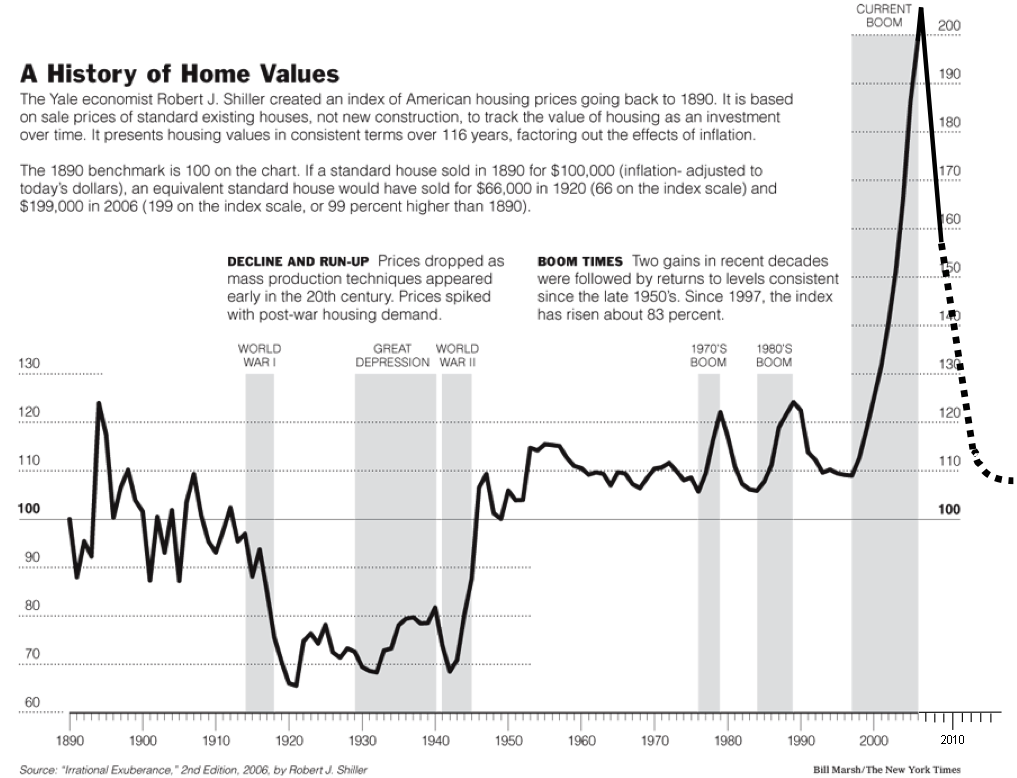
But Austrians are still saying that housing has to come down another 20% right? Based on this: http://www.ritholtz.com/blog/wp-content/uploads/2008/12/case-shiller-chart-updated.png

http://www.cnbc.com/id/40853858/Peter_Schiff_Home_Prices_To_Fall_Another_20

So when (if) the second fall occurs bringing housing back into its long run trend, you actually would have made money shorting housing in 2003. However, if the price of housing stays where it is and doesn’t crash again, then it’s not a bubble is it? And your model should be able to tell you “house prices are gonna trend at this level now, don’t start shorting housing until the price is above a certain level”. In this case (the case of assuming housing won’t crash again), then your theory should have told you only to start shorting in 2005-06.

EDIT: My apologies for making assumptions about RBC. I don’t understand it completely yet but I’m sure there will be another time to discuss it.

If they identified it with certainty then why didn’t they all take the opportunity to make billions of dollars shorting housing (and in the process popping the bubble before it became big enough to have real consequences)?

Wasn’t really the point I was making. The point was “If doctors are so smart, why is death still an inevitability?”. Why does aging still happen? Why is cancer still around? Why can’t we cure the common cold? If doctors can’t even cure a common cold then does medicine have no worth? Surely they’re as incompetent as economists, who can’t even predict a measly housing bubble?

Doctors are limited by technology. Economists are limited by the accuracy of their ideas. Also, pretty soon (next couple of decades) I think that diseases are going to drastically decrease with the advent of affordable nanotechnology.
Here’s the full Krugman quote:

"A few months ago the vast majority of business economists mocked concerns about a ‘‘double dip,’’ a second leg to the downturn. But there were a few dogged iconoclasts out there, most notably Stephen Roach at Morgan Stanley. As I’ve repeatedly said in this column, the arguments of the double-dippers made a lot of sense. And their story now looks more plausible than ever.

The basic point is that the recession of 2001 wasn’t a typical postwar slump, brought on when an inflation-fighting Fed raises interest rates and easily ended by a snapback in housing and consumer spending when the Fed brings rates back down again. This was a prewar-style recession, a morning after brought on by irrational exuberance. To fight this recession the Fed needs more than a snapback; it needssoaring household spending to offset moribund business investment. And to do that,as Paul McCulley of Pimco put it, Alan Greenspan needs to create a housing bubbleto replace the Nasdaq bubble"

Can you substantiate your claim that this is an attempt at humor?

But Austrians are still saying that housing has to come down another 20% right? Based on this: http://www.ritholtz.com/blog/wp-content/uploads/2008/12/case-shiller-chart-updated.png

http://www.cnbc.com/id/40853858/Peter_Schiff_Home_Prices_To_Fall_Another_20

So when (if) the second fall occurs bringing housing back into its long run trend, you actually would have made money shorting housing in 2003. However, if the price of housing stays where it is and doesn’t crash again, then it’s not a bubble is it? And your model should be able to tell you “house prices are gonna trend at this level now, don’t start shorting housing until the price is above a certain level”. In this case (the case of assuming housing won’t crash again), then your theory should have told you only to start shorting in 2005-06.

It may well be that the housing market prices have yet to completely fall. Even if that were true, it still wouldn’t make shorting them since 2003 or even 04 or 05 worth it. Every day you short and your pick doesn’t fall, you lose money. And with less and less principal with which to invest, so the less profit you will get. So even if a stock goes up 5 points a day for a year and then down 1825 points in a day, you still will not have profited due to diminished principal. Therefore it is quite unreasonable to expect that Austrians should have shorted the housing market. That task remains to be fulfilled by the riskier investors.

Economists are limited by technology also. Specifically, the ability to collect data. That’s changing. For example, normally to assess changes in the price level or labour force participation we send out interviewers to households, which is very costly in terms of both money and time. But now, as has been done with the BPP index (an independent measure of inflation), we can have a computer automatically search through millions of prices for goods and services online. The accuracy and precision of predictions economic models make is constrained, as in physics, by your ability to test for the marginal impact of each of your variables. The more access there is to data, the easier it will be to dispose of economic theories inconsistent with it.

So he’s basically saying “People should be paying attention to those who say there’s a real risk of a double-dip. The Fed isn’t going to be able to avoid that just with bringing interest rates back down like normal. The only way a double-dip could possibly be averted is if there’s a housing bubble to replace the Nasdaq bubble.”

He’s not making a recommendation that the Fed create a housing bubble. He’s saying that the only reason the US wouldn’t enter a double dip would be if there were a housing bubble. The US didn’t have a double dip, and later Krugman said it’s very likely there’s a housing bubble. http://www.youtube.com/watch?v=qo4ExWEAl_k. I mean, who really cares though. This isn’t especially important to the point.

Absolutely, shorting housing in 05 would be worth it. You’re in it for the long run, remember. You’re basically saying “Yeah, if I invest my principal now I’ll end up getting a 7% return after ten years. But I’m still losing money, because every day I could be making capital gains by correctly predicting whether the stock market will go up or down”. Yeah, but you can’t correctly predict if the stock market will go up or down, or if the housing bubble will continue for another week or whether it’ll burst tomorrow. You can predict that within ten years the price of houses will be back to trend, so you bet based on that. It doesn’t matter that you could be making money while it’s still going up, that’s extremely risky. It’s not risky to make money when you know it’ll be down to trend in ten years time, but you still make a massive return (making this kind of riskless return is called arbitrage).

Economists are limited by technology also. Specifically, the ability to collect data. That’s changing. For example, normally to assess changes in the price level or labour force participation we send out interviewers to households, which is very costly in terms of both money and time. But now, as has been done with the BPP index (an independent measure of inflation), we can have a computer automatically search through millions of prices for goods and services online. The accuracy and precision of predictions economic models make is constrained, as in physics, by your ability to test for the marginal impact of each of your variables. The more access there is to data, the easier it will be to dispose of economic theories inconsistent with it.

Economic theories, to be accurate, must be reasoned into existence and not deduced from data. Should they be reasoned in from data, one makes the mistake of confusing causation with correlation. A common example of this being Keynesians mistaking high spending as a cause of a wealthy society instead of an effect of one. To deduce theory from data and have the theory be useful one must be able to test your statements with controlled environments, i.e. all else being equal. If you cannot have this controlled environment then you cannot claim a causal relationship with any validity. How could you carry out this scenario? Making theories out of reason is a sounder approach because it does not seek to apply an inappropriate methodology: that which is appropriate for repeatable and controlled experiments to that which is unrepeatable and uncontrollable.

Also, even if you do get all the data in the world with which to put forth theories, you would very likely be using government statistics. Governments have a number of high incentives to misrepresent or lie about their economic statistics and this has been validated historically.

So he’s basically saying “People should be paying attention to those who say there’s a real risk of a double-dip. The Fed isn’t going to be able to avoid that just with bringing interest rates back down like normal. The only way a double-dip could possibly be averted is if there’s a housing bubble to replace the Nasdaq bubble.”

He’s not making a recommendation that the Fed create a housing bubble. He’s saying that the only reason the US wouldn’t enter a double dip would be if there were a housing bubble. The US didn’t have a double dip, and later Krugman said it’s very likely there’s a housing bubble. http://www.youtube.com/watch?v=qo4ExWEAl_k. I mean, who really cares though. This isn’t especially important to the point.

Moving goalposts? Not a joke anymore? Anyways let’s use his own words instead of your editing. He says that to fight a recession they need high household spending, so they should inflate a bubble. Simple and in his own words. But you’re right, it doesn’t prove anything, although it lends support to my inital point.

Absolutely, shorting housing in 05 would be worth it. You’re in it for the long run, remember. You’re basically saying “Yeah, if I invest my principal now I’ll end up getting a 7% return after ten years. But I’m still losing money, because every day I could be making capital gains by correctly predicting whether the stock market will go up or down”. Yeah, but you can’t correctly predict if the stock market will go up or down, or if the housing bubble will continue for another week or whether it’ll burst tomorrow. You can predict that within ten years the price of houses will be back to trend, so you bet based on that. It doesn’t matter that you could be making money while it’s still going up, that’s extremely risky. It’s not risky to make money when you know it’ll be down to trend in ten years time, but you still make a massive return (making this kind of riskless return is called arbitrage).

This response confounds me. Shorting a stock while it does not sink means the diminishment of principal with which one shorts. Thus the prolonged shorting of a floating stock pick means the diminishment of your investing principal such that even with a large jerk downards, you will have lost your money, not profited off of it. How could the Austrians know if the bubble was going to crash in 08, 09, 10? Or how high it would go before then? All these are essential knowledge bits for the preservation of your principal if you would consider shorting. Sadly they aren’t knowable.

I don’t know what you’ve been told, but the Austrian School doesn’t have a monopoly on logic. Every modern economic model is reasoned into existence and then confirmed or disconfirmed with data. As I said before, all modern macroeconomic models have microfoundations now, built up from the utility maximising consumer and the profit maximising producer. Data is there to test the models. It’s all well and good having a theory of gravity that says every object on earth is accelerated towards the earth’s centre of gravity at 9.8m/s/s irrespective of its mass. But it’s not enough to just assume your model is complete and hasn’t missed out on some vital steps or that your assumptions are in fact true, no matter how “self-evident” they are. You need to actually test that things are accelerated at 9.8m/s/s irrespective of mass. You may find that when you attempt to extrapolate the velocity of an object in freefall, you’ve missed out on a vital piece of information: air resistance (which is affected by mass).

It’s still a joke, in that it’s supposed to be funny… He didn’t say “should”. There were no normative statements there. He said that in order to avoid a double dip Greenspan would need to create a housing bubble. It’s not a recommendation. I don’t remember what your initial point was… sorry.

I don’t understand what you’re talking about when you say the principal diminishes. The principal doesn’t diminish at all, no more than if you go long on a stock that doesn’t rise every day. Are you talking about a margin call?

I don’t know what you’ve been told, but the Austrian School doesn’t have a monopoly on logic. Every modern economic model is reasoned into existence and then confirmed or disconfirmed with data. As I said before, all modern macroeconomic models have microfoundations now, built up from the utility maximising consumer and the profit maximising producer. Data is there to test the models. It’s all well and good having a theory of gravity that says every object on earth is accelerated towards the earth’s centre of gravity at 9.8m/s/s irrespective of its mass. But it’s not enough to just assume your model is complete and hasn’t missed out on some vital steps or that your assumptions are in fact true, no matter how “self-evident” they are. You need to actually test that things are accelerated at 9.8m/s/s irrespective of mass. You may find that when you attempt to extrapolate the velocity of an object in freefall, you’ve missed out on a vital piece of information: air resistance (which is affected by mass).

It is my understanding that non-Austrian schools use methodologies which roughly base off of statistical history to establish trends. Ex: “X historically rises with Z, thus when Z goes up X goes up.” I believe that the Austrian school is unique in its employment of methodological individualism and subjectivity. I agree that economic history may lend support to a theory, but a reference to an incident which seems to contradict it is not a refutation. I hope there is a third poster that can lend insight on what the methodologies of the schools are. It was always my understanding that Keynesians worked that way, but perhaps not monetarists? To be frank I’m not sure but I was under the impression that the Austrians were the only ones to use logic alone to develop their theories.

It’s still a joke, in that it’s supposed to be funny… He didn’t say “should”. There were no normative statements there. He said that in order to avoid a double dip Greenspan would need to create a housing bubble. It’s not a recommendation. I don’t remember what your initial point was… sorry.

He said: needs…needs…needs. Sounds normative to me. It is a suggestion to Greenspan to avoid a recession.

I don’t understand what you’re talking about when you say the principal diminishes. The principal doesn’t diminish at all, no more than if you go long on a stock that doesn’t rise every day. Are you talking about a margin call?

Yes it does! Because it’s in a bubble! Thus the price of the stock is rising until it crashes. “no more than if you go long on a stock that doesn’t rise every day”; That is one important if. In a bubble, the stock rises.

Well that’s a misunderstanding. On all counts. In reference to the last one, “using logic alone”, the models are built from logic, but data gives you a hint as to where you should be looking. For example, if you want to construct a theory of light scattering, it’d be very hard to do that a priori. However if you notice that the sky is blue, that gives you hint that your theory should be consistent with the fact that blue light scatters more easily in air than red light does.

needs, as in, is necessary. Like in, “If he wants to pass his test, he needs to study”. Doesn’t mean “I want him to study”. It’s just a statement of necessary condition. Either way, this is irrelevant. Krugman addressed this on his blog a while ago (which I’m sure you don’t read anyway), but I can’t be bothered finding it because this doesn’t even matter. Who cares what Krugman said (even though it’s being misinterpreted)?

This still makes no sense. The present value of your short will decrease, as the stock price rises, but you know that in the long run it will increase. Same as if you go long on a stock and the market corrects. You’re not losing money; you don’t have to do anything (unless there’s a margin call). You know that in the long run the price of that stock will increase, and since it’s the long run you’re worried about, you don’t care if the market corrects in the short run.

Fairly good discussion so far gentlemen, simply throwing in my two cents as to the focus of the discussion not the content as such

  1. You’re now getting into the more nitty-gritty details of methodology but the fact is that it would appear that you two have been misunderstanding the other one’s use of ‘logic’. The Austrians do employ an entirely different method based entirely upon a priori reasoning of human behavior with very limited reference to facts except insofar as they are applied a priori, whereas most economists reference external models after a general, and unpraxeological, theory is developed and then conform their theories to the models as much as possible.

  2. I think it matters very much whether or not a very important, Nobel Prize winning, Keynesian economist wanted to inflate a housing bubble which dealt a serious blow to the American economy in every way imaginable. I’ve never heard it refered to as a joke before, I would like to see what Krugman said on the matter.

  3. This actually matters a lot less, the fact is that many Austrians predicted the housing bubble and they are documented as doing so, their investment choices are fairly irrelevant and as for what is actually relevant to the discussion it should be their actual statemens about the matter.

Many economists predicted some sort of crash, at varying levels of specificity, not just Austrians. See the paper here for a comprehensive list:

http://mpra.ub.uni-muenchen.de/15892/1/MPRA_paper_15892.pdf. No school of thought has a monopoly on this prediction.

Austrians do employ some fairly stringent (implicit) empirical assumptions in their reasoning. They make assumptions about expectations and learning. Labor supply is assumed to be upward sloping. Income effects are assumed to be null.

However, I’m not sure RBC is that much better. Does a representative agent model really have firm microfoundations?

Well that’s a misunderstanding. On all counts. In reference to the last one, “using logic alone”, the models are built from logic, but data gives you a hint as to where you should be looking. For example, if you want to construct a theory of light scattering, it’d be very hard to do that a priori. However if you notice that the sky is blue, that gives you hint that your theory should be consistent with the fact that blue light scatters more easily in air than red light does.

I’ll rephrase. Austrian theories are developed independent of data. Other theories are developed dependent on data. Do you agree? This dependence on data is problematic for the reasons I discussed above.

needs, as in, is necessary. Like in, “If he wants to pass his test, he needs to study”. Doesn’t mean “I want him to study”. It’s just a statement of necessary condition. Either way, this is irrelevant. Krugman addressed this on his blog a while ago (which I’m sure you don’t read anyway), but I can’t be bothered finding it because this doesn’t even matter. Who cares what Krugman said (even though it’s being misinterpreted)?

It’s a statement of opinion of necessary condition, as no school of economics has yet been proven objectively correct. Making statements such as ‘need’ in an article imply the writer’s opinion on the needs of the subject. There’s no way to detach opinion from the statement. A positive statement would be “the Nasdaq bubble has crashed”. A normative statement is “here’s what must/should/need/ has to be done for a more desirable situation”. I agree with Neodoxy. That the modern-day shining knight of Keynes advocated a second bubble to fix the first speaks to the faultiness of the school’s philosophy.

This still makes no sense. The present value of your short will decrease, as the stock price rises, but you know that in the long run it will increase. Same as if you go long on a stock and the market corrects. You’re not losing money; you don’t have to do anything (unless there’s a margin call). You know that in the long run the price of that stock will increase, and since it’s the long run you’re worried about, you don’t care if the market corrects in the short run.

You’re just repeating yourself. Take this example. I have $1000 and invest it in X. X goes down for five consecutive years for a total of B percent stock price. My $1000 is now worth $700. Should X rise B in one year or even one day, the principal with which it is rising is no longer $1000, but $700. Thus my possible profits were diminished from the slump period. Had I invested the day before X rose B, my $1000 would be worth 1000xB. This same principle applies to shorting. So when I buy the stock and it rises and falls, that’s much worse than if I just buy the stock and it falls. Capiche?

Which modern economic models do you think do this? The only example that comes to mind is something like the old simple Keynesian model, where, for example, people are assumed to consume out of current income.

Very well:

http://krugman.blogs.nytimes.com/2009/06/17/and-i-was-on-the-grassy-knoll-too/

http://econlog.econlib.org/archives/2009/06/defending_what.html

Well to me your investment choices are a signal to your confidence in, and the truthfullness of, your own theory. Your theory predicts an arbitrage opportunity. My question would be, why isn’t it that investors quickly move to restore zero-arbitrage? The great thing about competition, as I’m sure you’ll agree, is that businesses which provide a better good/service will thrive and eventually encompass the market, and the businesses which sell an inferior good/service will wither away and fail. Now this theory is saying that there exists a very large arbitrage opportunity; the ability for some firm to gain an exorbitant amount money with zero (or extremely low) risk. Why is it that some smart Austrian investors didn’t make shitloads of riskless money, which would position them as one of the dominant fund managers now since they could say “hey look, we made massive shitloads of return on this and we didn’t have to get bailed out for our excessie risk taking.”. If markets are the least bit efficient, why are all investors systematically ignoring these easy gains? You don’t find many $100 bills lying in the street because somebody will always quickly snatch it up. Why is this $100 bill being left on the ground?