“Neo liberal doctrine” and “access to all the world’s labor supplies”, coupled with an “excessive power of capital” created the world wide depression. If you don’t “join an anti-capitalism group, we’re going to repeat the process”.
This video has way too many views.
I think it’s so funny that, ineveitably, “evil” capitalists will be depicted as Mr. Money bags from Monopoly or giant, disembodied boots stomping on workers.
In a sociology class I took in undergrad, we did an ‘exercise’ where everyone in the class played monopoly, only each player was given a certain amount of money and hotels at the beginning. Within a few turns only the ones who began rich survived and everyone else lost.
That was kind of the whole point of the game ‘Monopoly’ - Georgist propaganda. Whoever buys up the land can force you to pay rent to them - didn’t that always seem like a strange feature of the game?
I swear to Freud, “neo-liberal” is the hipster leftist equivalent of “neo-confederate”. Also, they might actually have a point regarding folks reading too much Hayek; look at the amount of times he’s presented as second only to Friedman as a free market advocate, when the media’s forced to give any remotely non-statist view of market relations a spokesman, while Mises gets totally sidelined.
It IS interesting how little love Mises gets considering all the influence he provided. And forget about Rothbard. The only time I ever see him referenced (all 3 times), it’s always something about how “right wing extremists” think we should privatize the ocean.
A few years ago, in my Western Civ History class, we were assigned to read something from Keynes’ General Theory. I asked my adjunct professor why they only gave us one side of the story and he, surprisingly, agreed.
It’s been a while since I’ve read the road to serfdom–where do ancaps take offense to Hayek’s philosophy again? Monetarist?
Certainly not for monetarism - from the 70’s Hayek advocated a free market in money. Usually it’s because in some of his works in the 60’s and 70’s he said that a small welfare state is fine, in fact he thought that it shouldn’t be considered coercive. His final work, however - The Fatal Conceit - has very little if anything that a free market anarchist would disagree with. In fact I think it’s probably the best introduction to market anarchism.
Parker’s philosophy deviated from the prevalent theme of board game design; he believed that games should be played for enjoyment and did not need to emphasize morals and values.
If we are to believe his words.
Also, a guy on the AnCap subreddit decided he would try to make a “free market” monopoly game that would be a lot more realistic. He said that he made a version of it and started playing and with the added dimensions to the game it became a lot harder to win
Stolen from the comments on one of these Reddit posts:
An-Cap RISK goes like this: All teams line up their soldiers, look at each other, and then realize peaceful trade will yield higher gains with a lot less… um… risk.
I’ve actually designed a board game where players attempt to take over a free market by buying votes in order to get freebies, stifle competition through regulation, and set up central banking. ABCT is incorporated, with inflation and boom-bust cycles created when the central bank is in play (under free market, there’s deflation each turn and no boom-bust).
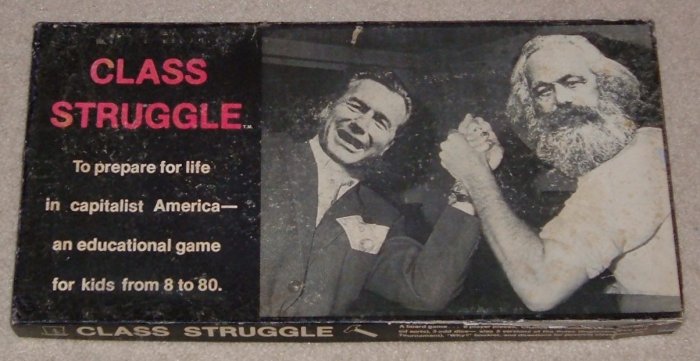
Talking about board games… here’s a particularly amusing one. It was a business venture by an American Marxist professor of politics named Bertell Ollman.