Honestly, I keep it all pretty simple with what I eat and it seems to work out well enough.
I’m more concerned about calories than the miligrams of sodium, fat, and proteins I’m taking. It’s all about the calories.
Honestly, I keep it all pretty simple with what I eat and it seems to work out well enough.
I’m more concerned about calories than the miligrams of sodium, fat, and proteins I’m taking. It’s all about the calories.
So how much does it cost to get a good personal trainer? Just to get the form on my lifts correct? I’m currently suffering major tendon damage in my upper back, cause unknown (really), but when I get back I want to have better form.
@ filc
Well that’s good they start off slow, concentrate on form. Form’s most important. Hands-on coaching for anything especially Olympic lifts is a big plus. Most people can’t afford it.
There’s no risk in lifting, including Olympic-type lifts (properly done) when compared to doing nothing at all as atrophy sets in raising risk of injury from bending over to pick up groceries or other everday activities. Using machines (if not prescriped by a PT) is more risky than free weights too.
Running or jogging I don’t do. 10-50 yard spints are good with adequate rest in between. Can’t maintain the intensity 50-200 yards, more like fast running, but still good. Swimming’s good, but for cardio I prefer circuits with weights like this (I use much less weight):
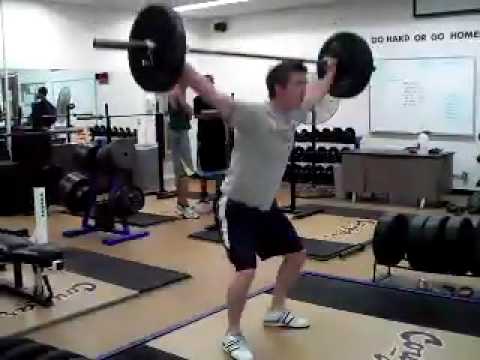
And Tabata Protocal or HIT whatever, basically 20:10 - 20 sec. work whatever like Squat Rows, 10 sec. rest for 8 sets; 4 min. total. Also KB’s are great for Tabata. I also like using TRX suspension trainer for lots of stuff.
Right so I guess my point is, there is no risk in doing crossfit (Properly done).
The video you linked is extreeeeemely similar to crossfit. In fact just not knowing any better I would have assumed thats what he was doing.
Tabata’s are frequently used as well. I did a tabata last night after my WOD, doing situps.
Cost you 30 bucks for the book:
http://aasgaardco.com/store/store.php?crn=199&rn=312&action=show_detail
And/or $25 for the DVD:
http://aasgaardco.com/store/store.php?crn=210
Both are excellent. Book has much more.
EDIT: BTW, where will you find a COMPETENT trainer? The training world is as messed up as the economics world. Most are “Keynesians”, with Rippetoe being one of the few “Austrians”. Rest assured that the ones at Bally’s and places like that are literally worse than useless.
A good rule of thumb is if you dont see them actually squatting say 300 to parallel and deadlifting say 400 then they won’t know anything. Which means finding a powerlifting coach. [I don’t know anything about olympic lifting guys].
I don’t really feel like debating xahrx or parsing that long post, but I noticed one important mistake (“olive oil is magical” or something). Read here.
There are some dangerous ideas out there.
One such idea is that saturated fat is dangerous. That is version 2.0 of Ancel Keys Lipid Hypothesis. (Version 1.0 was that dietary cholesterol was dangerous).
Now what if we take an often helpful idea like low carbohydrate eating and combine it with this dangerous idea?
Maybe we get an even more dangerous idea. An idea like, limiting both carbohydrate and saturated fat simultaneously.
You can only eat so much protein, so a low carb diet is a high fat diet. If we try to eat low carb and limit saturated fat, or animal products, because there is something dangerous about “red meat” or whatever, we are doing something incoherent.
If we are to eat more fats on low carb while limiting animals, guess what?
We have just created a diet that maximizes total PUFA consumption.
Any diet, to the degree it is low carb and says to limit sat fat to only 10%, will necessarily be a HIGH PUFA DIET.
It’s simple math.
You have to eat something, and if you are foolish enough to limit carbs in general, and animal fats simultaneously, and even if you eat protein to the point of nausea, guess what’s left?
Plant fat.
What predominates in plant fat?
Linoleic acid.
I don’t care if you get it all from olive, canola oil and furniture finish (flaxseed oil), you cannot eat low carb and low SFA without eating more than twice as much PUFA as is desirable.
Even if you ate 60% of total calories as olive oil, you are already at about 6% of kcal as PUFA, not counting any fish oil you would need to take to get a reasonable 6:3 balance. This, in my opinion, is more pro-inflammatory and very likely MORE atherogenic than a high carb diet without excess fructose and wheat, and may even result in more hyperglycemia and hyperinsulinemia via leaky gut/liver and hypothalamic inflammation.
You have done this not-so-clever maneuver by replacing carbohydrate, a class of macronutrient that contains two of the neolithic agents (wheat and fructose), with PUFAs, which is a subclass of fat that in excess quantity is a neolithic agent.
I cannot emphasize it enough. Avoidance of excess linoleic acid is far more important than being “low carb”.
It may, in fact, be the lead horseman in the post-industrial diet right now.
You can’t eat healthy in an evolutionarily concordant manner if you cling to the lipid hypothesis.
SAT FAT or PUFA - only one is a neolithic agent. You already know which one.
These
[quotes]
(http://startingstrength.wikia.com/wiki/Wit_and_Wisdom_of_Mark_Rippetoe) from Rippetoe are pretty funny. A weightlifting book that mentions division of labor on the first page? I was wondering why he’s “Austrian”.
And the paper you posted showed that an athlete’s diet can help you get physically fit.
That article stated the following:
I meant that he knows what what. As opposed to most trainers who have it all backwards. So that he is the Austrian of lifting, and they are the Keynesians.
It would also be consistent to believe that insulin simply lowered test output, though I agree it is inconclusive.
What I’m afraid of is not what this paper is focused on, namely micromanaging pre-post workout carbs, but perpetually elevated insulin levels. Say, from evenly spacing your low GI carbohydrates out all day. At the very very least this will make it impossible to drop fat. But to confirm my fear that test will be chronically lowered, as I see often bantered around, we’d need to do/find a study where someone was put on this kind of diet. I couldn’t find one.
Anyway, whoever is following this thread has the raw information and can make up their own minds.
It seems kind of pointless to ingest carbs after a tension workout. If you’re doing a volume/pump workout, your glycogen stores will be depleted and so, depending on your P ratio, a larger % of the carbs will go to refilling those stores. But if you’ve done a tension/strength workout, it might not be of much benefit.
Yeah I get it now Dave. Those quotes really made me chuckle.
I was driving home the other night, listening to the radio, and the guy filling in for Art Bell on Coast to Coast AM was talking to some other guy about Nazis, UFOs, the Kennedy Assassination, time travel, and George Bush, and how it all relates to OneWorldGovernment. This, of course, made me think about barbell training…
…
On the possibility of a failure to deadlift resulting in stroke:
Deadlifts that are too heavy to pull generally don’t take very long; the bar just kinda lays there. So if trying to move immovable objects was dangerous from the standpoint of stroke, the history of the human race would be littered with stupid people’s corpses.
…
A Rip Anecdote:
My favorite happens to be the tale on supplementary equipment. A man insisted on wearing straps for exercises he probably could have gotten away without having worn them. Rip, in classic Rip fashion, decided to start wearing straps to do all sorts of things, including opening doors and going to the bathroom (he would wear one on his “holding” hand, gotta have wrist support for that) until the guy stopped wearing straps completely.
Trust me, I can be way more antagonistic. And ‘help’ in this case would be getting some of the people here clued into reality as opposed to the mythical world they live in where human bodies are magical space time warp machines that can violate the laws of physics.
I don’t much care. I’ve already tried to postively explain that human bodies can’t violate the laws of physics as politely as I can without wondering if snowflake is actually insane or otherwise mentally ill. And the rejection of the energy balance equation is on a level with that; it is a rejection of reality. This is not a debatable point, unless of course you want to rewrite every physics text known to man and take on Einstein, et al. Otherwise it’s time to rethink the human digestive system / black hole alternate universe theory.
All hormones do is allocate energy when it comes in, they can’t create it or magically make it go away. So it doesn’t matter how high or low your insulin or testosterone or any other hormone is; calorie excess will lead to stored energy which is an increase in mass, calorie deficit will lead to burned energy in the form of lost mass. The adjustments your body can make via shifts in composition and resting metabolism are limited. As I said before insulin will not all of sudden make a 4000kCal a day person be able to maintain their mass at 15kCal. In the adjustments controlled by genetics, it’s almost fully out of your control no matter what you eat. Which means the end result, as physics would predict, is energy in vs energy out.
If I had said something nearly as insane, they would have, and for good reason.
Years of training people, an unfinished degree in kinesiology and a partially finished CSCS cert from the NSCA that I’m thinking of testing for. Otherwise, that’s it, and all I need because just as the laws of thermodynamics don’t give insulim a mulligan, neither does my possession or lack of certification change that fact.
Controlling emotions is for Vulcans. I’m a human being with a brain and someone is telling me, and others, to disregard the laws of physics and how they apply to the human body. Perhaps your lack of education in this area is hindering your ability to realize that if you took what he’s saying and applied it to another area of physics, that little pause Willy Coyote used to take advantage of before falling to hold up a sign communicating his feelings to the audience is actually something you can count on having in reality. Because gravity has wiggle room, so go ahead, walk off that cliff…
The timed nature of some of the workouts leads some people to sacrifice form for speed, leading to danger. Check the wiki on CrossFit, there’s some criticisms referenced in there. It’s not inherently bad, some of the workouts are ill thought out given the target audience.
Then you correct them, as opposed to let them continue to believe in BS.
This is not a cop out, this is reality. And as someone who has actually done this before, I’ll take my opinion over yours. The only thing you can determine from a simple “I want to lose slabs of fat” statement is that a person is eating way more than they should. Without assessing their individual circumstances, not the least of which is their current health condition, recommending a diet is premature. Get off of insulin for God’s sake, what about his schedule of all things? Availability of food during the day and what types? There’s a myriad of questions and individual circumstances that could limit and/or recommend a diet for him to follow that would serously impact his chances of success. Telling someone to go low carb when they’re only realistic choice of food around doesn’t allow that isn’t smart.
So say low carb activists. Reality is a bit different, especially when people aren’t in an environment friendly to sucking down nothing but protein and fat. I’ve worked with many a person who couldn’t maintain their daily activity levels on a low carb diet. It’s amazing what a little oatmeal can accomplish.
Yes, and I’ve been over why your rejection of the laws of physics ain’t exactly sound advice.
Or perhaps you could also recommend a multi vit/mineral supp while your at it, and maybe some fiber so his ass doesn’t clog like someone rammed a cork in it? Not everyone ‘adjusts’ to the diet so easily, not in the least because the lethargy continues and/or the availability of low carb food is problematic. And, also, not in the least because people like you lead them to believe that calories don’t matter, so in some cases they do in fact make up for their carb loss with enough fat and protein to maintain and even up their calorie intake, in which case they actually stay the same or gain weight after the initial loss of water weight. And, if you actually gave a damn about the person in question you’d take the time to find out what their circumstances are before getting involved in recommending diets. The first I always did was make people go for a physical if they haven’t already. Because the last thing I needed was some putz stroking out on me while trying to pinch a loaf because his new low carb diet lead to constipation because his fiber intake dropped like a rock.
Basic and wrong. Eating less is the overall goal. Low carb is one way among many to accomplish that goal.
Which means you need to eat even less. Going low carb can help a little with this, it can’t rewrite the laws of physics such that you can maintain a 400lb behemoth on 1200kCal a day. For all you know this guy is sucking down 4 or 5 Krispy Kremes a day. Now, while going ‘low carb’ would technically eliminate that, I’d say if this were the case his problems are deeper and simply cutting the donuts out and leaving other carbs would be simpler, enough to make a massive difference, and perhaps easier to maintain than cutting almost all carbs. But, since we know jack about his circumstances…
I never said hormones are hidden, I said all they do is affect variables in the equation. Your the one with the ‘calories don’t matter philosophy’, not me.
My preconceptions are the laws of physics. Yours are that calories don’t matter, Taubes is in perfect agreement with McDonald, and insulin isn’t just a hormone, it’s amagic elf that can add or remove fat at will and cast it into another dimension. And again we have magic in GOMAD. You know why people gain weight on a gallon of milk a day? Because they’re drinking a gallon of milk a day. A gallon of whole milk would be around 2300 kCal, a gallon of skim would be around 1400 kCal. That’s why people put weight on fairly easily with GOMAD, because they’re taking in 2/3 to a full day’s worth of calories on top of their normal diet. If there’s one thing people are universally shitty at when it comes to diet, it’s estimating calorie intake properly. Fat people think they’re eating very little, people who want to gain weight swear they’re eating tons. Funny, how almost every successful strategy is just a convoluted way to either make them eat significantly less or more without having to count the details in terms of kCal, like by cutting carbs (fully 1/4 to 1/2 of modern Americans’ calorie intake) or adding a gallon of milk respectively.
Mistake correlation with causation much? Low carb diets can be and often are effective. That doesn’t mean the dipshit espousing them, Taubes, has a clue as to how or why they are effective. And when he has made statements such as “Calories don’t matter,” well all I can say at this point is if you’re willing to accept that statement uncritically, I have a few bridges to sell you.
Where do they go instead then? Once more, it’s in your blood, hence energy in. And her’s crux; if you’re still in a calorie surplus, they’re going to go straight to your ass. If you’re in a calorie deficit, you’ll burn them. And if you’re on a low carb diet, your body will have some preference for burning them over muscle tissue. But you still didn’t accomplish magic. All you did was engage in a diet strategy that manipulated the variables in the energy equation to help you preferentially burn stored fat as a fuel source IF AND ONLY IF you stay in a calorie deficit. Meaning: calories DO matter…
In my experience it can help appetite, but I’ve also seen people throw down metric assloads of unprocessed food to no avail. Because processed or unprocessed, excess calories are excess calories. If you want to you can lose weight eating donuts as long as you keep the overall calories below maintenance. You’ll probably be screwed health-wise for other reasons, but you’ll be skinny, if not healthy.
Some of the best advice, ever. Keep it simple. Often people can make pretty startling changes to their bodies with one or more simple changes to their diet regimen. One guy I trained a long time ago was all over the place in terms of work, and ate a crap load of fast food. Just skipping the fries saved him about a thousand calories a day. Next knock the cheese off the cheeseburger. Next switch your coke to an unsweetened tea. Etc., etc., etc., etc. And wowzer, losing weight without cutting carbs out. Must be magic.
Get someone with a cert worth a damn by an org that publishes a journal on a regular basis. Otherwise you’re going hit or miss with the weekend certification crowd. What lifts are you doing? My routine is simple:
Day 1
Squat 5X5
Bench 1X5
Row 1X5
Day 2
Deadlift 5X5
Clean and Press 5X5
Lat Pull Downs 5X5
Day 3
Squat 1X5
Bench 5X5
Row 5X5
Talk about reading comprehension difficulties…
The point about olive oil was sarcasm. Advocates of the mediteranean diet often bring up it’s high olive oil content as the reason for it’s success. And that’s just as much BS as Taubes et al. claiming low carbs are the key. All successful diets have one common denominator: calorie control. So once more, in complete oppossition of wha Taubes preaches, calories do matter.
PS, I don’t mean to be an asshole. It is, I admit, more than a little bit in my nature though.
Alright folks, anymore meta-discussion about who’s insane and who’s an asshole needs to be “taken outside” to the Member Issues foum.
Yeah I tried a 5x5 routine. Was a bit more exercises than this. In retrospect my workouts probably ran a little too long (90 minutes) but I was new, and everything works for beginners.
What do you think of HST programs? I’m planning on using one after I recover from my tendinosis. Maybe. Low volume is nice, and the strategic deconditioning has been pretty much forced on me.
Oh, and i forgot. Smaller muscles like the rear delts don’t seem to be worked by any of the major lifts (maybe I am mistaken). Your workout routine, as well as many others, seem to neglect these kinds of muscles. Is there a consequence to this?
The posterior deltoids contribute to every pull just like the anterior deltoids contribute to every push. His routine included two pulls: (1) rows and (2) lateral pull downs. They also are prime movers in keeping the bar close to you in deadlifts. So his routine doesn’t neglect them.
Thanks. I checked and you’re right. They’re listed under synergists at exrx.net’s db.
You are mistaken. The rear delts are worked by bent-over rows and deadlifts (the top portion of the pull) as a secondary muscle.
EDIT: Looks like I was late replying. Sorry.
What do you guys think of the different routines here? I’ve only been lifting sporadically, and I know now that when I used to more regularly (quite a while ago) I was doing lots of stuff wrong. I’m confused about this post too. For one thing, I feel like my bar weights more like 30 pounds, but I guess I could try to weigh it on a body scale.
If I do something like this…
For example (weight x reps x sets)
Squat
45 x 5 x 2
95 x 5 x 1
135 x 3 x 1
185 x 2 x 1
225 x 5 x 3 <–Work SetsBench Press
45 x 5 x 2
85 x 5 x 1
125 x 3 x 1
155 x 2 x 1
175 x 5 x 3 <–Work SetsDeadlift
135 x 5 x 2
185 x 5 x 1
225 x 3 x 1
275 x 2 x 1
315 x 5 x 1 <–Work SetPress
45 x 5 x 2
75 x 5 x 1
95 x 3 x 1
115 x 2 x 1
135 x 5 x 3 <–Work SetsPower Clean
45 x 5 x 2
75 x 5 x 1
95 x 3 x 1
115 x 2 x 1
135 x 5 x 3<–Work Sets
What order am I doing the Work Sets in? Is it all one exercise at a time or rotating? Probably this is a stupid question, but I have no clue what I am doing. Also, I am a weakling, so I guess I should try first today to find what weight I can do 5 reps, but not 6 at then try to proportionally scale down the warmup weights?
You piss and shit calories. That’s why it’s generally recommended that you consume less than 30g of protein in a meal, since any additional protein will be wasted.