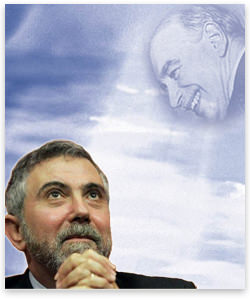
I realized this piece wasn’t quite complete, because it didn’t really lay out Krugman’s fiscal stimulus advocacy, so I added more. In the additional text, I really try to drive home how complete a Keynesian he is with reference to an uber-Keynesian thing he wrote which I just recently found. The new content (below) is in the second half of the article:
According to Krugman’s assessment of the current state of the economy, monetary stimulus has done pretty much all it could do (thank God for that!), and we are now coming upon a Keynesian “liquidity trap”, which, as he characterizes it, is “a situation in which conventional monetary policy loses all traction. When short-term interest rates are close to zero…” What does Keynesian doctrine prescribe in such situations? It calls for massive fiscal stimulus: government spending intended to fill the hole in aggregate demand that underconsumption has left. This is how Krugman himself characterized it in February, according to a University of Pennsylvaniae-newsletter:
With monetary policy a non-starter, “That leaves nothing but government spending” to prime the pump, Krugman said. “That’s pure Keynes.”
Krugman estimated that the “spending hole” in the U.S. economy is $2.9 trillion dollars. Because of that, he complained, Obama’s stimulus package should be over three times its present size!
“It’s helpful, but it does not cover even one-third of the gap, so it’s disappointing,” Krugman said. Out of the $789 billion approved, only about $600 billion adds real stimulus, in Krugman’s opinion. “So you’ve only got $600 billion to fill a $2.9 trillion hole.”
The only hole that needs filling is the one in Krugman’s understanding. As we have already seen, the notion that stimulus does any good by moving money out of mattresses and bank vaults is fallacious. And as Ludvig von Mises wrote:
a government can spend or invest only what it takes away from its citizens and that its additional spending and investment curtails the citizens’ spending and investment to the full extent of it quantity.
This leads to the question of whether government spending and investment does more good than private spending and investment. Sound economics answers this question with a resounding “no”; yet we don’t even need to consider the question in regards to Krugman’s Keynesianism. This is because ultimately Keynesian fiscal stimulus is not even about the goods and services produced by the additional spending (infrastructure, welfare, etc). You see, the fiscal stimulus might as well be literally filling holes, as well as figuratively, since according to Keynes’ ridiculous understanding of how an economy works, it doesn’t matter what the government spends money on. Even digging up holes just to refill them would qualify as beneficial stimulus. You might think that this must not be literally true: “Keynes may have been wrong on some things, but no economist as prominent as he was would believe something so foolish!” Read the man’s words for yourself:
If the Treasury were to fill old bottles with banknotes, bury them at suitable depths in disused coal mines which are then filled up to the surface with town rubbish, and leave it to private enterprise on well-tried principles of laissez-faire to dig the notes up again (the right to do so being obtained, of course, by tendering for leases of the note-bearing territory), there need be no more unemployment and, with the help of the repercussions, the real income of the community, and its capital wealth also, would probably become a good deal greater than it actually is. It would, indeed, be more sensible to build houses and the like; but if there are political and practical difficulties in the way of this, the above would be better than nothing.
The above passage was not some off-hand note written to a colleague in a fit of academic speculation. It was written in his chief contribution to economics, upon which his reputation rests: The General Theory of Employment, Interest, and Money. I don’t care how prominent, credentialed, or “accomplished” an economist is. If he says that burying cash in the ground can be a boon to society, then he should be immediately dismissed from public and academic discourse.
The simple fact that Krugman regards such a fellow as an exemplar of economic scholarship would be highly telling by itself. “Okay,” you might think, “Keynes was a bit extreme. But Krugman himself wouldn’t go so far as to believe something like that.”
Wrong again. In April, Krugman actually bemoaned the fact that Obama’s stimulus projects were under budget. He actually wants government stimulus spending to be inefficient, simply because that would mean more spending! And the title of the piece in which he made this complaint? “Time for Bottles in Coal Mines.”
I told you he’s hard-core.
This brings me to a side point I’d like to make. One might think that in writing in such, let’s say “direct”, language, I’m needlessly vilifying both Keynes and Krugman. I certainly wouldn’t write this way about just anyone I happened to disagree with. But, as it should now be evident, Keynesians are special. Their economic doctrines are sofallacious, and their policies are so destructive that, for the sake of truth and humanity, one cannot be too forthright in denouncing them.
Conclusion
Paul Krugman wants to be our savior. Like a savior, he would perform a miracle for us: that of turning consumption into wealth. But who would accept a messiah with such a “John the Baptist” harbinger as John Maynard Keynes, who proclaimed that credit expansion could perform the “miracle… of turning a stone into bread”? In any case Krugman is a curious kind of savior: one more interested in seeming brilliant than in actually helping people. In the Newsweek profile, he said of his policy advocacy:
“I am not overflowing with human compassion. It’s more of an intellectual thing.”
Indeed, there is something almost calculated in the unblinking wrong-headedness of both Keynes and Krugman. You’re not likely to get much notoreity as a public intellectual advocating common sense. What’s more, you can’t express common sense in calculus, which is actually useful in the natural sciences, but which only provides a fallacious veil of obscurity and elitism over the social sciences. In other words, sound economics just doesn’t make for a cool-looking blackboard. And without a cool-looking blackboard, how would Paul Krugman be the “quant nerd saving civilization”? John Maynard Keynes reveled in the ballyhoo over his bold “new economics”, even though his doctrines were merely age-old inflationist fallacies dressed up in mathematical jargon. When confronted with the fact that his solutions would never work in the long run, he would dismissively say, “In the long run, we’re all dead.” Keynes’ short run was long enough for him to live the rest of his life as the scholarly savior who turned economic stone into bread. But as Murray Rothbard used to say, now Keynes is dead, and we’re all stuck living in his “long run” (See Rothbard’s essay on Keynes the Man.) For our own sake, let’s hope Paul Krugman’s tenure as an influential economist, as well as the current renascence of Keynes he represents, is a mercifully short-run affair.