Salt water would never emerge as money because people would never have a reason to exchange goods for it in the first place since they could just go and get their own.
@Vive
I was going to disagree with you here, but after thinking about it some more…nevermind. Keep up the good work!
“Value” is a verb. It is only used in its noun form for convenience of expression or to hide agency. If confusion results from the noun form, just taboo it. Then it is impossible to say meaningless things like, “Part of the value inheres in the object.”
False.
Look up “Masochism”.
Or in modified Euthyphro’s Dilemma, are the characteristics of money what they are because we value those characteristics, or do we value those characteristics because they make for better money?
Hen and egg question?
The criteria we have for good money are the results of our judgements, which is basically stemming from our experience and logic and of course information exchanges we do have with other people. So it’s kind of both, we agree that something is money, because it has characteristics we value as traits for good money.
A two-line sublimation of my point. Thanks AJ.
No, unless it’s an artificial money. (Fiat, cryptocurrency.)
Yes.
That’s a false dilemma; One does not exclude the other.
We value money because it’s useful to us as a medium of exchange. It’s useful as a medium of exchange because of its characteristics (Which are either artificial or natural.)
Voluntary exchanges of the item in question is what gives us the average value among a society (market value.)
Any item in a free market will gravitate to what the society percieves as its most valuable use. In the case of fiat money, the perception must be artificially altered by means described in the “Regression Theorem”.
I don’t think so.
Clayton -
The fact that “value” is used as a noun, for whatever reason, is proof that it isn’t strictly a verb. Trying to say that its really a verb, but not really a noun is nonsense, and it certainly doesn’t falsify any claims about value lying outside of the self.
What I’m interested in, for a claim like this, is how it squares with the general attitude of subjectivism.
I guess here’s where I’m going with all of this. The subjective-objective dichotomy doesn’t leave room for a middle ground where the relationship between the self and the external exists. Essentially, the way the dichotomy ends up is: Objectivism (completely minde-independent) vs. Subjectivism (everything else). But the difference between a hallucination and an experience, or a dream and a value judgement is significant enough to justify distinction. If you can’t value something as money because that thing can’t be money (for whatever reason), then the external is exerting a real force on the mind.
I’m really drawn to Rand’s IOS dichotomy for this reason. She makes the distinction between the inherent, the objective, and the subjective (the objective is the name she gave to the middle ground, while the inherent is the name she gave to the external, mind-independent). When Rand said value was objective, she didn’t mean that values were inherent traits residing in objects; rather, she mean’t that valuation was not fully subjective – it was valuation of an object, and effected by facts of reality.
And like I said, I don’t think this undermines value subjectivism as an economic theory. What it does undermine, is the idea that we can’t talk about values as being better or worse, good and bad. Since they are towards real objects/goals with real characteristics, and since those real characteristics are effected by actual laws of reality, then some values are more in line with reality than others. Mostly, this is aimed at the usual retort that “values are subjective.” You shouldn’t value sea water as a medium of exchange – and the STV doesn’t change this.
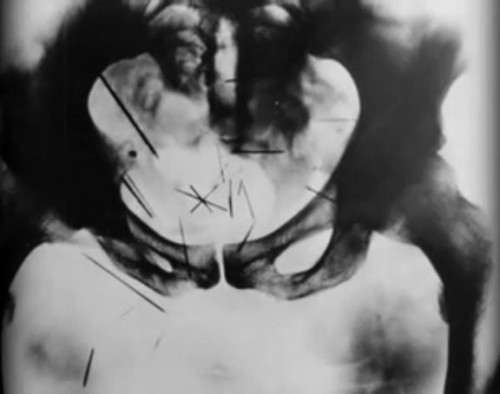
See those black lines? Those are sewing needles. Self inflicted without any coercian.
As a society, you might say that people wont choose to drink battery acid, but to say categorically that no one anywhere would ever do it through their own volition is just wrong.
@Seraiah: You’re making my point for me… the evidence you’ve given that you imagine supports your argument is an X-ray… obviously taken at a hospital or doctor’s office. In other words, this is clearly pathological behavior. No one can deny that the intentional self-infliction of pain is one means that people use in the pursuit of satisfaction (the ultimate/final end). The example I gave (drinking battery acid) is illustrative of the kind of behavior that can only be pathological but never a means to the satisfaction of any human end, not even masochism, not even euthanasia, not even for renown (because the individual won’t be around to reap the benefits, he cannot be being satisfied by them). It is in the same category of pathological behavior as self-immolation, hara-kiri or any kind of protest-suicide/notoriety-suicide.
You can imagine a hostage situation where you must perform a sadistic act specified by the hostage-taker in order to redeem someone or something you care about more than your own life and freedom from excruciating, long-term pain. But this kind of behavior is not action at all, any more than when a high school bully slaps you with your own hand. It is what Mises called “autistic exchange”, that is, the situation where you see what appears to be an “exchange” occurring but where, in fact, the will/ends of only one of the parties is being expressed. There is no mutuality, hence, there is no exchange, hence, there is no possibility of action on the part of the dominated party.
Clayton -
You’re arguing that the person was dominated by his own mind and therefore what he did wasn’t an “action”? Some people’s subjective values can be completely apart from the mainstream, there’s nothing mysterious going on here.
Drinking battery acid can be the means to the satisfaction of a human end. Namely; Masochism.
I could not possibly disagree more.
Suicide and self-harm can be purposeful human actions, even if they are generally seen as bad things destroying value. And of course one can also regret such bad action later. That doesn’t impair on Praxeologie as a method, yet someone may make plead for paternalistic intervention in the light of such things.
Let me crank up the contrast to the maximum to make the point.
Imagine that everyone, once a year, must (and does) go to an audit. At this audit, they must choose between two options: a) Nothing (go out the door and live ordinary life) and b) guaranteed, life-long, excruciating, way-beyond-any-threshold-you-can-handle-but-still-not-black-out pain. Who will choose option b? Will anyone, ever, in the history of all humanity choose option b? Of course not.
And if some freak did choose option b, we could safely categorize such an individual as mentally ill. There’s something wrong - in a medical/biological/psychological sense - with anyone who chooses option b. In other words, to avoid all this silly debate about people who stick needles where the sun doesn’t shine, we can just make it a tautology - anyone who knowingly chooses suffering for its own sake - not even to serve God, not even for notoriety, not for any other purpose but simply to suffer - is unwell. That is what we mean by pathological behavior.
Euthanasia (as distinct from, say, protest-suicide or other kinds of suicide) is a form of human action, in that the individual is choosing to forego the quantity of his life in preference for quality. Epicurus has explained at length why such a decision is rational. But other kinds of suicide are pathological. They are often dramatic precisely because the individual is not in his right state of mind, he is not making a rational choice regarding the maintenance and cultivation of his own homeostasis. He is exhibiting behavior that is evidence of mental disease, like the individual in a high fever who lashes about wildly and utters delusions.
Clayton -
Mika, the challenge would be to define the word “value” without reference to an agent.
Would I be correct in assuming that you want to categorically remove people who want pain for its own sake from everyone else for the purpose of espousing that “do what thou wilt” should be the whole of the law? The reason I’m inclined to do so is because of your other thread talking about a sort of secular church.
The contradiction would be glaring if you included them, aye?
Thing is, there’s no reason to believe that Albert Fish was any less in control of his actions than you or I. He was a human acting on his desires. Often people need to restrain themselves, and this is not at all a bad thing. People that cannot control their desires are killed or indefinately detained because the rest of society doesn’t want to live with them.
Perhaps I’ve assumed to much, why do you think the distinction is important, and at what point does a person go from being extremely masochistic to sub-human (Or some other word you want to use…)?
Seraiah,
I don’t think that is what Clayton is trying to say. Masochists like pain because it brings them pleasure (in some capacity). It brings them satisfaction. Just like how a priest taking a vow of celibacy brings him satisfaction (I wonder how well they all follow it, but that’s something else). We can disagree with their choices, but we can see that these choices lead to their satisfaction.
I think what Clayton is saying, is that when someone chooses pain and it does not bring them satisfaction, then there is something wrong them.
Money has to be scarce, thus excluding salt water and sand from your scenario.
I just clicked this thread and don’t really want to read back…
If anyone is using this quote,
…to stand up for “freedom” they should know that Crowley’s “Book of the Law” is a bible type book. It doesn’t mean “freedom.” In fact, George H.W. Bush’s mom was a mistress of Crowley. Crowley was the spiritual guru of FDR’s Secretary of Treasury. FDR’s Treasury Sec. designed the dollar bill. Those people are so far from freedom it hurts.
Right - when someone chooses pain for no reason but to suffer, there is something wrong with them. People choose to undergo all sorts of pains - the pain of heart surgery, the pain of dental work, the pain of leaving family for a career, and so on. But all of these pains have a purpose which, on balance, the individual has calculated is worth it. This is a reflection of the nature of any acting being - the capacity to trade off short-run against long-run consequences. Humans are unique among the animals in the time range over which we are able to trade off consequences.
The extremist Jesuit who self-flaggelates as a form of penance does so because he believes that this is bringing him closer to God, which is the most satisfying thing of all to him. The masochist who has someone inflict neurological or other kinds of pain on him does so because - by definition - he derives sexual satisfaction from this or derives satisfaction from giving sexual satisfaction to another who enjoys the infliction of pain. None of these are examples of choosing pain for its own sake. We might miscalculate and choose a course of action that is painful but does not lead to our own satisfaction (as did the masochist whose x-ray is featured above), but then it is the recognition that we have made a mistake - not the neurological pain - that is the criterion for determining that we have failed to attain our end, that is, our satisfaction.
When you push it further to the extreme, you get into the realm of psychosis, that is, pathological behavior. I have a relative who inflicted serious bodily harm on himself on the basis of a passage of Scripture he read. It must have been extremely painful, painful beyond words. He is paranoid schizophrenic, that is, there is something wrong with his mind. There is something in his mind/brain that is manifestly set against its intended function (a pathology). The proper dividing line between pathological behavior and miscalculation is the presence of delusion, whether delusion regarding means (“inflicting grave bodily injury on myself will bring me satisfaction”) or delusion regarding ends (“My end is not my own satisfaction, it is something else.”) People who miscalculate aren’t deluded, they are either ignorant, not intelligent enough or are suffering from a crisis of self-worth that prevents them from correctly calculating the proper means to achieve their final end or identify what their final end actually is (satisfaction).
Clayton -