He wrote a book. I use the word ‘wrote’ loosely. It is mostly about him (which is a red flag for me) and it appears to have a lot of things in there that say “John McCain isn’t an ‘imperialist’.” My ass he isn’t. Surely, Rand would notice the blatant imperialism of McCain, Graham, and Lieberman…the Georgia thing (south ossetia), Israel, Iran, etc. Things do not look good.
Rand is going to water down the message. We’ll go from ‘End the FED’ to ‘let me install the light bulbs I want’. And it sends shivers down my spine when I hear people (or see typed) things like, “But, that is a step in the direction of freedom!” As if giving up on the central banking cartel and the military industrial complex for raw milk and toilet bowl water usage freedom is somehow comparable.
I’m sure you believe this to be true, but I’ve yet to hear any arguments proving it in principle. The state is necerssarily a coercer, that much is true, that is what makes it a state, however the NAP offers elucidation of two types of coercion: ethical responsive-coercion and unethical aggressive-coercion. You simply decide that a state can only use aggression or must inevitably use aggression when you say things like this, and clearly it would be possibly for a state to only use responsive-coercion, thus a state is not necessarily an aggressor just because it has public sanction to use coercion. Inasmuch as it uses that coercion purely for rights protection and the like, it does a good, ethical thing and is not an aggressor. I’ve never heard a principled argument explain why a state must inevitably use aggression, only statements to that effect as above.
You’re saying the state cannot avoid using aggression, gotcha. That’s slightly more refined that saying ‘only’ as I had before, meaning you admit the possibility of the state using ethical forms of aggression, but you maintain that the state eventually ‘must’ aggress, for unspecified reasons. Is that right? I’d love to hear a principled argument why you consider that to be the case. I’ve never seen one. What is it that precipitates this eventual aggression?
What does it mean to call it the essence of the state? That’s a non-statement that really says nothing. Does it mean that without systematic aggression you couldn’t call a group of people a state? Even though they had public sanction on the use of force and were using it to protect basic rights? That would be a bit silly I think.
Would that mean that you wouldn’t call an autarchist republic a state? If a “non-state” were using responsive-coercion only and then one day used aggression, do they suddenly become a state in your eyes? Aren’t you simply defining a state as an aggressor outright?
Typo. Meant to write ‘the NAP’; no I do not claim some silly multitude of NAPs. I wrote it to show that we can derive moral uses of force from principle. If a state could hold purely to reponsive-coercion they would never be an aggressor and that would be a very good thing. The question then is if it is possible for such a state to exist without aggressing.
But then, there’s never been a state in actuality like an autarchist republic, so it’s difficult for me to accept historical arguments in this state of affairs. In a society where the socialist-ethic of majority-rule sanctions forcing laws on people, I’ll accept readily that such a state is in fact innately aggressive, because majority-rule is innately aggressive. I don’t know why you never brought that up before actually because it’s a damn good point But an autarchist republic rejects majority rule. It may then not be innately aggressive. Yet it is still a state. So it seems to violate your claim that a state is innately aggressive.
Which is to say, you assume all states must be X, but there are other forms of states that you may have not considered which aren’t X. If you said all states in history are X and thereby innately aggressive, I would have to agree immediately, but that would still say nothing about future states.
The state need neither be a monopoly nor use aggression to maintain that. So, once again you criticize the state for attributes that are not necessarily existent and then assume that all states must simply be that way.
An autarchist republic rejects citizen-capture within a jurisdiction based on a commitment to voluntaryism, so it does not monopolize people but freely allows them to enter voluntarily and leave by their own choice.
There need not be, and indeed should not be. But, as I’ve explained before, the nature of law is such that it must have a territorial monopoly within its jurisdiction–you can’t have competing governments in the same jurisdictional, law simply doesn’t work that way. But it is desirable to allow experimentation. Thus the way you circumvent monopoly is by allowing people to move between jurisdictions freely, via micro-secession. The competition comes from the ability to move to abandon a jurisdiction and join or start another.
As for actual physical protection of basic rights, in case you were referring to police, I don’t think there should be a monopoly on physical enforcement at all. Police are not essential to a state’s operation, and can be provided privately.
In lieu of actual evidence, at the very least a principled reasoning through. Seems to me that no society has long existed of any considerable size without a sanctioned use of force to combat aggression in society. Even the wild west had the sheriff, about as minimal a government as you can get.
The idea of no sanctioned use of force immediately runs into a couple problems. The problem of slavery, 3rd party aggression, and abuse, etc. In such societies, with no impersonal force whose goal is to protect basic rights of everyone without any personal involvement in the situation, you would have the strong man able to hold slaves quite literally. That is untenable. And you’d eventually find the strong man acting as if he were government.
There’s a lot of assumptions built in there. You assume people don’t have word of what’s happening. Why then would they be attacked or simply attack themselves? If they don’t know what’s going on and attack an army, it’s ethical to defend yourself–he’s being foolish. If the soldiers attack him though he’s not attacking, then they should be prosecuted for murder.
In any case, I’m not going to ever give sanction to an aggression.
Where I and the anarchs differ is in what I call the essential functions of the state which are why societies around the world historically have setup states. These are the necessary functions a society asks any state to fulfill, though most states go well beyond these essentials into unessentials.
Have you read it? It doesn’t seem like a philosophical book like any of Ron’s. I’m interested to know if Rand has read Mises and Rothbard. I’m not going to judge him on the way he presents himself to the mainstream. If I had done that with Ron Paul, I never would have realised he is a voluntarist.
Also what did Rand say about Ron’s Liberty Defined?
I think it’s possible Rand is just “getting warmed up” by bringing up mundane examples of government intrusions. I believe he may become more radical in his rhetoric over time.
Good article. It is obvious from his body language that he did “hold his nose and make a deal” by endorsing Romney. I think it’s quite likely he is “acting as a double agent” (in the words in the article), although I wouldn’t put it like that, any more than I would say that Ron is acting as a double agent (by posing as a Constitutionalist, while being a voluntarist). It’s a means to get a foot in the door. Whether it’s worth getting Rand through the door depends, for me, on how dedicated he is to the liberty message. Does he understand the depth of the movement he has become a part of?
I simply won’t assume that people who have volunteered for a ‘righeous’ cause are somehow angels that have the ability to surgically remove evildoers from the world. When reality hits and the invaders end up massacring thousands of innocents, who is going to prosecute them for murder?
They’d rightly be prosecuted in the jurisdiction in which they committed the crime, or barring that their home territory.
Fee for service and voluntary subscriptions as people desire. Not taxation. These essential functions are dispute resolution and protection of basic rights.
I’m really surprised that you would say that you’ve never heard an argument explaining why a state must inevitably use aggression. Have you read anything written by Hans-Hermann Hoppe, to name just one example of someone who has advanced such an argument?
But maybe I’m shortening my arguments too much, because it’s obvious to me that any monopoly over the legitimate use of force must ultimately employ aggression, because any monopoly is ultimately maintained only by aggression. That is to say, it will aggress against people in preventing them from using some other agreed-upon means of resolving disputes.
See above.
It’s a question of definition. Anarcho-capitalists/voluntaryists typically define “state” such that employing systematic aggression is an essential feature of it. So to call it the essence of (what we call) the state is hardly a non-statement, if you ask me. But to answer your question, yes it does mean that. If something doesn’t satisfy the conditions contained in a definition for a word, it can’t logically be called by that word.
Why is that? I’m sorry but I really don’t understand what makes it “a bit silly” in your opinion.
No, I don’t think so. The difference between the state and any other aggressor is that the state enjoys widespread legitimacy while any other aggressor doesn’t.
I still don’t have a full understanding of your notion of an “autarchist republic”, and since you’re apparently still in the process of fleshing it out, I don’t expect to have a full understanding of it anytime soon. But that doesn’t deter you from inserting your yet-to-be-fleshed-out notion into debates as though it were already fleshed out. I call that “dishonesty”.
It’s becoming clear to me that you and I don’t mean the same thing by the word “state”. Have you offered your definition anywhere? If not, could you please do so in your next post?
Again, we seem to be using different definitions for the word “state”. If a group of people is forcibly preventing others from seeking out alternative arrangements, then ceteris paribus I consider that group to be committing aggression. I define “state” as “a group of people which purports to hold a monopoly over legitimate coercion”, which implies that it purports to hold a monopoly over the legitimate settling of disputes. So either your yet-to-be-fleshed-out “autarchist republic” satisfies this definition, in which case it must logically be called a “state”, or it does not, in which case it must logically not be called a “state”. But since you apparently haven’t finished fleshing out this “autarchist republic”, the jury’s still out on whether it meets my definition of a “state”. Whether you define “state” different is, quite frankly, completely irrelevant.
My definition of “state” doesn’t depend upon any particular history. Neither does yours, I imagine. You’re of course free to define the word “state” however you like, but unless we agree on a definition for “state” to use in this discourse, we won’t achieve as much mutual understanding and communication as we otherwise would have achieved.
To put it another way, if I define “state” a certain way, such that the proposition “all states are X” is true by definition (i.e. it’s an analytic statement, akin to “all bachelors are unmarried”, not a synthetic statement), then anything which is not X cannot logically be called a “state”. There is no “proper definition” of “state” to be discovered out in the world.
This again highlights our different definitions. Like I said above, if I define “state” such that certain attributes must be present, then anything which doesn’t have all of those attributes cannot logically be called a “state”. You asserting that “the state need neither be a monopoly nor use aggression to maintain that” simply means you’re defining the word “state” differently from me.
Yet people within this alleged “jurisdiction” (as it’s apparently territorial) are presumably not allowed to resolve disputes without involving the “autarchist republic”. For that to have any physical relevance, the “autarchist republic” will threaten and/or use force to prevent people from resolving disputes without involving it. Since you claim it rejects “citizen-capture” (I assume you mean arrest and imprisonment), the only force it would threaten or use would be to remove people from its “jurisdiction”. However, if such a removed person owns immovable property within the “jurisdiction”, then being removed from the “jurisdiction” means being forcibly kept away from at least some of his property. In such a situation, at the very least, I would consider the threat or use of force to remove someone from the “jurisdiction” to be aggressive. Furthermore, if the “autarchist republic” claims the authority to forcibly remove people from immovable property that they claim to own, that means it’s claiming itself as the actual owner of that immovable property, as it’s claiming that its decisions regarding that immovable property supersede those of the people who claim to own it.
Note that I use the phrase “immovable property” above in the hope that you won’t try to insert your floating-island scenario, as I consider the context to be far broader than that. I will categorically oppose any and all attempts to narrow the context in that way.
You should understand by now that I haven’t found your explanation satisfying. Let me ask you this: if people are compelled to resolve disputes through a single institution, do you think that institution constitutes a monopoly or not?
Do you consider dispute resolution to be essential to a state’s operation?
Here you again put a strawman in place of what anarcho-capitalists/voluntaryists actually say. We look at it like this: any use of force to combat aggression in society - that is, any use of non-aggressive force in response to aggressive force - is legitimate and therefore sanctioned. We see no need to constrain this legitimacy and sanction to a certain group of people wearing certain costumes etc.
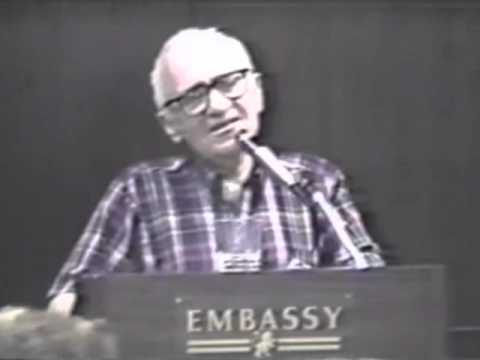
Murray responds to a question regarding his “endorsement” of Johnson over Goldwater in ‘64. This parallels the recent accusation made by Jack Hunter (The Southern Avenger) that Rothbard endorsed George H. Bush in ‘92, which is apparently meant to validate Rand Paul’s endorsement of Mitt Romney.
The article provides a contrasting of/comparison given the two evils presented. Rothbard ends by saying:
“A vote for Bill Clinton is a vote to destroy the last vestige of parental control and responsibility in America. A victory for Bush will—at least partly—hold back the hordes for another four years. Of course, that is not exactly soul-satisfying. What would be soul-satisfying would be taking the offensive at long last, launching a counter-revolution in government, in the economy, in the culture, everywhere against malignant left-liberalism. When oh when do we get to start?”
That revolution commenced with Ron Paul’s 2007 presidential campaign, and arrived largely in full force this year. Foreshadowing this, Rothbard was asked in ‘89 who he would support in the ‘92 election. He goes on to discuss Ron Paul who could “knock the socks of Bush”.
So, what’s the difference between Rothbard’s “endorsement” and Rand Paul’s?
Rand made a positive endorsement of Romney. There was no attempt to contrast Romney and Obama. In fact, Rand Paul is going to campaign for Romney even in light of there being a revolution underway. Any attempts at comparing Rothbard’s actions with that of Rand’s are severely lacking.
Furthermore see: “Rothbard Vindicated: Idealist and Strategist” by Lew Rockwell
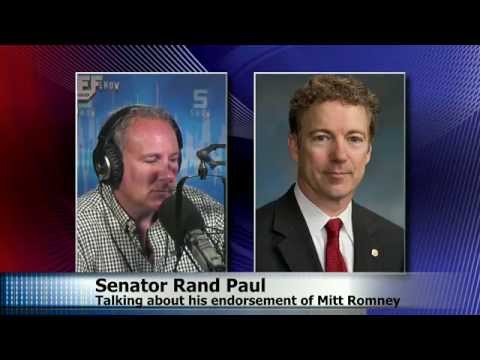
Our second guest is Sen. Rand Paul, Kentucky’s junior Republican senator, on why he’s backing Mitt Romney.
Free download will be available in about an hour at http://schiffradio.com/, will be available for about a week. Look for the “Today” tab [June 12, 2012].
I really like the Lew Rockwell interview of how Rand Paul was never really a libertarian. People expect him to be a carbon-copy of his father and he is not that.
I think this notion that Rand is secretly working for the betterment of the “liberty movement” is a pretty convoluted one. It is not some master plan. He is staying alive in the party. That is all. He is not his father.
Oh voting works. I don’t think anyone is saying that it doesn’t. It is just what is being voted on and the existence of voting that disturbs some people.
The other difference: Rothbard was a virtual nobody in politics and he could say whatever the hell he wanted about politicians and their views and it wouldn’t bite him in the ass in regards to any political changes he was trying to push through. Because he wasn’t actually trying to push through ANY changes, unlike Rand Paul. Rothbard led the philosophical movement. The philosophical movement that hasn’t made any remarkable inroad until Ron Paul.
If you think refusal to give an endorsement of Romney (an endorsement that I would call bland and neutral rather than positive) wouldn’t impact Rands ability to garner support for liberty-minded bills among republicans in the senate, you strongly underestimate the childishness of the GOP.
 But an autarchist republic rejects majority rule. It may then not be innately aggressive. Yet it is still a state. So it seems to violate your claim that a state is innately aggressive.