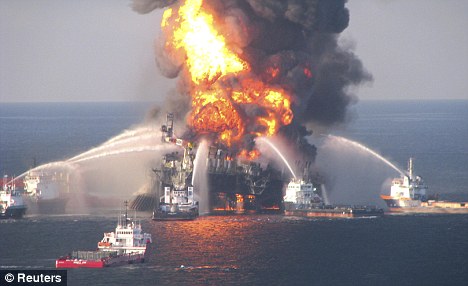
Yeah, well this “accident” didn’t happen in the North Sea or off Norway, both sites with intense European environmental regulation. It just happened to happen in the deregulated U.S. zone after an 8 years of a President who used to run an oil company.
BP wouldn’t even be paying for the clean up if it wasn’t liable under our collectivist courts and our collectivist laws. You live in a collective of individuals known as a society, get over it.
BP wouldn’t even be paying for the clean up if it wasn’t liable under our collectivist courts and our collectivist laws
Proof?
You live in a collective of individuals known as a society, get over it.
Yes, I live among other human beings. Why this is proof of the fact that individual rights should be sarificed for the “collective gain” (whatever that means) you have yet to prove.
Yeah, well this “accident” didn’t happen in the North Sea or off Norway, both sites with intense European environmental regulation. It just happened to happen in the deregulated U.S. zone after an 8 years of a President who used to run an oil company.
Are you saying that an accident is impossible in the North Sea due to high regulation? Are you saying there are no accidents on in highly regulated regions?
We both know thats not true. I would also like to know just how deregulated drilling is off the US coast. Willing to bet its not unregulated.
Which is legal protection granted to the owners of BP by the government. So you think the same people who protect the owners of BP from liability are the ones who will protect us from them?
What are the time frames the management at BP thinks in? If I’m CEO of BP, and I can make a much bigger bonus by installing cheaper oil rigs which will have a 1 in 100 aggregate chance of catastrophic failure in a year, do I take that gamble?
How is this different from a government bureaucrat? Why would he care at all? Would he gamble? If the owners were liable for all damages in a case like this (including all personal assets), they would not hire short sighted gamblers to run thier company. (that is assuming that you are right and that they do currently).
The issue is that PRIVATE INDIVIDUALS or associations should not be allowed to gamble with everyone else’s business, especially around things which might negatively affect entire regions of the Earth.
Regulation does not stop this. Or accidents.
That’s ideally what regulation is for, so society can have input into what’s approriate for issues that potentially impact society in general.
Society is not the government and regulation does not do this. Regulation and government are politics. Politics is not about what is ideal for society.
Haha, apparently there were NO U.S. inspectors allowed on board of the rig! No government inspectors! (I guess because it’s in international waters and foreign flagged?)
In other words, this BP rig is a pure result of free market action!
And it might poison the entire Gulf of Mexico! (if they can’t stop it, it could poison even more than that!)
By the way, I am not against drilling it, I am just against doing so without proper controls.
The rig that was drilling was not a US Flagged rig. That means US Inspectors were not allowed on board the rig to inspect it. As a matter of National Security under the GATT the USA has a right to demand US Only in various technology. The USA should never allow a foreign flag vessel to drill for oil in the US Economic Zone (200 mile limit).
Acoustic automated shut of devices should be required.
I think US Federal Inspectors should have to be resident on and inspecting rigs like this 24/7.
I think that the drilling should be required to do some smaller holes that deliberately miss the main deposit that test the structure before main drilling operations happen.
Careful procedures should be in place to set up wells before they hit the main deposit. The well casing should have to be inserted well before the drill hits the deposit and it should have to be cemented in at least 2 weeks prior to finishing the hole down to the oil or gas. This is to give the cement time to set. The casing should have ridging to make this cement have a tight wedged grip on the miles of rock around it. This is required because the lift pressure on a pipe in this case could easily reach 20 million pounds of lift. This is an insane amount of up pressure. Even at 70,000 psi it would lift about 140 million pounds. (almost 64,000 long tons!)
Now, let’s see, who could possibly mandate that such controls be put in place, and check to make sure they’re installed properly? Maybe a private insurance company, maybe the shareholders of BP will fly down there to check it out themselves, or maybe an invisible market leprechaun will use his invisible hands to fix this whole problem!
List of rail accidents in France. The SNCF is a state monopoly that control every trains, every rail etc. There are many accidents. If it was privatized, what make you think that private company would risk millions of € of damage, bad advertissement and deaths ?
They don’t happen with good, democratic regulation.
If there’s a handful of unaccountable people making decisions which could blow up in everyone else’s faces, it doesn’t matter whether they’re wearing Mao jackets or 3 piece Armani suits. It’s the same problem: concentrated, unaccountable decision making power.
Things that potentially affect the people in general have to be decided by the people in general. How many nuclear accidents have there been in France?
About the French trains: my French isn’t so great, but it looks to me like there are 26 deaths listed on your list for the decade of 2000-2010.
Around 100 million riders took the TGV (which is just the high-speed train) in France every year during that period. This isn’t counting local trains, light rail, subway, cargo rail etc.; just high speed rail.
Taken together, the odds of dying from a French rail accident is much less than one in a million, literally.
For comparison, 41, 611 Americans died in car accidents in 2001, and supposedly the odds of an American dying in a car accident is about 1 in 6550. That’s way worse than 1 in a million.
The state controlled French rail system is at least 150 times safer than travellingdown a U.S. highway. The trains are pretty comfortable too
You are illiterate. Read my response at least, and I’m sure many others make the same or similar claims. Quit flaming like an ideaologue.
You are an idiot. You know nothing about drilling operations or reservoir expoloration. As a petroleum engineer, it is painfully obvious how little you understand. We don’t want you in charge.
Bwahahah you know that the string they drill with IS the casing right? You know that they start out with surface casing, then several intermediate casings, and then production casing, all of which are cemented after their completion. I.e. All the casing strings save for the production casing string had been cemented.
Also let it set 2 weeks? Are you high? They SQUEEZE the water out of the cement during the cementation job. It is as hard as rock about an hour after they do this.
Also, what do you think cementation of the casing strings is going to do? Oil still flows THROUGH the cemented casing and into the water. Jesus man. Epic brain fail.
LOL you’re afraid of the casing being blown out of the hole? Hahahahah. Do you even know how they hold back formation pressure during drilling operations?
They’re not going to blow the god damn casing out of the well… OMG what difference would it make it they did.
AAAAHAHAHAHAHAH Reservoirs NEVER reach 70k PSIA.
Seriously dude, you don’t know anything. Maybe it makes you feel good to tell other people they’re wrong. Fine. Just get that brain tumor fixed and stop huffing paint.
And they’d be safer if they were? The invisible market leprechaun again, right?
Uhh, that’s not what I’m saying. You’re making a comparison acting like French state-run trains are safer than America’s roads that aren’t even privately owned. Your comparison makes no sense whatsoever.
“You are an idiot. You know nothing about drilling operations or reservoir expoloration. As a petroleum engineer, it is painfully obvious how little you understand. We don’t want you in charge.”
Well, we’re seeing what happens when petroleum engineers and the ‘free market’ are in charge, aren’t we?
“BP didn’t want to spend the money for a system - a fail safe system, used all over the world…[that could have prevented this]. We’re talking about a company that makes forty billion a year that wouldn’t invest five hundred thousand dollars…It is the most unreported part of this story…”