Right to Property?

This forum has likely handled such newbish questions before, but I might have something new to add (or maybe am just too lazy to read through the whole forum; nah, I will do that too :stuck_out_tongue: ).

Anyway: I am a libertarian and strictly anti-communist. However, upon rational consideration, I see where self-posession, non-aggression, and contract rights come from, yet do not find a logical first step to proving property rights.

Here is how I see it:

Once property is already distributed in a society (or acquired, if you prefer the term), then the right to property seems to arise very plainly: Employees get property (money) in exchange for their work (giving up part of their lives). For some reason, further logic on property post-acquisition escapes me at the moment, but I do believe I am settled into that point.

However, how does this property get acquired in the first place? This runs parallel to my question about settling and dividing of new lands. When the Europeans came to the New World, did they violate property rights on Native Americans? Furthermore, even if the Native Americans had not been here, how would a European acquire that land? How much land can you acquire? Certain amount per day (who decides on the quota)? As much as you can control and defend (if we turn to “defense”, then truly the concept of property breaks down to “who can best fight off the others”)?

This argument may actually be more pressing than we realize. The idea of dividing the moon and selling it off has come up. Who has the right/power to do this? Governments? I am very distrustful, as no government operates on libertarian principles. First come first served? Again, how much land can be acquired, then?

Furthermore, what about generally-accepted natural resources? Can someone buy up all the water in the world? Can people conquer the air? Land itself is also a natural resource. Does someone have the right/power to literally blow up the moon as long as no physical debris hurts any other human being? The tides would be messed up, which could hurt people on boats in the ocean. Are the tides simply a “privilege” or a natural fundamental so old that we consider it a part of nature? Would messing up the tides be a direct violation of the NAP?

Sorry for being so young and confused :slight_smile:

Thanks for the great website and amazing forum!

In a nutshell, unowned or abandoned stuff becomes property when someone acquires it and starts using it.

At the end of the day, the finer points will have to be decided by common-law jurisprudence. The precise extent to which someone was “using” something, whether they’d staked a claim to it etc. Sometimes it will be a simple matter, but sometimes it will be a difficult matter to decide, which is why there needs to be a legal system to work those problems.

In any case, if there is a free market, there will be powerful economic incentives to counteract the concentration of resources in the hands of people who will not use them for their most desired purpose. Even if the original owners are unlikely candidates, why would they necessarily hold onto it?

Blowing up the moon… As you say, it would cause harm. It is this specific harm that has to form the basis of a legal prosecution. Blowing up the moon doesn’t need to be an illegal act in itself. It is illegal to cause harm. Blowing up the moon would cause harm. This is the libertarian answer to environmentalism… You don’t need specific legislation to curb environmental harm. Harm is illegal at common law. There’s no reason why piece of moon debris crushing your hourse should be illegal, but not the screwed up tides destroying it. The causative chain is just as cleary demonstrable.

when someone acquires

But how does that happen? Do you cordon it off and stick a flag on it?

there will be powerful economic incentives

But that relies on statistics and specific details. A governmental system shouldn’t say “oh, this likely won’t happen.” It should say how certain matters are handled definitively. It’s akin to asking “what if there is race discrimination in employment” and answering “the system makes it unprofitable to do that, so don’t worry” (while the correct answer is “it’s the employer’s right to discriminate”).

the finer points

Hm, but its seems like the matter of acquiring land is not a “finer point” but a pretty big one. And how do you define common-law jurisprudence and who decides on it?

Just cordoning it off would probably be fine. There has to be an element of owner’s control exercised over the previously unowned thing. It’s different to a state claiming sovereignty, where they just pitch up somewhere, plant the flag and claim the entire landmass.

Look, there is always property. It’s like language. It may be a convention, but it’s essential to our identity as social, acting persons. You cannot decide not to have property if you want to have society - you can simply decide who should own what. Similarly, we can’t resolve to communicate without language - we can simply decide which language to speak. Someone is always the de facto owner of desired resources. Resources have to be allocated and disposed of by someone. Under socialism, it’s the state bureaucrats and ruling elites.

The person who first comes across and begins to utilise previously unutilised resources should have a prima facie superior claim to them than anyone else. No one else could have a claim in the thing if it were genuinely previously unowned or abandoned. The practical, technical details, which can be complex, come in when one has to decide whether these contingencies are in fact the case.

The fact is, however, that there are economic incentives against pervasive racial discrimination, and there are economic incentives against the extreme situations technically allowable by natural law. You shouldn’t discard practical arguments if your concerns are practical and not entirely theoretical. I mean, maybe you think all drugs should be legalised on principle, but perhaps it is also prudent to mention that you do not think that this will result in everyone becoming addicted to crack, otherwise people might think you a nutcase. It can be a problem for libertarians.

Lawyers make jurisprudence. If the market is free, consumers choose the lawyers.

there is always property

As there has always been large state control over matters and suppression of the rights of man.

cordoning it off

But how much can you cordon off? Arguably you could cordon off an entire continent and using an airplane drop seeds down onto the land to claim “control”.

I’m afraid I have to disagree with you there. What has “always” (as long as humans have been humans) existed is the sense of local community/family/tribe that’s part of the human psyche. It’s that part that is abused and twisted to allow for the state’s veneer of legitimacy to subsist, but they’re not one and the same thing. The state is a parasite that pretends that its fulfilling that role of real society and community, when in fact it is destroying the host organism. The vast, imperial state came about as a religious cult/military establishment a few thousand years ago. Property, in a de facto natural sense, is much, much older than that, as is spoken language.

I suppose you could,theoretically, but I don’t see how that’s going to result in insurmountable practical problems. It’s not like you could do it if there were anyone living on the continent.

If you can defend it its yours. If you can take it (morality aside) and defend it, its yours. Thats pretty much it.

Borders and sectioning off land mean nothing. If any nation wants to claim new land they risk reprecussions of war with a strong mother nation or competing nation, or possibly sanctions from peacekeeping nations ect.

In the U.S. today, our quasi-commie government owns all property. You pay for the land and then you pay rent to them to live on it. Good luck winning that battle :wink:

My example for the state control was just to say that you can’t say “there is always property” to prove that there is a right to property (another example is there is always murder).

I don’t see how that’s going to result in insurmountable practical problems

People could claim entire continents by themselves! It doesn’t seem … normal.

If you can defend it its yours

But then there’s no “right” to property! It again just falls into anarchy/statism. And since (at least in this forum) we derive a lot of our liberties from the right to property, there go our liberties.

The right to property is one that can be enforced through a court of law. Ownership by force and defense invalidates the need for a judicial system and thus essentially any contractual relations between people.

There’s a difference between asserting that there is always property and that there has always been property. Society, by definition, excludes criminal activity. A ‘society’ is defined in terms of ethics and laws and taboos, and murder is, by definition, a form of killing that is always taboo, and therefore outside the ambit of society. I challenge you to conceive of a society in which there is no system of ethically appropriate and ethically inappropriate resource allocation. You simply cannot propose to your fellow man that we all stop deciding who should get to use what scarce resources. It cannot be done. The purpose of society is to avoid conflict.

It is from this undeniable starting point that one can assert that a particular person should have a right to particular property. If the first person to set upon unused resources does not have such a right, then why would anyone else?

Could they? Practically? I mean, there are no empty continents left on Earth, and you’d need major, major cooperation from a lot of other people to colonise another planet. Practical concerns…

There are a lot of planets out there. Maybe one day it will be practical for a single person to own an entire one. Who knows.

But the practical aspect is irrelevant to my question (but maybe not to your argument):

Is this acquisition of land theoretically sound? Anything may sound farfetched… until someone does it. Then it’s the top thing-to-regulate of the day.

Imagine a scenario where there is a new volcanic island. Not too big, 2 miles by 2 miles. I go there and claim it as my own. Is this a right that a libertarian society would have to accept inherently and definitively? Is this the “just” and supreme way of acquiring land? (I am viewing this in the natural rights framework, where natural rights are undeniable rights we have inherent to our humanity that cannot be legally violated by anyone, and a judicial system exists to uphold such rights with final, uncorrupted authority).

Ahhhhh… I gotcha. You are looking for some kind of philosophical truth. An easy answer but probably a lot will disagree with me although I personally see it as 100% correct:

Defense of property is the stark, cold, evolutionary/athiestic reality. Kill or be killed, survival of the strongest, life is accidental anyway, defend it or lose it- PERIOD. Strength is your only “right” to property. Mankind is a conglomoration of atoms, here one day gone the next- no right, no wrong. His actions and thoughts on “property rights” are nothing more than nerve synapses and chemical reactions firing off in the brain. No right, no wrong… only what IS, exists.

The “right to property” you’re talking about is a religious belief- based upon the assumption that mankind has value. I agree with Adam Smith, the value of something is determined by the labor that goes into attaining it. God who is supreme value and the only intrinsic value creates giving mankind value, mankind labors giving his own creation value ect. Now you have to determine where you yourself are coming from… An athiestic philosophy IMHO is going to contradict himself here when talking about property rights, a christian will base his views on the christian world view and a Hindu on his.

I guess my point is that property rights, outside of a religious context, is merely an illusion based on the assumption that mankind has value. Find what you are basing that assumption off of, and you will have your answer to what determines property rights.

By that standard, every fucking human concept is illusion, including your opinion. Thanks for a good example of self-detonating post.

I guess my point is that property rights, outside of a religious context, is merely an illusion based on the assumption that mankind has value

Gaaah, libertarianism relies on religion as one of its pillars? I myself am Christian, but would like to deduce a governmental system separate from religion.

property rights, outside of a religious context, is merely an illusion

That’s what I’m trying to figure out: are they an illusion outside of religion or not? If they are, then does the same go for self-ownership, contract rights, and NAP?

Defense of property is the stark, cold, evolutionary/athiestic reality

It is the evolutionary reality, but so are a lot of things we dislike and would like to fix by establishing a “rights” system. If we do not establish it and merely go by evolution and “reality”, we retreat into anarchy (which I’ve been considering but have put aside temporarily due to concerns over my assumption of property rights, which I ask about now).

every fucking human concept is illusion, including your opinion

Slightly harshly worded, but I had missed that point :stuck_out_tongue:

You need to ascribe value to a God in order to worship Him. You wouldn’t worship Him if you didn’t agree with His views. You wouldn’t say that He was God. If He’s the supreme and final moral authority, then on what basis do you agree with Him? Or would you agree with anything that something claiming to be a God prescribed? Isn’t that just might-makes-right?

Seriously, value is in the eye of the beholder, whatever station he might have. One cannot solve the deontology versus consequentialism saga with God. It is an interesting saga, though.

By that standard, every fucking human concept is illusion, including your opinion. Thanks for a good example of self-detonating post.

uh no- the concept of burning fire wood to stay warm remains unchanged. The concept of mouthing off in forums to people smarter than you remains unchanged j/k. Human knowledge goes on… we learn more and more. The sky doesn’t fall. The illusion is when you think you’re something that your not. I don’t think getting angry about it is going to make you any more or less correct, please don’t get your feelings hurt that is not my intention. I like this forum, most people are intelligent and willing to discuss things like adults, please help continue the trend :slight_smile:

It depends on what IS

IS atheism correct? IS Christianity correct? IS Islam correct?

The yes and no answers to those questions have serious world-view ramifications!

If you’re a Christian for instance and you believe God created you and loves you ect and that IS… then there is no illusion! Feel free to treat humans with value because they actually HAVE value per God creating you in Genesis and calling you “good”! Feel free to treat people like crap but know that you are going against the nature of your world-view.

If you’re an athiest and you believe that life on this planet was an accident and that’s what IS… then there is no illusion! You’re an accidental bi-product of the collision of atoms and I’m the accidental bi-product of a collision of atoms! Feel free to treat other people like the accidental bi-product of the collision of atoms that they are! Please tell me how you derive special value over a lump of coal that was also the by-product of a collision of atoms! Live however you want to and die like there’s no tomorrow cuz there’s not! You don’t have to pretend that you’re something your not. Can you treat people nice, can you live by a moral code? heck yeah its you’re choice. Just because your an accident doesn’t mean you HAVE TO act any certain way. Just know that if you don’t and you want to be completely evil, by your own world view thats perfectly acceptable also. It is illusion to attach any special higher purpose to those actions.

Problems come from trying to have your foot in both worlds.

Personally, I believe very few people in this world are true athiests. There is the secular humanist who says “there is no God, only man” and then there’s the spiritual humanist who says “there is no God but man” You are probably more of a spiritual humanist. A Christian or Muslim will say God decides truth, God is my salvation ect. A true athiest will say there is no truth there is no salvation- we are accidents. The spiritual humanist will say, “I decide my own truth, I can save myself”- its kind of a self-deism thing. You decide whats right and wrong, you are a god unto yourself- just like the Christian/Muslim god- you derive value intrinsically.

Peace out, sorry if I offended anybody- not my intention. I’ve literally woken up in the night thinking about stuff like this. My own philosophy, I call it Benosophy :wink:

Um, I don’t think I’ve read a single thing in this thread that is mainstream Austrian theory on property. Seems like a case of the blind leading the blind. I recommend you listen to this:

I take a slightly more positivistic view than Hoppe but I think the nihilism of Minuteman is flatly reactionary. I don’t think that God is going to set everything right at the end of the world, so there is no justice in that religious sense. However, rightful possession, aka ownership, is meaningful and useful and is an integral part of human social order. It is as much a brute fact of the human social order as prices are. It is misleading in the extreme to paint a portrait of human society as based on catch-as-catch-can. The vast majority of human social interactions are cooperative and peaceful and while the potential for coercive/violent interaction is an important component of human behavior (both for the good and for the bad), it is far from being the primary consideration in human interactions.

Clayton -

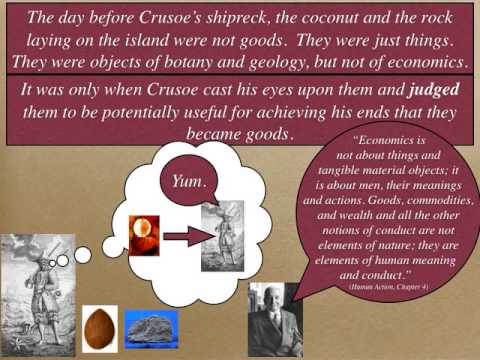
Ridiculous. Austrian economics explicitly rejects the intrinsic theory of value. Nothing has value-in-itself. Value is imputed by individuals to things. A video by J. Grayson Lilburne of this forum:

Clayton -

You need to ascribe value to a God in order to worship Him. You wouldn’t worship Him if you didn’t agree with His views. You wouldn’t say that He was God. If He’s the supreme and final moral authority, then on what basis do you agree with Him? Or would you agree with anything that something claiming to be a God prescribed? Isn’t that just might-makes-right?

Seriously, value is in the eye of the beholder, whatever station he might have. One cannot solve the deontology versus consequentialism saga with God. It is an interesting saga, though.

Funny, when I was pondering all of this I looked up God in Merrium Websters Dictionary and the most basic definition was “someone or something of supreme value” Supreme to me means all-encompassing, intrinsic. Value is something that is passed on. Lots of things have value to humans, but do they continue to have value if humanity has no value? Everything is dependent on something/someone else for value… the origin must have value. God is the origin and the only place value can originate if it truly exists.

Personally,
The way I see it, if God created this universe, he created a very delicate balance. Opposite forces attract because they must, like forces repel because they must. White blood cells attack imperfections because they must. I don’t think God enjoys punishing sin, he does it because he must- its his nature and the nature of the universe he created. In Christianity he leaves a way out, he takes the punishment himself.

Don’t really know what I’d do if God was evil. If he was I don’t see how anything in life could be good. If he were evil I don’t see how we would be allowed to make the choice whether to follow or not.

If value is in the eye of the beholder then I don’t see how it can truly exist. If you value a chair you built and someone comes and smashes it to the ground calling it worthless. Who is right? It can’t be both

Didn’t mean to steal this thread, it kind of turned into the “morality of property rights” by the author but it looks like gonna go full blown into a religious discussion :stuck_out_tongue: