I also liked how RP said that the tea party “racism” only accounts for maybe 1-2 percent of the movement.
Oh SNAP!!
His goal is undoubtedly socialism, but Ron pointed out what is actually happening now. Not the fictitious goal, but the real event. I think it’s important to do this as it points out the actual means that are being implemented to the fictitious end. Yes fascism and marxist socialism have the same end. But it would be practical to target the means that are happening in the real world, not to target the fictitious end result that never happens. In rhetoric that would work, which is great to get the point across. Rhetoric is an excellent means. Rhetorically target the same end result. It does a great job in providing one neat package that all of these means are attempting to achieve. Yet when actual means are to be targeted, meaning actual people and where they work and what do they do, then it helps to point out who is doing the lobbying and who the gov’t is granting monopoly privileges to.
Great. So when this system is going to be a disaster, the socialists will say : “It’s not socialism, don’t blame us. Even Ron Paul says so”
This rhetoric is confusing and not providing any useful information to the ignorant listner. Look, the fact is that there will be tens of thousands (if not more) of government bureaucrats working under current or new government agencies that will control and direct this system and see that thousand of command and control regulations are carried out. If that’s not the right step in the direction of Obama style socialism, I don’t know what is.
What good is it to say that Obama is not a socialist then? Who is he trying to appease? The socialists? I mean let’s face it. people don’t know diddly-squat! So now Ron Paul is going educate the masses about technical differences in the means for seeking the same end - government control! Give me a break.
And anyway, Corporatism to the ignoramus sounds more closely related to Capitalism then to Socialism.
So if rhetoric is your goal , then I would say that’s 1 to 0 for the Socialists. Thanks Ron!
Just a few weeks ago I saw him in a video say that “At some point taxes becomes theft”. Maybe I didn’t understand the whole context of what he was saying before, but this is great. This is great to hear on mainstream TV.
That’s why it’s a socialist fantasy. You could point out the Soviet Union, etc… and they still say it wasn’t the real socialism. There isn’t a real socialism. It’s impossible. So what if they say that. They say it anyways for no matter what actually happens. They have to because what actually happens is never socialism. It’s a utopian idea. An ideal that can’t manifest itself in the world outside of some people’s minds.
Call it socialism then. Here’s one: corporate socialism.
This is how I see it. All these terms: socialism, corporatism, etc… mean the same thing. They are monopolies enforced by violent means. To point out socialism takes away from the corporate involvement. The way socialism is defined in common vernacular it has to do with unions and gov’t take overs. It has nothing to do with corporations that lobby the gov’t and the likes of Goldman Sachs, etc… don’t squeeze into what the term socialism means even to the populist if that’s who you are trying to appeal to. Maybe the gov’t isn’t trying to take over all the means of production. That’s a possibility, if what we mean by gov’t take over is to have no prices, no private property, etc… and the gov’t simply takes it all over. Maybe what is really happening, which currently is what is happening, is the gov’t is handing out monopoly privileges, like the King of England used to hand out charters to certain companies to give those still private companies that dealt with a supply and demand mechanism still, a monopoly.
I mean it depends on the audience. Maybe tell grandpa joe who grew up with the reds that it’s communism. But none of this describes the actual going ons which is the corporate world is in D.C. lobbying for all kinds of special privileges and the gov’t is giving them these monopolies. It’s the violently upheld monopoly that is the real problem. Not if it’s socialism, corporatism, etc…
No matter what in the political arena with a gov’t it gets all screwed up anyways. Now some people will focus on the corporate world and this may cause more harm than good on capitalism, I agree with you. The sights are never set right to the target with the gov’t and justice will never happen with gov’t involvement. So no matter what people call it when it comes to gov’t politics, in the end it will get twisted to suit the next rising President who will special plead that he or she will save the day and every four years it starts all over again.
As oppose to what? The people’s socialism?
Look, you don’t have to explain to me that Ron Paul is against all forms of Socialism. You brought the issue of rhetoric for propaganda purposes. I simply say it’s awful. He should have stuck to socialism, or actually, how about the truth? Interventionism!.
Sure it does. Stock companies are seen by socialists as a step towards socialism. Just replace the stock holders of corporations with society and you have socialism. It’s also easy enough as already been proven. Just wait until the corporation fails and then take over it to avoid the alleged domino effect. There you have it!
So call it what it is: Interventionism. It sure ain’t corporatism even by Mises’ definition. It’s interventionism, or the hampered market economy! What’s wrong with the truth? It’s honest and it will be most effective.
Don’t know if that was said out of ignorance or as a white lie to not scare people off. Most folks are trained to conflate anarchy with chaos.
Not opposed to anything. It was another use of Rhetoric. No matter what the message to get out would be rid violent monopolies but who in politics is going to go around and explain that one.
That would work. I searched the Mises site a day or two ago for “corporatism” and found nothing of substance. I searched the internet and ended up with wikipedia. I started to read what it meant but have you ever looked at the definition that pops up in wikipedia? It’s way too long and interwoven with exceptions and qualifiers of different kinds of corporatism.
I guess it depends on who you are talking to. I’ve never encountered anybody that thought other than what I defined. But I was generalizing about something that I never really could anyways, ie. what’s in everybody’s mind when they think of socialism.
Where does Mises even define corporatism?
You make a good point.
And you know what? It’s the truth. I thought Ron Paul was for the truth.
Mises called it Corporativism. It’s basically another name for Guild Socialism which he does talk about in “Socialism”
Check here: http://mises.org/humanaction/chap33sec4.asp
And [if] after you read it, tell me again why corporatism is being used to describe the system we have. If we had a system of corporatism, you wouldn’t be getting any services.
I would be interested to know why Grayson Liburne also believes that Ron Paul is accurately using the term, as defined by Mises.
I think Ron understands that when the republicans call obama a “socialist”, they mean it in terms of international socialism / marxism / communism, which it clearly isn’t. And that is the point he is trying to make and clear up…
by saying it is correctly understood as “corporatism”, which is really a better way of publicly calling the state - “fascist”.
In essence though, that is what it is - NATIONAL SOCIALISM… i.e fascism / corporatism.
So it is socialist, just a different variant, a different type of government ownership of the means of production via licensing, regulation etc. Private profits, public loses.
Why not? Marxists are split in their methods to achieve socialism. Even Marx had two versions. Transforming the economy step by step by regulating business is fully compatible with Marxism.
You don’t really believe that we are any of those, do you? Because that would be a darn good refutation of the impossibility of socialism.
That’s an interesting thought. One possibly could say Ron’s knowledge is fallible. Especially after all he had done. It would be unfortunate if he was being deceptive.
I’m glad you let me know that Guild Socialism is another name for Corporativism so while reading “Socialism” I’ll have a more inclusive insight into what Mises was conveying. Thanks.
I may hold off on that link for now and keep on reading “Socialism” so I can get to the part on Guild Socialism and acquire an understanding that way.
I definitely do now too.
It’s just that Corporativism was the term the Italian Fascists coined for basically the same thing. “Socialism” was written before that which is why Mises only uses the term “Guild Socialism”
It’s about the end game.
Moving towards… and what are you talking about, The Third Reich wasn’t national socialist? lol. Mussolini’s Italy, wasn’t fascist? Huh?
“All within the state, nothing outside the state, nothing against the state.”
ah, and a good reason as to why Mises uses Guild Socialism to go along with that initial comment from your previous post on the subject. Excellent.
Seeing that Human action was written after the fact provides historical depth to Mises picking up the term Corporativism in that book.
interesting, thanks.[:)]
What are you talking about? Did I say we weren’t moving towards any of those things? NO. I said we are not any of those things. I still don’t get what you are trying to defend here.
We don’t have a corporatist system, so Ron Paul is wrong, unless he just redefined the term for his own use. He can do what he wants but he goes out of his way to say that what Obama is doing is not Socialism or that he isn’t a socialist, etc… That’s just nonsense. Sure, he hasn’t implemented socialism yet, but he hasn’t implemented corporatism either. And If he’s not a socialist then he’s not a corporatist either.
And anyway they are variants of the same thing. He’s addressing the masses and all they are hearing is - It’s not socialism, so if this sucks, don’t blame socialism. This is what they are already saying. It’s going to be crap because we didn’t get the public option, blah, blah ,blah. Not that the public option is socialism either, but you get the point.
Ron Paul’s correct definition, aswell as his description and his product differentiation.
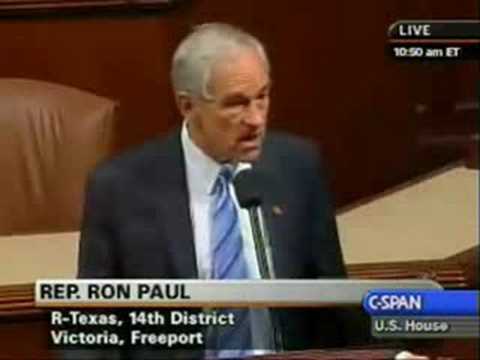
Here he clearly explains what he means by the term. And what pray tell, do you disagree with good sir?
Where did Ron say that? He didn’t. “Moving towards” is used. As such, stop the strawmen thanks.
Completely wrong. He is absolutely correct in what he has been saying, the bonus by-product is product differentiation. He is differentiating himself from the neo-conservatives / conservatives / republicans. Which he MUST continue to do. Libertarianism isn’t right wing, and it isn’t left wing.
Get over your gripe about not using the terms you wish, because of what you see as potential fall out from patsies getting the wrong message.
This article maps it out perfectly; Steven Yates - (LRC writer, and author at Mises.org)
The idea that President Barack Obama is a socialist is popular among many conservatives; all of us have seen automobiles sporting the bumper sticker reading, Don’t Blame Me; I Didn’t Vote For the Socialist — obviously referring to Obama. Not so fast, says, of all people, Ron Paul (R-Texas).
Addressing the Southern Republican Leadership Conference during its third day, Dr. Paul told the audience, “The question has been raised about whether or not our president is a socialist…. I am sure there are some people here who believe it. But in the technical sense, in the economic definition of a what a socialist is, no, he’s not a socialist.”
Dr. Paul continued, “He’s a corporatist. And unfortunately we have corporatists inside the Republican party and that means you take care of corporations and corporations take over and run the country.”
What he means, and whether or not he is right, depends on what we mean by socialism and what by corporatism. In its classical usages (classical here meaning within classical Marxist usage and its derivatives) socialism means: an economic system that is abolishing or has abolished the private ownership of the means of production in favor of public (i.e., state) ownership, with all wealth shared.
In this classical sense, Obama is clearly not a socialist. Nothing he has done, not even in the recent healthcare bill, seems aimed at abolishing private ownership of the means of production.
Much of what he has done since taking office, however, has vastly increased government control over the means of production — e.g., when he personally demands that a CEO step down (think General Motors). Is this what we mean by corporatism? Ron Paul described the healthcare bill as containing many corporatist provisions: “We see [corporatism] in the financial institutions, we see it in the military-industrial complex. And now we see it in the medical-industrial complex.”
Corporatism is often seen as monopolistic capitalism in which business and governmental elites partner with each other. This isn’t too far from the mark. Business elites possess what we might call the power of the purse — they have the money. Governmental elites possess what we might call the power of the sword — they write the rules. We might debate which one, if either, is truly dominant since both scratch each other’s backs and benefit handsomely from having thwarted both genuine marketplace competition and a truly open political and electoral process.
Corporatism hardly began with the current administration, of course, or its predecessor. In an article published in 2002, which deserves far more attention than it has ever received, commentator Robert Locke outlined the basic ideas behind corporatism and traced some of its history and influence.
According to Locke, corporatism “has the outward form of capitalism in that it preserves private ownership and private management, but with a crucial difference: as under socialism, government guarantees the flow of material goods, which under true capitalism it does not.” (Emphasis in original.) Corporatism does not really trust the marketplace to provide. It manipulates the marketplace “to deliver goods to political constituencies [which now include] basically everyone from economic elites to ordinary consumers.”
What has made corporatism so tempting is thus not hard to see. Locke explains further:
Big business, whatever its casuists at the Wall Street Journal editorial page may pretend, likes big government, except when big government gets greedy and tries to renegotiate the division of spoils. Although big business was an historic adversary of the introduction of the corporatist state, it eventually found common ground with it. The first thing big business has in common with big government is managerialism. The technocratic manager, who deals in impersonal mass aggregates, organizes through bureaucracy, and rules through expertise without assuming personal responsibility, is common to both. The second thing big business likes about big government is that it has a competitive advantage over small business in doing business with it and negotiating favors. Big government, in turn, likes big business because it is manageable; it does what it is told. It is much easier to impose affirmative action or racial sensitivity training on AT&T than on 50,000 corner stores. This is why big business has become a key enforcer of political correctness.
Locke traces the history of corporatism to the idea that the marketplace is not really self-regulating, since the “big boys” will not “play fair”; hence economic activity requires outside management, be it through regulation, subsidy, or control over the monetary system. The first major corporatist enterprise of the 20th century was none other than the Federal Reserve, a private corporation that is embedded within the federal government — as its own literature states, “independent within the government.”
Then, in the 1930s, the (Fed-caused) Great Depression further eroded confidence in the marketplace to deliver material goods without government intervention. That period gave us Social Security and Medicare: the beginnings of the intergeneration redistribution of wealth we have been stuck with ever since. As political constituencies both large and small have grown, the corporatist edifice has grown along with them, often with the full support of the mainstream voting public both liberal and conservative.
The Left likes corporatism for three reasons, says Locke: (1) it satisfies government’s (i.e., politicians’) lust for power; (2) its machinery makes redistribution of wealth to favored constituencies possible; and (3) it enables politicians to accomplish this while remaining personally affluent.
The Right likes corporatism for three different reasons, says Locke: (1) big business can achieve enormous profits, capitalist-style, while unloading some of the cost and risk onto government; (2) the merger of business and government enables those at the helm of big business to influence government in ways favorable to themselves (e.g., thwarting true competition, which big business has seen as a nuisance since John D. Rockefeller, Sr. was heard to pronounce competition a “sin”); and (3) this merger seems able to minimize or dissipate whatever social unrest its policies create in the masses.
Locke provides several examples of corporatist endeavors besides the Federal Reserve. Some are even more obvious in today’s post-bailout climate: Fannie Mae, Freddie Mac, the insurance industry generally (especially evident given Obama/Pelosi-care!), real estate, federal financing of scientific research, agricultural price-supports, and many others; we would probably want to add to our list so-called “free trade” agreements (e.g., NAFTA, CAFTA, etc.).
The point to all this is that if we going to criticize the Obama administration’s economic policies, we need to be sure we have its economics right — and if we are paying attention, we see far more continuity with past administrations than we do change. There have been no fundamental changes, despite candidate-Obama’s mantra about “change you can believe in.” (For this reason, many on the Left have grown as uneasy with this administration as any Tea Partier, even if for different reasons.)
Isn’t corporatism just a form of fascism? Yes and no. The most famous quote attributed to Italy’s Mussolini (the quote appears to be apocryphal) is that “fascism should more properly be called corporatism because it is the merger of state and corporate power.” Under fascism, unlike socialism, government did not assume ownership over corporations but controlled them, allowing nominal ownership. I would submit that if there is a difference, it is that in the English-speaking world more of a partnership between the two has emerged, and over a longer period of time — perhaps born of the quiet realization that many in the upper echelons of the corporate domain are as interested in power as any statist authoritarian has ever been, and that the two can achieve far more working together than they can separately. Working separately will, in fact, ensure that the two will butt heads more often than not.
Corporatism may be thought of as “soft fascism,” which is oligarchic but not totalitarian. Part of its genius has been to win acceptance from the voting public through (1) having created a mass and organizing it into groups, or political constituencies; (2) delivering goods to those constituencies; (3) all the while creating a sense of security for them if they play ball; and (4) (although the idea calls for a separate article) corporatism has sponsored “public schools,” further encouraging its acceptance through consistent ratcheting down of education not just about our founding principles but absent clear thinking about economics and even personal finance, while ratcheting up the current mixture of pop culture and job skills training (e.g., school-to-work, no-child-left-behind, etc.). The vast majority of teenagers educated this way will not question the system; the few who do can be safely marginalized.
Ron Paul has been the one Republican operating clearly outside the corporatist mindset. This might help explain why he and his supporters have been marginalized within the Republican Party, the mainstream of which serves corporatist interests. There are probably Democrats who are not corporatists. Dennis Kucinich might be an example.
All of which brings us to the question: If corporatism really is the best name for the economic system currently throttling America, can it be fought — and perhaps undermined? Of course, we have to identify it first. Most people have never heard the term. Then we might argue that corporatism is, in the long run, unsustainable: Social Security and Medicare, those two 1930s corporatist standbys, are both technically broke and on the federal equivalent of life support. As Baby Boomers retire, the situation will grow progressively worse! It was not without reason that Keynes said, “In the long run, we are all dead.” Corporatism incorporates Keynesian economics and encourages massive spending by both government and consumers as the key to rising prosperity without looking far into the future. When people will not spend, generally because they cannot spend, there is an incentive to get money into their pockets; otherwise the economy falls into crisis. Spending money one does not have creates debt. The temptation is to monetize government debt. The result is the slow erosion of our dollars’ purchasing power. The dollar in fact has lost 10 percent of its value in just the past year. Massive and still-growing indebtedness has the potential to be our downfall and the downfall of corporatism.
These considerations are all imminently rational, but the corporatist edifice we now live under has been built up under such a long period of time — several generations, in fact — that dismantling it all at once would precipitate chaos. Moreover, the public is now accustomed to it. They fear the loss of their safety nets, and might argue reasonably that they spent their lives paying into Social Security and are now entitled to benefit from it. Healthcare costs are indeed astronomical; moreover, without Medicare (or some type of government aid), they would be priced beyond the reach of many elderly people. These are the main reasons Social Security and Medicare are politically untouchable, and that any politician proposing to abolish them would be rejected immediately by the majority of voters except for libertarians.
This issue is much larger than Obama. One way or another, he’ll be gone in a few years. The problems will remain, and would have worsened even if McCain had been elected in 2008. How do we “turn back the clock”? Can we?
Robert Locke offers these troubling thoughts:
With these two different kinds of trust [in the self-regulating nature of the marketplace, and its ability to deliver material goods] gone, corporatism becomes not only worthwhile, but necessary. Crucially, it becomes psychologically necessary, independently of whether government can deliver on its promises, because people instinctively turn to government as their protector.
Anyone who is serious about getting rid of corporatism must explain how they are going to restore these two kinds of trust or persuade people to live without them. In particular, it is almost certainly useless, as verified by the fact that government has grown under every postwar Republican administration, to try to nibble away at big government without renegotiating the social contract that underlies it. If we don’t have a plan to renegotiate this social contract, we must face the fact that the electorate will demand that it be respected.
Conza,
That Steven Yates article was excellent. Robert Locke really got in-depth even describing what appear to be psychological inclinations that form in such a political climate.
It’s obvious I don’t have the knowledge to share the way Yates, and Locke did. And DD5 brought up very interesting points that had me introspect on what I’m missing in all of this which is the knowledge is be able to share what’s going on the way it appears Ron P., Yates, Locke, or Mises are each contending on this subject. That’s for sure without question. So back to the books for me without any further ado.