Never saw any sort of publicity for it. Also never saw what Patri looked like before.
Never saw any sort of publicity for it. Also never saw what Patri looked like before.
The biggest problem I see is some international body like the United Nations imposing itself on a seasteading community.
How do we define “international waters”? Like whereever it floats its thier water at that time. or does it sit in one spot?
It’ll be interesting to watch. I’m skeptical of the “governments as producers” and “citizens as consumers” model… I’m more inclined to think of governments as farmers and citizens as cattle.
Clayton -
Friedman family is so sweet.
Also, I doubt it would work because of the amount of green one would need, and the obvious problems of storms and the like.
Whenever I hear something about Seasteading I think of Bioshock.
I agree that the issue is that if any seastead truly came to be, the UN or some joint action group would impose limitations on it. Keeping in mind that living at sea is a very large investment for both the owners and the clients, this uncertainty about whether the seastead will actually be able to retain the freedom it set out to achieve is killing the projects. My impression at least.
The FSP and secession movements are much more likely candidates for freedom in the foreseeable future. Otherwise I like the practical spin that Patri puts on things.
Seasteading is absurdity and stupidity, for no good reason.
I remember the crazy British radio jockey who acquired “Sealand”, an oil rig, and who was left alone by the British government simply for how crazy he was.
Absurdity? Water is like land, except softer. You float instead of stand, dip instead of till.
Do I really need to point the logistical nightmare that idea proposes?
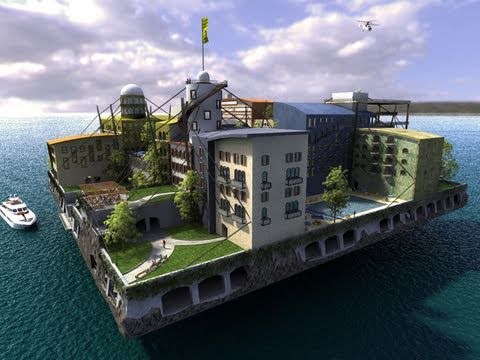
I love how telling that image is of the lack of knowledge by it’s creator.
I’m with you, it’s not that Seasteading is unworkable, it’s just that it’s very costly. It seems resources are much better used by simple getting a city or small region to succeed and form “The Free City of Whatever.”
Practical points have been raised. FSPs certainly hold a lot of water, but I would not discount the idea of sea-steading. Some contend that the United Nations would impose regulation - it certainly would. But if a moderately powerful world body would impose regulation on a sea-faring nation, how much more would a very powerful nation (the United States, etc) impose regulation or even open hostilities against a Libertarian society. If it was carved from former United States territory (hypothetical: New Hampshire secedes), I could easily see martial law imposed in the region and perhaps a brief struggle.
Also, I would think that the cost of imposing restrictions on a sea-stead would be higher, and due to the divided nature of the UN, one might have greater political chances, though economic opportunity would certainly be less far from land, as costs of operating a business would be a factor higher than in a regular location.
Anyone want to come to Australia instead?
Micronational activities were disproportionately common throughout Australia in the final three decades of the 20th century.
Double post.
As long as they’re still paying taxes, they’re not independent. It’s money makes the world go 'round…
Clayton -
Like I said, a logistic nightmare, they didn’t cover the reality of getting any sort of material good’s without having to find a method to order from a current state, and then paying for the transport to the seateading colony.
See here:
That’s the closest thing they came to even discussing the logistic’s involved. They never once even discussed the origin of these good’s, and simply assumed they would be prior existing for such a concept.
They stated they would use Petro product’s for energy, but have not noted the frequency, methodology, or the source they intent to implement. How would such a venture even come up with the capital to cover these expenses? Anything they can provide for any nation can just as easily be provided by any said nation with a coastline with a far greater return on the investment.
Furthermore, the imagery they display is of lush green grass, and foliage that represent’s the average yard of any land based facility. However, they never take into account the dispersion effect of the salt content’s of the sea water, and how salt effect’s the root’s of freshwater plants. I know quite a bit about what salt does to fresh water plant’s like the ones they show in that imagery. (I run an Aquaponics setup in my backyard that would feed 9 families if required. We’ve done the reasearch on a saltwater based versions.) Salt hydrolocks the roots of said plants, and causes actual salt burns that prevent the root’s from uptaking oxygen and vital nutrients. The best plants they could grow in such an environment are palm’s and algae. Have fun eating coconuts and algae slime.
Like I said, it’s telling of the lack of knowledge on the creator’s behalf. It’s very telling that the very project in itself show’s severe lack of research on the challenges involved.
I would further to say, that it’s ridiculous to think anything like this could be successful. Why does this scream Venus Project to me?
@NidStyles: I am also skeptical of the feasibility of seasteads but I think you’re incorrect that a lot of good thought hasn’t gone into it. Peter Thiel, a self-described libertarian (anarcho-capitalist?), is the major funder of TSI. He’s no Venus Project flunky for sure, and Patri Friedman - the creator/director of TSI - is the son of David Friedman, a self-described anarcho-capitalist. I don’t think Patri has expressed his own views on AC but implied within the whole idea of sea-steading is that we need to “evolve out of” the Statist order and the best way to accomplish this is to reduce the cost of experimenting with different social systems.
I think that, with this in mind, it should be clear that an important part of the demand for seasteads would be to house businesses that could not legally operate onshore… financial services, arms services, sexual services, drug services… all the “vices” and “undefendable” lines of production which Block discusses, for example. So far, TSI messaging has stayed away from discussing this but it is implied within everything they say regarding the demand for businesses which are not limited by the legal confines of onshore law systems.
The primary problem I see here is that if seasteads really were successful in producing goods and services which cannot be legally produced at a reasonable cost on shore, one of two things will happen. First, the nations that care about it the most will demand that the offending seasteads be shut down and might even take action in this regard (although there is a defense against this… a seastead can move out of the way). Second, the nations affected by it the most might just relax their laws and pull the business back away from the seasteads. For example, let’s say MaryJaneStead opens up off the shore of San Francisco outside of US territorial waters (I think 12 miles). It’s still within the EEZ but that doesn’t necessarily matter. So, potheads from San Fran can jump a free boat ride out to the seastead and smoke world class pot to their heart’s content. Who knows, maybe they’ll even let you rent your own hydroponic space and grown your own bud. Anyway, if the “vice” in question is not considered sufficiently “evil” by the general public to whip up popular support for a raid of the seastead then the likely response would be to simply legalize it onshore, killing demand for the seastead.
Anyway, it’s definitely an interesting idea and I think you’re selling short how much thought these guys have put into it.
Clayton -
Good intentions do not directly equate to good thought. I will not get into my personal view of Libertarians here, as this is not the thread for it, but I can pretty assure you that they are just as prone to Human failing’s as everyone else. Even though they are less prone to the failing’s of the more statist mentality of the Progressives.
I may be blunt here, but any Libertarian pushing for social change to get away from statist order is simply falling into the same trap that creates the statist mentality in the first place. The inate nature of such a concept as “society” is statist from it’s very philosophy alone.
They may not be related to the Venus Project, but the only perceivable difference that this proposal presents is that they would be willing to use capital goods to acheive their goal’s. The results would be the same. Anyone that has ever spent time out at sea can attest to this. It end’s up being a community based effort with strong Old-World Libertarian/Socialist underpinnings. It essential would end up with creating a situation where Free-Will is thwarted as your very survival is removed from your own hand’s, and placed upon the amount of work you intend to contribute to the whole. Look into how the Pirates of the early 18th Century operated to better understand this.
None of that is hard to find anywhere in the world, regardless of legality. In South Korea for example, there’s entire section’s of of cities dedicated to the sex trade. The same with Japan, Philippnes, Thailand, Hong Kong, and several countles European countries.
Arm’s are just as easy to come by. For a mere $3K a year fee in the US alone you can legally manufacture any sort of automatic firearm you wish, and with such a profit potential you can easily cover that $3K with a single sale.
Financial Services, that one I can agree with, but any sort of Libertarian based economics model would be based primarily on storage, rather than a market of sort’s. This is bearing in mind that you could open up as a sort of International Banking service for Third World nation’s, and be able to act as a buffer with contractual trade agreement’s with various national exchanges. That would be the best way to go about it from my perspective.
The biggest issue I see with this sort of concept is that you would possibly face reprisal from other nation’s if you are making unpinned transaction’s with nation’s that are being used by the larger nation’s as a “boogeyman”. Like trading with Iran, the US is very likely to either embargo you, or outright attack you. Not exactly a good position if the basis of the project follow’s NAP.
Nation’s do not act rational to threats to corporate interest’s. Most likely is they will vilify you, and then push a media campaign declaring you as a “terrorist” and then attack you. It’s hard to move out of the way from a deck gun of a naval FF. It’s also harder to avoid being bombed by aircraft. It’s actually 75 miles to get out into International waters. The 12 mile figure is the declared territory. 75 miles is the jusristional limit. It wouldn’t matter though how far away you are though, Iraq was over 10K miles away, and look what happened to them.
I agree, it is interesting. I am not, however, selling it short. My crtiques of the concept are completely realistic, and required for a rational analysis of the concept. Without someone pointing out these issues, how would you ever think of all of the possible downfall’s of such an idea? It’s only rational to have a varying set of perspective’s to hash any issues out of any sort of idea that would require such a grand scale of investment.
Just to add further, not all Libertarians are grounded in economic and rational realities. This is why I always point out the potential flaws. I’m not against any idea in particular, if it’s sound and does not contribute to further coercion and violation of personal right’s.
They’re going about it in a peaceful, apolitical way… they’re not trying to change laws or lobby, they’re just trying to run it as a peaceful business. I don’t think it’s going to work, at least, not in the way they’re envisioning. But I’m glad someone is trying.
Clayton -